 Add to Chrome
 Add to Firefox
 Add to Edge
UniMoFlow: Grounding Instruction-Driven 3D Human Motion Editing in Generation
Aug 10, 2026
Instruction-driven editing of 3D human motion requires precise spatiotemporal localization, rich semantic grounding, and strict preservation of unmodified content. Existing methods either resort to training-free adaptation of generative models or rely solely on triplet supervision; however, adaptation often yields suboptimal control, and manually curated triplet datasets remain severely limited in scale and semantic diversity. To overcome this bottleneck, we ground motion editing directly within text-to-motion generation across data, architecture, and inference. At the data level, we develop a closed-loop synthesis-and-verification pipeline that produces Omni-MoEdit, a large-scale dataset spanning body-part, amplitude, temporal, action, and style edits. At the architectural level, we introduce UniMoFlow, a unified latent flow-matching model that shares broad semantic and kinematic knowledge between generation and editing. At the inference level, SAFE (Source-Anchored Flow Editing) complements UniMoFlow with controllable, source-anchored refinement. Furthermore, we augment standard evaluations with semantics-aware metrics to account for valid edits that inherently deviate from a single ground-truth reference. Extensive experiments demonstrate improved target-text alignment, edit effectiveness, and cycle consistency, while maintaining competitive source fidelity and text-to-motion generation quality.

MAGIS: Evidence-Based Multi-Agent Reasoning for Interpretable Strabismus Clinical Decision-Making
Jun 08, 2026Strabismus is a common ocular disorder that requires fine-grained subtype diagnosis for individualized treatment planning. However, existing deep learning methods mainly provide diagnostic predictions without transparent reasoning, while recent large vision-language models (LVLMs), although promising for joint image understanding and report generation, remain highly prone to hallucination in this evidence-sensitive and rule-driven medical task. To address these challenges, we propose MAGIS, an evidence-based Multi-AGent reasoning for Interpretable Strabismus diagnosis framework. MAGIS transforms black-box end-to-end generation into a structured diagnostic process consisting of candidate hypothesis generation, dual-evidence constrained context, evidence-based corrective verification, and report generation. Specifically, we introduce a Dual-Evidence Constrained Context (DECC) mechanism that jointly organizes visual evidence from the photograph of the nine cardinal positions of gaze and evidence-based clinical diagnostic rules into a constrained context for reliable diagnostic reasoning. We further develop an Evidence-Based Corrective Verification (EBCV) mechanism that verifies whether the current diagnostic hypothesis is supported by visual evidence, heatmap-based visual cues, and evidence-based clinical diagnostic rules. Hypothesis refinement is triggered when inconsistency is detected. Experiments on a fine-grained strabismus benchmark demonstrate that MAGIS not only significantly outperforms other state-of-the-art diagnostic systems, improving the weighted F1 score from 72.0% to 91.3%, but also substantially improves the clinical reliability (consistency, alignment, and completeness) of generated diagnostic reports. These results demonstrate that MAGIS provides an effective solution for building accurate, evidence-based, and clinically interpretable strabismus diagnosis systems.
CoFi-UCGen: Coarse-to-Fine Unsupervised Conditional Generation without Label Priors
Jun 04, 2026Unsupervised conditional image generation (UCGen) aims to control generation without relying on manually annotated labels, yet remains challenging due to unstructured semantic representations across granularities. To address this, we propose a novel coarse-to-fine UCGen framework (CoFi-UCGen) that explicitly disentangles global semantics from fine-grained variations, which to the best of our knowledge, sets out the first successful attempt for both coarse- and fine-grained conditional generation without any labels. More specifically, we first propose the adversarial semantic reciprocal learning theory to ensure the semantic consistency and completeness between images and latent spaces. Based on the consistency, we propose the bit-codes to learn a structured coarse-grained latent space, and further prove distinct global semantics inherent from our bit-codes while preserving independent noise sampling for generation. Building upon these bit-codes, we establish a fine-grained semantic basis and introduce a hierarchical modulation mechanism in diffusion models, by enabling layer-wise injection from coarse conditions to progressively control fine-grained attributes during generation. Extensive experiments demonstrate that without any label priors or pre-trained feature extractors, our CoFi-UCGen consistently outperforms existing UCGen methods in terms of image quality, semantic consistency, and control accuracy, verifying the effectiveness of explicit coarse-to-fine semantic decomposition for the challenging UCGen task.
SpecFed: Accelerating Federated LLM Inference with Speculative Decoding and Compressed Transmission
Apr 28, 2026Federated inference enhances LLM performance in edge computing through weighted averaging of distributed model predictions. However, autoregressive LLM inference requires frequent full-model forward passes across workers, severely limiting decoding throughput. Distributed deployment further aggravates this due to a communication bottleneck: each worker must transmit full token probability distributions per draft token, dominating end-to-end latency. To address these challenges, we introduce speculative decoding to enable parallel LLM processing and propose a top-K compressed transmission scheme with two server-side reconstruction strategies. We theoretically analyze the robustness of our method in terms of local reconstruction error, aggregation bias, and acceptance-rate bias, and derive corresponding bounds. Experiments demonstrate that our scheme achieves high generation fidelity while significantly reducing communication overhead.
Low-Latency Edge LLM Handover via Joint KV Cache Transfer and Token Prefill
Mar 30, 2026Edge deployment of large language models (LLMs) can reduce latency for interactive services, but mobility introduces service interruptions when an user equipment (UE) hands over between base stations (BSs). To promptly resume decoding, the target-side edge server must recover the UE context state, which can be provisioned either by token forwarding followed by prefill computation or by direct key-value (KV) cache transmission over backhaul. This paper proposes a unified handover (HO) design that jointly selects the prefill length and schedules backhaul KV cache delivery to minimize the worst-user LLM HO delay for multiple UEs. The resulting scheme admits a tractable step-wise solution with explicit feasibility conditions and a constructive rate-scheduling policy. Simulations show that the proposed method consistently outperforms baselines across a wide range of backhaul capacities, prefill speeds, and context sizes, providing practical guidelines for mobility-aware Edge LLM token streaming.
OnlineHMR: Video-based Online World-Grounded Human Mesh Recovery
Mar 18, 2026Human mesh recovery (HMR) models 3D human body from monocular videos, with recent works extending it to world-coordinate human trajectory and motion reconstruction. However, most existing methods remain offline, relying on future frames or global optimization, which limits their applicability in interactive feedback and perception-action loop scenarios such as AR/VR and telepresence. To address this, we propose OnlineHMR, a fully online framework that jointly satisfies four essential criteria of online processing, including system-level causality, faithfulness, temporal consistency, and efficiency. Built upon a two-branch architecture, OnlineHMR enables streaming inference via a causal key-value cache design and a curated sliding-window learning strategy. Meanwhile, a human-centric incremental SLAM provides online world-grounded alignment under physically plausible trajectory correction. Experimental results show that our method achieves performance comparable to existing chunk-based approaches on the standard EMDB benchmark and highly dynamic custom videos, while uniquely supporting online processing. Page and code are available at https://tsukasane.github.io/Video-OnlineHMR/.
Clustering-Based User Selection in Federated Learning: Metadata Exploitation for 3GPP Networks
Jan 15, 2026Federated learning (FL) enables collaborative model training without sharing raw user data, but conventional simulations often rely on unrealistic data partitioning and current user selection methods ignore data correlation among users. To address these challenges, this paper proposes a metadatadriven FL framework. We first introduce a novel data partition model based on a homogeneous Poisson point process (HPPP), capturing both heterogeneity in data quantity and natural overlap among user datasets. Building on this model, we develop a clustering-based user selection strategy that leverages metadata, such as user location, to reduce data correlation and enhance label diversity across training rounds. Extensive experiments on FMNIST and CIFAR-10 demonstrate that the proposed framework improves model performance, stability, and convergence in non-IID scenarios, while maintaining comparable performance under IID settings. Furthermore, the method shows pronounced advantages when the number of selected users per round is small. These findings highlight the framework's potential for enhancing FL performance in realistic deployments and guiding future standardization.
Fast Collaborative Inference via Distributed Speculative Decoding
Dec 18, 2025Speculative decoding accelerates large language model (LLM) inference by allowing a small draft model to predict multiple future tokens for verification by a larger target model. In AI-native radio access networks (AI-RAN), this enables device-edge collaborative inference but introduces significant uplink overhead, as existing distributed speculative decoding schemes transmit full vocabulary logits at every step. We propose a sparsify-then-sample strategy, Truncated Sparse Logits Transmission (TSLT), which transmits only the logits and indices of a truncated candidate set. We provide theoretical guarantees showing that the acceptance rate is preserved under TSLT. TSLT is further extended to multi-candidate case, where multiple draft candidates per step increase acceptance probability. Experiments show that TSLT significantly reduces uplink communication while maintaining end-to-end inference latency and model quality, demonstrating its effectiveness for scalable, communication-efficient distributed LLM inference in future AI-RAN systems.
Communication-Efficient Collaborative LLM Inference via Distributed Speculative Decoding
Sep 04, 2025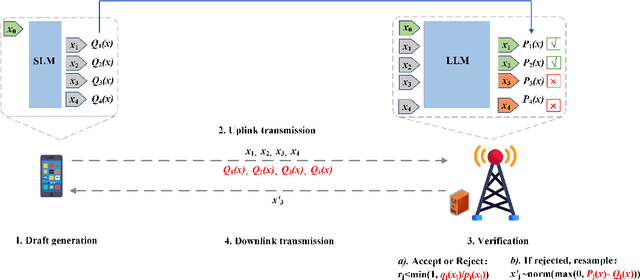
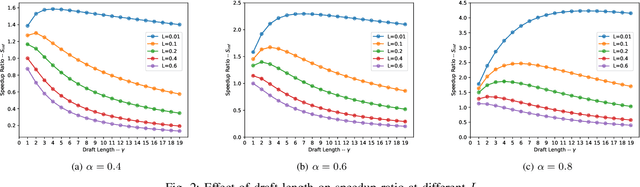
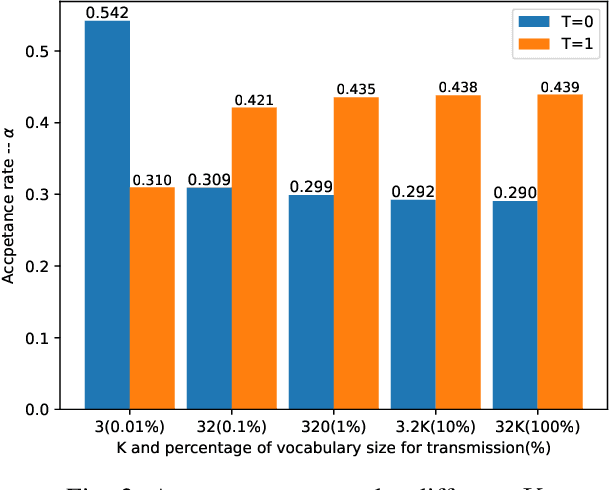
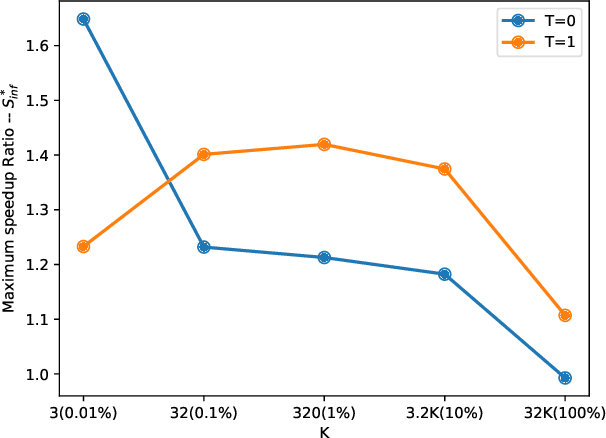
Speculative decoding is an emerging technique that accelerates large language model (LLM) inference by allowing a smaller draft model to predict multiple tokens in advance, which are then verified or corrected by a larger target model. In AI-native radio access networks (AI-RAN), this paradigm is well-suited for collaborative inference between resource-constrained end devices and more capable edge servers or base stations (BSs). However, existing distributed speculative decoding requires transmitting the full vocabulary probability distribution from the draft model on the device to the target model at the BS, which leads to prohibitive uplink communication overhead. To address this issue, we propose a ``Top-K Sparse Logits Transmission (TK-SLT)`` scheme, where the draft model transmits only the top-K token raw probabilities and the corresponding token indices instead of the entire distribution. This approach significantly reduces bandwidth consumption while maintaining inference performance. We further derive an analytical expression for the optimal draft length that maximizes inference throughput, and provide a theoretical analysis of the achievable speedup ratio under TK-SLT. Experimental results validate both the efficiency and effectiveness of the proposed method.
DSSD: Efficient Edge-Device Deployment and Collaborative Inference via Distributed Split Speculative Decoding
Jul 16, 2025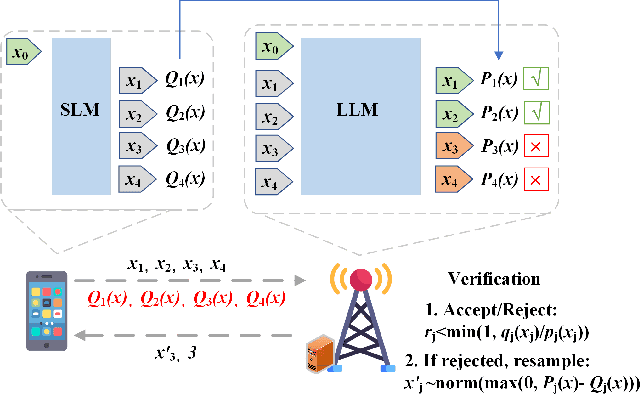
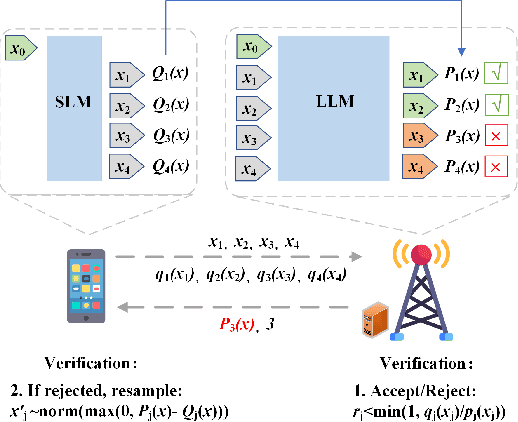
Large language models (LLMs) have transformed natural language processing but face critical deployment challenges in device-edge systems due to resource limitations and communication overhead. To address these issues, collaborative frameworks have emerged that combine small language models (SLMs) on devices with LLMs at the edge, using speculative decoding (SD) to improve efficiency. However, existing solutions often trade inference accuracy for latency or suffer from high uplink transmission costs when verifying candidate tokens. In this paper, we propose Distributed Split Speculative Decoding (DSSD), a novel architecture that not only preserves the SLM-LLM split but also partitions the verification phase between the device and edge. In this way, DSSD replaces the uplink transmission of multiple vocabulary distributions with a single downlink transmission, significantly reducing communication latency while maintaining inference quality. Experiments show that our solution outperforms current methods, and codes are at: https://github.com/JasonNing96/DSSD-Efficient-Edge-Computing