 Add to Chrome
 Add to Firefox
 Add to Edge
MAD-HOI: Masked Autoregressive Diffusion for Generating Articulated Hand Object Interactions from Text
Aug 10, 2026
Methods for text-based generation of hand-object interaction (HOI) sequences primarily focus on producing smooth, physically plausible trajectories. A truly utilitarian method should additionally support variable-length generation, composite motion sequences, motion completion and infilling, and reliable termination without compromising physical plausibility. Standard diffusion models for HOI generation are typically trained only for text-to-motion generation on atomic motions and require the motion length to be specified a-priori. Autoregressive (AR) methods provide greater sequence-level flexibility, but commonly depend on discrete motion codes, which can lose contact-sensitive motion detail. To address these key limitations, we present a model performing Masked Autoregression with Diffusion for HOI generation (MAD-HOI). Our method starts by encoding hand and object motions in a continuous latent space while keeping them disentangled to maintain stream-wise control. This is followed by a masked autoregressive transformer to predict context features that condition a flow-matching head. MAD-HOI is capable of motion generation for atomic and composite articulated sequences, conditioned motion completion and infilling, as well as EOM (End of Motion) prediction from a single training objective. We provide comprehensive evaluations for these capabilities and benchmark our method on the ARCTIC and GRAB datasets. Our experiments demonstrate that our method generates more diverse and physically plausible interactions compared to other open-sourced baseline methods.

MAVERIX: Multimodal Audio-Visual Evaluation Reasoning IndeX
Mar 27, 2025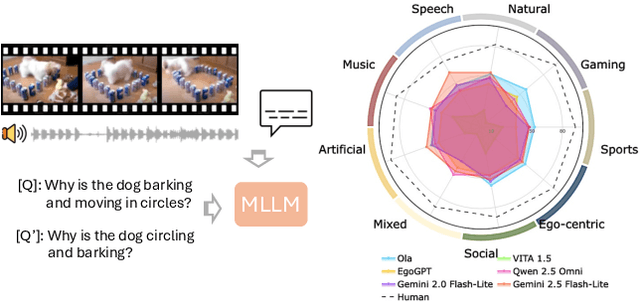
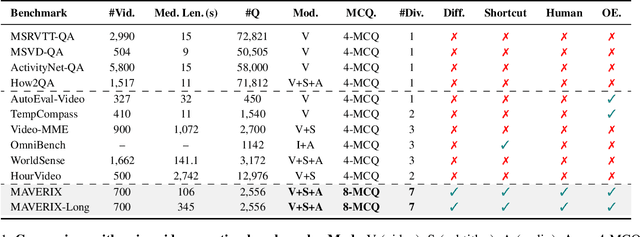
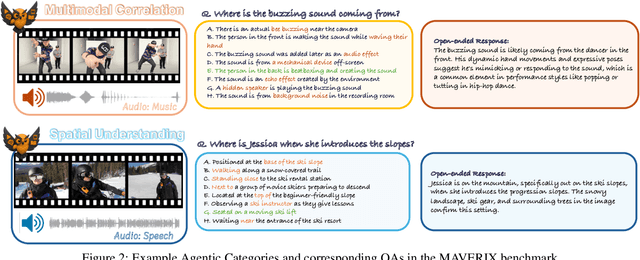
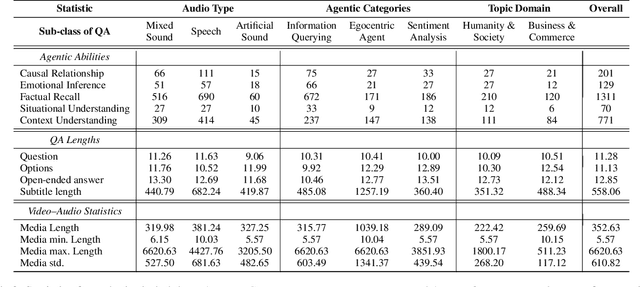
Frontier models have either been language-only or have primarily focused on vision and language modalities. Although recent advancements in models with vision and audio understanding capabilities have shown substantial progress, the field lacks a standardized evaluation framework for thoroughly assessing their cross-modality perception performance. We introduce MAVERIX~(Multimodal Audio-Visual Evaluation Reasoning IndeX), a novel benchmark with 700 videos and 2,556 questions explicitly designed to evaluate multimodal models through tasks that necessitate close integration of video and audio information. MAVERIX uniquely provides models with audiovisual tasks, closely mimicking the multimodal perceptual experiences available to humans during inference and decision-making processes. To our knowledge, MAVERIX is the first benchmark aimed explicitly at assessing comprehensive audiovisual integration. Experiments with state-of-the-art models, including Gemini 1.5 Pro and o1, show performance approaching human levels (around 70% accuracy), while human experts reach near-ceiling performance (95.1%). With standardized evaluation protocols, a rigorously annotated pipeline, and a public toolkit, MAVERIX establishes a challenging testbed for advancing audiovisual multimodal intelligence.