 Add to Chrome
 Add to Firefox
 Add to Edge
HieDG: A Hierarchical Discrete Geometry-Guided Framework for Multi-Animal Tracking
Jul 01, 2026
Multi-animal tracking (MAT) is critical for wildlife monitoring and behavioral analysis, yet remains challenging due to uniform appearance, high density, and irregular motion. Existing methods typically follow heuristic- or query-based paradigms: the former relies on handcrafted geometric associations without end-to-end optimization, whereas the latter enables joint optimization but relies heavily on appearance embeddings. In such conditions, continuous geometric embeddings can be unstable, as small coordinate perturbations may disproportionately alter cross-frame attention weights, degrading identity association performance. To address this limitation, we propose HieDG, a Hierarchical Discrete Geometry-guided tracking framework that reformulates geometric dynamics as structured discrete representations within a query-based tracker. Instead of directly using raw geometric signals, HieDG employs a two-stage residual codebook to discretize position, scale, and velocity cues, transforming unstable continuous geometry into structured, stable discrete tokens. These tokens are aligned with visual embeddings and integrated into the tracking queries to enhance identity consistency. Extensive experiments on animal-specific benchmarks (AnimalTrack, BFT, and BuckTales) demonstrate state-of-the-art association performance with significant improvements in HOTA, AssA, and IDF1. Additional evaluations on generic multi-object tracking benchmarks, including DanceTrack and SportsMOT, show competitive performance, indicating the broader applicability of discretized geometric modeling beyond animal-specific scenarios.

SkelEM: Training-Signal Decoupling of Skeleton and Diffusion for Self-supervised Axial Super-Resolution in Volume Microscopy
Jun 29, 2026Volume microscopy, including electron and light microscopy, suffers from severe anisotropic resolution due to physical axial sectioning. Existing self-supervised axial super-resolution (ASR) methods face a trilemma bounded by overly smoothed regression textures, structural hallucinations of pure diffusion models, and prohibitive inference latency. In this paper, we propose Skeleton-refinE Microscopy (SkelEM), a self-supervised framework that decouples ASR at the training-signal level: a frozen topological network and a diffusion refiner are optimized by disjoint objectives, separating low-frequency topology formulation from high-frequency detail enhancement. Building on this deterministic skeleton, we exploit a unified cycle-consistent mechanism on input sparse slices to simultaneously extract a real-domain residual prior and bidirectionally align the diffusion refiner, washing away cross-plane artifacts without synthetic bias. By truncating the reverse diffusion process with this physical prior, SkelEM achieves high-fidelity detail restoration in merely $\le 5$ steps. To rigorously assess cross-instrument generalization, we further introduce BRAVE-ASR, a new benchmark of co-aligned anisotropic and isotropic volumes acquired on a Plasma-FIB instrument. Across public benchmarks, SkelEM achieves the most favorable balance across the fidelity-perception trade-off among self-supervised methods, with state-of-the-art downstream membrane segmentation performance and robust zero-shot generalization across distinct modalities.
Evaluation of LLMs for Mathematical Formalization in Lean
Jun 04, 2026Within the past few years, the ability of Large Language Models (LLMs) to generate formal mathematical proofs has improved drastically. We provide a comparison of various LLMs' effectiveness in producing formal proofs in Lean 4 with the goal of assisting those seeking to use LLMs to support their own projects. We utilize both pass@$k$ and refine@$k$ metrics as the benchmark for our comparison and evaluate on subsets of both miniF2F and miniCTX datasets. Our testing shows that overall, Gemini 3.1 Pro and Claude Opus 4.7 perform best. Gemini 3.1 Pro achieved a 92\% success rate on miniF2F via refine@32 whereas Opus 4.7 achieved a 86\% success rate on miniCTX via refine@32. When taking cost into account, NVIDIA Nemotron 3 Super and GPT-OSS 120B were the most efficient, with competitive accuracies and average costs of $<\$0.01$ per correct proof.
InterveneBench: Benchmarking LLMs for Intervention Reasoning and Causal Study Design in Real Social Systems
Mar 16, 2026Causal inference in social science relies on end-to-end, intervention-centered research-design reasoning grounded in real-world policy interventions, but current benchmarks fail to evaluate this capability of large language models (LLMs). We present InterveneBench, a benchmark designed to assess such reasoning in realistic social settings. Each instance in InterveneBench is derived from an empirical social science study and requires models to reason about policy interventions and identification assumptions without access to predefined causal graphs or structural equations. InterveneBench comprises 744 peer-reviewed studies across diverse policy domains. Experimental results show that state-of-the-art LLMs struggle under this setting. To address this limitation, we further propose a multi-agent framework, STRIDES. It achieves significant performance improvements over state-of-the-art reasoning models. Our code and data are available at https://github.com/Sii-yuning/STRIDES.
Efficient Medical Image Restoration via Reliability Guided Learning in Frequency Domain
Apr 15, 2025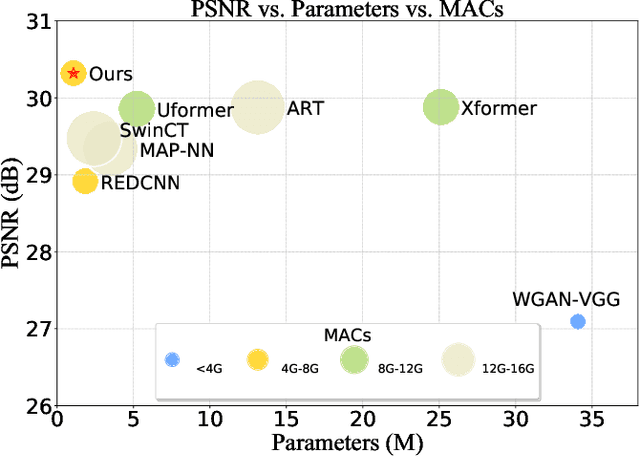
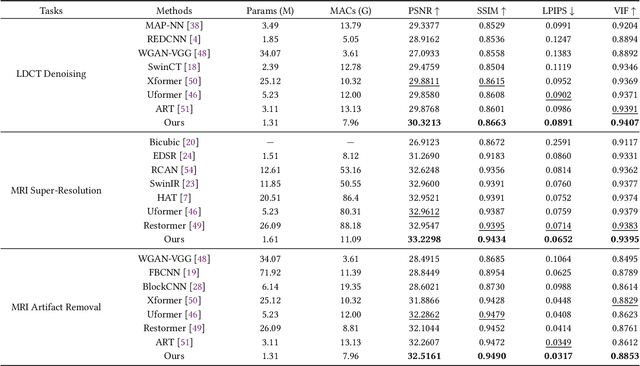
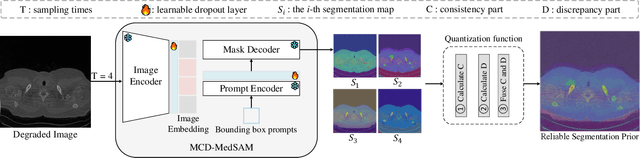
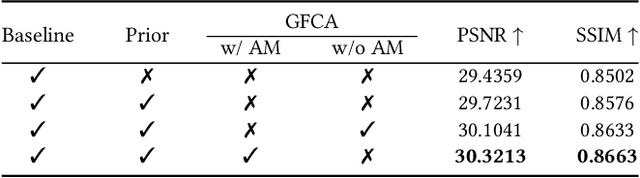
Medical image restoration tasks aim to recover high-quality images from degraded observations, exhibiting emergent desires in many clinical scenarios, such as low-dose CT image denoising, MRI super-resolution, and MRI artifact removal. Despite the success achieved by existing deep learning-based restoration methods with sophisticated modules, they struggle with rendering computationally-efficient reconstruction results. Moreover, they usually ignore the reliability of the restoration results, which is much more urgent in medical systems. To alleviate these issues, we present LRformer, a Lightweight Transformer-based method via Reliability-guided learning in the frequency domain. Specifically, inspired by the uncertainty quantification in Bayesian neural networks (BNNs), we develop a Reliable Lesion-Semantic Prior Producer (RLPP). RLPP leverages Monte Carlo (MC) estimators with stochastic sampling operations to generate sufficiently-reliable priors by performing multiple inferences on the foundational medical image segmentation model, MedSAM. Additionally, instead of directly incorporating the priors in the spatial domain, we decompose the cross-attention (CA) mechanism into real symmetric and imaginary anti-symmetric parts via fast Fourier transform (FFT), resulting in the design of the Guided Frequency Cross-Attention (GFCA) solver. By leveraging the conjugated symmetric property of FFT, GFCA reduces the computational complexity of naive CA by nearly half. Extensive experimental results in various tasks demonstrate the superiority of the proposed LRformer in both effectiveness and efficiency.
From Diffusion to Resolution: Leveraging 2D Diffusion Models for 3D Super-Resolution Task
Nov 25, 2024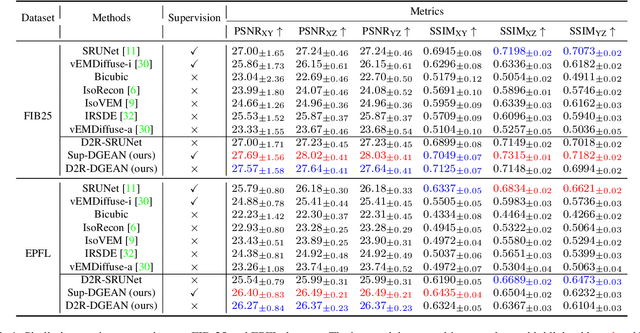
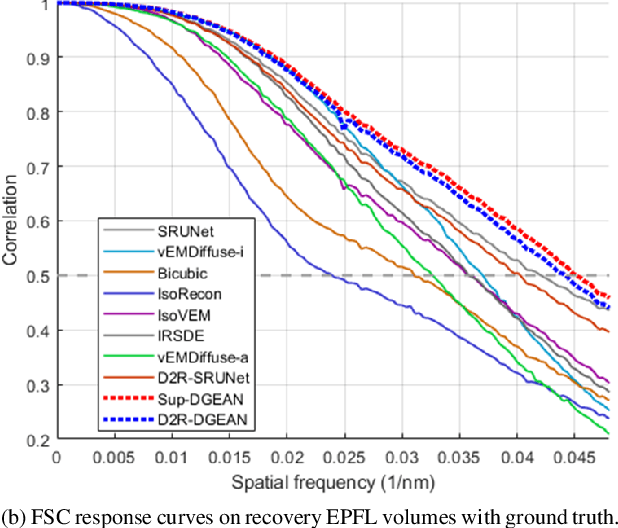
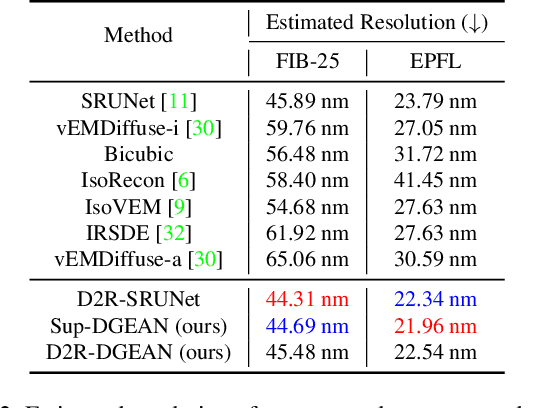
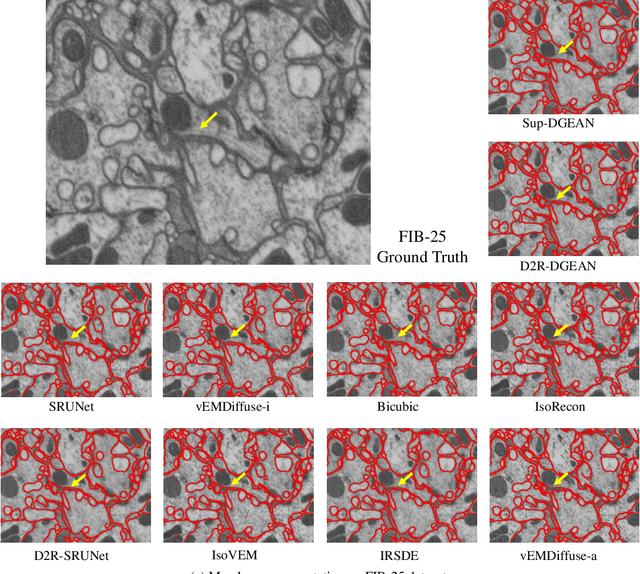
Diffusion models have recently emerged as a powerful technique in image generation, especially for image super-resolution tasks. While 2D diffusion models significantly enhance the resolution of individual images, existing diffusion-based methods for 3D volume super-resolution often struggle with structure discontinuities in axial direction and high sampling costs. In this work, we present a novel approach that leverages the 2D diffusion model and lateral continuity within the volume to enhance 3D volume electron microscopy (vEM) super-resolution. We first simulate lateral degradation with slices in the XY plane and train a 2D diffusion model to learn how to restore the degraded slices. The model is then applied slice-by-slice in the lateral direction of low-resolution volume, recovering slices while preserving inherent lateral continuity. Following this, a high-frequency-aware 3D super-resolution network is trained on the recovery lateral slice sequences to learn spatial feature transformation across slices. Finally, the network is applied to infer high-resolution volumes in the axial direction, enabling 3D super-resolution. We validate our approach through comprehensive evaluations, including image similarity assessments, resolution analysis, and performance on downstream tasks. Our results on two publicly available focused ion beam scanning electron microscopy (FIB-SEM) datasets demonstrate the robustness and practical applicability of our framework for 3D volume super-resolution.