 Add to Chrome
 Add to Firefox
 Add to Edge
PCS-UQ: Uncertainty Quantification via the Predictability-Computability-Stability Framework
May 13, 2025
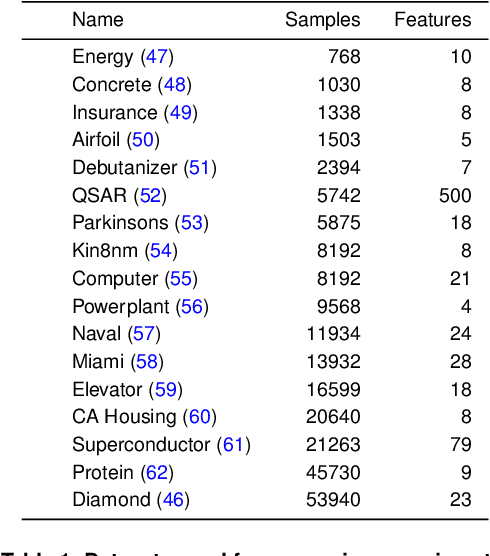
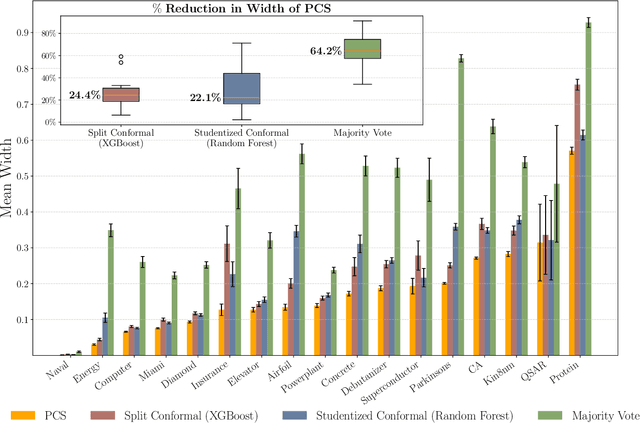
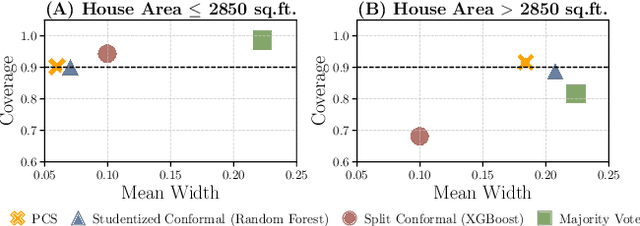
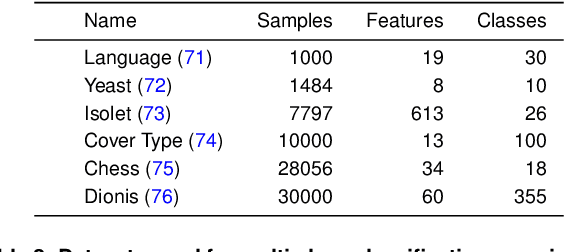
As machine learning (ML) models are increasingly deployed in high-stakes domains, trustworthy uncertainty quantification (UQ) is critical for ensuring the safety and reliability of these models. Traditional UQ methods rely on specifying a true generative model and are not robust to misspecification. On the other hand, conformal inference allows for arbitrary ML models but does not consider model selection, which leads to large interval sizes. We tackle these drawbacks by proposing a UQ method based on the predictability, computability, and stability (PCS) framework for veridical data science proposed by Yu and Kumbier. Specifically, PCS-UQ addresses model selection by using a prediction check to screen out unsuitable models. PCS-UQ then fits these screened algorithms across multiple bootstraps to assess inter-sample variability and algorithmic instability, enabling more reliable uncertainty estimates. Further, we propose a novel calibration scheme that improves local adaptivity of our prediction sets. Experiments across $17$ regression and $6$ classification datasets show that PCS-UQ achieves the desired coverage and reduces width over conformal approaches by $\approx 20\%$. Further, our local analysis shows PCS-UQ often achieves target coverage across subgroups while conformal methods fail to do so. For large deep-learning models, we propose computationally efficient approximation schemes that avoid the expensive multiple bootstrap trainings of PCS-UQ. Across three computer vision benchmarks, PCS-UQ reduces prediction set size over conformal methods by $20\%$. Theoretically, we show a modified PCS-UQ algorithm is a form of split conformal inference and achieves the desired coverage with exchangeable data.

Long-Short Chain-of-Thought Mixture Supervised Fine-Tuning Eliciting Efficient Reasoning in Large Language Models
May 06, 2025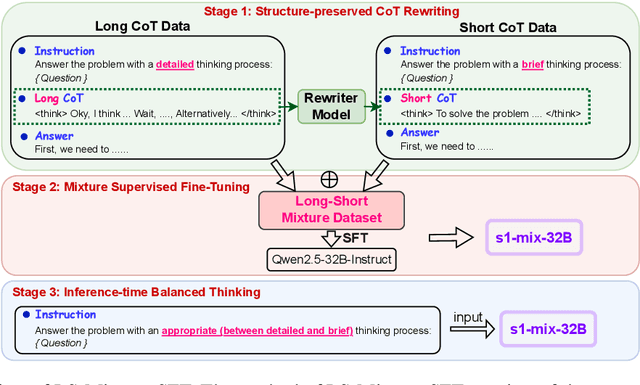
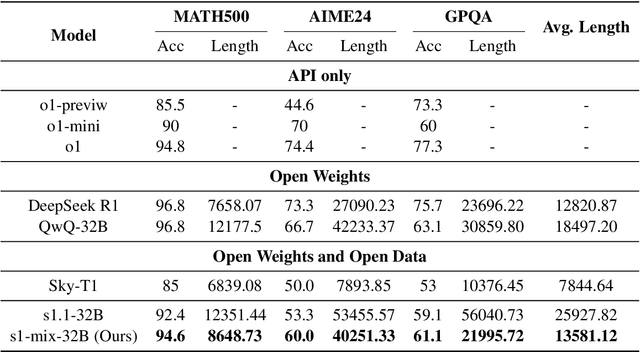
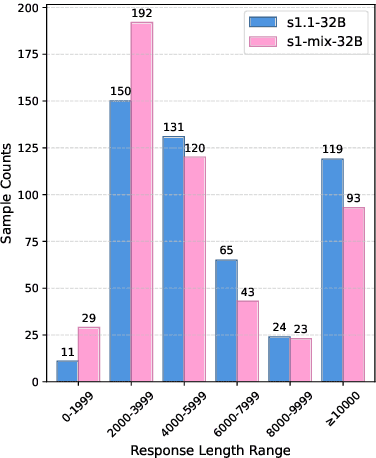
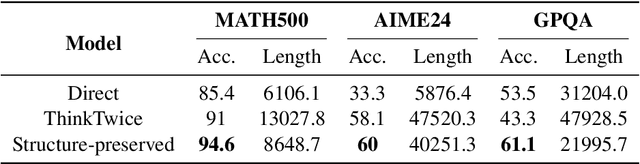
Recent advances in large language models have demonstrated that Supervised Fine-Tuning (SFT) with Chain-of-Thought (CoT) reasoning data distilled from large reasoning models (e.g., DeepSeek R1) can effectively transfer reasoning capabilities to non-reasoning models. However, models fine-tuned with this approach inherit the "overthinking" problem from teacher models, producing verbose and redundant reasoning chains during inference. To address this challenge, we propose \textbf{L}ong-\textbf{S}hort Chain-of-Thought \textbf{Mixture} \textbf{S}upervised \textbf{F}ine-\textbf{T}uning (\textbf{LS-Mixture SFT}), which combines long CoT reasoning dataset with their short counterparts obtained through structure-preserved rewriting. Our experiments demonstrate that models trained using the LS-Mixture SFT method, compared to those trained with direct SFT, achieved an average accuracy improvement of 2.3\% across various benchmarks while substantially reducing model response length by approximately 47.61\%. This work offers an approach to endow non-reasoning models with reasoning capabilities through supervised fine-tuning while avoiding the inherent overthinking problems inherited from teacher models, thereby enabling efficient reasoning in the fine-tuned models.
Enhancing CBMs Through Binary Distillation with Applications to Test-Time Intervention
Mar 09, 2025Concept bottleneck models~(CBM) aim to improve model interpretability by predicting human level ``concepts" in a bottleneck within a deep learning model architecture. However, how the predicted concepts are used in predicting the target still either remains black-box or is simplified to maintain interpretability at the cost of prediction performance. We propose to use Fast Interpretable Greedy Sum-Trees~(FIGS) to obtain Binary Distillation~(BD). This new method, called FIGS-BD, distills a binary-augmented concept-to-target portion of the CBM into an interpretable tree-based model, while mimicking the competitive prediction performance of the CBM teacher. FIGS-BD can be used in downstream tasks to explain and decompose CBM predictions into interpretable binary-concept-interaction attributions and guide adaptive test-time intervention. Across $4$ datasets, we demonstrate that adaptive test-time intervention identifies key concepts that significantly improve performance for realistic human-in-the-loop settings that allow for limited concept interventions.
SPEX: Scaling Feature Interaction Explanations for LLMs
Feb 19, 2025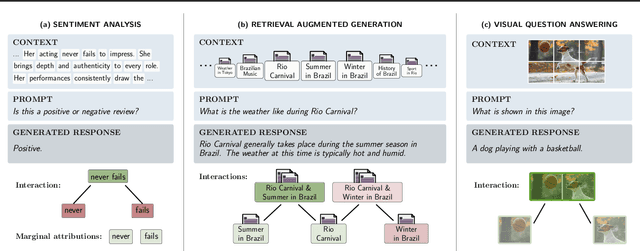

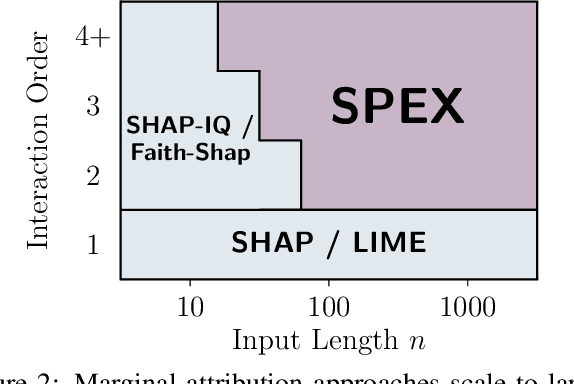
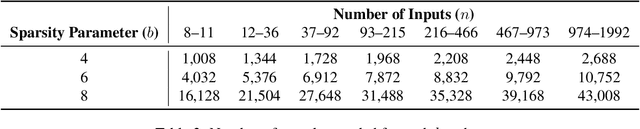
Large language models (LLMs) have revolutionized machine learning due to their ability to capture complex interactions between input features. Popular post-hoc explanation methods like SHAP provide marginal feature attributions, while their extensions to interaction importances only scale to small input lengths ($\approx 20$). We propose Spectral Explainer (SPEX), a model-agnostic interaction attribution algorithm that efficiently scales to large input lengths ($\approx 1000)$. SPEX exploits underlying natural sparsity among interactions -- common in real-world data -- and applies a sparse Fourier transform using a channel decoding algorithm to efficiently identify important interactions. We perform experiments across three difficult long-context datasets that require LLMs to utilize interactions between inputs to complete the task. For large inputs, SPEX outperforms marginal attribution methods by up to 20% in terms of faithfully reconstructing LLM outputs. Further, SPEX successfully identifies key features and interactions that strongly influence model output. For one of our datasets, HotpotQA, SPEX provides interactions that align with human annotations. Finally, we use our model-agnostic approach to generate explanations to demonstrate abstract reasoning in closed-source LLMs (GPT-4o mini) and compositional reasoning in vision-language models.
Benefits of Early Stopping in Gradient Descent for Overparameterized Logistic Regression
Feb 18, 2025In overparameterized logistic regression, gradient descent (GD) iterates diverge in norm while converging in direction to the maximum $\ell_2$-margin solution -- a phenomenon known as the implicit bias of GD. This work investigates additional regularization effects induced by early stopping in well-specified high-dimensional logistic regression. We first demonstrate that the excess logistic risk vanishes for early-stopped GD but diverges to infinity for GD iterates at convergence. This suggests that early-stopped GD is well-calibrated, whereas asymptotic GD is statistically inconsistent. Second, we show that to attain a small excess zero-one risk, polynomially many samples are sufficient for early-stopped GD, while exponentially many samples are necessary for any interpolating estimator, including asymptotic GD. This separation underscores the statistical benefits of early stopping in the overparameterized regime. Finally, we establish nonasymptotic bounds on the norm and angular differences between early-stopped GD and $\ell_2$-regularized empirical risk minimizer, thereby connecting the implicit regularization of GD with explicit $\ell_2$-regularization.
ParMod: A Parallel and Modular Framework for Learning Non-Markovian Tasks
Dec 17, 2024
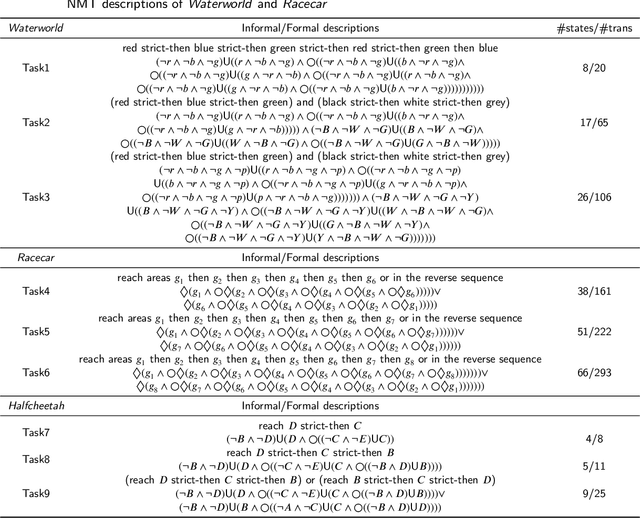


The commonly used Reinforcement Learning (RL) model, MDPs (Markov Decision Processes), has a basic premise that rewards depend on the current state and action only. However, many real-world tasks are non-Markovian, which has long-term memory and dependency. The reward sparseness problem is further amplified in non-Markovian scenarios. Hence learning a non-Markovian task (NMT) is inherently more difficult than learning a Markovian one. In this paper, we propose a novel \textbf{Par}allel and \textbf{Mod}ular RL framework, ParMod, specifically for learning NMTs specified by temporal logic. With the aid of formal techniques, the NMT is modulaized into a series of sub-tasks based on the automaton structure (equivalent to its temporal logic counterpart). On this basis, sub-tasks will be trained by a group of agents in a parallel fashion, with one agent handling one sub-task. Besides parallel training, the core of ParMod lies in: a flexible classification method for modularizing the NMT, and an effective reward shaping method for improving the sample efficiency. A comprehensive evaluation is conducted on several challenging benchmark problems with respect to various metrics. The experimental results show that ParMod achieves superior performance over other relevant studies. Our work thus provides a good synergy among RL, NMT and temporal logic.
Deep Sparse Latent Feature Models for Knowledge Graph Completion
Nov 24, 2024
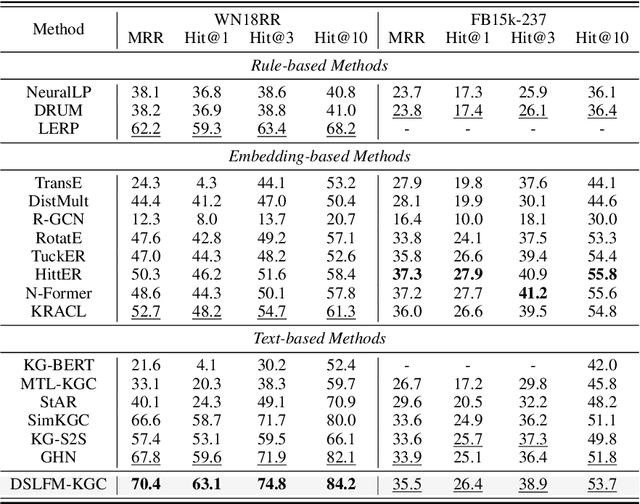

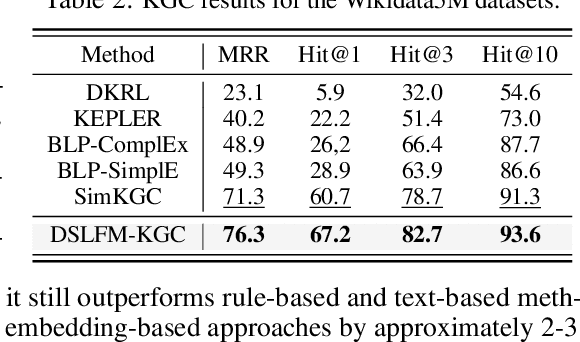
Recent progress in knowledge graph completion (KGC) has focused on text-based approaches to address the challenges of large-scale knowledge graphs (KGs). Despite their achievements, these methods often overlook the intricate interconnections between entities, a key aspect of the underlying topological structure of a KG. Stochastic blockmodels (SBMs), particularly the latent feature relational model (LFRM), offer robust probabilistic frameworks that can dynamically capture latent community structures and enhance link prediction. In this paper, we introduce a novel framework of sparse latent feature models for KGC, optimized through a deep variational autoencoder (VAE). Our approach not only effectively completes missing triples but also provides clear interpretability of the latent structures, leveraging textual information. Comprehensive experiments on the WN18RR, FB15k-237, and Wikidata5M datasets show that our method significantly improves performance by revealing latent communities and producing interpretable representations.
Rate, Explain and Cite (REC): Enhanced Explanation and Attribution in Automatic Evaluation by Large Language Models
Nov 03, 2024
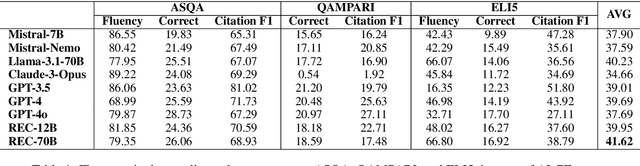
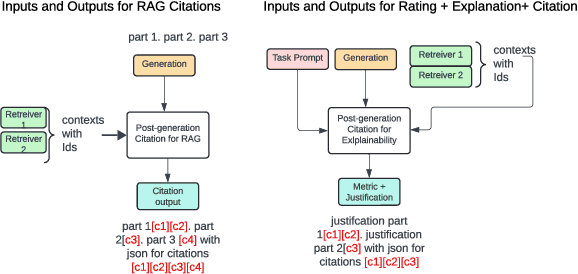
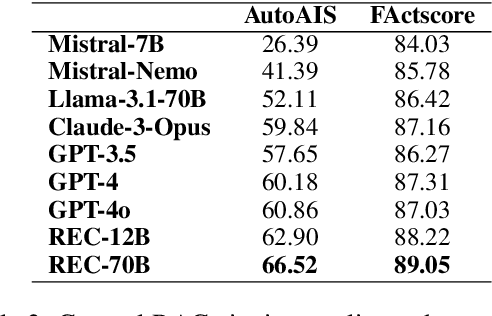
LLMs have demonstrated impressive proficiency in generating coherent and high-quality text, making them valuable across a range of text-generation tasks. However, rigorous evaluation of this generated content is crucial, as ensuring its quality remains a significant challenge due to persistent issues such as factual inaccuracies and hallucinations. This paper introduces two fine-tuned general-purpose LLM autoevaluators, REC-12B and REC-70B, specifically designed to evaluate generated text across several dimensions: faithfulness, instruction following, coherence, and completeness. These models not only provide ratings for these metrics but also offer detailed explanations and verifiable citations, thereby enhancing trust in the content. Moreover, the models support various citation modes, accommodating different requirements for latency and granularity. Extensive evaluations on diverse benchmarks demonstrate that our general-purpose LLM auto-evaluator, REC-70B, outperforms state-of-the-art LLMs, excelling in content evaluation by delivering better quality explanations and citations with minimal bias. It achieves Rank \#1 as a generative model on the RewardBench leaderboard\footnote{\url{https://huggingface.co/spaces/allenai/reward-bench}} under the model name \texttt{TextEval-Llama3.1-70B}. Our REC dataset and models are released at \url{https://github.com/adelaidehsu/REC}.
KnowGraph: Knowledge-Enabled Anomaly Detection via Logical Reasoning on Graph Data
Oct 10, 2024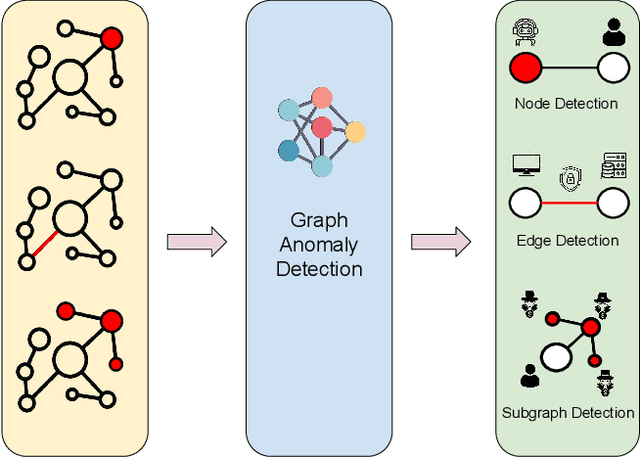

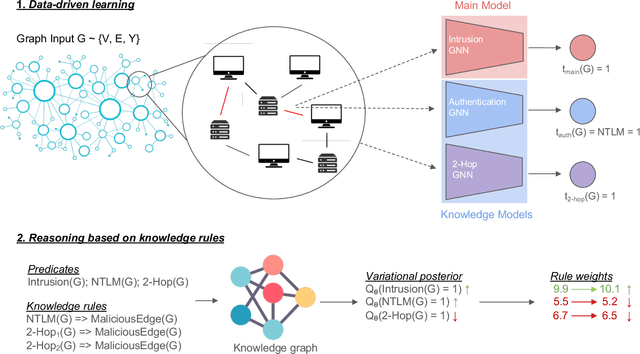

Graph-based anomaly detection is pivotal in diverse security applications, such as fraud detection in transaction networks and intrusion detection for network traffic. Standard approaches, including Graph Neural Networks (GNNs), often struggle to generalize across shifting data distributions. Meanwhile, real-world domain knowledge is more stable and a common existing component of real-world detection strategies. To explicitly integrate such knowledge into data-driven models such as GCNs, we propose KnowGraph, which integrates domain knowledge with data-driven learning for enhanced graph-based anomaly detection. KnowGraph comprises two principal components: (1) a statistical learning component that utilizes a main model for the overarching detection task, augmented by multiple specialized knowledge models that predict domain-specific semantic entities; (2) a reasoning component that employs probabilistic graphical models to execute logical inferences based on model outputs, encoding domain knowledge through weighted first-order logic formulas. Extensive experiments on these large-scale real-world datasets show that KnowGraph consistently outperforms state-of-the-art baselines in both transductive and inductive settings, achieving substantial gains in average precision when generalizing to completely unseen test graphs. Further ablation studies demonstrate the effectiveness of the proposed reasoning component in improving detection performance, especially under extreme class imbalance. These results highlight the potential of integrating domain knowledge into data-driven models for high-stakes, graph-based security applications.
A generative framework to bridge data-driven models and scientific theories in language neuroscience
Oct 01, 2024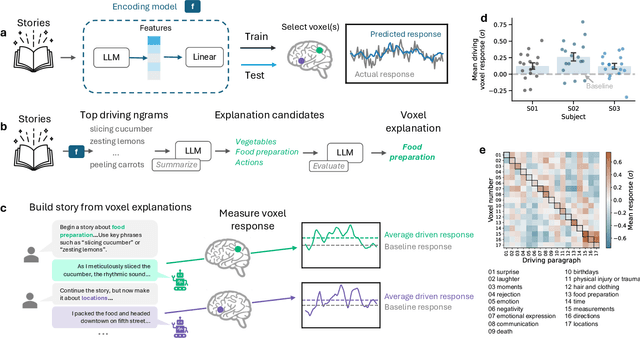
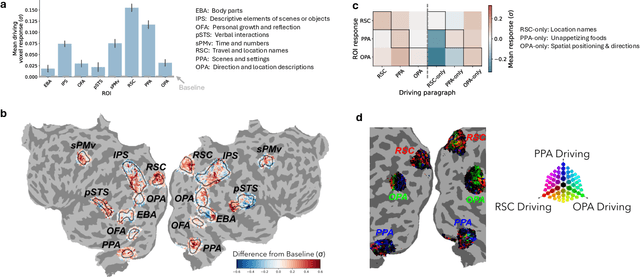
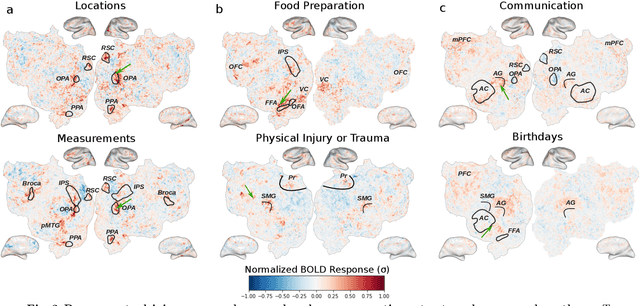

Representations from large language models are highly effective at predicting BOLD fMRI responses to language stimuli. However, these representations are largely opaque: it is unclear what features of the language stimulus drive the response in each brain area. We present generative explanation-mediated validation, a framework for generating concise explanations of language selectivity in the brain and then validating those explanations in follow-up experiments that use synthetic stimuli. This approach is successful at explaining selectivity both in individual voxels and cortical regions of interest (ROIs).We show that explanatory accuracy is closely related to the predictive power and stability of the underlying statistical models. These results demonstrate that LLMs can be used to bridge the widening gap between data-driven models and formal scientific theories.