 Add to Chrome
 Add to Firefox
 Add to Edge
HOIMask: Towards Generative Masked Modeling for Human Object Interaction Generation
Aug 15, 2026
Diffusion-based methods have dominated the HOI generation, as they enable critical contact fusions or signals to guide the diffusion process. However, they often result in high artifacts and unstable interaction quality due to error accumulation during iterative denoising. In this work, we propose HOIMask, the first generative masked framework for modeling HOI motion in discrete space. HOIMask first encodes both motion sequences and contact-aware signals into discrete 2D human and object token maps via HOI Vector Quantization (VQ), preserving fine-grained spatial-temporal structure beyond conventional 1D representations. On this basis, a generative masked modeling framework is employed to jointly capture human-object interaction dynamics, leveraging a transformer architecture designed to model complex spatial-temporal and interaction dependencies. To generate more coherent and physically plausible motions, we further introduce a novel contact-aware reconstruction guidance in discrete space during inference, which fuses contact signals to optimize HOI tokens that forces the generated motion with higher spatio-temporal consistency. With craftily designed motion interaction tokens, dedicated architecture and guidance strategy, HOIMask outperforms state-of-the-art diffusion-based methods, generating more realistic and semantically aligned HOI motions. Please refer to https://jyhflash.github.io/HOIMask/ for more results.

SOFFLFM: Super-resolution optical fluctuation Fourier light-field microscopy
Aug 26, 2022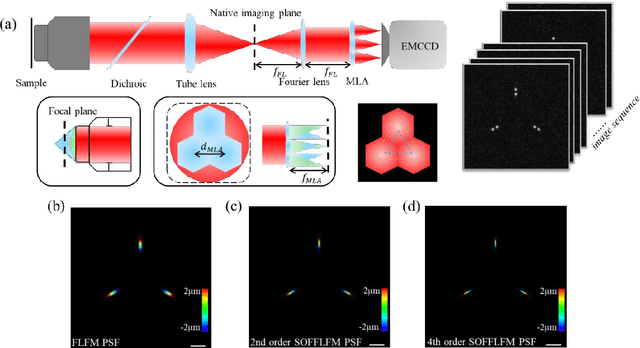
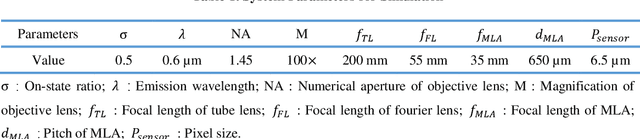
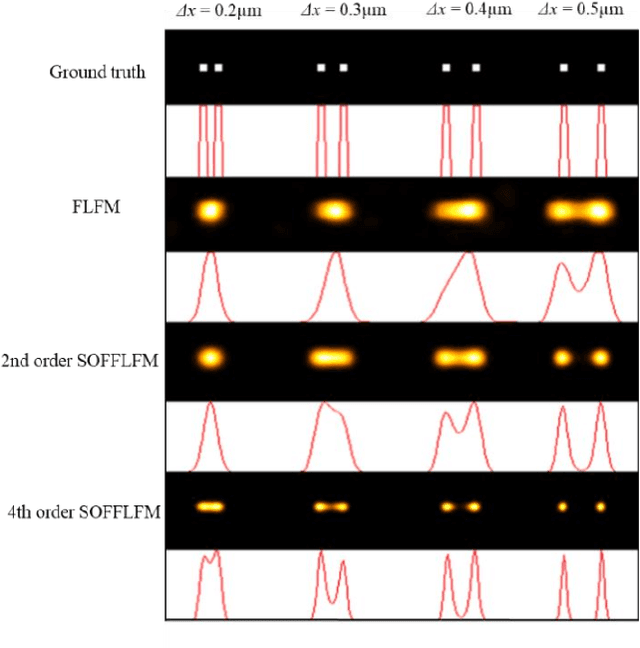
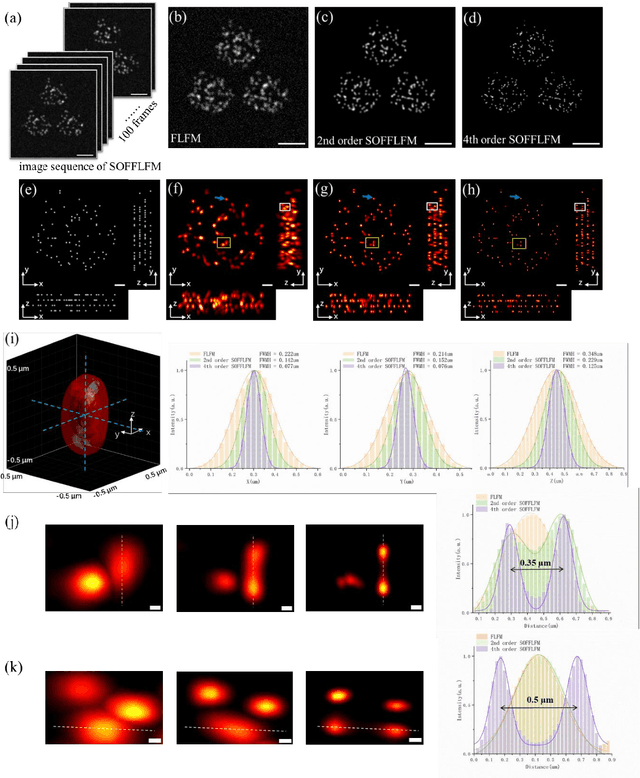
Fourier light-field microscopy (FLFM) uses a micro-lens array (MLA) to segment the Fourier Plane of the microscopic objective lens to generate multiple two-dimensional perspective views, thereby reconstructing the three-dimensional(3D) structure of the sample using 3D deconvolution calculation without scanning. However, the resolution of FLFM is still limited by diffraction, and furthermore, dependent on the aperture division. In order to improve its resolution, a Super-resolution optical fluctuation Fourier light field microscopy (SOFFLFM) was proposed here, in which the Sofi method with ability of super-resolution was introduced into FLFM. SOFFLFM uses higher-order cumulants statistical analysis on an image sequence collected by FLFM, and then carries out 3D deconvolution calculation to reconstruct the 3D structure of the sample. Theoretical basis of SOFFLFM on improving resolution was explained and then verified with simulations. Simulation results demonstrated that SOFFLFM improved lateral and axial resolution by more than sqrt(2) and 2 times in the 2nd and 4th order accumulations, compared with that of FLFM.