 Add to Chrome
 Add to Firefox
 Add to Edge
Behavior-Grounded Lane Representation Learning for Multi-Task Traffic Digital Twins
May 03, 2026
Traffic digital twins are powerful tools for advanced traffic management, and most systems are built on static geometric representations. However, these representations fail to capture the dynamic functional semantics required for behavior-aware reasoning, such as how a lane operates under complex traffic conditions. To address this gap, we introduce GeoLaneRep, a behavior-grounded lane representation learning framework for traffic digital twins. GeoLaneRep jointly encodes static lane geometry, observed vehicle trajectories, and operational descriptors into a shared, cross-camera semantic embedding. The encoder is trained with a joint objective combining contrastive cross-camera alignment, auxiliary role supervision, and temporal anomaly detection. Across 16 roadside cameras and 132 lanes, the learned embeddings achieve a $0.004$ lateral-rank error and an edge-role F1 of $1.000$ in zero-shot cross-camera matching, and an AUROC of $0.991$ for window-level anomaly detection. We further show that the same behavioral embeddings can condition a diffusion-based generator to synthesize lane geometries that satisfy targeted operational specifications, with $87.9\%$ overall specification accuracy across 38 lane groups. GeoLaneRep thus provides a semantic interface between roadside observations and downstream digital twin tasks, supporting cross-camera transfer, behavior-aware monitoring, and goal-directed lane synthesis. The framework is openly available at https://github.com/raynbowy23/GeoLaneRep.

Truck Parking Usage Prediction with Decomposed Graph Neural Networks
Jan 23, 2024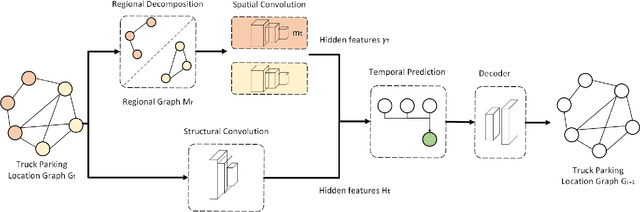

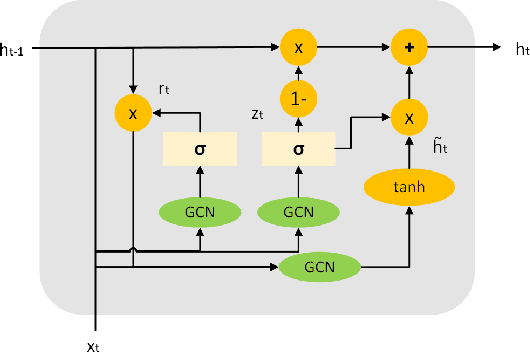
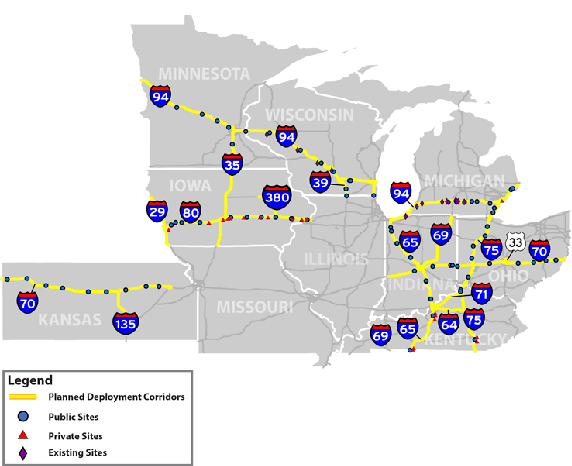
Truck parking on freight corridors faces various challenges, such as insufficient parking spaces and compliance with Hour-of-Service (HOS) regulations. These constraints often result in unauthorized parking practices, causing safety concerns. To enhance the safety of freight operations, providing accurate parking usage prediction proves to be a cost-effective solution. Despite the existing research demonstrating satisfactory accuracy for predicting individual truck parking site usage, few approaches have been proposed for predicting usage with spatial dependencies of multiple truck parking sites. We present the Regional Temporal Graph Neural Network (RegT-GCN) as a predictive framework for assessing parking usage across the entire state to provide better truck parking information and mitigate unauthorized parking. The framework leverages the topological structures of truck parking site distributions and historical parking data to predict occupancy rates across a state. To achieve this, we introduce a Regional Decomposition approach, which effectively captures the geographical characteristics. We also introduce the spatial module working efficiently with the temporal module. Evaluation results demonstrate that the proposed model surpasses other baseline models, improving the performance by more than $20\%$ compared with the original model. The proposed model allows truck parking sites' percipience of the topological structures and provides higher performance.