 Add to Chrome
 Add to Firefox
 Add to Edge
Targeted Counterfactual Fingerprinting for Black-Box LLM Ownership Verification
Aug 08, 2026
Large language models (LLMs) are high-value assets that can be derived through redeployment, fine-tuning, quantization, or further alignment. Because deployed LLMs are commonly exposed only through query APIs, ownership verification must often rely on black-box text responses. This setting is difficult: generations are open-ended and can vary across repeated queries, while existing black-box fingerprints rely on signals that are fragile under a final-response interface, including full-text matching, soft behavioral features, or model-specific prompts designed not to transfer. We propose TCF (Targeted Counterfactual Fingerprinting), a black-box LLM fingerprinting framework that converts open-ended generation comparison into constrained-answer targeted counterfactual transfer. TCF restricts each verification query to a finite answer space, reducing the surface-form ambiguity that enters the verification score, and optimizes a prompt perturbation toward a counterfactual target different from the protected model's clean answer on the original prompt. Verification reduces to checking whether the suspect model's parsed final answer matches the recorded target. We introduce the source-model counterfactual margin (SCM), a protected-model-only quantity that certifies the target is unlikely before the perturbation and likely after it; SCM controls target selection, perturbation stopping, and fingerprint filtering. Under explicit derived-preservation and independent-transfer budgets motivated by local behavioral closeness, we derive a target-accuracy gap between derived and independent models. Across four LLM families, TCF achieves an average AUC of 0.9861, improving over TRAP, ProFLingo, and ZeroPrint by 0.07 to 0.19.

SoK: Robustness in Large Language Models against Jailbreak Attacks
May 06, 2026Large Language Models (LLMs) have achieved remarkable success but remain highly susceptible to jailbreak attacks, in which adversarial prompts coerce models into generating harmful, unethical, or policy-violating outputs. Such attacks pose real-world risks, eroding safety, trust, and regulatory compliance in high-stakes applications. Although a variety of attack and defense methods have been proposed, existing evaluation practices are inadequate, often relying on narrow metrics like attack success rate that fail to capture the multidimensional nature of LLM security. In this paper, we present a systematic taxonomy of jailbreak attacks and defenses and introduce Security Cube, a unified, multi-dimensional framework for comprehensive evaluation of these techniques. We provide detailed comparison tables of existing attacks and defenses, highlighting key insights and open challenges across the literature. Leveraging Security Cube, we conduct benchmark studies on 13 representative attacks and 5 defenses, establishing a clear view of the current landscape encompassing jailbreak attacks, defenses, automated judges, and LLM vulnerabilities. Based on these evaluations, we distill critical findings, identify unresolved problems, and outline promising research directions for enhancing LLM robustness against jailbreak attacks. Our analysis aims to pave the way towards more robust, interpretable, and trustworthy LLM systems. Our code is available at Code.
Sirens' Whisper: Inaudible Near-Ultrasonic Jailbreaks of Speech-Driven LLMs
Mar 14, 2026Speech-driven large language models (LLMs) are increasingly accessed through speech interfaces, introducing new security risks via open acoustic channels. We present Sirens' Whisper (SWhisper), the first practical framework for covert prompt-based attacks against speech-driven LLMs under realistic black-box conditions using commodity hardware. SWhisper enables robust, inaudible delivery of arbitrary target baseband audio-including long and structured prompts-on commodity devices by encoding it into near-ultrasound waveforms that demodulate faithfully after acoustic transmission and microphone nonlinearity. This is achieved through a simple yet effective approach to modeling nonlinear channel characteristics across devices and environments, combined with lightweight channel-inversion pre-compensation. Building on this high-fidelity covert channel, we design a voice-aware jailbreak generation method that ensures intelligibility, brevity, and transferability under speech-driven interfaces. Experiments across both commercial and open-source speech-driven LLMs demonstrate strong black-box effectiveness. On commercial models, SWhisper achieves up to 0.94 non-refusal (NR) and 0.925 specific-convincing (SC). A controlled user study further shows that the injected jailbreak audio is perceptually indistinguishable from background-only playback for human listeners. Although jailbreaks serve as a case study, the underlying covert acoustic channel enables a broader class of high-fidelity prompt-injection and commandexecution attacks.
AMPO: Automatic Multi-Branched Prompt Optimization
Oct 11, 2024


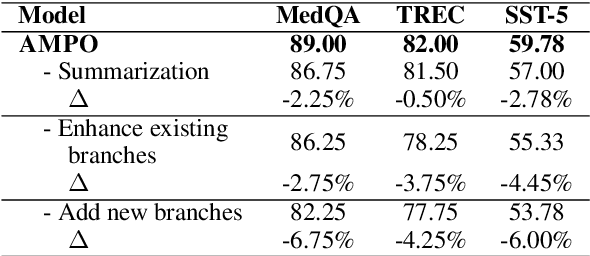
Prompt engineering is very important to enhance the performance of large language models (LLMs). When dealing with complex issues, prompt engineers tend to distill multiple patterns from examples and inject relevant solutions to optimize the prompts, achieving satisfying results. However, existing automatic prompt optimization techniques are only limited to producing single flow instructions, struggling with handling diverse patterns. In this paper, we present AMPO, an automatic prompt optimization method that can iteratively develop a multi-branched prompt using failure cases as feedback. Our goal is to explore a novel way of structuring prompts with multi-branches to better handle multiple patterns in complex tasks, for which we introduce three modules: Pattern Recognition, Branch Adjustment, and Branch Pruning. In experiments across five tasks, AMPO consistently achieves the best results. Additionally, our approach demonstrates significant optimization efficiency due to our adoption of a minimal search strategy.
StraGo: Harnessing Strategic Guidance for Prompt Optimization
Oct 11, 2024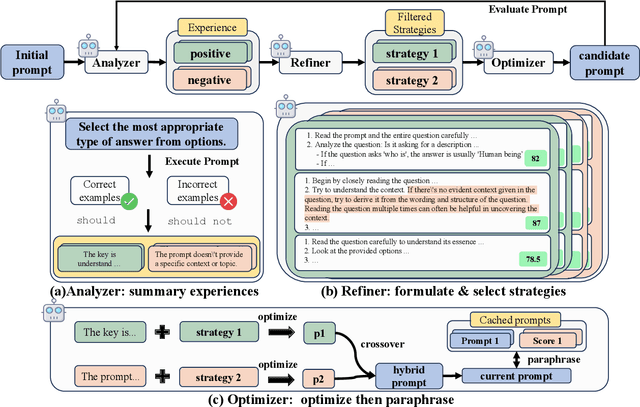


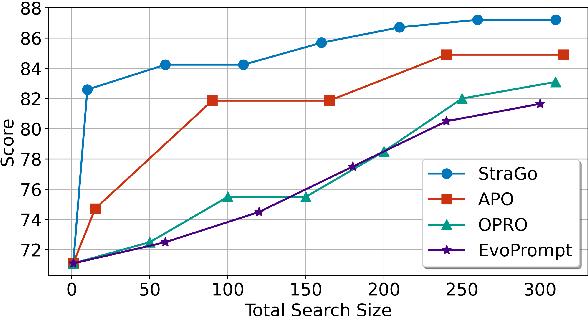
Prompt engineering is pivotal for harnessing the capabilities of large language models (LLMs) across diverse applications. While existing prompt optimization methods improve prompt effectiveness, they often lead to prompt drifting, where newly generated prompts can adversely impact previously successful cases while addressing failures. Furthermore, these methods tend to rely heavily on LLMs' intrinsic capabilities for prompt optimization tasks. In this paper, we introduce StraGo (Strategic-Guided Optimization), a novel approach designed to mitigate prompt drifting by leveraging insights from both successful and failed cases to identify critical factors for achieving optimization objectives. StraGo employs a how-to-do methodology, integrating in-context learning to formulate specific, actionable strategies that provide detailed, step-by-step guidance for prompt optimization. Extensive experiments conducted across a range of tasks, including reasoning, natural language understanding, domain-specific knowledge, and industrial applications, demonstrate StraGo's superior performance. It establishes a new state-of-the-art in prompt optimization, showcasing its ability to deliver stable and effective prompt improvements.