 Add to Chrome
 Add to Firefox
 Add to Edge
SoK: Robustness in Large Language Models against Jailbreak Attacks
May 06, 2026
Large Language Models (LLMs) have achieved remarkable success but remain highly susceptible to jailbreak attacks, in which adversarial prompts coerce models into generating harmful, unethical, or policy-violating outputs. Such attacks pose real-world risks, eroding safety, trust, and regulatory compliance in high-stakes applications. Although a variety of attack and defense methods have been proposed, existing evaluation practices are inadequate, often relying on narrow metrics like attack success rate that fail to capture the multidimensional nature of LLM security. In this paper, we present a systematic taxonomy of jailbreak attacks and defenses and introduce Security Cube, a unified, multi-dimensional framework for comprehensive evaluation of these techniques. We provide detailed comparison tables of existing attacks and defenses, highlighting key insights and open challenges across the literature. Leveraging Security Cube, we conduct benchmark studies on 13 representative attacks and 5 defenses, establishing a clear view of the current landscape encompassing jailbreak attacks, defenses, automated judges, and LLM vulnerabilities. Based on these evaluations, we distill critical findings, identify unresolved problems, and outline promising research directions for enhancing LLM robustness against jailbreak attacks. Our analysis aims to pave the way towards more robust, interpretable, and trustworthy LLM systems. Our code is available at Code.

FideDiff: Efficient Diffusion Model for High-Fidelity Image Motion Deblurring
Oct 02, 2025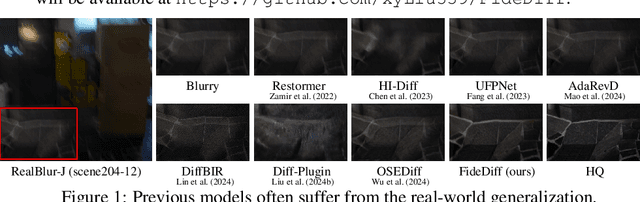
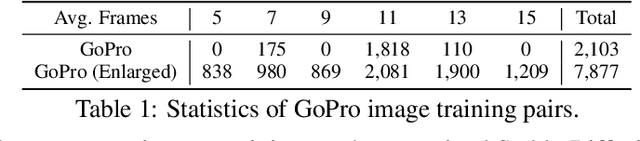
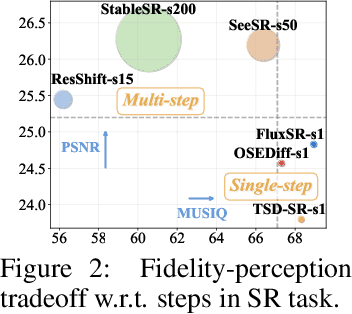
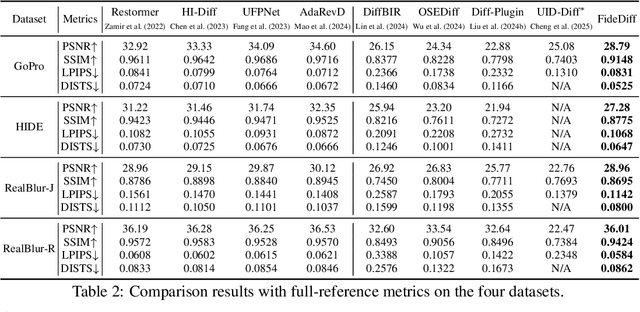
Recent advancements in image motion deblurring, driven by CNNs and transformers, have made significant progress. Large-scale pre-trained diffusion models, which are rich in true-world modeling, have shown great promise for high-quality image restoration tasks such as deblurring, demonstrating stronger generative capabilities than CNN and transformer-based methods. However, challenges such as unbearable inference time and compromised fidelity still limit the full potential of the diffusion models. To address this, we introduce FideDiff, a novel single-step diffusion model designed for high-fidelity deblurring. We reformulate motion deblurring as a diffusion-like process where each timestep represents a progressively blurred image, and we train a consistency model that aligns all timesteps to the same clean image. By reconstructing training data with matched blur trajectories, the model learns temporal consistency, enabling accurate one-step deblurring. We further enhance model performance by integrating Kernel ControlNet for blur kernel estimation and introducing adaptive timestep prediction. Our model achieves superior performance on full-reference metrics, surpassing previous diffusion-based methods and matching the performance of other state-of-the-art models. FideDiff offers a new direction for applying pre-trained diffusion models to high-fidelity image restoration tasks, establishing a robust baseline for further advancing diffusion models in real-world industrial applications. Our dataset and code will be available at https://github.com/xyLiu339/FideDiff.