 Add to Chrome
 Add to Firefox
 Add to Edge
OCDB: Revisiting Causal Discovery with a Comprehensive Benchmark and Evaluation Framework
Jun 07, 2024
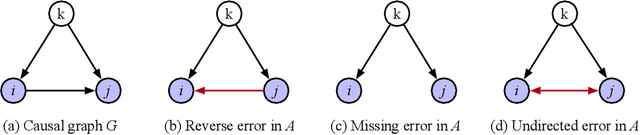
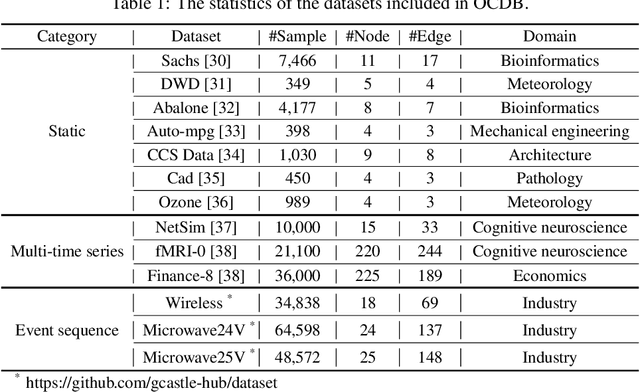
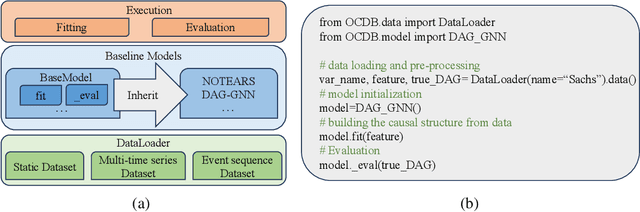
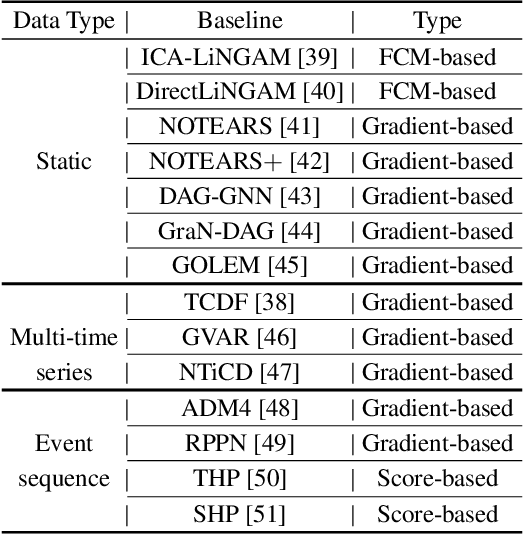
Large language models (LLMs) have excelled in various natural language processing tasks, but challenges in interpretability and trustworthiness persist, limiting their use in high-stakes fields. Causal discovery offers a promising approach to improve transparency and reliability. However, current evaluations are often one-sided and lack assessments focused on interpretability performance. Additionally, these evaluations rely on synthetic data and lack comprehensive assessments of real-world datasets. These lead to promising methods potentially being overlooked. To address these issues, we propose a flexible evaluation framework with metrics for evaluating differences in causal structures and causal effects, which are crucial attributes that help improve the interpretability of LLMs. We introduce the Open Causal Discovery Benchmark (OCDB), based on real data, to promote fair comparisons and drive optimization of algorithms. Additionally, our new metrics account for undirected edges, enabling fair comparisons between Directed Acyclic Graphs (DAGs) and Completed Partially Directed Acyclic Graphs (CPDAGs). Experimental results show significant shortcomings in existing algorithms' generalization capabilities on real data, highlighting the potential for performance improvement and the importance of our framework in advancing causal discovery techniques.

Accelerating Inference of Retrieval-Augmented Generation via Sparse Context Selection
May 25, 2024


Large language models (LLMs) augmented with retrieval exhibit robust performance and extensive versatility by incorporating external contexts. However, the input length grows linearly in the number of retrieved documents, causing a dramatic increase in latency. In this paper, we propose a novel paradigm named Sparse RAG, which seeks to cut computation costs through sparsity. Specifically, Sparse RAG encodes retrieved documents in parallel, which eliminates latency introduced by long-range attention of retrieved documents. Then, LLMs selectively decode the output by only attending to highly relevant caches auto-regressively, which are chosen via prompting LLMs with special control tokens. It is notable that Sparse RAG combines the assessment of each individual document and the generation of the response into a single process. The designed sparse mechanism in a RAG system can facilitate the reduction of the number of documents loaded during decoding for accelerating the inference of the RAG system. Additionally, filtering out undesirable contexts enhances the model's focus on relevant context, inherently improving its generation quality. Evaluation results of two datasets show that Sparse RAG can strike an optimal balance between generation quality and computational efficiency, demonstrating its generalizability across both short- and long-form generation tasks.
EiG-Search: Generating Edge-Induced Subgraphs for GNN Explanation in Linear Time
May 02, 2024Understanding and explaining the predictions of Graph Neural Networks (GNNs), is crucial for enhancing their safety and trustworthiness. Subgraph-level explanations are gaining attention for their intuitive appeal. However, most existing subgraph-level explainers face efficiency challenges in explaining GNNs due to complex search processes. The key challenge is to find a balance between intuitiveness and efficiency while ensuring transparency. Additionally, these explainers usually induce subgraphs by nodes, which may introduce less-intuitive disconnected nodes in the subgraph-level explanations or omit many important subgraph structures. In this paper, we reveal that inducing subgraph explanations by edges is more comprehensive than other subgraph inducing techniques. We also emphasize the need of determining the subgraph explanation size for each data instance, as different data instances may involve different important substructures. Building upon these considerations, we introduce a training-free approach, named EiG-Search. We employ an efficient linear-time search algorithm over the edge-induced subgraphs, where the edges are ranked by an enhanced gradient-based importance. We conduct extensive experiments on a total of seven datasets, demonstrating its superior performance and efficiency both quantitatively and qualitatively over the leading baselines.
* 19 pages
Data Interpreter: An LLM Agent For Data Science
Mar 12, 2024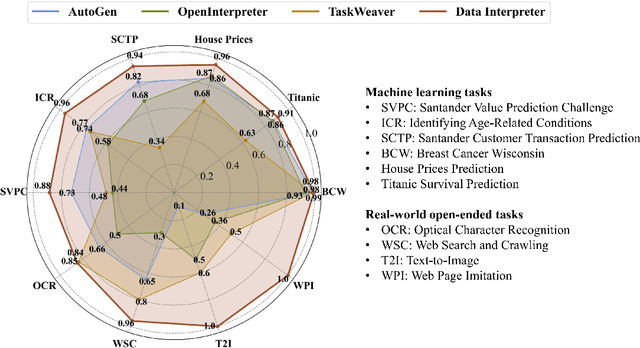


Large Language Model (LLM)-based agents have demonstrated remarkable effectiveness. However, their performance can be compromised in data science scenarios that require real-time data adjustment, expertise in optimization due to complex dependencies among various tasks, and the ability to identify logical errors for precise reasoning. In this study, we introduce the Data Interpreter, a solution designed to solve with code that emphasizes three pivotal techniques to augment problem-solving in data science: 1) dynamic planning with hierarchical graph structures for real-time data adaptability;2) tool integration dynamically to enhance code proficiency during execution, enriching the requisite expertise;3) logical inconsistency identification in feedback, and efficiency enhancement through experience recording. We evaluate the Data Interpreter on various data science and real-world tasks. Compared to open-source baselines, it demonstrated superior performance, exhibiting significant improvements in machine learning tasks, increasing from 0.86 to 0.95. Additionally, it showed a 26% increase in the MATH dataset and a remarkable 112% improvement in open-ended tasks. The solution will be released at https://github.com/geekan/MetaGPT.
OPEx: A Component-Wise Analysis of LLM-Centric Agents in Embodied Instruction Following
Mar 05, 2024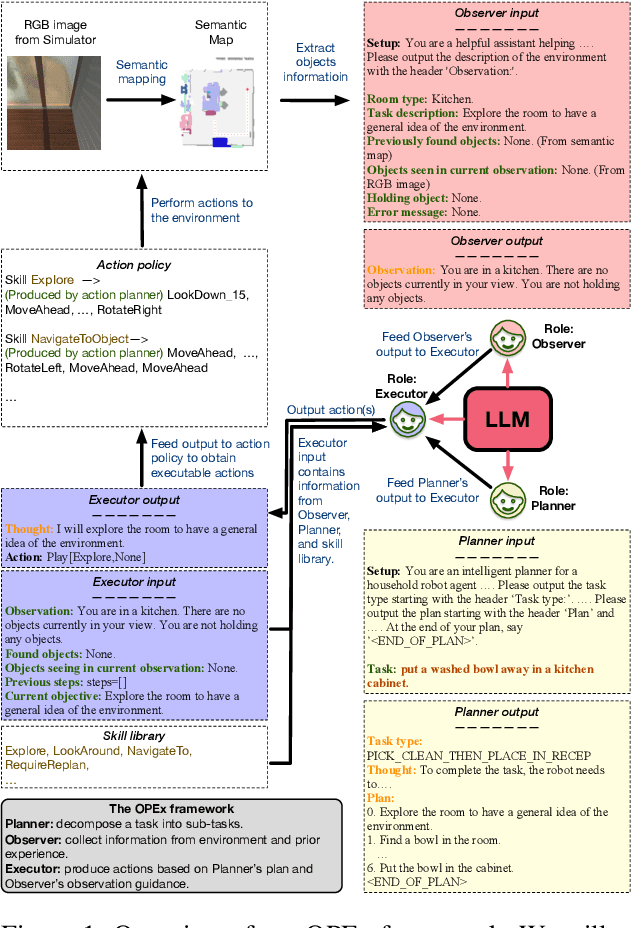

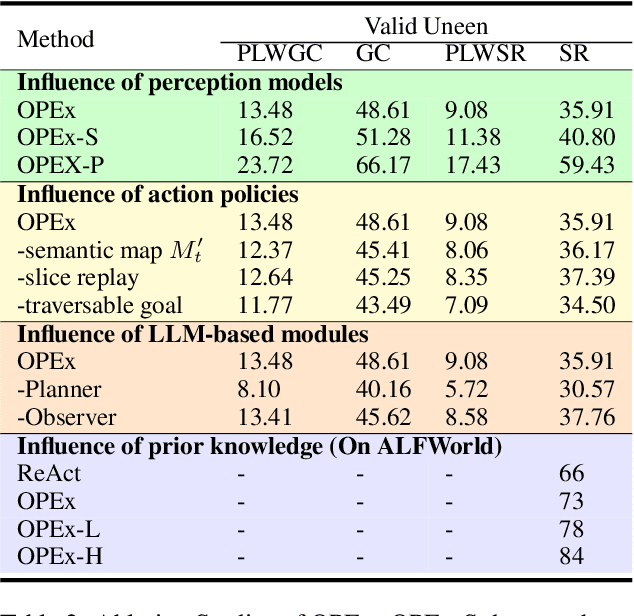
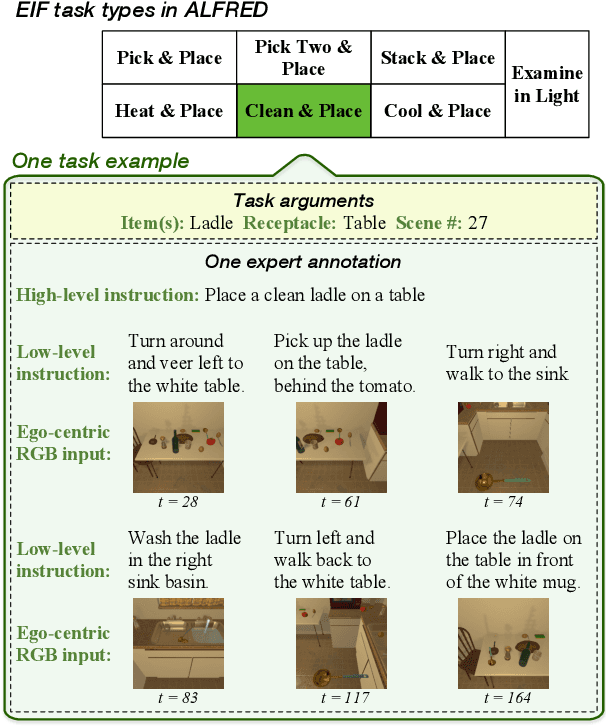
Embodied Instruction Following (EIF) is a crucial task in embodied learning, requiring agents to interact with their environment through egocentric observations to fulfill natural language instructions. Recent advancements have seen a surge in employing large language models (LLMs) within a framework-centric approach to enhance performance in embodied learning tasks, including EIF. Despite these efforts, there exists a lack of a unified understanding regarding the impact of various components-ranging from visual perception to action execution-on task performance. To address this gap, we introduce OPEx, a comprehensive framework that delineates the core components essential for solving embodied learning tasks: Observer, Planner, and Executor. Through extensive evaluations, we provide a deep analysis of how each component influences EIF task performance. Furthermore, we innovate within this space by deploying a multi-agent dialogue strategy on a TextWorld counterpart, further enhancing task performance. Our findings reveal that LLM-centric design markedly improves EIF outcomes, identify visual perception and low-level action execution as critical bottlenecks, and demonstrate that augmenting LLMs with a multi-agent framework further elevates performance.
FAC$^2$E: Better Understanding Large Language Model Capabilities by Dissociating Language and Cognition
Feb 29, 2024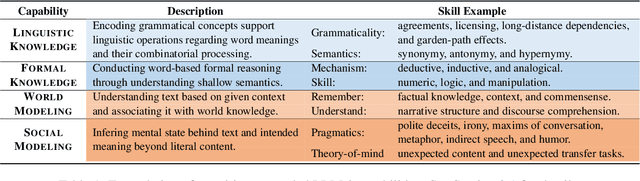

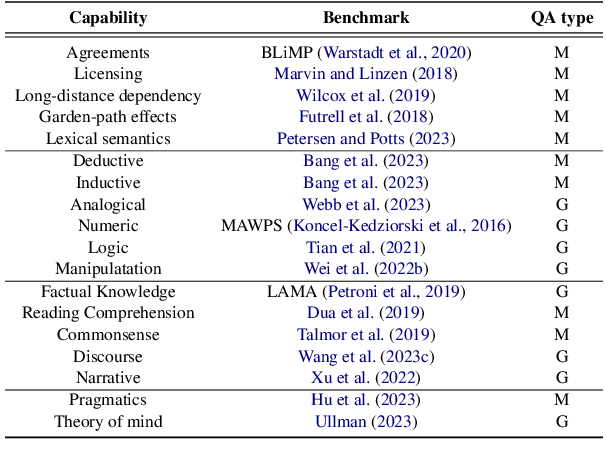

Large language models (LLMs) are primarily evaluated by overall performance on various text understanding and generation tasks. However, such a paradigm fails to comprehensively differentiate the fine-grained language and cognitive skills, rendering the lack of sufficient interpretation to LLMs' capabilities. In this paper, we present FAC$^2$E, a framework for Fine-grAined and Cognition-grounded LLMs' Capability Evaluation. Specifically, we formulate LLMs' evaluation in a multi-dimensional and explainable manner by dissociating the language-related capabilities and the cognition-related ones. Besides, through extracting the intermediate reasoning from LLMs, we further break down the process of applying a specific capability into three sub-steps: recalling relevant knowledge, utilizing knowledge, and solving problems. Finally, FAC$^2$E evaluates each sub-step of each fine-grained capability, providing a two-faceted diagnosis for LLMs. Utilizing FAC$^2$E, we identify a common shortfall in knowledge utilization among models and propose a straightforward, knowledge-enhanced method to mitigate this issue. Our results not only showcase promising performance enhancements but also highlight a direction for future LLM advancements.
Resonance RoPE: Improving Context Length Generalization of Large Language Models
Feb 29, 2024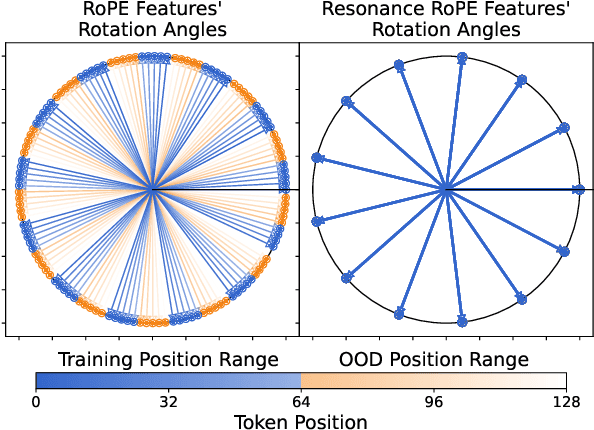

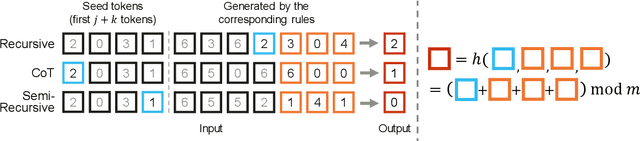

This paper addresses the challenge of train-short-test-long (TSTL) scenarios in Large Language Models (LLMs) equipped with Rotary Position Embedding (RoPE), where models pre-trained on shorter sequences face difficulty with out-of-distribution (OOD) token positions in longer sequences. We introduce Resonance RoPE, a novel approach designed to narrow the generalization gap in TSTL scenarios by refining the interpolation of RoPE features for OOD positions, significantly improving the model performance without additional online computational costs. Furthermore, we present PosGen, a new synthetic benchmark specifically designed for fine-grained behavior analysis in TSTL scenarios, aiming to isolate the constantly increasing difficulty of token generation on long contexts from the challenges of recognizing new token positions. Our experiments on synthetic tasks show that after applying Resonance RoPE, Transformers recognize OOD position better and more robustly. Our extensive LLM experiments also show superior performance after applying Resonance RoPE to the current state-of-the-art RoPE scaling method, YaRN, on both upstream language modeling tasks and a variety of downstream long-text applications.
GOAt: Explaining Graph Neural Networks via Graph Output Attribution
Jan 26, 2024Understanding the decision-making process of Graph Neural Networks (GNNs) is crucial to their interpretability. Most existing methods for explaining GNNs typically rely on training auxiliary models, resulting in the explanations remain black-boxed. This paper introduces Graph Output Attribution (GOAt), a novel method to attribute graph outputs to input graph features, creating GNN explanations that are faithful, discriminative, as well as stable across similar samples. By expanding the GNN as a sum of scalar products involving node features, edge features and activation patterns, we propose an efficient analytical method to compute contribution of each node or edge feature to each scalar product and aggregate the contributions from all scalar products in the expansion form to derive the importance of each node and edge. Through extensive experiments on synthetic and real-world data, we show that our method not only outperforms various state-ofthe-art GNN explainers in terms of the commonly used fidelity metric, but also exhibits stronger discriminability, and stability by a remarkable margin.
Deciphering Digital Detectives: Understanding LLM Behaviors and Capabilities in Multi-Agent Mystery Games
Dec 01, 2023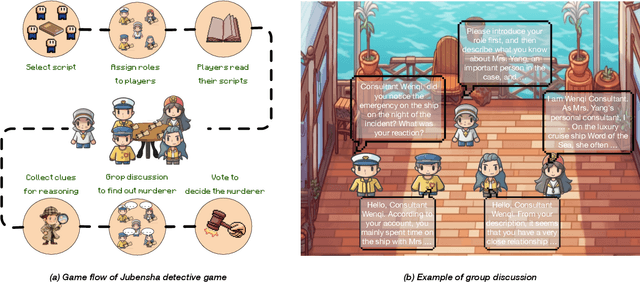
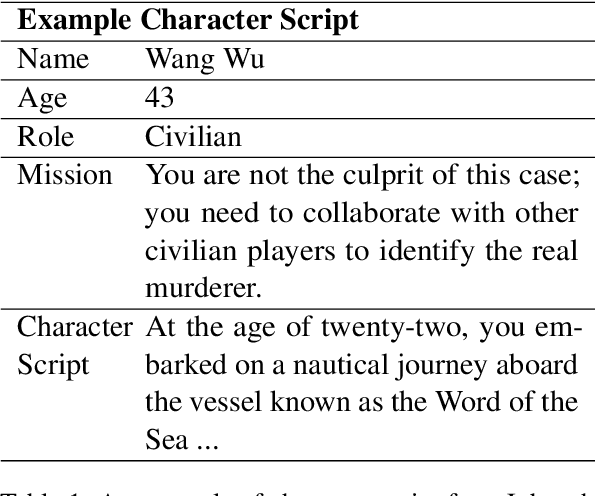
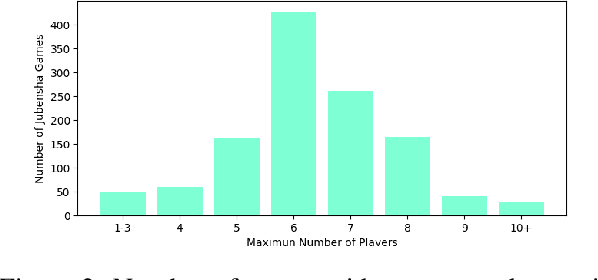
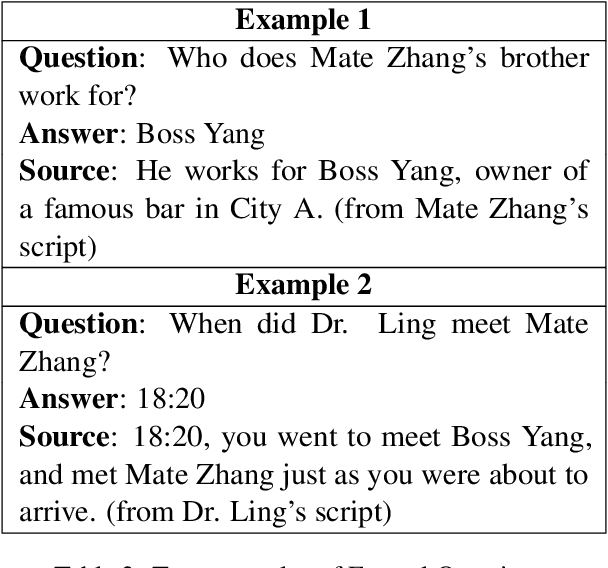
In this study, we explore the application of Large Language Models (LLMs) in "Jubensha" (Chinese murder mystery role-playing games), a novel area in AI-driven gaming. We introduce the first Chinese dataset specifically for Jubensha, including character scripts and game rules, to foster AI agent development in this complex narrative environment. Our work also presents a unique multi-agent interaction framework using LLMs, allowing AI agents to autonomously engage in the game, enhancing the dynamics of Jubensha gameplay. To evaluate these AI agents, we developed specialized methods targeting their mastery of case information and reasoning skills. Furthermore, we incorporated the latest advancements in in-context learning to improve the agents' performance in critical aspects like information gathering, murderer detection, and logical reasoning. The experimental results validate the effectiveness of our proposed methods. This work aims to offer a fresh perspective on understanding LLM capabilities and establish a new benchmark for evaluating large language model-based agents to researchers in the field.
HoneyBee: Progressive Instruction Finetuning of Large Language Models for Materials Science
Oct 12, 2023We propose an instruction-based process for trustworthy data curation in materials science (MatSci-Instruct), which we then apply to finetune a LLaMa-based language model targeted for materials science (HoneyBee). MatSci-Instruct helps alleviate the scarcity of relevant, high-quality materials science textual data available in the open literature, and HoneyBee is the first billion-parameter language model specialized to materials science. In MatSci-Instruct we improve the trustworthiness of generated data by prompting multiple commercially available large language models for generation with an Instructor module (e.g. Chat-GPT) and verification from an independent Verifier module (e.g. Claude). Using MatSci-Instruct, we construct a dataset of multiple tasks and measure the quality of our dataset along multiple dimensions, including accuracy against known facts, relevance to materials science, as well as completeness and reasonableness of the data. Moreover, we iteratively generate more targeted instructions and instruction-data in a finetuning-evaluation-feedback loop leading to progressively better performance for our finetuned HoneyBee models. Our evaluation on the MatSci-NLP benchmark shows HoneyBee's outperformance of existing language models on materials science tasks and iterative improvement in successive stages of instruction-data refinement. We study the quality of HoneyBee's language modeling through automatic evaluation and analyze case studies to further understand the model's capabilities and limitations. Our code and relevant datasets are publicly available at \url{https://github.com/BangLab-UdeM-Mila/NLP4MatSci-HoneyBee}.