 Add to Chrome
 Add to Firefox
 Add to Edge
PAUSE: A User-Centric Benchmark for Personal AI Assistants in Unified Service Environments
Jul 29, 2026
Personal AI assistants are increasingly deployed as task-oriented, tool-augmented agents that operate within unified service environments to support everyday user activities. In realistic settings, such assistants must reason over persistent user state, respect user-specific configurations and permissions, and sustain long-horizon, constraint-aware interactions across multiple services. Existing benchmarks, however, often fragment service contexts or abstract away user state, limiting their ability to evaluate user-centric personal assistant behavior in realistic service settings. We introduce PAUSE, a user-centric benchmark for evaluating personal AI assistants in stateful, service-integrated environments. PAUSE captures core challenges of real-world assistant deployment by requiring agents to coordinate actions across heterogeneous user-owned resources while maintaining consistency with environment state, authorization constraints over multi-turn interactions. The benchmark incorporates explicit user-agent interaction via realistic user simulation, enabling evaluation beyond static tool execution. To support principled and reproducible evaluation, PAUSE adopts a multi-regime evaluation framework aligned with task characteristics. Open-ended service management tasks are assessed using semantic and trajectory-level behavioral metrics, while constraint-intensive tasks admit deterministic, state-based verification. Benchmark results show that even state-of-the-art proprietary models fail to reach 70% task completion on scenarios requiring stateful reasoning and configuration awareness, revealing consistent and interpretable failure patterns. Finally, we present a user-centric synthesis pipeline that enables scalable generation of coherent service environments, user configurations, and reliably annotated tasks, supporting benchmark extensibility and future research.

Multi-Head Latent Control: A Unified Interface for LLM Agent Decision Making
Jul 15, 2026Large language models are increasingly deployed as agents, but reliable agentic behavior requires more than next-token prediction. At inference time, it is preferred that an agent can decide whether to proceed with its current reasoning, defer to a stronger model, request additional information, invoke external tools, or abstain under the given setup. Existing approaches address these decisions through prompt-level routing, external orchestration, or task-specific fine-tuning, which primarily rely on input-side signals, and are often costly and difficult to maintain as model backbones evolve. We ask whether such control decisions can be inferred directly from a model's latent generation process. We introduce Multi-Head Latent Control, a lightweight layer that reads hidden-state trajectories from a frozen LLM or VLM to produce deployment-time control signals. A Capability Head predicts whether the current model can solve the instance or should defer to a stronger collaborator, while a Resolution Head predicts appropriate resolution decision Clarification, Tool Use, Abstention, or Direct Answering. Both heads are trained only on latent traces from the same frozen LLM backbone, enabling post hoc adaptation without modifying the model. Across language and vision-language settings, Multi-Head Latent Control consistently improves the quality-cost tradeoff of multi-model systems, enabling early handoff from partial generations and more accurate intervention decisions. In routed execution (small + large model), it reduces large-model usage by up to 90.7 percent on AndroidWorld and 27-53 percent on average across benchmarks, while retaining most of large-model performance. Additionally, the learned control signals improve tool-use decision quality, yielding up to +158 percent relative score gain and 65.5 percent fewer missed-required tool calls.
Don't Show Pixels, Show Cues: Unlocking Visual Tool Reasoning in Language Models via Perception Programs
Apr 14, 2026Multimodal language models (MLLMs) are increasingly paired with vision tools (e.g., depth, flow, correspondence) to enhance visual reasoning. However, despite access to these tool-generated visual cues, MLLMs often fail to benefit from them. Existing approaches typically feed raw tool outputs into the model, but these dense, pixel-level representations are misaligned with the language-native reasoning strengths of LLMs, leading to weak perception and reliance on language priors. We argue that, in problems where vision tools can provide the necessary visual cues, the bottleneck is not more tool calls or larger MLLMs, it is how tool outputs are represented. We introduce Perception Programs (P$^2$), a training-free, model-agnostic method that rewrites tool outputs into compact, structured, language-native summaries that MLLMs can directly parse and reason over. Across six perception-centric tasks in BLINK, P$^2$ consistently yields large improvements over base models and raw tool-augmented baselines. With GPT-5 Mini as the base model, P$^2$ raises its accuracy from 41.35\% to 86.47\% on multi-view reasoning, from 52.42\% to 81.45\% on relative depth, and achieves a 22\% average gain across tasks, setting new state-of-the-art results. Even on smaller MLLMs, e.g., InternVL3.5-4B and Qwen3VL-4B, we observe 15-40\% absolute gains from P$^2$, surpassing prior agentic, supervised, and RL-based tool-use methods-without any training or model modifications.
RAISE: Requirement-Adaptive Evolutionary Refinement for Training-Free Text-to-Image Alignment
Feb 28, 2026Recent text-to-image (T2I) diffusion models achieve remarkable realism, yet faithful prompt-image alignment remains challenging, particularly for complex prompts with multiple objects, relations, and fine-grained attributes. Existing training-free inference-time scaling methods rely on fixed iteration budgets that cannot adapt to prompt difficulty, while reflection-tuned models require carefully curated reflection datasets and extensive joint fine-tuning of diffusion and vision-language models, often overfitting to reflection paths data and lacking transferability across models. We introduce RAISE (Requirement-Adaptive Self-Improving Evolution), a training-free, requirement-driven evolutionary framework for adaptive T2I generation. RAISE formulates image generation as a requirement-driven adaptive scaling process, evolving a population of candidates at inference time through a diverse set of refinement actions-including prompt rewriting, noise resampling, and instructional editing. Each generation is verified against a structured checklist of requirements, enabling the system to dynamically identify unsatisfied items and allocate further computation only where needed. This achieves adaptive test-time scaling that aligns computational effort with semantic query complexity. On GenEval and DrawBench, RAISE attains state-of-the-art alignment (0.94 overall GenEval) while incurring fewer generated samples (reduced by 30-40%) and VLM calls (reduced by 80%) than prior scaling and reflection-tuned baselines, demonstrating efficient, generalizable, and model-agnostic multi-round self-improvement. Code is available at https://github.com/LiyaoJiang1998/RAISE.
iCLP: Large Language Model Reasoning with Implicit Cognition Latent Planning
Dec 30, 2025Large language models (LLMs), when guided by explicit textual plans, can perform reliable step-by-step reasoning during problem-solving. However, generating accurate and effective textual plans remains challenging due to LLM hallucinations and the high diversity of task-specific questions. To address this, we draw inspiration from human Implicit Cognition (IC), the subconscious process by which decisions are guided by compact, generalized patterns learned from past experiences without requiring explicit verbalization. We propose iCLP, a novel framework that enables LLMs to adaptively generate latent plans (LPs), which are compact encodings of effective reasoning instructions. iCLP first distills explicit plans from existing step-by-step reasoning trajectories. It then learns discrete representations of these plans via a vector-quantized autoencoder coupled with a codebook. Finally, by fine-tuning LLMs on paired latent plans and corresponding reasoning steps, the models learn to perform implicit planning during reasoning. Experimental results on mathematical reasoning and code generation tasks demonstrate that, with iCLP, LLMs can plan in latent space while reasoning in language space. This approach yields significant improvements in both accuracy and efficiency and, crucially, demonstrates strong cross-domain generalization while preserving the interpretability of chain-of-thought reasoning.
Can LLMs Predict Their Own Failures? Self-Awareness via Internal Circuits
Dec 23, 2025Large language models (LLMs) generate fluent and complex outputs but often fail to recognize their own mistakes and hallucinations. Existing approaches typically rely on external judges, multi-sample consistency, or text-based self-critique, which incur additional compute or correlate weakly with true correctness. We ask: can LLMs predict their own failures by inspecting internal states during inference? We introduce Gnosis, a lightweight self-awareness mechanism that enables frozen LLMs to perform intrinsic self-verification by decoding signals from hidden states and attention patterns. Gnosis passively observes internal traces, compresses them into fixed-budget descriptors, and predicts correctness with negligible inference cost, adding only ~5M parameters and operating independently of sequence length. Across math reasoning, open-domain question answering, and academic knowledge benchmarks, and over frozen backbones ranging from 1.7B to 20B parameters, Gnosis consistently outperforms strong internal baselines and large external judges in both accuracy and calibration. Moreover, it generalizes zero-shot to partial generations, enabling early detection of failing trajectories and compute-aware control. These results show that reliable correctness cues are intrinsic to generation process and can be extracted efficiently without external supervision.
PerfCoder: Large Language Models for Interpretable Code Performance Optimization
Dec 16, 2025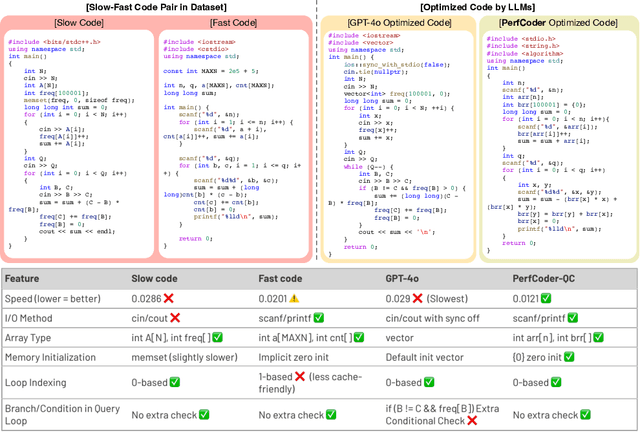
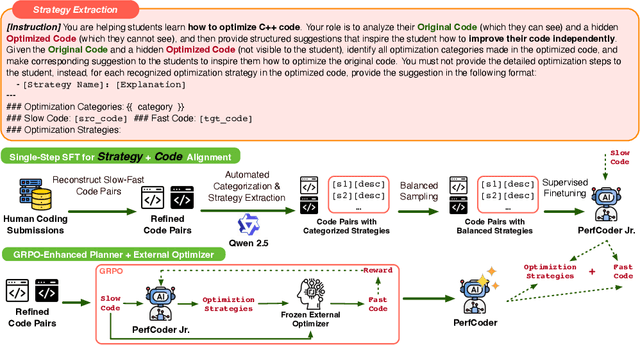
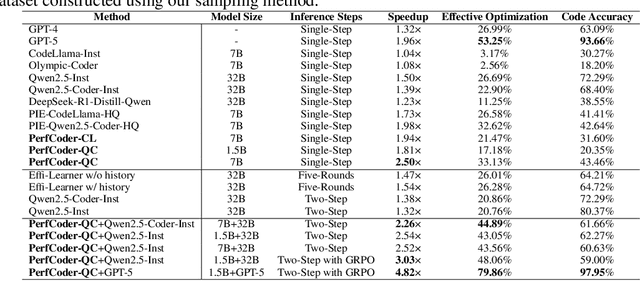
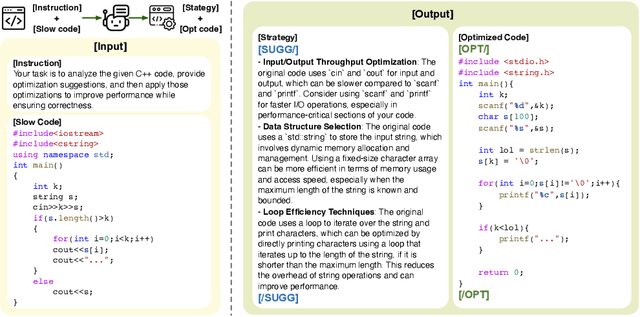
Large language models (LLMs) have achieved remarkable progress in automatic code generation, yet their ability to produce high-performance code remains limited--a critical requirement in real-world software systems. We argue that current LLMs struggle not only due to data scarcity but, more importantly, because they lack supervision that guides interpretable and effective performance improvements. In this work, we introduce PerfCoder, a family of LLMs specifically designed to generate performance-enhanced code from source code via interpretable, customized optimizations. PerfCoder is fine-tuned on a curated collection of real-world optimization trajectories with human-readable annotations, and preference-aligned by reinforcement fine-tuning using runtime measurements, enabling it to propose input-specific improvement strategies and apply them directly without relying on iterative refinement. On the PIE code performance benchmark, PerfCoder surpasses all existing models in both runtime speedup and effective optimization rate, demonstrating that performance optimization cannot be achieved by scale alone but requires optimization stratetgy awareness. In addition, PerfCoder can generate interpretable feedback about the source code, which, when provided as input to a larger LLM in a planner-and-optimizer cooperative workflow, can further improve outcomes. Specifically, we elevate the performance of 32B models and GPT-5 to new levels on code optimization, substantially surpassing their original performance.
rSIM: Incentivizing Reasoning Capabilities of LLMs via Reinforced Strategy Injection
Dec 09, 2025Large language models (LLMs) are post-trained through reinforcement learning (RL) to evolve into Reasoning Language Models (RLMs), where the hallmark of this advanced reasoning is ``aha'' moments when they start to perform strategies, such as self-reflection and deep thinking, within chain of thoughts (CoTs). Motivated by this, this paper proposes a novel reinforced strategy injection mechanism (rSIM), that enables any LLM to become an RLM by employing a small planner to guide the LLM's CoT through the adaptive injection of reasoning strategies. To achieve this, the planner (leader agent) is jointly trained with an LLM (follower agent) using multi-agent RL (MARL), based on a leader-follower framework and straightforward rule-based rewards. Experimental results show that rSIM enables Qwen2.5-0.5B to become an RLM and significantly outperform Qwen2.5-14B. Moreover, the planner is generalizable: it only needs to be trained once and can be applied as a plug-in to substantially improve the reasoning capabilities of existing LLMs. In addition, the planner supports continual learning across various tasks, allowing its planning abilities to gradually improve and generalize to a wider range of problems.
Re-ttention: Ultra Sparse Visual Generation via Attention Statistical Reshape
May 28, 2025Diffusion Transformers (DiT) have become the de-facto model for generating high-quality visual content like videos and images. A huge bottleneck is the attention mechanism where complexity scales quadratically with resolution and video length. One logical way to lessen this burden is sparse attention, where only a subset of tokens or patches are included in the calculation. However, existing techniques fail to preserve visual quality at extremely high sparsity levels and might even incur non-negligible compute overheads. % To address this concern, we propose Re-ttention, which implements very high sparse attention for visual generation models by leveraging the temporal redundancy of Diffusion Models to overcome the probabilistic normalization shift within the attention mechanism. Specifically, Re-ttention reshapes attention scores based on the prior softmax distribution history in order to preserve the visual quality of the full quadratic attention at very high sparsity levels. % Experimental results on T2V/T2I models such as CogVideoX and the PixArt DiTs demonstrate that Re-ttention requires as few as 3.1\% of the tokens during inference, outperforming contemporary methods like FastDiTAttn, Sparse VideoGen and MInference. Further, we measure latency to show that our method can attain over 45\% end-to-end % and over 92\% self-attention latency reduction on an H100 GPU at negligible overhead cost. Code available online here: \href{https://github.com/cccrrrccc/Re-ttention}{https://github.com/cccrrrccc/Re-ttention}
FP4DiT: Towards Effective Floating Point Quantization for Diffusion Transformers
Mar 19, 2025Diffusion Models (DM) have revolutionized the text-to-image visual generation process. However, the large computational cost and model footprint of DMs hinders practical deployment, especially on edge devices. Post-training quantization (PTQ) is a lightweight method to alleviate these burdens without the need for training or fine-tuning. While recent DM PTQ methods achieve W4A8 on integer-based PTQ, two key limitations remain: First, while most existing DM PTQ methods evaluate on classical DMs like Stable Diffusion XL, 1.5 or earlier, which use convolutional U-Nets, newer Diffusion Transformer (DiT) models like the PixArt series, Hunyuan and others adopt fundamentally different transformer backbones to achieve superior image synthesis. Second, integer (INT) quantization is prevailing in DM PTQ but doesn't align well with the network weight and activation distribution, while Floating-Point Quantization (FPQ) is still under-investigated, yet it holds the potential to better align the weight and activation distributions in low-bit settings for DiT. In response, we introduce FP4DiT, a PTQ method that leverages FPQ to achieve W4A6 quantization. Specifically, we extend and generalize the Adaptive Rounding PTQ technique to adequately calibrate weight quantization for FPQ and demonstrate that DiT activations depend on input patch data, necessitating robust online activation quantization techniques. Experimental results demonstrate that FP4DiT outperforms integer-based PTQ at W4A6 and W4A8 precision and generates convincing visual content on PixArt-$\alpha$, PixArt-$\Sigma$ and Hunyuan in terms of several T2I metrics such as HPSv2 and CLIP.