 Add to Chrome
 Add to Firefox
 Add to Edge
QCA: Query- and Content-Aware Keyframe Selection for Long Video Understanding
Jul 01, 2026
Video understanding is often plagued by severe temporal redundancy, where processing dense frame sequences is both semantically inefficient and computationally expensive. This challenge is further amplified when only a small subset of frames is truly relevant to the given query. In this paper, we propose a Query- and Content-Aware (QCA) keyframe selection framework that can select a compact yet information-rich set of frames from long videos. QCA first partitions the video into temporal segments and estimates the information contribution of each segment by jointly modeling query relevance and content deviation, and dynamically allocates keyframe budget to each segment. Within each segment, QCA anchors on the most query-relevant frame and iteratively incorporates additional frames to maximize diversity while maintaining high semantic relevance to the query. Crucially, our method requires no additional training and can be seamlessly integrated into existing Video-LLMs. Extensive experiments across multiple long video understanding benchmarks demonstrate that our proposed approach achieves state-of-the-art performance and has strong generalization ability. For instance, QCA achieves 67.8\% on LongVideoBench using 128 frames, while GPT-4o achieves 66.7\% using 256 frames. Our codes are available in \href{https://github.com/hktk07/QCA}{GitHub}.

Towards a Dynamic and Fixed-budget Memory Bank for Efficient Streaming Video Understanding
Jun 24, 2026Currently, streaming video understanding is still a daunting task for existing \emph{multimodal large language models} (MLLMs). Its difficulties not only lie in handling the ever-increasing video frames, but also in the unpredictability of future video content and input instructions. In this paper, we study this task from the perspective of constructing a dynamic but fixed-budget memory bank, and propose a novel and training-free approach termed \emph{\textbf{CausalMem}}. CausalMem is dedicated to constructing a dynamic visual memory update mechanism, thereby maximizing the amount of information in streaming video within a limited memory space, much like the human brain. In practice, CausalMem estimates the redundancy of visual tokens and updates the memory bank via an online semantic basis, which models the principal semantics of the observed video stream. To validate CausalMem, we apply it to two representative MLLMs, namely LLaVA-OneVision and Qwen2.5-VL respectively, and conduct extensive experiments on both streaming and offline video understanding benchmarks. The experimental results not only show the great advantages than existing methods under both streaming and offline settings, \emph{e.g.}, $+3.2\%$ and $+3.0\%$ average accuracy gains respectively, but also witness the superior semantic preservation for streaming videos, \emph{e.g.}, using 12$k$ token budgets to memorize hour-long streaming videos, which achieves more than \textbf{20$\times$} visual token compression ratio and only occupies about \textbf{82 MB} storage. \textbf{Our code} is given in \href{https://github.com/hktk07/CausalMem}{CausalMem}.
Towards Fast and Effective Long Video Understanding of Multimodal Large Language Models via Adaptive Quasi-Gaussian Sampling
Jun 24, 2026Long video understanding remains a daunting challenge for Multimodal Large Language Models (MLLMs) due to the excessive computation and memory footprint. Thus, keyframe selection is often adopted to mitigate this shortcoming, which however still suffers from low flexibility and high noise due to its hard sampling principle. In this paper, we define video frame selection as a problem of Quasi-Gaussian Sampling, and propose an adaptive and training-free approach termed AdaQ. Inspired by the 3-$σ$ rule of Gaussian distribution, the objective of AdaQ is to achieve the optimal 3-$σ$ interval for different examples, i.e., a smaller 3-$σ$ interval for the local query and a larger one for the global query, thereby facilitating robust and adaptive frame sampling. To validate AdaQ, we apply it to four MLLMs with three embedding models. The extensive experimental results not only show its obvious performance gains over the default MLLMs and the SOTA keyframe selection methods, e.g., helping Qwen3-VL-8B outperform GPT4o by 15.8% on average by using only 64 frames, but also confirm its superior robustness and high efficiency for long-video understanding, e.g., only 1 hyper-parameter needs to be set.
ForestPrune: High-ratio Visual Token Compression for Video Multimodal Large Language Models via Spatial-Temporal Forest Modeling
Mar 24, 2026Due to the great saving of computation and memory overhead, token compression has become a research hot-spot for MLLMs and achieved remarkable progress in image-language tasks. However, for the video, existing methods still fall short of high-ratio token compression. We attribute this shortcoming to the insufficient modeling of temporal and continual video content, and propose a novel and training-free token pruning method for video MLLMs, termed ForestPrune, which achieves effective and high-ratio pruning via Spatial-temporal Forest Modeling. In practice, ForestPrune construct token forests across video frames based on the semantic, spatial and temporal constraints, making an overall comprehension of videos. Afterwards, ForestPrune evaluates the importance of token trees and nodes based on tree depth and node roles, thereby obtaining a globally optimal pruning decision. To validate ForestPrune, we apply it to two representative video MLLMs, namely LLaVA-Video and LLaVA-OneVision, and conduct extensive experiments on a bunch of video benchmarks. The experimental results not only show the great effectiveness for video MLLMs, e.g., retaining 95.8% average accuracy while reducing 90% tokens for LLaVA-OneVision, but also show its superior performance and efficiency than the compared token compression methods, e.g., +10.1% accuracy on MLVU and -81.4% pruning time than FrameFusion on LLaVA-Video.
KTV: Keyframes and Key Tokens Selection for Efficient Training-Free Video LLMs
Feb 03, 2026Training-free video understanding leverages the strong image comprehension capabilities of pre-trained vision language models (VLMs) by treating a video as a sequence of static frames, thus obviating the need for costly video-specific training. However, this paradigm often suffers from severe visual redundancy and high computational overhead, especially when processing long videos. Crucially, existing keyframe selection strategies, especially those based on CLIP similarity, are prone to biases and may inadvertently overlook critical frames, resulting in suboptimal video comprehension. To address these significant challenges, we propose \textbf{KTV}, a novel two-stage framework for efficient and effective training-free video understanding. In the first stage, KTV performs question-agnostic keyframe selection by clustering frame-level visual features, yielding a compact, diverse, and representative subset of frames that mitigates temporal redundancy. In the second stage, KTV applies key visual token selection, pruning redundant or less informative tokens from each selected keyframe based on token importance and redundancy, which significantly reduces the number of tokens fed into the LLM. Extensive experiments on the Multiple-Choice VideoQA task demonstrate that KTV outperforms state-of-the-art training-free baselines while using significantly fewer visual tokens, \emph{e.g.}, only 504 visual tokens for a 60-min video with 10800 frames, achieving $44.8\%$ accuracy on the MLVU-Test benchmark. In particular, KTV also exceeds several training-based approaches on certain benchmarks.
Grounded Chain-of-Thought for Multimodal Large Language Models
Mar 17, 2025Despite great progress, existing multimodal large language models (MLLMs) are prone to visual hallucination, greatly impeding their trustworthy applications. In this paper, we study this problem from the perspective of visual-spatial reasoning, and propose a new learning task for MLLMs, termed Grounded Chain-of-Thought (GCoT). Different from recent visual CoT studies, which focus more on visual knowledge reasoning, GCoT is keen to helping MLLMs to recognize and ground the relevant visual cues step by step, thereby predicting the correct answer with grounding coordinates as the intuitive basis. To facilitate this task, we also carefully design and construct a dataset called multimodal grounded chain-of-thought (MM-GCoT) consisting of 24,022 GCoT examples for 5,033 images. Besides, a comprehensive consistency evaluation system is also introduced, including the metrics of answer accuracy, grounding accuracy and answer-grounding consistency. We further design and conduct a bunch of experiments on 12 advanced MLLMs, and reveal some notable findings: i. most MLLMs performs poorly on the consistency evaluation, indicating obvious visual hallucination; ii. visual hallucination is not directly related to the parameter size and general multimodal performance, i.e., a larger and stronger MLLM is not less affected by this issue. Lastly, we also demonstrate that the proposed dataset can help existing MLLMs to well cultivate their GCoT capability and reduce the inconsistent answering significantly. Moreover, their GCoT can be also generalized to exiting multimodal tasks, such as open-world QA and REC.
KALE-LM: Unleash The Power Of AI For Science Via Knowledge And Logic Enhanced Large Model
Sep 27, 2024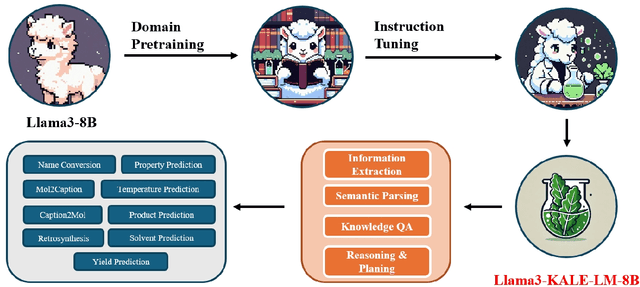
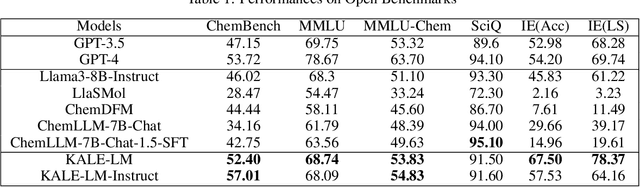
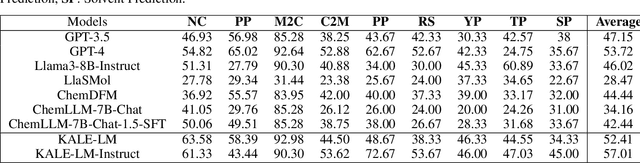
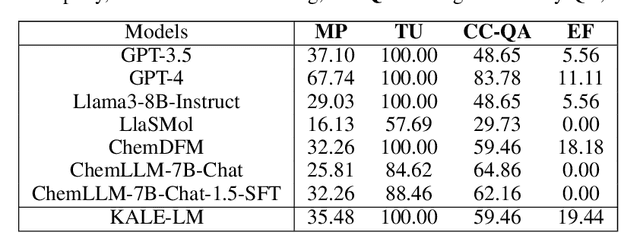
Artificial intelligence is gradually demonstrating its immense potential, and increasing attention is being given to how AI can be harnessed to advance scientific research. In this vision paper, we present our perspectives on how AI can better assist scientific inquiry and explore corresponding technical approach. We have proposed and open-sourced a large model of our KALE-LM model series, Llama3-KALE-LM-Chem-8B, which has achieved outstanding performance in tasks related to the field of chemistry. We hope that our work serves as a strong starting point, helping to realize more intelligent AI and promoting the advancement of human science and technology, as well as societal development.