 Add to Chrome
 Add to Firefox
 Add to Edge
Beyond Perplexity: A Geometric and Spectral Study of Low-Rank Pre-Training
May 13, 2026
Pre-training large language models is dominated by the memory cost of storing full-rank weights, gradients, and optimizer states. Low-rank pre-training has emerged to address this, and the space of methods has grown rapidly. A central question remains open: do low-rank methods produce models that generalize comparably to full-rank training, or does the rank constraint fundamentally alter the solutions reached? Existing comparisons rely almost entirely on validation perplexity from single-seed runs, often carried forward from prior literature. Yet perplexity is a poor proxy for solution quality; two methods can match on perplexity while converging to different loss landscape regions and internal representations. We close this gap by characterizing the solutions found by five low-rank pre-training methods, GaLore and Fira (memory-efficient optimizers), CoLA and SLTrain (architecture reparameterizations), and ReLoRA (adapter-style updates with periodic resets), against full-rank training at three model scales (60M, 130M, 350M). We evaluate each along 16 metrics across four dimensions: 1-D loss landscape along random/top-K PCA directions, 1-D interpolation between checkpoints, spectral structure of the weights and learned updates, and activation similarity to full-rank training. We show that low-rank methods are not equivalent to full-rank training, nor to one another, even when validation perplexity is close. Full-rank training settles into a sharper basin than low-rank methods along random directions, while the reverse holds for the top-1 PCA direction. Each method converges to a geometrically distinct basin. Low-rank activations diverge from full-rank in later layers as training progresses, with GaLore tracking full-rank most closely. Further, validation perplexity does not translate to downstream performance at every scale. Adding geometric and spectral metrics improves the prediction.

Adversarial Arena: Crowdsourcing Data Generation through Interactive Competition
Apr 20, 2026Post-training Large Language Models requires diverse, high-quality data which is rare and costly to obtain, especially in low resource domains and for multi-turn conversations. Common solutions are crowdsourcing or synthetic generation, but both often yield low-quality or low-diversity data. We introduce Adversarial Arena for building high quality conversational datasets by framing data generation as an adversarial task: attackers create prompts, and defenders generate responses. This interactive competition between multiple teams naturally produces diverse and complex data. We validated this approach by conducting a competition with 10 academic teams from top US and European universities, each building attacker or defender bots. The competition, focused on safety alignment of LLMs in cybersecurity, generated 19,683 multi-turn conversations. Fine-tuning an open-source model on this dataset produced an 18.47% improvement in secure code generation on CyberSecEval-Instruct and 29.42% improvement on CyberSecEval-MITRE.
Diverse, not Short: A Length-Controlled Self-Learning Framework for Improving Response Diversity of Language Models
May 22, 2025
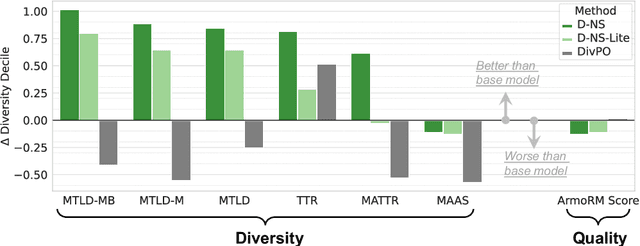
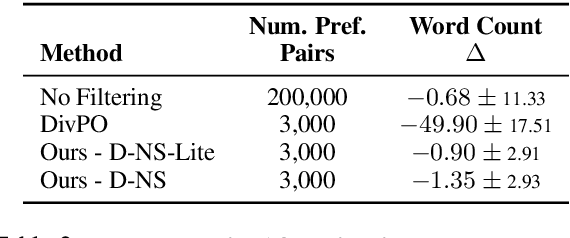
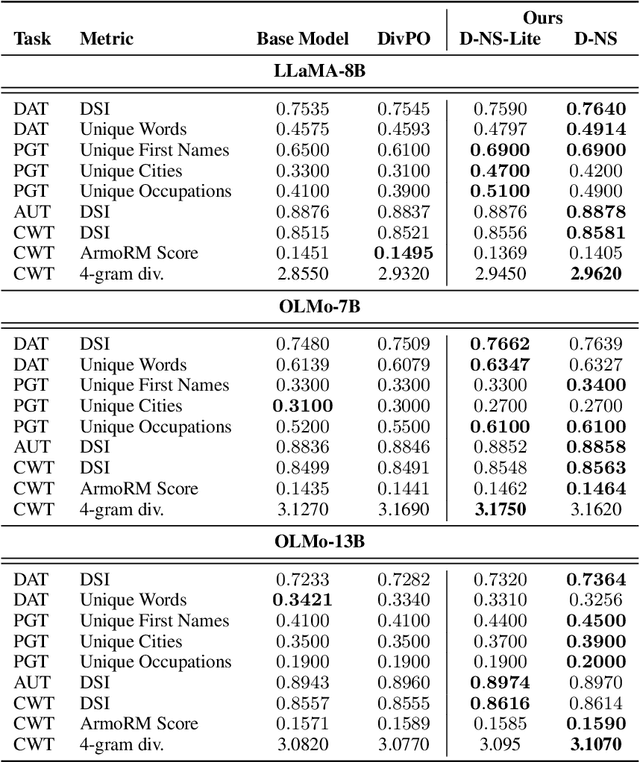
Diverse language model responses are crucial for creative generation, open-ended tasks, and self-improvement training. We show that common diversity metrics, and even reward models used for preference optimization, systematically bias models toward shorter outputs, limiting expressiveness. To address this, we introduce Diverse, not Short (Diverse-NS), a length-controlled self-learning framework that improves response diversity while maintaining length parity. By generating and filtering preference data that balances diversity, quality, and length, Diverse-NS enables effective training using only 3,000 preference pairs. Applied to LLaMA-3.1-8B and the Olmo-2 family, Diverse-NS substantially enhances lexical and semantic diversity. We show consistent improvement in diversity with minor reduction or gains in response quality on four creative generation tasks: Divergent Associations, Persona Generation, Alternate Uses, and Creative Writing. Surprisingly, experiments with the Olmo-2 model family (7B, and 13B) show that smaller models like Olmo-2-7B can serve as effective "diversity teachers" for larger models. By explicitly addressing length bias, our method efficiently pushes models toward more diverse and expressive outputs.
MergeME: Model Merging Techniques for Homogeneous and Heterogeneous MoEs
Feb 04, 2025

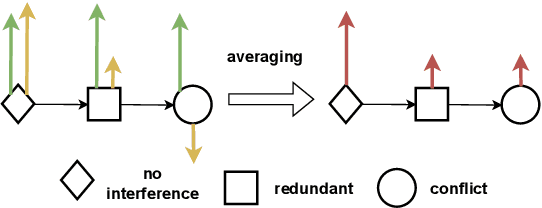
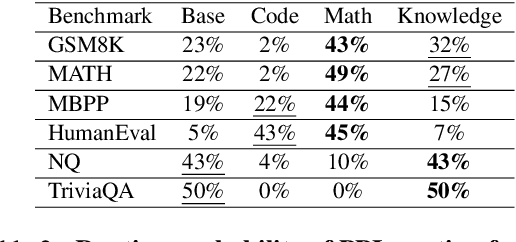
The recent success of specialized Large Language Models (LLMs) in domains such as mathematical reasoning and coding has led to growing interest in methods for merging these expert LLMs into a unified Mixture-of-Experts (MoE) model, with the goal of enhancing performance in each domain while retaining effectiveness on general tasks. However, the effective merging of expert models remains an open challenge, especially for models with highly divergent weight parameters or different architectures. State-of-the-art MoE merging methods only work with homogeneous model architectures and rely on simple unweighted averaging to merge expert layers, which does not address parameter interference and requires extensive fine-tuning of the merged MoE to restore performance. To address these limitations, this paper introduces new MoE merging techniques, including strategies to mitigate parameter interference, routing heuristics to reduce the need for MoE fine-tuning, and a novel method for merging experts with different architectures. Extensive experiments across multiple domains demonstrate the effectiveness of our proposed methods, reducing fine-tuning costs, improving performance over state-of-the-art methods, and expanding the applicability of MoE merging.
Emergent Abilities in Reduced-Scale Generative Language Models
Apr 02, 2024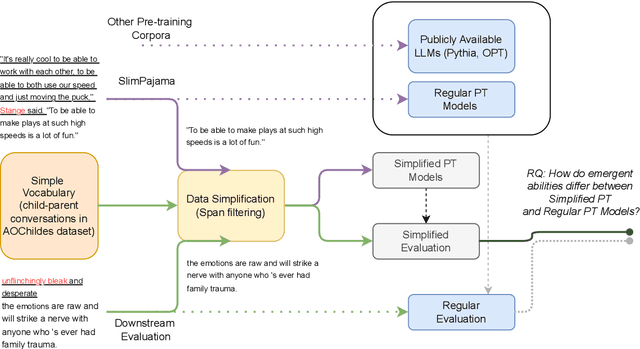
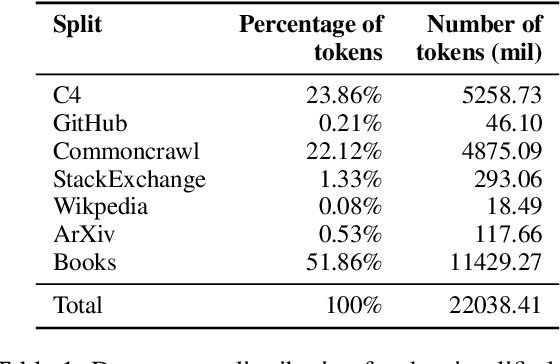
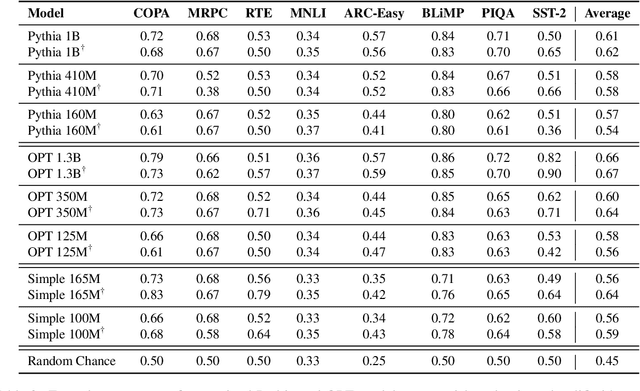
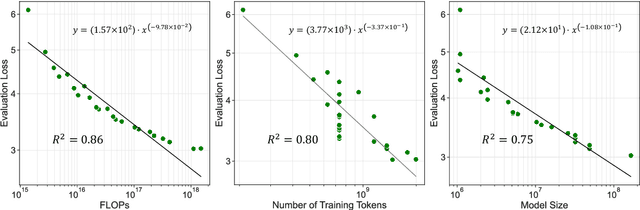
Large language models can solve new tasks without task-specific fine-tuning. This ability, also known as in-context learning (ICL), is considered an emergent ability and is primarily seen in large language models with billions of parameters. This study investigates if such emergent properties are strictly tied to model size or can be demonstrated by smaller models trained on reduced-scale data. To explore this, we simplify pre-training data and pre-train 36 causal language models with parameters varying from 1 million to 165 million parameters. We show that models trained on this simplified pre-training data demonstrate enhanced zero-shot capabilities across various tasks in simplified language, achieving performance comparable to that of pre-trained models six times larger on unrestricted language. This suggests that downscaling the language allows zero-shot learning capabilities to emerge in models with limited size. Additionally, we find that these smaller models pre-trained on simplified data demonstrate a power law relationship between the evaluation loss and the three scaling factors: compute, dataset size, and model size.
Deconstructing In-Context Learning: Understanding Prompts via Corruption
Apr 02, 2024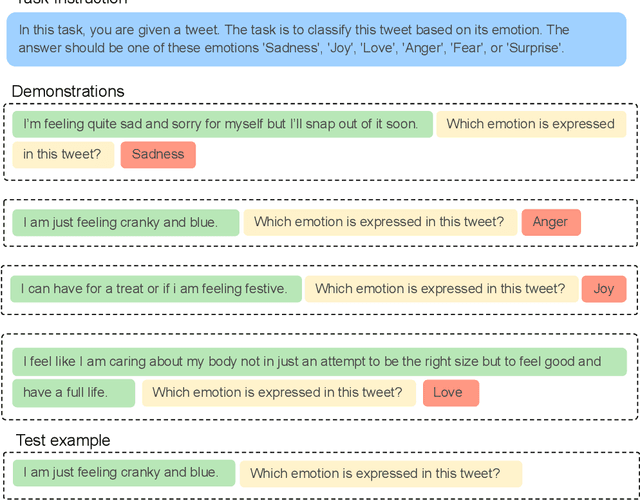
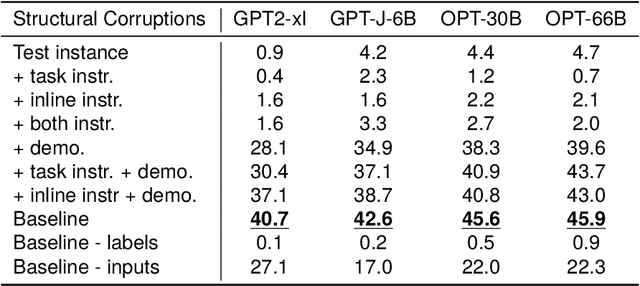
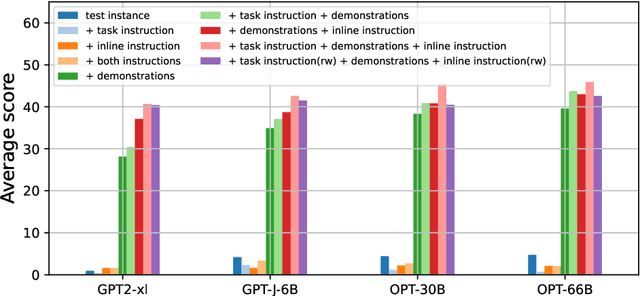
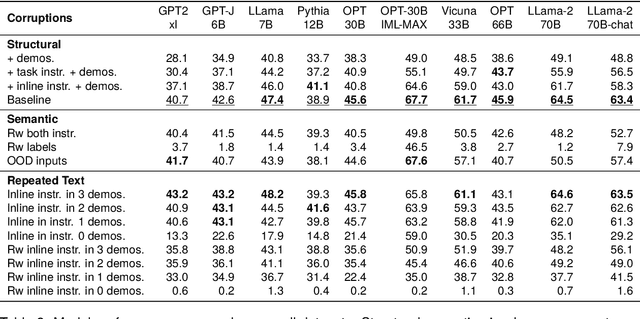
The ability of large language models (LLMs) to "learn in context" based on the provided prompt has led to an explosive growth in their use, culminating in the proliferation of AI assistants such as ChatGPT, Claude, and Bard. These AI assistants are known to be robust to minor prompt modifications, mostly due to alignment techniques that use human feedback. In contrast, the underlying pre-trained LLMs they use as a backbone are known to be brittle in this respect. Building high-quality backbone models remains a core challenge, and a common approach to assessing their quality is to conduct few-shot evaluation. Such evaluation is notorious for being highly sensitive to minor prompt modifications, as well as the choice of specific in-context examples. Prior work has examined how modifying different elements of the prompt can affect model performance. However, these earlier studies tended to concentrate on a limited number of specific prompt attributes and often produced contradictory results. Additionally, previous research either focused on models with fewer than 15 billion parameters or exclusively examined black-box models like GPT-3 or PaLM, making replication challenging. In the present study, we decompose the entire prompt into four components: task description, demonstration inputs, labels, and inline instructions provided for each demonstration. We investigate the effects of structural and semantic corruptions of these elements on model performance. We study models ranging from 1.5B to 70B in size, using ten datasets covering classification and generation tasks. We find that repeating text within the prompt boosts model performance, and bigger models ($\geq$30B) are more sensitive to the semantics of the prompt. Finally, we observe that adding task and inline instructions to the demonstrations enhances model performance even when the instructions are semantically corrupted.
Prompt Perturbation Consistency Learning for Robust Language Models
Feb 24, 2024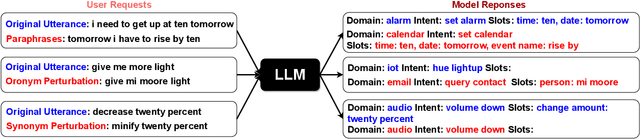
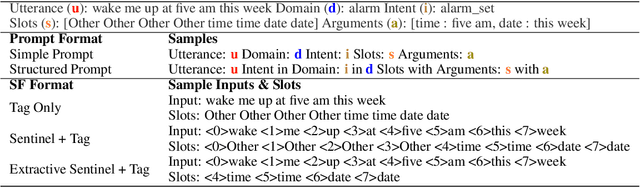
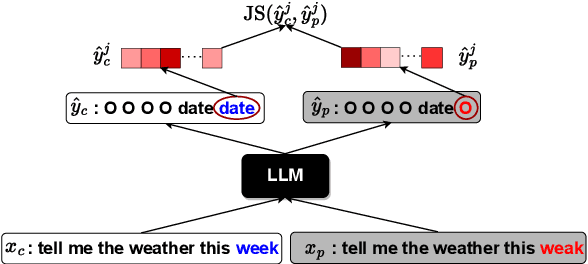

Large language models (LLMs) have demonstrated impressive performance on a number of natural language processing tasks, such as question answering and text summarization. However, their performance on sequence labeling tasks such as intent classification and slot filling (IC-SF), which is a central component in personal assistant systems, lags significantly behind discriminative models. Furthermore, there is a lack of substantive research on the robustness of LLMs to various perturbations in the input prompts. The contributions of this paper are three-fold. First, we show that fine-tuning sufficiently large LLMs can produce IC-SF performance comparable to discriminative models. Next, we systematically analyze the performance deterioration of those fine-tuned models due to three distinct yet relevant types of input perturbations - oronyms, synonyms, and paraphrasing. Finally, we propose an efficient mitigation approach, Prompt Perturbation Consistency Learning (PPCL), which works by regularizing the divergence between losses from clean and perturbed samples. Our experiments demonstrate that PPCL can recover on average 59% and 69% of the performance drop for IC and SF tasks, respectively. Furthermore, PPCL beats the data augmentation approach while using ten times fewer augmented data samples.
Let's Reinforce Step by Step
Nov 10, 2023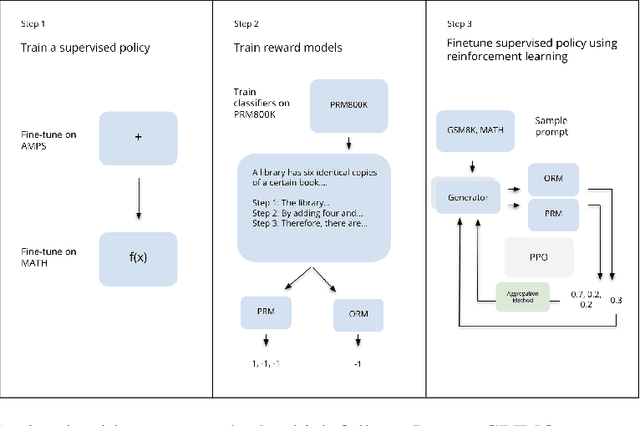
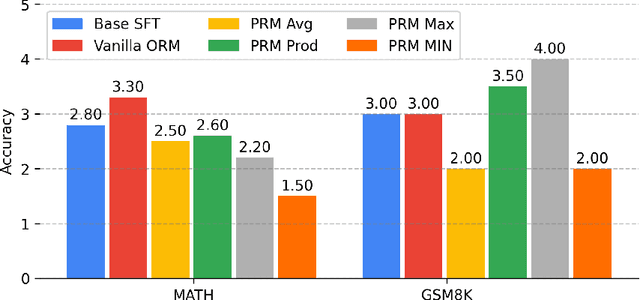
While recent advances have boosted LM proficiency in linguistic benchmarks, LMs consistently struggle to reason correctly on complex tasks like mathematics. We turn to Reinforcement Learning from Human Feedback (RLHF) as a method with which to shape model reasoning processes. In particular, we explore two reward schemes, outcome-supervised reward models (ORMs) and process-supervised reward models (PRMs), to optimize for logical reasoning. Our results show that the fine-grained reward provided by PRM-based methods enhances accuracy on simple mathematical reasoning (GSM8K) while, unexpectedly, reducing performance in complex tasks (MATH). Furthermore, we show the critical role reward aggregation functions play in model performance. Providing promising avenues for future research, our study underscores the need for further exploration into fine-grained reward modeling for more reliable language models.
Stack More Layers Differently: High-Rank Training Through Low-Rank Updates
Jul 13, 2023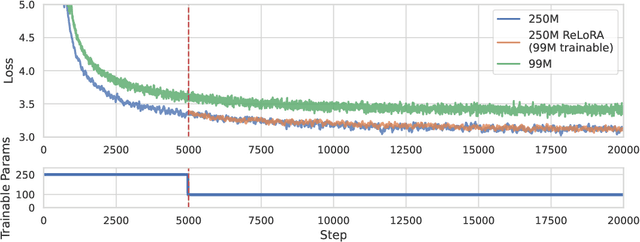
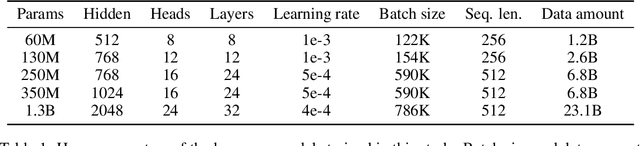
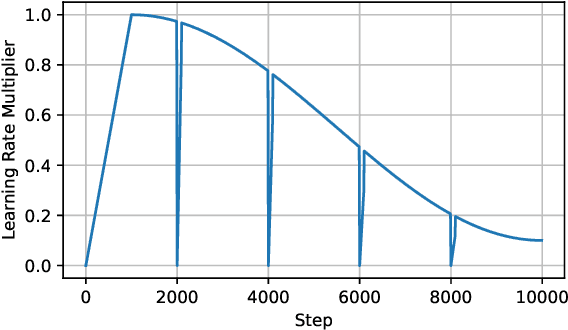
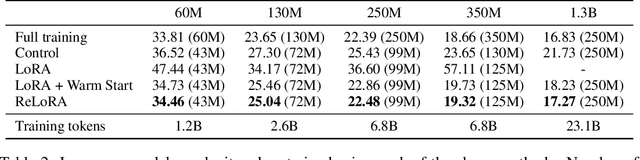
Despite the dominance and effectiveness of scaling, resulting in large networks with hundreds of billions of parameters, the necessity to train overparametrized models remains poorly understood, and alternative approaches do not necessarily make it cheaper to train high-performance models. In this paper, we explore low-rank training techniques as an alternative approach to training large neural networks. We introduce a novel method called ReLoRA, which utilizes low-rank updates to train high-rank networks. We apply ReLoRA to pre-training transformer language models with up to 350M parameters and demonstrate comparable performance to regular neural network training. Furthermore, we observe that the efficiency of ReLoRA increases with model size, making it a promising approach for training multi-billion-parameter networks efficiently. Our findings shed light on the potential of low-rank training techniques and their implications for scaling laws.
Recipes for Sequential Pre-training of Multilingual Encoder and Seq2Seq Models
Jun 14, 2023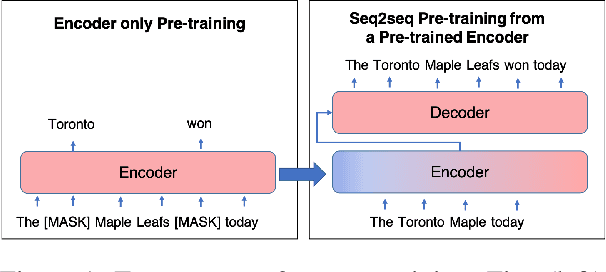
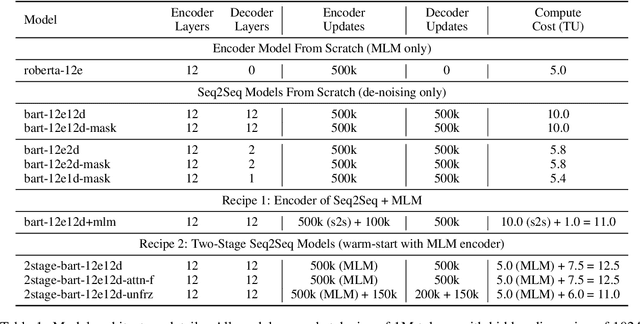
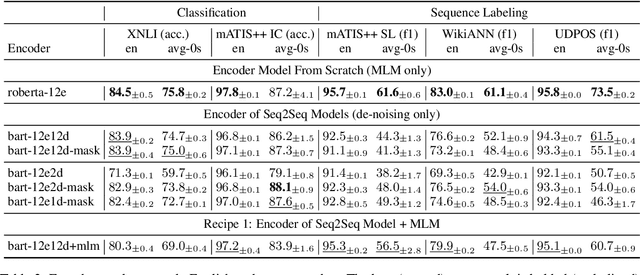
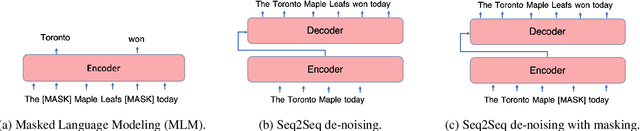
Pre-trained encoder-only and sequence-to-sequence (seq2seq) models each have advantages, however training both model types from scratch is computationally expensive. We explore recipes to improve pre-training efficiency by initializing one model from the other. (1) Extracting the encoder from a seq2seq model, we show it under-performs a Masked Language Modeling (MLM) encoder, particularly on sequence labeling tasks. Variations of masking during seq2seq training, reducing the decoder size, and continuing with a small amount of MLM training do not close the gap. (2) Conversely, using an encoder to warm-start seq2seq training, we show that by unfreezing the encoder partway through training, we can match task performance of a from-scratch seq2seq model. Overall, this two-stage approach is an efficient recipe to obtain both a multilingual encoder and a seq2seq model, matching the performance of training each model from scratch while reducing the total compute cost by 27%.