 Add to Chrome
 Add to Firefox
 Add to Edge
A Pre-Training Analogue of Grokking in Language Models: Tracing Delayed Grammatical Generalization
May 29, 2026
Grokking, the phenomenon in which neural networks generalize long after fitting their training data, has been studied in supervised settings on many epochs. LLM pre-training instead involves next-token prediction over an unlabeled corpus, with limited data repetition and no explicit train/validation split. To address this, we propose an exposure-based framework that enables the study of grokking-like dynamics during LLM pre-training. We ground our evaluation in BLiMP minimal pairs, which provide controlled grammatical contrasts. For every BLiMP minimal pair, we identify a critical phrase, the smallest continuous span that captures the grammatical contrast and the phenomenon-relevant context. Examples whose critical phrase appears in the pre-training window are assigned to the proxy-train split; the remaining examples are assigned to the proxy-validation split. Across five grammatical phenomena, we observe delayed generalization. Analyzing pre-training checkpoints before and after generalization shows that grammatical concept vectors become more predictive of grammatical acceptability and occupy a higher-dimensional subspace after generalization. We also find that attention from the critical token to the relevant context token is concentrated in a small number of heads.

Activation Steering for Synthetic Data Generation: The Role of Diversity in Downstream Safety Detection
May 27, 2026Safety detection models require examples of HHH (Helpful, Harmless, Honest)-violating outputs for robust generalization, however such examples are scarce. Activation Steering (AS) has emerged as a data-efficient method for generating target-concept-aligned responses. We investigate whether AS can generate high-quality training datasets for downstream classifiers, a question that remains untested. We present a two-fold study with intrinsic and extrinsic evaluation across $4$ concepts $\times\,2$ models $\times\,4$ steering methods. Intrinsically, beyond the field-standard rubric of steering success (concept alignment) and coherence, we introduce sample- and set-level diversity as a quality axis previously absent from the literature, and find that increasing steering strength reduces response diversity. Extrinsically, we replace HHH-violating examples in the available training data with steered generations and fine-tune detection classifiers. AS-generated data results in a better classifier than the prompting-generated data on $3$ of $4$ concepts. However, only $41$ of $136$ AS configurations outperform prompting, indicating that downstream utility lies in a narrow regime that jointly satisfies success, coherence, and diversity. The harmonic mean of these three axes correlates with downstream AUROC more consistently across concepts than success and coherence alone, providing a practical heuristic target for practitioners tuning AS hyperparameters. Together, our results highlight the potential of AS in synthetic data generation for improving safety detection and identify diversity as a critical, previously overlooked axis for tuning AS.
Playing with Words, Improving with Rewards: Training Language Models for Creative Association
May 27, 2026Large Language Models (LLMs) are being applied to increasingly difficult problems and use cases. To navigate their vast solution spaces effectively, LLMs need to be creative. Yet the subjective nature of creativity and the limits of human judgment make training LLMs for creativity especially challenging. As a solution, we train LLMs on Codenames, a word-association game that exercises the two central axes of creativity, divergent and convergent thinking, while yielding objectively verifiable outcomes. This verifiability lets us bypass human judgment and train with Reinforcement Learning with Verifiable Rewards (RLVR). We train Qwen3-1.7B, 4B, and 8B models and evaluate them on ten creativity and four reasoning benchmarks. We find that the precision-diversity trade-off is scale-dependent: the 8B model prioritizes creativity over precision, while the 1.7B and 4B models gain reasoning precision at the cost of creativity. Concretely, the 8B model shows modest but consistent creativity gains (8 of 10 benchmarks) with only minor reasoning degradation, whereas the smaller models achieve substantial gains on reasoning tasks. Our study presents a scalable and effective solution to train LLMs for creativity.
Beyond Perplexity: A Geometric and Spectral Study of Low-Rank Pre-Training
May 13, 2026Pre-training large language models is dominated by the memory cost of storing full-rank weights, gradients, and optimizer states. Low-rank pre-training has emerged to address this, and the space of methods has grown rapidly. A central question remains open: do low-rank methods produce models that generalize comparably to full-rank training, or does the rank constraint fundamentally alter the solutions reached? Existing comparisons rely almost entirely on validation perplexity from single-seed runs, often carried forward from prior literature. Yet perplexity is a poor proxy for solution quality; two methods can match on perplexity while converging to different loss landscape regions and internal representations. We close this gap by characterizing the solutions found by five low-rank pre-training methods, GaLore and Fira (memory-efficient optimizers), CoLA and SLTrain (architecture reparameterizations), and ReLoRA (adapter-style updates with periodic resets), against full-rank training at three model scales (60M, 130M, 350M). We evaluate each along 16 metrics across four dimensions: 1-D loss landscape along random/top-K PCA directions, 1-D interpolation between checkpoints, spectral structure of the weights and learned updates, and activation similarity to full-rank training. We show that low-rank methods are not equivalent to full-rank training, nor to one another, even when validation perplexity is close. Full-rank training settles into a sharper basin than low-rank methods along random directions, while the reverse holds for the top-1 PCA direction. Each method converges to a geometrically distinct basin. Low-rank activations diverge from full-rank in later layers as training progresses, with GaLore tracking full-rank most closely. Further, validation perplexity does not translate to downstream performance at every scale. Adding geometric and spectral metrics improves the prediction.
Diverse, not Short: A Length-Controlled Self-Learning Framework for Improving Response Diversity of Language Models
May 22, 2025
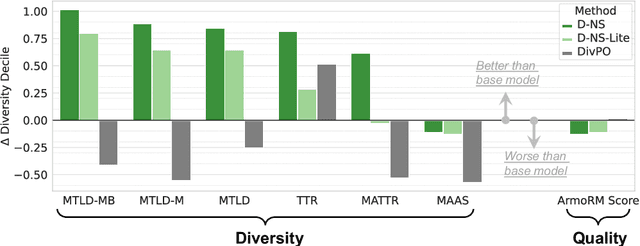
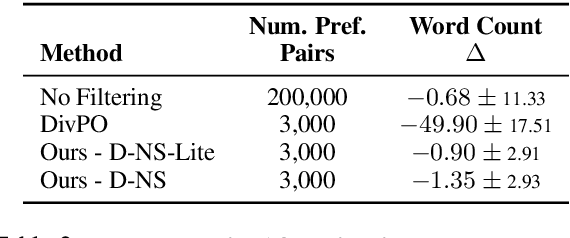
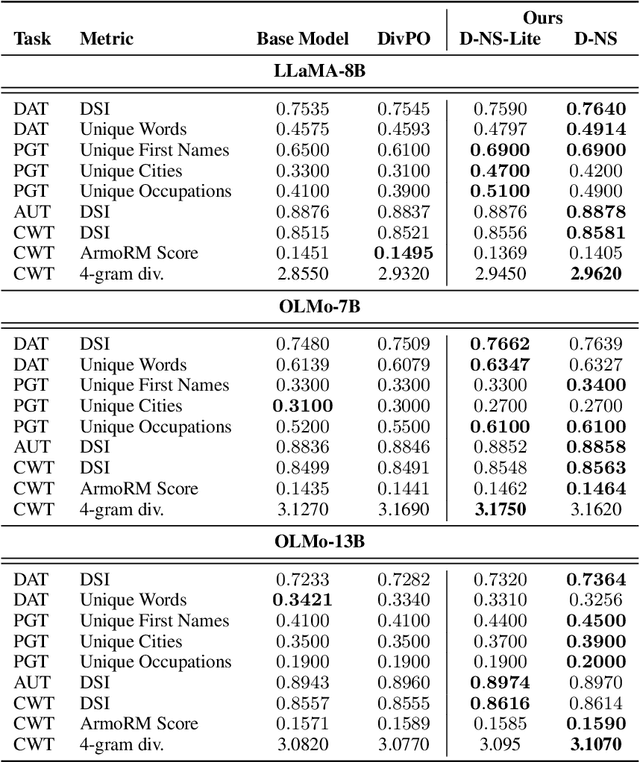
Diverse language model responses are crucial for creative generation, open-ended tasks, and self-improvement training. We show that common diversity metrics, and even reward models used for preference optimization, systematically bias models toward shorter outputs, limiting expressiveness. To address this, we introduce Diverse, not Short (Diverse-NS), a length-controlled self-learning framework that improves response diversity while maintaining length parity. By generating and filtering preference data that balances diversity, quality, and length, Diverse-NS enables effective training using only 3,000 preference pairs. Applied to LLaMA-3.1-8B and the Olmo-2 family, Diverse-NS substantially enhances lexical and semantic diversity. We show consistent improvement in diversity with minor reduction or gains in response quality on four creative generation tasks: Divergent Associations, Persona Generation, Alternate Uses, and Creative Writing. Surprisingly, experiments with the Olmo-2 model family (7B, and 13B) show that smaller models like Olmo-2-7B can serve as effective "diversity teachers" for larger models. By explicitly addressing length bias, our method efficiently pushes models toward more diverse and expressive outputs.
Emergent Abilities in Reduced-Scale Generative Language Models
Apr 02, 2024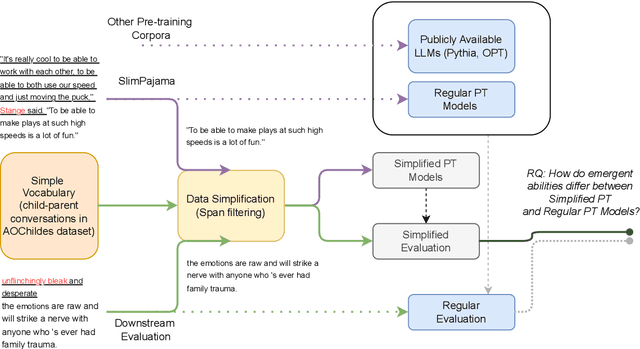
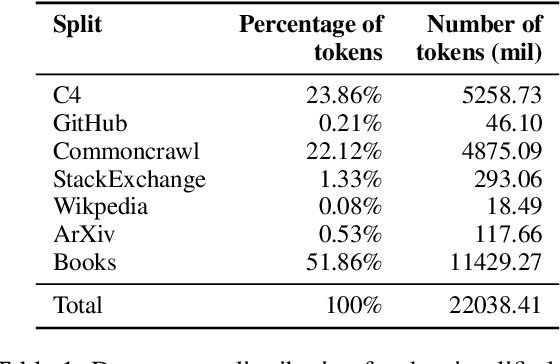
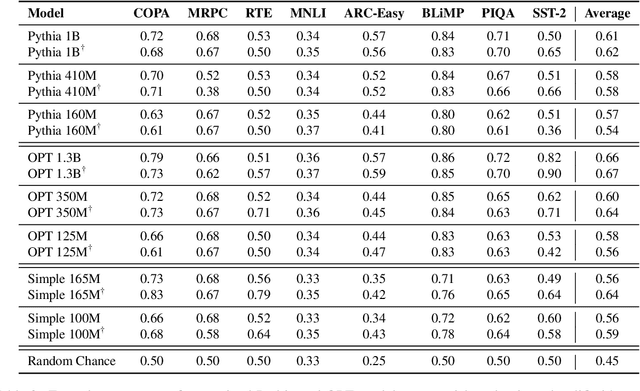
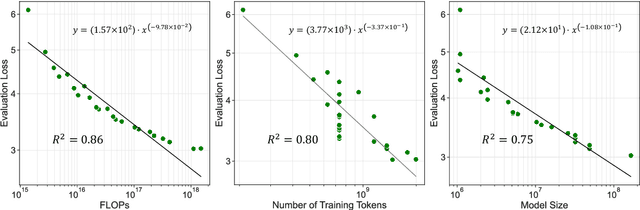
Large language models can solve new tasks without task-specific fine-tuning. This ability, also known as in-context learning (ICL), is considered an emergent ability and is primarily seen in large language models with billions of parameters. This study investigates if such emergent properties are strictly tied to model size or can be demonstrated by smaller models trained on reduced-scale data. To explore this, we simplify pre-training data and pre-train 36 causal language models with parameters varying from 1 million to 165 million parameters. We show that models trained on this simplified pre-training data demonstrate enhanced zero-shot capabilities across various tasks in simplified language, achieving performance comparable to that of pre-trained models six times larger on unrestricted language. This suggests that downscaling the language allows zero-shot learning capabilities to emerge in models with limited size. Additionally, we find that these smaller models pre-trained on simplified data demonstrate a power law relationship between the evaluation loss and the three scaling factors: compute, dataset size, and model size.
LocalTweets to LocalHealth: A Mental Health Surveillance Framework Based on Twitter Data
Feb 21, 2024Prior research on Twitter (now X) data has provided positive evidence of its utility in developing supplementary health surveillance systems. In this study, we present a new framework to surveil public health, focusing on mental health (MH) outcomes. We hypothesize that locally posted tweets are indicative of local MH outcomes and collect tweets posted from 765 neighborhoods (census block groups) in the USA. We pair these tweets from each neighborhood with the corresponding MH outcome reported by the Center for Disease Control (CDC) to create a benchmark dataset, LocalTweets. With LocalTweets, we present the first population-level evaluation task for Twitter-based MH surveillance systems. We then develop an efficient and effective method, LocalHealth, for predicting MH outcomes based on LocalTweets. When used with GPT3.5, LocalHealth achieves the highest F1-score and accuracy of 0.7429 and 79.78\%, respectively, a 59\% improvement in F1-score over the GPT3.5 in zero-shot setting. We also utilize LocalHealth to extrapolate CDC's estimates to proxy unreported neighborhoods, achieving an F1-score of 0.7291. Our work suggests that Twitter data can be effectively leveraged to simulate neighborhood-level MH outcomes.
Honey, I Shrunk the Language: Language Model Behavior at Reduced Scale
May 30, 2023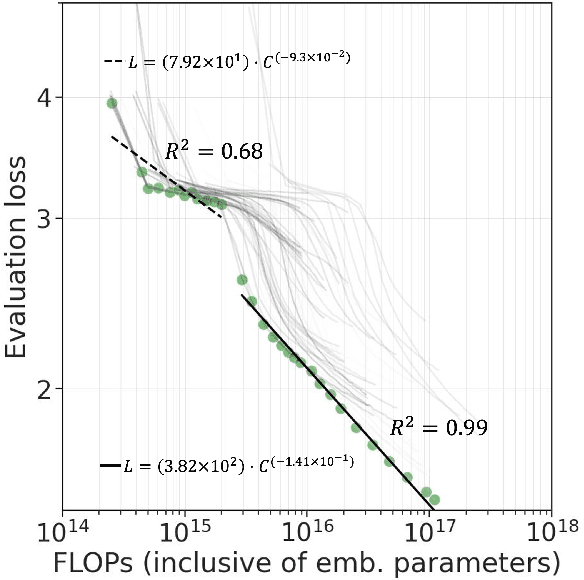
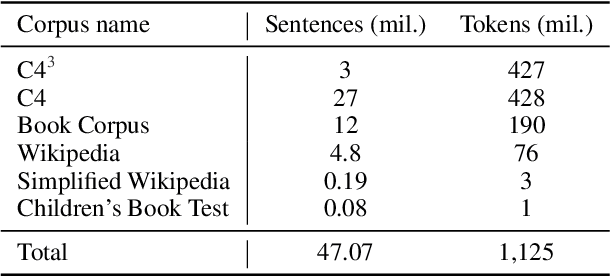

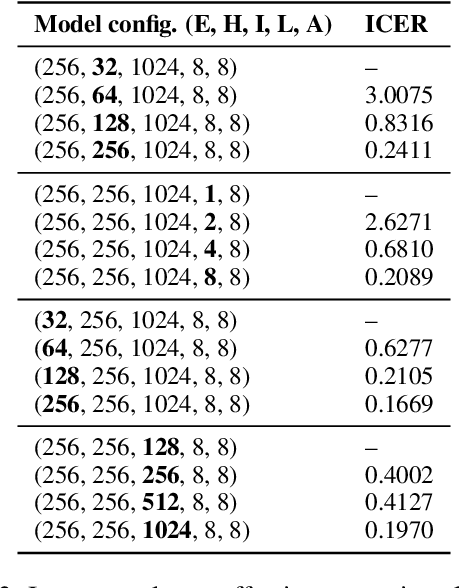
In recent years, language models have drastically grown in size, and the abilities of these models have been shown to improve with scale. The majority of recent scaling laws studies focused on high-compute high-parameter count settings, leaving the question of when these abilities begin to emerge largely unanswered. In this paper, we investigate whether the effects of pre-training can be observed when the problem size is reduced, modeling a smaller, reduced-vocabulary language. We show the benefits of pre-training with masked language modeling (MLM) objective in models as small as 1.25M parameters, and establish a strong correlation between pre-training perplexity and downstream performance (GLUE benchmark). We examine downscaling effects, extending scaling laws to models as small as ~1M parameters. At this scale, we observe a break of the power law for compute-optimal models and show that the MLM loss does not scale smoothly with compute-cost (FLOPs) below $2.2 \times 10^{15}$ FLOPs. We also find that adding layers does not always benefit downstream performance.
Scaling Down to Scale Up: A Guide to Parameter-Efficient Fine-Tuning
Mar 28, 2023

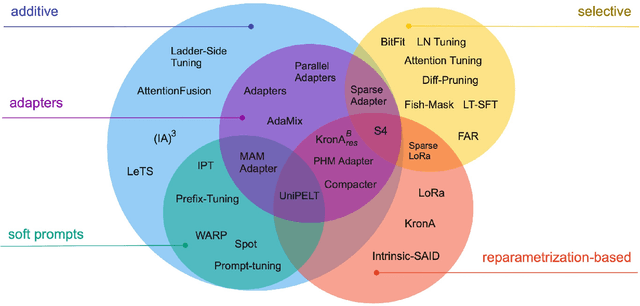
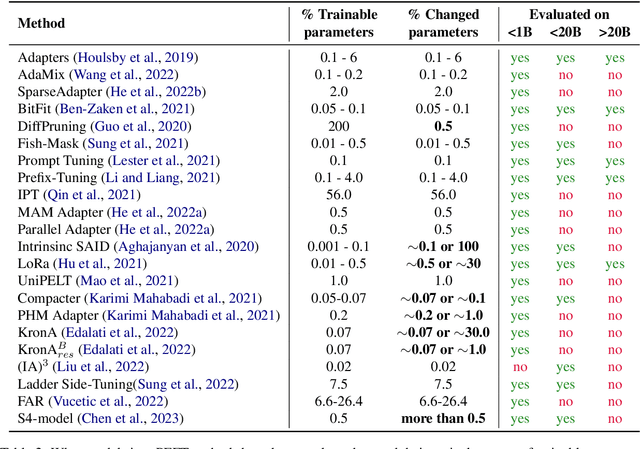
This paper presents a systematic overview and comparison of parameter-efficient fine-tuning methods covering over 40 papers published between February 2019 and February 2023. These methods aim to resolve the infeasibility and impracticality of fine-tuning large language models by only training a small set of parameters. We provide a taxonomy that covers a broad range of methods and present a detailed method comparison with a specific focus on real-life efficiency and fine-tuning multibillion-scale language models.