 Add to Chrome
 Add to Firefox
 Add to Edge
Do Medical Foundation Models Generalize on the African Brain?
Jul 30, 2026
Medical foundation models (FMs) are increasingly used for brain MRI analysis. However, their evaluation remains dominated by high-resource datasets, leaving generalization to African cohorts underexplored. We assess whether FMs generalize equally to African and non-African brain MRI data across two tasks: dementia classification using a Nigerian dataset and brain tumor segmentation using BraTS-Africa. We evaluate two generalist FMs (BrainIAC, 3DINO) and two segmentation-specific FMs (MedSAM2, Medical-SAM2) against a from-scratch baseline. For classification, FMs provide limited gains (highest ROC-AUC of 0.86 with BrainIAC), whereas for segmentation they consistently improve performance, reaching up to 0.86 Dice with MedSAM2. Performance differences between African and non-African cohorts are inconsistent and appear more related to dataset size than data origin. These results suggest that FMs do not exhibit an inherent bias against African cohorts, and highlight the limited availability and diversity of African neuroimaging datasets as the main barrier to robust evaluation and deployment.

Cross-Attention Multimodal Learning for Predicting Response to Neoadjuvant Imatinib in Gastrointestinal Stromal Tumors: A Multicenter Retrospective Study
Jun 24, 2026Background: Response to neoadjuvant imatinib in gastrointestinal stromal tumors (GISTs) is highly variable and cannot be reliably predicted using current clinical or molecular markers. This study developed and evaluated an explainable multimodal deep learning framework integrating computed tomography (CT) imaging and clinical variables to predict treatment response. Methods: Patients from four tertiary centers were retrospectively included between 2000-2023 in independent pretraining (n=935) and prediction (n=213) cohorts. A cross-attention framework integrating clinical variables and tumor-centered CT imaging was developed to predict response to neoadjuvant imatinib. Two training strategies were evaluated: (1) self-supervised pretraining with low-rank adaptation and (2) training from scratch. Hyperparameters were optimized using SMAC3. Performance was assessed through internal cross-validation and external testing. Ablation analyses and attention-based explanations were used to quantify modality contributions. Results: Among 213 patients (54.5% responders), responders had larger tumors (112 vs. 89 mm, P=0.026), higher mitotic index (3 vs. 0, P<0.001), and more frequent KIT mutations (69.0% vs. 56.7%, P=0.019). Cross-attention models achieved the highest internal performance (AUC up to 0.99) but lower external performance (AUC 0.60-0.63). Clinical-only performance was moderate (AUC 0.66), whereas imaging-only models showed limited generalizability (AUC 0.56-0.66). Explainability analyses identified significant differences in feature importance between responders and non-responders, including CD117, BRAF, PDGFRA, age, sex, disease status, and comorbidities (FDR-adjusted P<=0.036). Conclusion: The cross-attention framework shows potential for improving imatinib response prediction in GIST while providing interpretable insights into multimodal determinants of treatment response.
Automatic Extraction of Structured Information from Brain MRI Reports Using an Open-Weight Large Language Model
Jun 05, 2026Objectives: Automatic data extraction from free-text radiology reports enables large-scale research, but few studies assessed the performance of large language models (LLMs) on Dutch neuroradiology reports. Methods: We analyzed 947 brain MRI reports from a tertiary memory clinic (2016-2021), authored by consultant neuroradiologists. Trained medical students annotated thirty variables; 100 reports were double-annotated to assess inter-rater reliability. We evaluated the performance of the open-weight LLM LLaMA 3.1 using different languages (Dutch vs. English translation) and few-shot prompting with different example selection strategies. Performance was evaluated using balanced accuracy for categorical variables, accuracy and mean absolute error for counts, and text similarity for free-text. Metrics were computed across 10 random splits of the 947 reports. Results: LLaMA 3.1 demonstrated high zero-shot performance for visual rating scores (mean [95%-CI]): Medial Temporal Atrophy: 90% [77-100%] on the left and 96% [94-99%] on the right, Global Cortical Atrophy: 87% [83-91%], and Fazekas: 94% [93-96%]. Microbleed mentions were detected with 93% accuracy [92-95%] and infarct mentions with 82% [80-84%]. Text similarity for lesion location reached 0.95 [0.95-0.96]. Performance was lower for numerical variables: 80% [78-82%] for the number of microbleeds and 66% [63-68%] for infarcts. English translation yielded comparable results. Few-shot prompting improved performance for numerical variables, achieving 92% [90-93%] for microbleeds and 81% [77-85%] for infarcts using structural similarity-based selection. Conclusion: LLaMA 3.1 shows strong potential for extracting data from Dutch neuroradiology reports. Few-shot prompting enhances performance for numerical variables, whereas challenges remain for location-specific variables.
MedSapiens: Taking a Pose to Rethink Medical Imaging Landmark Detection
Nov 06, 2025This paper does not introduce a novel architecture; instead, it revisits a fundamental yet overlooked baseline: adapting human-centric foundation models for anatomical landmark detection in medical imaging. While landmark detection has traditionally relied on domain-specific models, the emergence of large-scale pre-trained vision models presents new opportunities. In this study, we investigate the adaptation of Sapiens, a human-centric foundation model designed for pose estimation, to medical imaging through multi-dataset pretraining, establishing a new state of the art across multiple datasets. Our proposed model, MedSapiens, demonstrates that human-centric foundation models, inherently optimized for spatial pose localization, provide strong priors for anatomical landmark detection, yet this potential has remained largely untapped. We benchmark MedSapiens against existing state-of-the-art models, achieving up to 5.26% improvement over generalist models and up to 21.81% improvement over specialist models in the average success detection rate (SDR). To further assess MedSapiens adaptability to novel downstream tasks with few annotations, we evaluate its performance in limited-data settings, achieving 2.69% improvement over the few-shot state of the art in SDR. Code and model weights are available at https://github.com/xmed-lab/MedSapiens .
Evaluating the Fairness of Neural Collapse in Medical Image Classification
Jul 08, 2024Deep learning has achieved impressive performance across various medical imaging tasks. However, its inherent bias against specific groups hinders its clinical applicability in equitable healthcare systems. A recently discovered phenomenon, Neural Collapse (NC), has shown potential in improving the generalization of state-of-the-art deep learning models. Nonetheless, its implications on bias in medical imaging remain unexplored. Our study investigates deep learning fairness through the lens of NC. We analyze the training dynamics of models as they approach NC when training using biased datasets, and examine the subsequent impact on test performance, specifically focusing on label bias. We find that biased training initially results in different NC configurations across subgroups, before converging to a final NC solution by memorizing all data samples. Through extensive experiments on three medical imaging datasets -- PAPILA, HAM10000, and CheXpert -- we find that in biased settings, NC can lead to a significant drop in F1 score across all subgroups. Our code is available at https://gitlab.com/radiology/neuro/neural-collapse-fairness
Large Intestine 3D Shape Refinement Using Point Diffusion Models for Digital Phantom Generation
Sep 15, 2023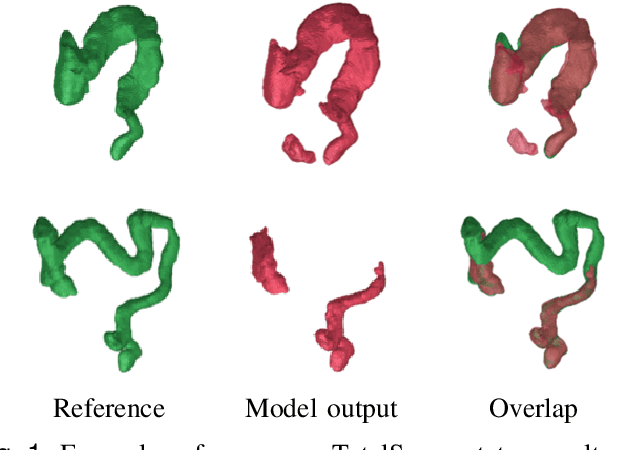
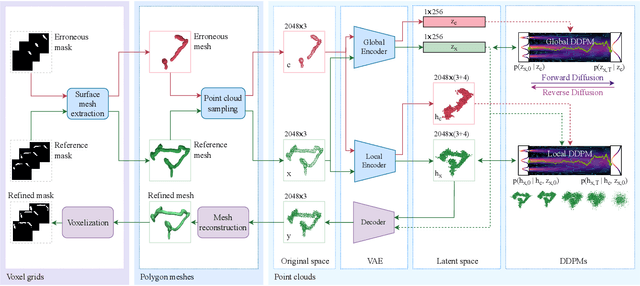
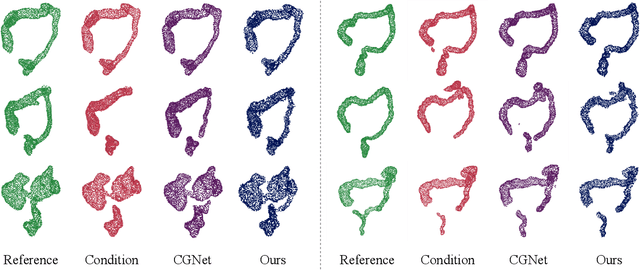
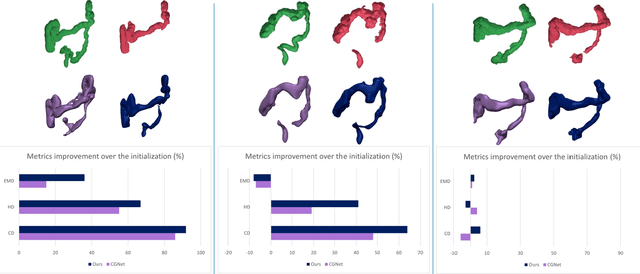
Accurate 3D modeling of human organs plays a crucial role in building computational phantoms for virtual imaging trials. However, generating anatomically plausible reconstructions of organ surfaces from computed tomography scans remains challenging for many structures in the human body. This challenge is particularly evident when dealing with the large intestine. In this study, we leverage recent advancements in geometric deep learning and denoising diffusion probabilistic models to refine the segmentation results of the large intestine. We begin by representing the organ as point clouds sampled from the surface of the 3D segmentation mask. Subsequently, we employ a hierarchical variational autoencoder to obtain global and local latent representations of the organ's shape. We train two conditional denoising diffusion models in the hierarchical latent space to perform shape refinement. To further enhance our method, we incorporate a state-of-the-art surface reconstruction model, allowing us to generate smooth meshes from the obtained complete point clouds. Experimental results demonstrate the effectiveness of our approach in capturing both the global distribution of the organ's shape and its fine details. Our complete refinement pipeline demonstrates remarkable enhancements in surface representation compared to the initial segmentation, reducing the Chamfer distance by 70%, the Hausdorff distance by 32%, and the Earth Mover's distance by 6%. By combining geometric deep learning, denoising diffusion models, and advanced surface reconstruction techniques, our proposed method offers a promising solution for accurately modeling the large intestine's surface and can easily be extended to other anatomical structures.