 Add to Chrome
 Add to Firefox
 Add to Edge
MedSapiens: Taking a Pose to Rethink Medical Imaging Landmark Detection
Nov 06, 2025
This paper does not introduce a novel architecture; instead, it revisits a fundamental yet overlooked baseline: adapting human-centric foundation models for anatomical landmark detection in medical imaging. While landmark detection has traditionally relied on domain-specific models, the emergence of large-scale pre-trained vision models presents new opportunities. In this study, we investigate the adaptation of Sapiens, a human-centric foundation model designed for pose estimation, to medical imaging through multi-dataset pretraining, establishing a new state of the art across multiple datasets. Our proposed model, MedSapiens, demonstrates that human-centric foundation models, inherently optimized for spatial pose localization, provide strong priors for anatomical landmark detection, yet this potential has remained largely untapped. We benchmark MedSapiens against existing state-of-the-art models, achieving up to 5.26% improvement over generalist models and up to 21.81% improvement over specialist models in the average success detection rate (SDR). To further assess MedSapiens adaptability to novel downstream tasks with few annotations, we evaluate its performance in limited-data settings, achieving 2.69% improvement over the few-shot state of the art in SDR. Code and model weights are available at https://github.com/xmed-lab/MedSapiens .

FD-SOS: Vision-Language Open-Set Detectors for Bone Fenestration and Dehiscence Detection from Intraoral Images
Jul 12, 2024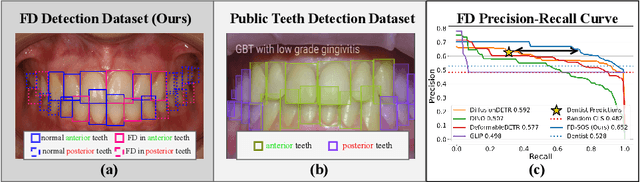
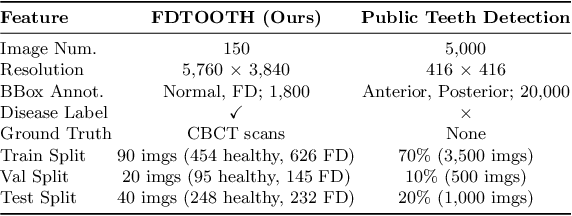
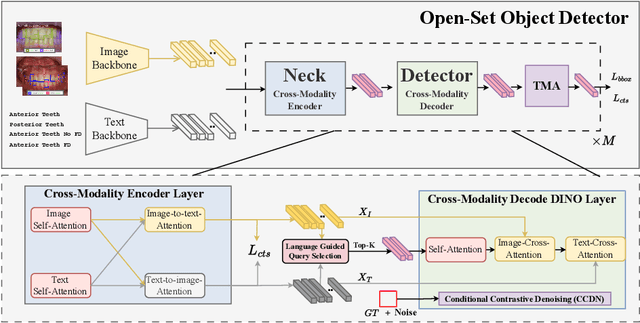
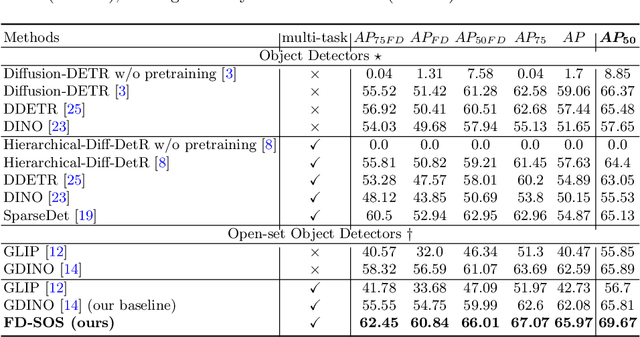
Accurate detection of bone fenestration and dehiscence (FD) is crucial for effective treatment planning in dentistry. While cone-beam computed tomography (CBCT) is the gold standard for evaluating FD, it comes with limitations such as radiation exposure, limited accessibility, and higher cost compared to intraoral images. In intraoral images, dentists face challenges in the differential diagnosis of FD. This paper presents a novel and clinically significant application of FD detection solely from intraoral images. To achieve this, we propose FD-SOS, a novel open-set object detector for FD detection from intraoral images. FD-SOS has two novel components: conditional contrastive denoising (CCDN) and teeth-specific matching assignment (TMA). These modules enable FD-SOS to effectively leverage external dental semantics. Experimental results showed that our method outperformed existing detection methods and surpassed dental professionals by 35% recall under the same level of precision. Code is available at: https://github.com/xmed-lab/FD-SOS.