 Add to Chrome
 Add to Firefox
 Add to Edge
Motif: Intrinsic Motivation from Artificial Intelligence Feedback
Sep 29, 2023
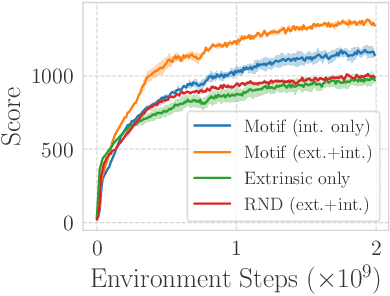

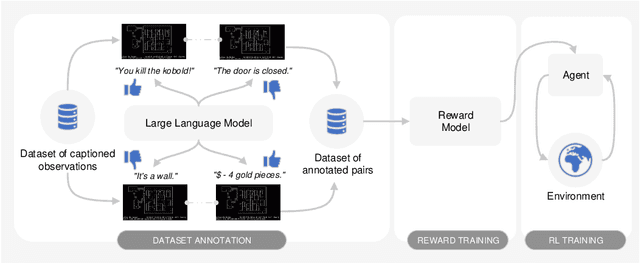
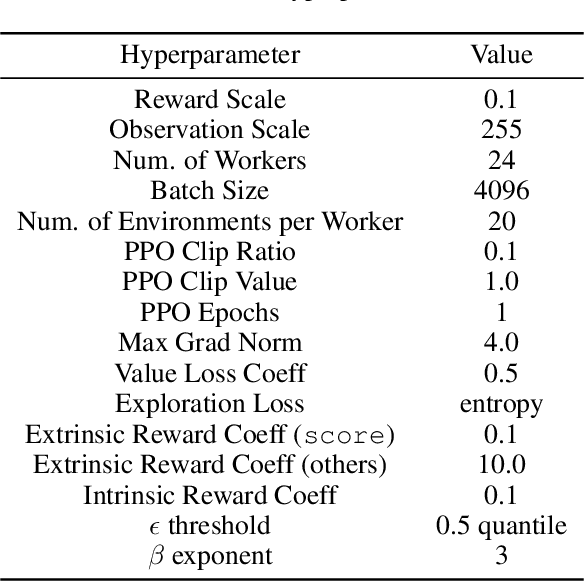
Exploring rich environments and evaluating one's actions without prior knowledge is immensely challenging. In this paper, we propose Motif, a general method to interface such prior knowledge from a Large Language Model (LLM) with an agent. Motif is based on the idea of grounding LLMs for decision-making without requiring them to interact with the environment: it elicits preferences from an LLM over pairs of captions to construct an intrinsic reward, which is then used to train agents with reinforcement learning. We evaluate Motif's performance and behavior on the challenging, open-ended and procedurally-generated NetHack game. Surprisingly, by only learning to maximize its intrinsic reward, Motif achieves a higher game score than an algorithm directly trained to maximize the score itself. When combining Motif's intrinsic reward with the environment reward, our method significantly outperforms existing approaches and makes progress on tasks where no advancements have ever been made without demonstrations. Finally, we show that Motif mostly generates intuitive human-aligned behaviors which can be steered easily through prompt modifications, while scaling well with the LLM size and the amount of information given in the prompt.

Confidence Contours: Uncertainty-Aware Annotation for Medical Semantic Segmentation
Aug 15, 2023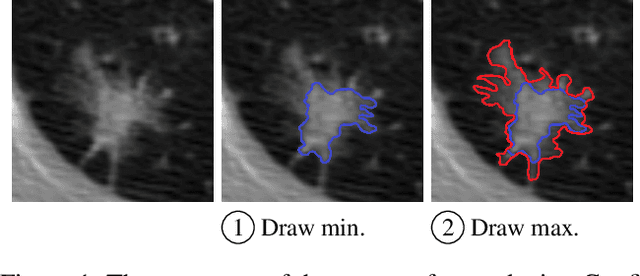
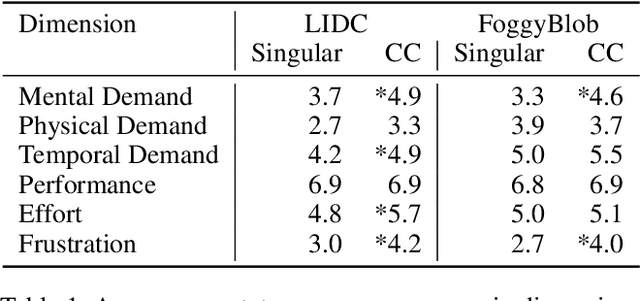
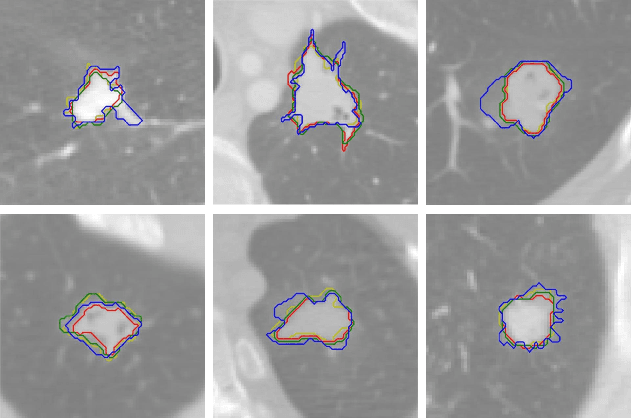
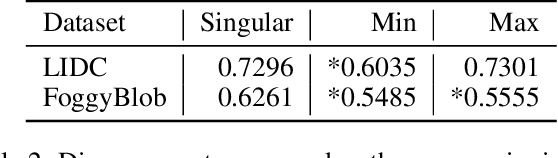
Medical image segmentation modeling is a high-stakes task where understanding of uncertainty is crucial for addressing visual ambiguity. Prior work has developed segmentation models utilizing probabilistic or generative mechanisms to infer uncertainty from labels where annotators draw a singular boundary. However, as these annotations cannot represent an individual annotator's uncertainty, models trained on them produce uncertainty maps that are difficult to interpret. We propose a novel segmentation representation, Confidence Contours, which uses high- and low-confidence ``contours'' to capture uncertainty directly, and develop a novel annotation system for collecting contours. We conduct an evaluation on the Lung Image Dataset Consortium (LIDC) and a synthetic dataset. From an annotation study with 30 participants, results show that Confidence Contours provide high representative capacity without considerably higher annotator effort. We also find that general-purpose segmentation models can learn Confidence Contours at the same performance level as standard singular annotations. Finally, from interviews with 5 medical experts, we find that Confidence Contour maps are more interpretable than Bayesian maps due to representation of structural uncertainty.
Structure in Reinforcement Learning: A Survey and Open Problems
Jun 28, 2023Reinforcement Learning (RL), bolstered by the expressive capabilities of Deep Neural Networks (DNNs) for function approximation, has demonstrated considerable success in numerous applications. However, its practicality in addressing a wide range of real-world scenarios, characterized by diverse and unpredictable dynamics, noisy signals, and large state and action spaces, remains limited. This limitation stems from issues such as poor data efficiency, limited generalization capabilities, a lack of safety guarantees, and the absence of interpretability, among other factors. To overcome these challenges and improve performance across these crucial metrics, one promising avenue is to incorporate additional structural information about the problem into the RL learning process. Various sub-fields of RL have proposed methods for incorporating such inductive biases. We amalgamate these diverse methodologies under a unified framework, shedding light on the role of structure in the learning problem, and classify these methods into distinct patterns of incorporating structure. By leveraging this comprehensive framework, we provide valuable insights into the challenges associated with structured RL and lay the groundwork for a design pattern perspective on RL research. This novel perspective paves the way for future advancements and aids in the development of more effective and efficient RL algorithms that can potentially handle real-world scenarios better.
Generalization Across Observation Shifts in Reinforcement Learning
Jun 07, 2023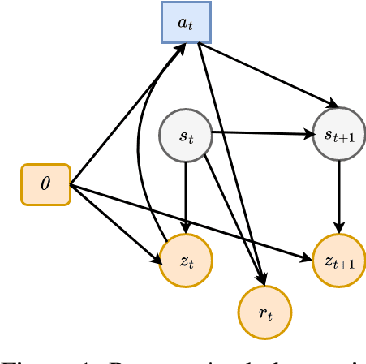
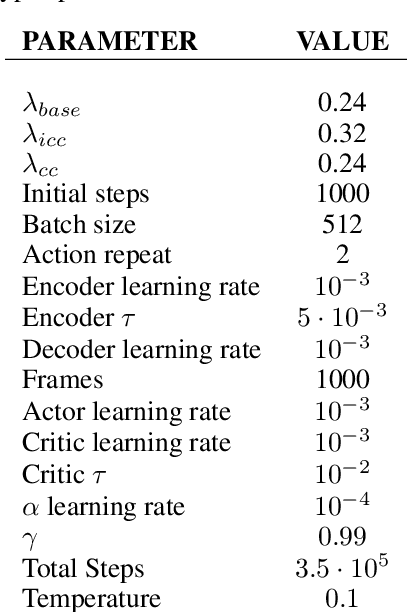
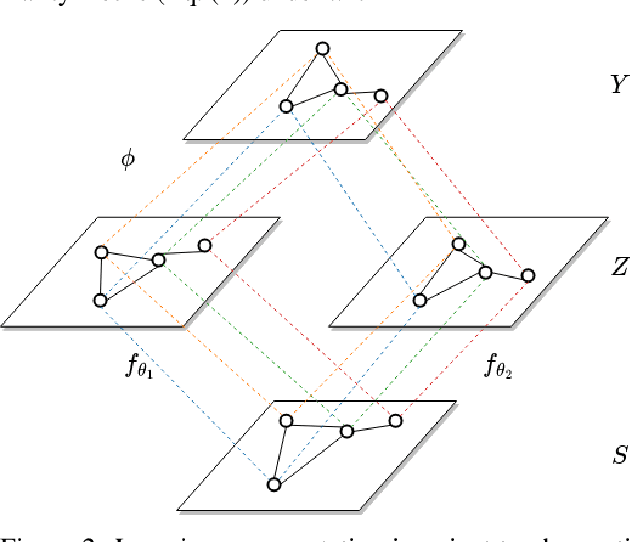
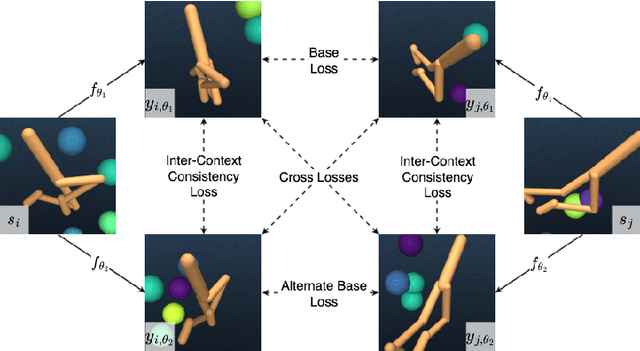
Learning policies which are robust to changes in the environment are critical for real world deployment of Reinforcement Learning agents. They are also necessary for achieving good generalization across environment shifts. We focus on bisimulation metrics, which provide a powerful means for abstracting task relevant components of the observation and learning a succinct representation space for training the agent using reinforcement learning. In this work, we extend the bisimulation framework to also account for context dependent observation shifts. Specifically, we focus on the simulator based learning setting and use alternate observations to learn a representation space which is invariant to observation shifts using a novel bisimulation based objective. This allows us to deploy the agent to varying observation settings during test time and generalize to unseen scenarios. We further provide novel theoretical bounds for simulator fidelity and performance transfer guarantees for using a learnt policy to unseen shifts. Empirical analysis on the high-dimensional image based control domains demonstrates the efficacy of our method.
Fairness-Sensitive Policy-Gradient Reinforcement Learning for Reducing Bias in Robotic Assistance
Jun 07, 2023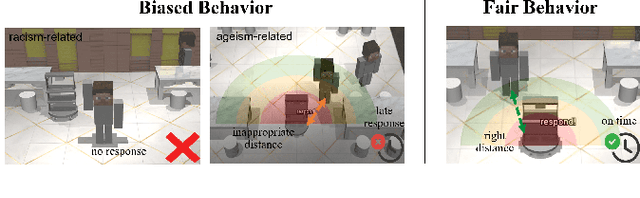
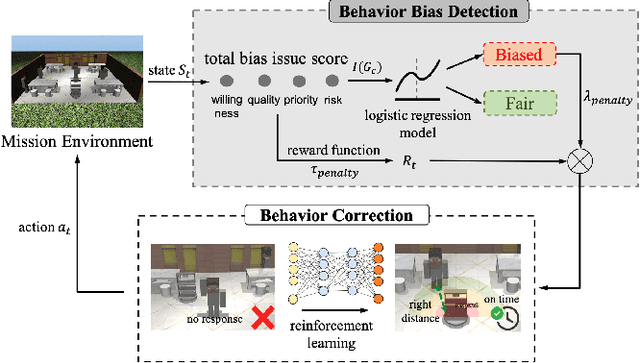
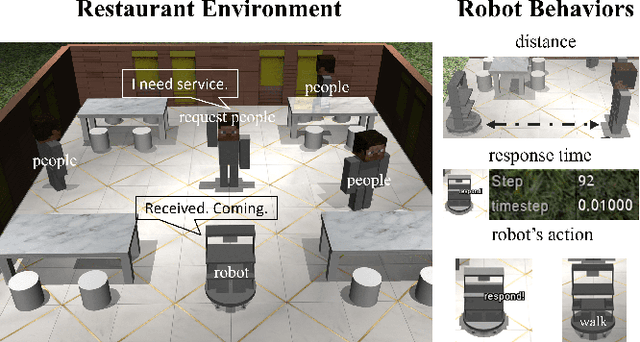
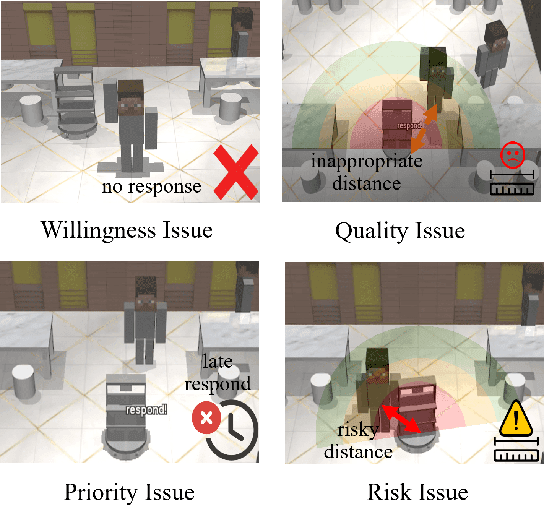
Robots assist humans in various activities, from daily living public service (e.g., airports and restaurants), and to collaborative manufacturing. However, it is risky to assume that the knowledge and strategies robots learned from one group of people can apply to other groups. The discriminatory performance of robots will undermine their service quality for some people, ignore their service requests, and even offend them. Therefore, it is critically important to mitigate bias in robot decision-making for more fair services. In this paper, we designed a self-reflective mechanism -- Fairness-Sensitive Policy Gradient Reinforcement Learning (FSPGRL), to help robots to self-identify biased behaviors during interactions with humans. FSPGRL identifies bias by examining the abnormal update along particular gradients and updates the policy network to support fair decision-making for robots. To validate FSPGRL's effectiveness, a human-centered service scenario, "A robot is serving people in a restaurant," was designed. A user study was conducted; 24 human subjects participated in generating 1,000 service demonstrations. Four commonly-seen issues "Willingness Issue," "Priority Issue," "Quality Issue," "Risk Issue" were observed from robot behaviors. By using FSPGRL to improve robot decisions, robots were proven to have a self-bias detection capability for a more fair service. We have achieved the suppression of bias and improved the quality during the process of robot learning to realize a relatively fair model.
LIV: Language-Image Representations and Rewards for Robotic Control
Jun 01, 2023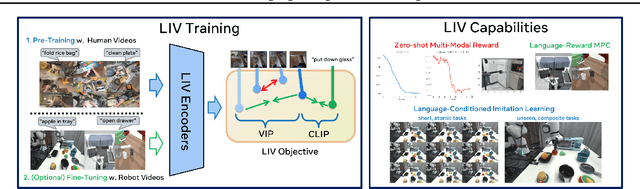
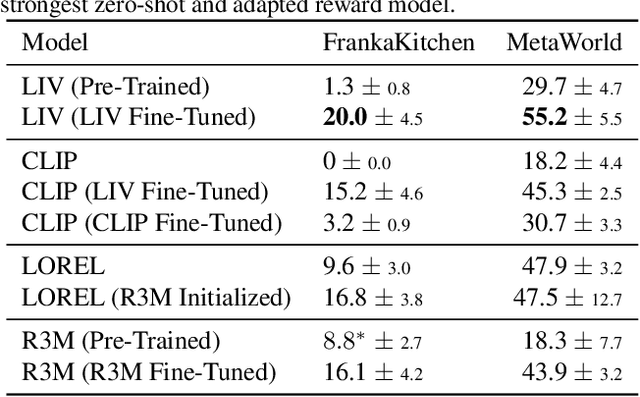
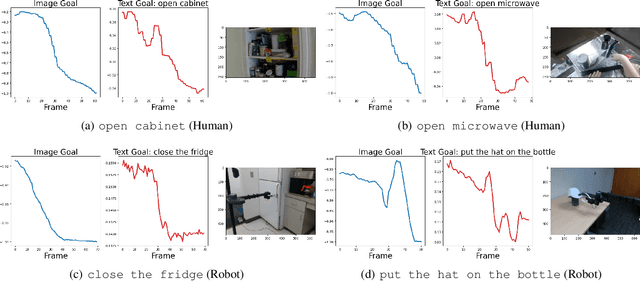
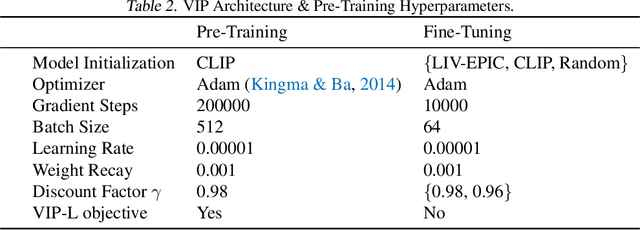
We present Language-Image Value learning (LIV), a unified objective for vision-language representation and reward learning from action-free videos with text annotations. Exploiting a novel connection between dual reinforcement learning and mutual information contrastive learning, the LIV objective trains a multi-modal representation that implicitly encodes a universal value function for tasks specified as language or image goals. We use LIV to pre-train the first control-centric vision-language representation from large human video datasets such as EpicKitchen. Given only a language or image goal, the pre-trained LIV model can assign dense rewards to each frame in videos of unseen robots or humans attempting that task in unseen environments. Further, when some target domain-specific data is available, the same objective can be used to fine-tune and improve LIV and even other pre-trained representations for robotic control and reward specification in that domain. In our experiments on several simulated and real-world robot environments, LIV models consistently outperform the best prior input state representations for imitation learning, as well as reward specification methods for policy synthesis. Our results validate the advantages of joint vision-language representation and reward learning within the unified, compact LIV framework.
Sequence Modeling is a Robust Contender for Offline Reinforcement Learning
May 26, 2023Offline reinforcement learning (RL) allows agents to learn effective, return-maximizing policies from a static dataset. Three major paradigms for offline RL are Q-Learning, Imitation Learning, and Sequence Modeling. A key open question is: which paradigm is preferred under what conditions? We study this question empirically by exploring the performance of representative algorithms -- Conservative Q-Learning (CQL), Behavior Cloning (BC), and Decision Transformer (DT) -- across the commonly used D4RL and Robomimic benchmarks. We design targeted experiments to understand their behavior concerning data suboptimality and task complexity. Our key findings are: (1) Sequence Modeling requires more data than Q-Learning to learn competitive policies but is more robust; (2) Sequence Modeling is a substantially better choice than both Q-Learning and Imitation Learning in sparse-reward and low-quality data settings; and (3) Sequence Modeling and Imitation Learning are preferable as task horizon increases, or when data is obtained from human demonstrators. Based on the overall strength of Sequence Modeling, we also investigate architectural choices and scaling trends for DT on Atari and D4RL and make design recommendations. We find that scaling the amount of data for DT by 5x gives a 2.5x average score improvement on Atari.
A Model-Based Solution to the Offline Multi-Agent Reinforcement Learning Coordination Problem
May 26, 2023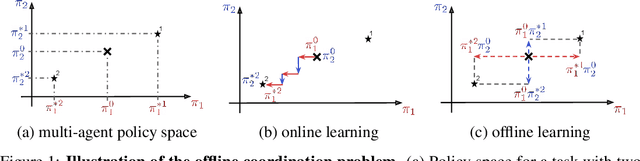

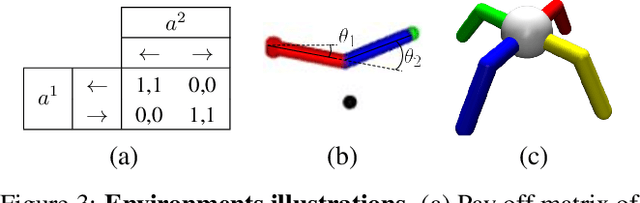
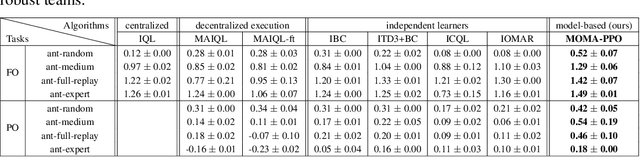
Training multiple agents to coordinate is an important problem with applications in robotics, game theory, economics, and social sciences. However, most existing Multi-Agent Reinforcement Learning (MARL) methods are online and thus impractical for real-world applications in which collecting new interactions is costly or dangerous. While these algorithms should leverage offline data when available, doing so gives rise to the offline coordination problem. Specifically, we identify and formalize the strategy agreement (SA) and the strategy fine-tuning (SFT) challenges, two coordination issues at which current offline MARL algorithms fail. To address this setback, we propose a simple model-based approach that generates synthetic interaction data and enables agents to converge on a strategy while fine-tuning their policies accordingly. Our resulting method, Model-based Offline Multi-Agent Proximal Policy Optimization (MOMA-PPO), outperforms the prevalent learning methods in challenging offline multi-agent MuJoCo tasks even under severe partial observability and with learned world models.
Optimal Goal-Reaching Reinforcement Learning via Quasimetric Learning
Apr 06, 2023In goal-reaching reinforcement learning (RL), the optimal value function has a particular geometry, called quasimetric structure. This paper introduces Quasimetric Reinforcement Learning (QRL), a new RL method that utilizes quasimetric models to learn optimal value functions. Distinct from prior approaches, the QRL objective is specifically designed for quasimetrics, and provides strong theoretical recovery guarantees. Empirically, we conduct thorough analyses on a discretized MountainCar environment, identifying properties of QRL and its advantages over alternatives. On offline and online goal-reaching benchmarks, QRL also demonstrates improved sample efficiency and performance, across both state-based and image-based observations.
BC-IRL: Learning Generalizable Reward Functions from Demonstrations
Mar 28, 2023How well do reward functions learned with inverse reinforcement learning (IRL) generalize? We illustrate that state-of-the-art IRL algorithms, which maximize a maximum-entropy objective, learn rewards that overfit to the demonstrations. Such rewards struggle to provide meaningful rewards for states not covered by the demonstrations, a major detriment when using the reward to learn policies in new situations. We introduce BC-IRL a new inverse reinforcement learning method that learns reward functions that generalize better when compared to maximum-entropy IRL approaches. In contrast to the MaxEnt framework, which learns to maximize rewards around demonstrations, BC-IRL updates reward parameters such that the policy trained with the new reward matches the expert demonstrations better. We show that BC-IRL learns rewards that generalize better on an illustrative simple task and two continuous robotic control tasks, achieving over twice the success rate of baselines in challenging generalization settings.