 Add to Chrome
 Add to Firefox
 Add to Edge
TREK: Distill to Explore, Reinforce to Refine
Jul 06, 2026
Group Relative Policy Optimization (GRPO) is effective when the current policy already samples useful reasoning trajectories, but it stalls on hard prompts whose correct solution modes lie outside the student's on-policy support. We propose TREK (Teacher-Routed Exploration via Forward KL), a simple staged procedure that uses distillation not for imitation but for exploration support expansion. A key advantage of TREK is its generality: because it only consumes verified output trajectories, it can use an external black-box teacher, a white-box teacher, or the same model given additional inference-time context, and it can efficiently identify which hard-prompt samples are most worth consolidating even when teacher internals are unavailable. TREK first identifies prompts where the unaided student has very low pass rate, queries a proposal source to produce verified candidate solutions, keeps the top-$r$ proposals ranked by current student likelihood, applies a short forward-KL phase to pull those verified modes into the student's support, and then returns to standard on-policy GRPO refinement. On mathematical reasoning, TREK with DeepSeek-V4 proposals improves Qwen3 models across all tested scales on AIME 2024 and AIME 2025; for Qwen3-8B, it improves AIME 2025 from 36.9 to 40.3 and AIME 2024 from 47.9 to 51.1 (avg@16), while the self-context variant reaches 38.5 and 49.6 without an external teacher. On agentic tasks, TREK raises ALFWorld success rate from 75.8 to 82.8 and ScienceWorld success rate from 12.5 to 26.7; notably, on the hardest task types, TREK achieves high success rates early in training while unaided GRPO requires substantially more optimization steps to reach comparable levels.

TRIAGE: Role-Typed Credit Assignment for Agentic Reinforcement Learning
Jun 30, 2026Agentic reinforcement learning requires assigning credit to environment-facing actions such as searches, clicks, edits, navigation commands, and object interactions. Standard GRPO uses the final verifier outcome as a uniform advantage over all action tokens. This outcome signal is useful but structurally incomplete: it punishes useful exploration in failed rollouts and reinforces redundant or regressive actions in successful rollouts. We propose TRIAGE, a role-typed credit assignment framework that adds a semantic role axis to outcome credit. A structured judge classifies each segment as decisive progress, useful exploration, no-progress infrastructure, or regression, and a fixed role-conditioned rule maps these labels to bounded segment-level process rewards. This keeps verifier outcomes as the source of optimization direction while correcting the two main blind spots of outcome-only credit. We further show that role-conditioned credit is the optimal segment-level correction expressible from role labels alone -- a projection of the per-segment advantage residual onto the role variable -- so that the fixed role constants reduce advantage estimation error whenever the judge is reliable, and we connect this to lower-variance policy gradients. Across ALFWorld, Search-QA, and WebShop, TRIAGE improves success rates over GRPO for two policy models and outperforms both a scalar judge-derived process reward and an outcome-supervised shared-backbone value baseline. Ablations show that the gain comes from role typing rather than merely adding dense rewards: reliable detection of regression inside successful trajectories is the dominant contributor, while exploration credit provides a consistent secondary gain; on completed ALFWorld and WebShop rollouts, TRIAGE also reduces environment-facing turns by an additional $10.4\%$ and $14.8\%$ relative to GRPO.
Beyond GRPO and On-Policy Distillation: An Empirical Sparse-to-Dense Reward Principle for Language-Model Post-Training
May 14, 2026When labeled verifiable training data is scarce, each checked example should be used where it has the most value. A common approach is to train the deployment student model directly with sparse RL methods such as GRPO. We argue that this is often inefficient. Sparse sequence-level reward is most useful for strong models that can explore and discover better behavior, while dense token-level teacher supervision is better suited for compressing that behavior into a smaller student. This suggests a simple allocation rule: use scarce labeled data upstream to improve the strongest available teacher, then transfer the improved behavior downstream through dense supervision. In this view, GRPO-style sparse RL and OPD-style distillation are not competing methods, but two reward-density regimes used at different stages. We evaluate this rule on verifiable math tasks with Qwen3 and Llama models. For a fixed Qwen3-1.7B deployment student, distilling from an RL-improved 8B teacher outperforms applying GRPO directly to the student with the same labeled data. In contrast, distilling from the same teacher before RL gives weaker results. The transfer bridge is also important: a forward-KL warmup on teacher rollouts followed by OPD on student rollouts performs best on MATH before any later student-side sparse RL, and gives the strongest pre-Stage 3 AIME results for the canonical 8B and 14B teachers. Finally, the bridge makes later student-side RL more effective. GRPO is weak when applied to a cold student, but after the bridge it raises MATH accuracy from 75.4% to 78.5%, outperforming a matched replay control by 2.8 points. Overall, the lesson is to avoid spending scarce labeled data on the least prepared policy: use sparse reward for teacher-side discovery, dense transfer for student compression, and student-side sparse reward only after the student has been bridged.
TIP: Token Importance in On-Policy Distillation
Apr 15, 2026On-policy knowledge distillation (OPD) trains a student on its own rollouts under token-level supervision from a teacher. Not all token positions matter equally, but existing views of token importance are incomplete. We ask a direct question: which tokens carry the most useful learning signal in OPD? Our answer is that informative tokens come from two regions: positions with high student entropy, and positions with low student entropy plus high teacher--student divergence, where the student is overconfident and wrong. Empirically, student entropy is a strong first-order proxy: retaining $50\%$ of tokens with entropy-based sampling matches or exceeds all-token training while reducing peak memory by up to $47\%$. But entropy alone misses a second important region. When we isolate low-entropy, high-divergence tokens, training on fewer than $10\%$ of all tokens nearly matches full-token baselines, showing that overconfident tokens carry dense corrective signal despite being nearly invisible to entropy-only rules. We organize these findings with TIP (Token Importance in on-Policy distillation), a two-axis taxonomy over student entropy and teacher--student divergence, and give a theoretical explanation for why entropy is useful yet structurally incomplete. This view motivates type-aware token selection rules that combine uncertainty and disagreement. We validate this picture across three teacher--student pairs spanning Qwen3, Llama, and Qwen2.5 on MATH-500 and AIME 2024/2025, and on the DeepPlanning benchmark for long-horizon agentic planning, where Q3-only training on $<$$20\%$ of tokens surpasses full-token OPD. Our experiments are implemented by extending the OPD repository https://github.com/HJSang/OPSD_OnPolicyDistillation, which supports memory-efficient distillation of larger models under limited GPU budgets.
SODA: Semi On-Policy Black-Box Distillation for Large Language Models
Apr 04, 2026Black-box knowledge distillation for large language models presents a strict trade-off. Simple off-policy methods (e.g., sequence-level knowledge distillation) struggle to correct the student's inherent errors. Fully on-policy methods (e.g., Generative Adversarial Distillation) solve this via adversarial training but introduce well-known training instability and crippling computational overhead. To address this dilemma, we propose SODA (Semi On-policy Distillation with Alignment), a highly efficient alternative motivated by the inherent capability gap between frontier teachers and much smaller base models. Because a compact student model's natural, zero-shot responses are almost strictly inferior to the powerful teacher's targets, we can construct a highly effective contrastive signal simply by pairing the teacher's optimal response with a one-time static snapshot of the student's outputs. This demonstrates that exposing the small student to its own static inferior behaviors is sufficient for high-quality distribution alignment, eliminating the need for costly dynamic rollouts and fragile adversarial balancing. Extensive evaluations across four compact Qwen2.5 and Llama-3 models validate this semi on-policy paradigm. SODA matches or outperforms the state-of-the-art methods on 15 out of 16 benchmark results. More importantly, it achieves this superior distillation quality while training 10 times faster, consuming 27% less peak GPU memory, and completely eliminating adversarial instability.
Sequential Decision-Making for Inline Text Autocomplete
Mar 21, 2024Autocomplete suggestions are fundamental to modern text entry systems, with applications in domains such as messaging and email composition. Typically, autocomplete suggestions are generated from a language model with a confidence threshold. However, this threshold does not directly take into account the cognitive load imposed on the user by surfacing suggestions, such as the effort to switch contexts from typing to reading the suggestion, and the time to decide whether to accept the suggestion. In this paper, we study the problem of improving inline autocomplete suggestions in text entry systems via a sequential decision-making formulation, and use reinforcement learning to learn suggestion policies through repeated interactions with a target user over time. This formulation allows us to factor cognitive load into the objective of training an autocomplete model, through a reward function based on text entry speed. We acquired theoretical and experimental evidence that, under certain objectives, the sequential decision-making formulation of the autocomplete problem provides a better suggestion policy than myopic single-step reasoning. However, aligning these objectives with real users requires further exploration. In particular, we hypothesize that the objectives under which sequential decision-making can improve autocomplete systems are not tailored solely to text entry speed, but more broadly to metrics such as user satisfaction and convenience.
Score Models for Offline Goal-Conditioned Reinforcement Learning
Nov 03, 2023Offline Goal-Conditioned Reinforcement Learning (GCRL) is tasked with learning to achieve multiple goals in an environment purely from offline datasets using sparse reward functions. Offline GCRL is pivotal for developing generalist agents capable of leveraging pre-existing datasets to learn diverse and reusable skills without hand-engineering reward functions. However, contemporary approaches to GCRL based on supervised learning and contrastive learning are often suboptimal in the offline setting. An alternative perspective on GCRL optimizes for occupancy matching, but necessitates learning a discriminator, which subsequently serves as a pseudo-reward for downstream RL. Inaccuracies in the learned discriminator can cascade, negatively influencing the resulting policy. We present a novel approach to GCRL under a new lens of mixture-distribution matching, leading to our discriminator-free method: SMORe. The key insight is combining the occupancy matching perspective of GCRL with a convex dual formulation to derive a learning objective that can better leverage suboptimal offline data. SMORe learns scores or unnormalized densities representing the importance of taking an action at a state for reaching a particular goal. SMORe is principled and our extensive experiments on the fully offline GCRL benchmark composed of robot manipulation and locomotion tasks, including high-dimensional observations, show that SMORe can outperform state-of-the-art baselines by a significant margin.
Sequence Modeling is a Robust Contender for Offline Reinforcement Learning
May 26, 2023Offline reinforcement learning (RL) allows agents to learn effective, return-maximizing policies from a static dataset. Three major paradigms for offline RL are Q-Learning, Imitation Learning, and Sequence Modeling. A key open question is: which paradigm is preferred under what conditions? We study this question empirically by exploring the performance of representative algorithms -- Conservative Q-Learning (CQL), Behavior Cloning (BC), and Decision Transformer (DT) -- across the commonly used D4RL and Robomimic benchmarks. We design targeted experiments to understand their behavior concerning data suboptimality and task complexity. Our key findings are: (1) Sequence Modeling requires more data than Q-Learning to learn competitive policies but is more robust; (2) Sequence Modeling is a substantially better choice than both Q-Learning and Imitation Learning in sparse-reward and low-quality data settings; and (3) Sequence Modeling and Imitation Learning are preferable as task horizon increases, or when data is obtained from human demonstrators. Based on the overall strength of Sequence Modeling, we also investigate architectural choices and scaling trends for DT on Atari and D4RL and make design recommendations. We find that scaling the amount of data for DT by 5x gives a 2.5x average score improvement on Atari.
Curriculum Script Distillation for Multilingual Visual Question Answering
Jan 17, 2023Pre-trained models with dual and cross encoders have shown remarkable success in propelling the landscape of several tasks in vision and language in Visual Question Answering (VQA). However, since they are limited by the requirements of gold annotated data, most of these advancements do not see the light of day in other languages beyond English. We aim to address this problem by introducing a curriculum based on the source and target language translations to finetune the pre-trained models for the downstream task. Experimental results demonstrate that script plays a vital role in the performance of these models. Specifically, we show that target languages that share the same script perform better (~6%) than other languages and mixed-script code-switched languages perform better than their counterparts (~5-12%).
Navigating Connected Memories with a Task-oriented Dialog System
Nov 15, 2022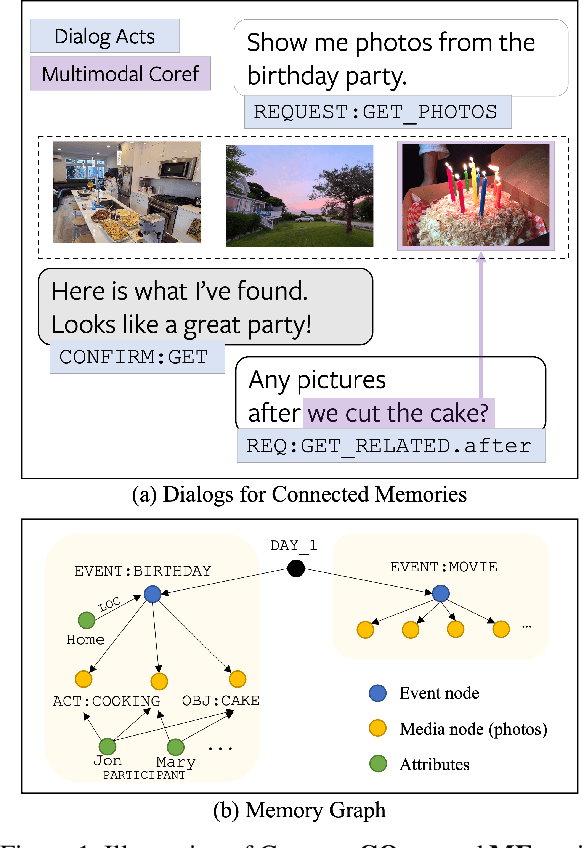
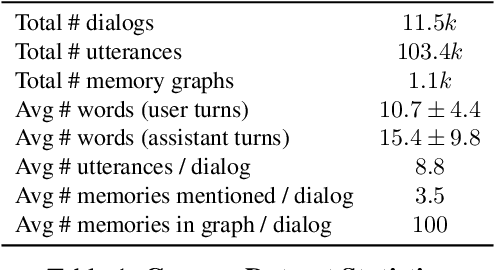
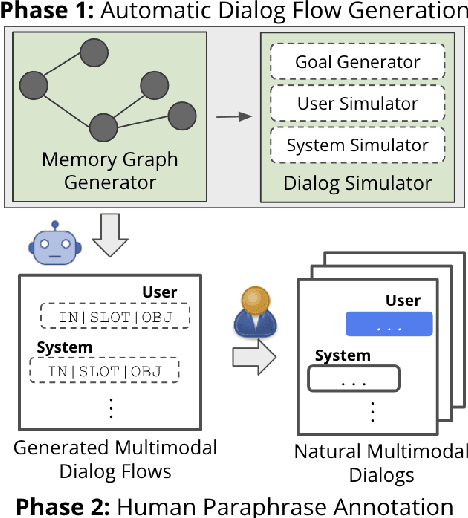
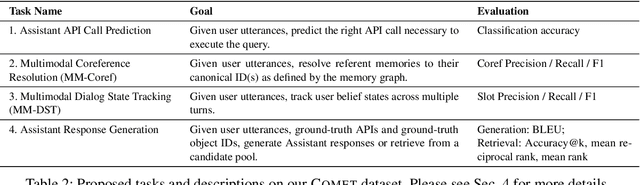
Recent years have seen an increasing trend in the volume of personal media captured by users, thanks to the advent of smartphones and smart glasses, resulting in large media collections. Despite conversation being an intuitive human-computer interface, current efforts focus mostly on single-shot natural language based media retrieval to aid users query their media and re-live their memories. This severely limits the search functionality as users can neither ask follow-up queries nor obtain information without first formulating a single-turn query. In this work, we propose dialogs for connected memories as a powerful tool to empower users to search their media collection through a multi-turn, interactive conversation. Towards this, we collect a new task-oriented dialog dataset COMET, which contains $11.5k$ user<->assistant dialogs (totaling $103k$ utterances), grounded in simulated personal memory graphs. We employ a resource-efficient, two-phase data collection pipeline that uses: (1) a novel multimodal dialog simulator that generates synthetic dialog flows grounded in memory graphs, and, (2) manual paraphrasing to obtain natural language utterances. We analyze COMET, formulate four main tasks to benchmark meaningful progress, and adopt state-of-the-art language models as strong baselines, in order to highlight the multimodal challenges captured by our dataset.