 Add to Chrome
 Add to Firefox
 Add to Edge
DataComp: In search of the next generation of multimodal datasets
May 03, 2023
Large multimodal datasets have been instrumental in recent breakthroughs such as CLIP, Stable Diffusion, and GPT-4. At the same time, datasets rarely receive the same research attention as model architectures or training algorithms. To address this shortcoming in the machine learning ecosystem, we introduce DataComp, a benchmark where the training code is fixed and researchers innovate by proposing new training sets. We provide a testbed for dataset experiments centered around a new candidate pool of 12.8B image-text pairs from Common Crawl. Participants in our benchmark design new filtering techniques or curate new data sources and then evaluate their new dataset by running our standardized CLIP training code and testing on 38 downstream test sets. Our benchmark consists of multiple scales, with four candidate pool sizes and associated compute budgets ranging from 12.8M to 12.8B samples seen during training. This multi-scale design facilitates the study of scaling trends and makes the benchmark accessible to researchers with varying resources. Our baseline experiments show that the DataComp workflow is a promising way of improving multimodal datasets. We introduce DataComp-1B, a dataset created by applying a simple filtering algorithm to the 12.8B candidate pool. The resulting 1.4B subset enables training a CLIP ViT-L/14 from scratch to 79.2% zero-shot accuracy on ImageNet. Our new ViT-L/14 model outperforms a larger ViT-g/14 trained on LAION-2B by 0.7 percentage points while requiring 9x less training compute. We also outperform OpenAI's CLIP ViT-L/14 by 3.7 percentage points, which is trained with the same compute budget as our model. These gains highlight the potential for improving model performance by carefully curating training sets. We view DataComp-1B as only the first step and hope that DataComp paves the way toward the next generation of multimodal datasets.

Stable and low-precision training for large-scale vision-language models
Apr 25, 2023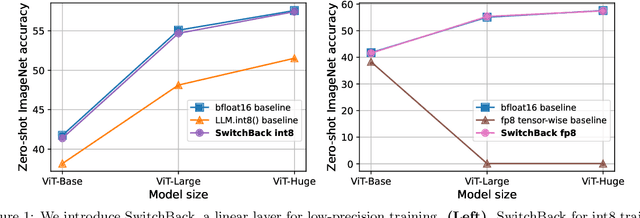
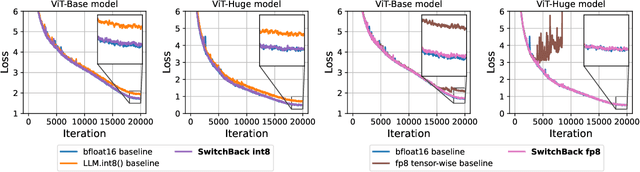
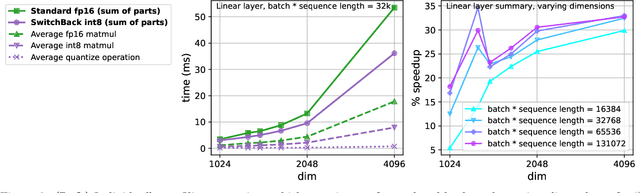
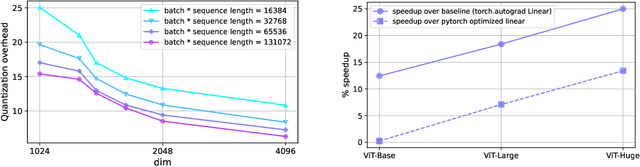
We introduce new methods for 1) accelerating and 2) stabilizing training for large language-vision models. 1) Towards accelerating training, we introduce SwitchBack, a linear layer for int8 quantized training which provides a speed-up of 13-25% while matching the performance of bfloat16 training within 0.1 percentage points for the 1B parameter CLIP ViT-Huge -- the largest int8 training to date. Our main focus is int8 as GPU support for float8 is rare, though we also analyze float8 training through simulation. While SwitchBack proves effective for float8, we show that standard techniques are also successful if the network is trained and initialized so that large feature magnitudes are discouraged, which we accomplish via layer-scale initialized with zeros. 2) Towards stable training, we analyze loss spikes and find they consistently occur 1-8 iterations after the squared gradients become under-estimated by their AdamW second moment estimator. As a result, we recommend an AdamW-Adafactor hybrid, which we refer to as StableAdamW because it avoids loss spikes when training a CLIP ViT-Huge model and outperforms gradient clipping.
Moving Forward by Moving Backward: Embedding Action Impact over Action Semantics
Apr 24, 2023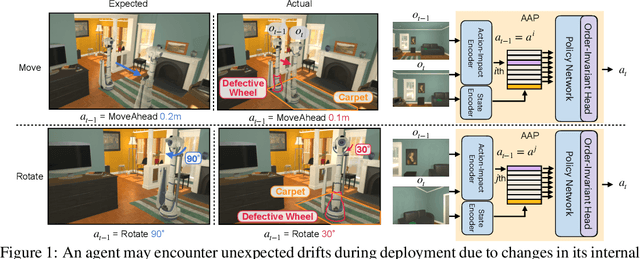
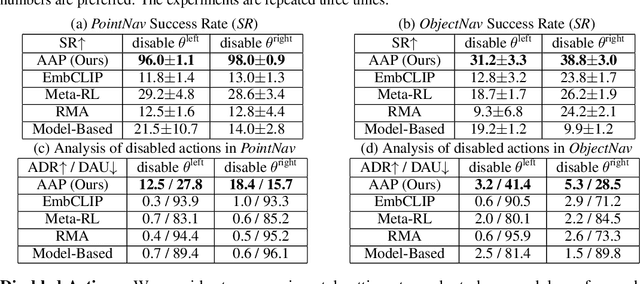
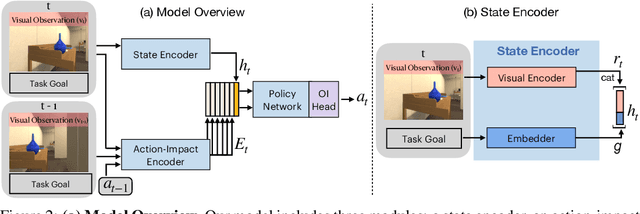
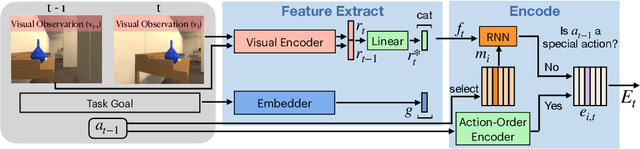
A common assumption when training embodied agents is that the impact of taking an action is stable; for instance, executing the "move ahead" action will always move the agent forward by a fixed distance, perhaps with some small amount of actuator-induced noise. This assumption is limiting; an agent may encounter settings that dramatically alter the impact of actions: a move ahead action on a wet floor may send the agent twice as far as it expects and using the same action with a broken wheel might transform the expected translation into a rotation. Instead of relying that the impact of an action stably reflects its pre-defined semantic meaning, we propose to model the impact of actions on-the-fly using latent embeddings. By combining these latent action embeddings with a novel, transformer-based, policy head, we design an Action Adaptive Policy (AAP). We evaluate our AAP on two challenging visual navigation tasks in the AI2-THOR and Habitat environments and show that our AAP is highly performant even when faced, at inference-time with missing actions and, previously unseen, perturbed action space. Moreover, we observe significant improvement in robustness against these actions when evaluating in real-world scenarios.
Reinforce Data, Multiply Impact: Improved Model Accuracy and Robustness with Dataset Reinforcement
Mar 15, 2023We propose Dataset Reinforcement, a strategy to improve a dataset once such that the accuracy of any model architecture trained on the reinforced dataset is improved at no additional training cost for users. We propose a Dataset Reinforcement strategy based on data augmentation and knowledge distillation. Our generic strategy is designed based on extensive analysis across CNN- and transformer-based models and performing large-scale study of distillation with state-of-the-art models with various data augmentations. We create a reinforced version of the ImageNet training dataset, called ImageNet+, as well as reinforced datasets CIFAR-100+, Flowers-102+, and Food-101+. Models trained with ImageNet+ are more accurate, robust, and calibrated, and transfer well to downstream tasks (e.g., segmentation and detection). As an example, the accuracy of ResNet-50 improves by 1.7% on the ImageNet validation set, 3.5% on ImageNetV2, and 10.0% on ImageNet-R. Expected Calibration Error (ECE) on the ImageNet validation set is also reduced by 9.9%. Using this backbone with Mask-RCNN for object detection on MS-COCO, the mean average precision improves by 0.8%. We reach similar gains for MobileNets, ViTs, and Swin-Transformers. For MobileNetV3 and Swin-Tiny we observe significant improvements on ImageNet-R/A/C of up to 10% improved robustness. Models pretrained on ImageNet+ and fine-tuned on CIFAR-100+, Flowers-102+, and Food-101+, reach up to 3.4% improved accuracy.
FastFill: Efficient Compatible Model Update
Mar 08, 2023In many retrieval systems the original high dimensional data (e.g., images) is mapped to a lower dimensional feature through a learned embedding model. The task of retrieving the most similar data from a gallery set to a given query data is performed through a similarity comparison on features. When the embedding model is updated, it might produce features that are not comparable/compatible with features already in the gallery computed with the old model. Subsequently, all features in the gallery need to be re-computed using the new embedding model -- a computationally expensive process called backfilling. Recently, compatible representation learning methods have been proposed to avoid backfilling. Despite their relative success, there is an inherent trade-off between the new model performance and its compatibility with the old model. In this work, we introduce FastFill: a compatible model update process using feature alignment and policy based partial backfilling to promptly elevate retrieval performance. We show that previous backfilling strategies suffer from decreased performance and demonstrate the importance of both the training objective and the ordering in online partial backfilling. We propose a new training method for feature alignment between old and new embedding models using uncertainty estimation. Compared to previous works, we obtain significantly improved backfilling results on a variety of datasets: mAP on ImageNet (+4.4\%), Places-365 (+2.7\%), and VGG-Face2 (+1.3\%). Further, we demonstrate that when updating a biased model with FastFill, the minority subgroup accuracy gap promptly vanishes with a small fraction of partial backfilling.
Neural Radiance Field Codebooks
Jan 10, 2023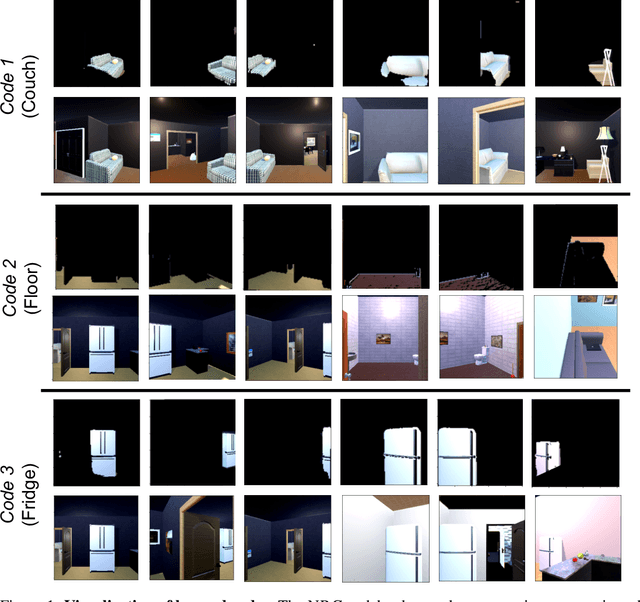
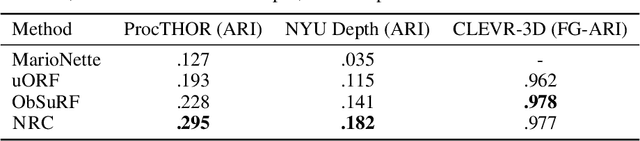
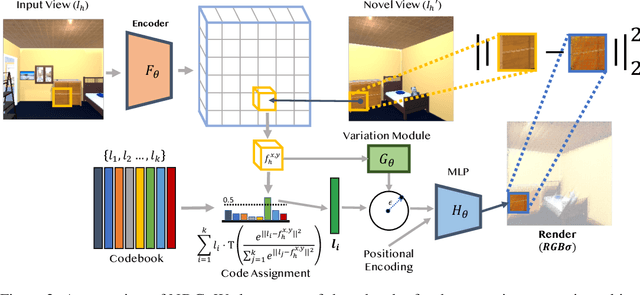
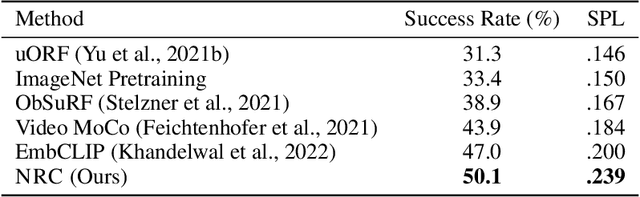
Compositional representations of the world are a promising step towards enabling high-level scene understanding and efficient transfer to downstream tasks. Learning such representations for complex scenes and tasks remains an open challenge. Towards this goal, we introduce Neural Radiance Field Codebooks (NRC), a scalable method for learning object-centric representations through novel view reconstruction. NRC learns to reconstruct scenes from novel views using a dictionary of object codes which are decoded through a volumetric renderer. This enables the discovery of reoccurring visual and geometric patterns across scenes which are transferable to downstream tasks. We show that NRC representations transfer well to object navigation in THOR, outperforming 2D and 3D representation learning methods by 3.1% success rate. We demonstrate that our approach is able to perform unsupervised segmentation for more complex synthetic (THOR) and real scenes (NYU Depth) better than prior methods (29% relative improvement). Finally, we show that NRC improves on the task of depth ordering by 5.5% accuracy in THOR.
RangeAugment: Efficient Online Augmentation with Range Learning
Dec 20, 2022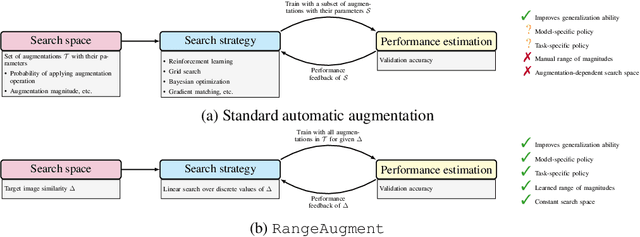
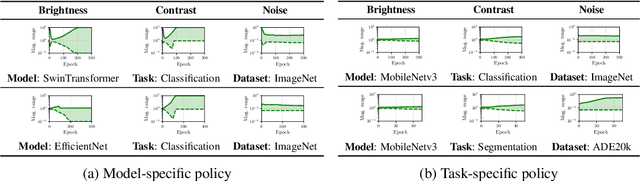

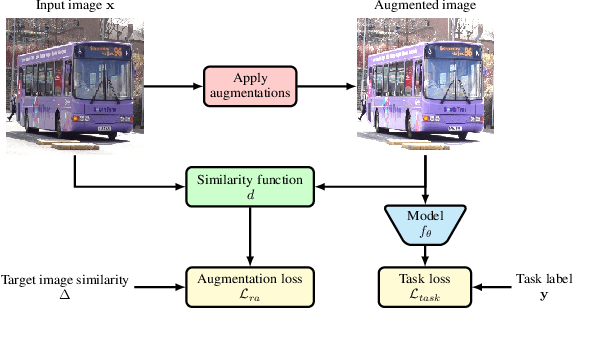
State-of-the-art automatic augmentation methods (e.g., AutoAugment and RandAugment) for visual recognition tasks diversify training data using a large set of augmentation operations. The range of magnitudes of many augmentation operations (e.g., brightness and contrast) is continuous. Therefore, to make search computationally tractable, these methods use fixed and manually-defined magnitude ranges for each operation, which may lead to sub-optimal policies. To answer the open question on the importance of magnitude ranges for each augmentation operation, we introduce RangeAugment that allows us to efficiently learn the range of magnitudes for individual as well as composite augmentation operations. RangeAugment uses an auxiliary loss based on image similarity as a measure to control the range of magnitudes of augmentation operations. As a result, RangeAugment has a single scalar parameter for search, image similarity, which we simply optimize via linear search. RangeAugment integrates seamlessly with any model and learns model- and task-specific augmentation policies. With extensive experiments on the ImageNet dataset across different networks, we show that RangeAugment achieves competitive performance to state-of-the-art automatic augmentation methods with 4-5 times fewer augmentation operations. Experimental results on semantic segmentation, object detection, foundation models, and knowledge distillation further shows RangeAugment's effectiveness.
Objaverse: A Universe of Annotated 3D Objects
Dec 15, 2022Massive data corpora like WebText, Wikipedia, Conceptual Captions, WebImageText, and LAION have propelled recent dramatic progress in AI. Large neural models trained on such datasets produce impressive results and top many of today's benchmarks. A notable omission within this family of large-scale datasets is 3D data. Despite considerable interest and potential applications in 3D vision, datasets of high-fidelity 3D models continue to be mid-sized with limited diversity of object categories. Addressing this gap, we present Objaverse 1.0, a large dataset of objects with 800K+ (and growing) 3D models with descriptive captions, tags, and animations. Objaverse improves upon present day 3D repositories in terms of scale, number of categories, and in the visual diversity of instances within a category. We demonstrate the large potential of Objaverse via four diverse applications: training generative 3D models, improving tail category segmentation on the LVIS benchmark, training open-vocabulary object-navigation models for Embodied AI, and creating a new benchmark for robustness analysis of vision models. Objaverse can open new directions for research and enable new applications across the field of AI.
Object Goal Navigation with End-to-End Self-Supervision
Dec 09, 2022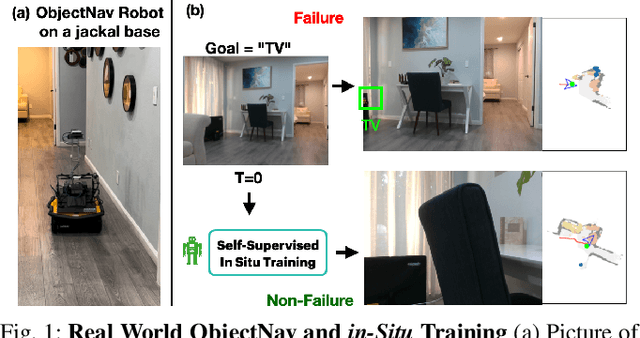
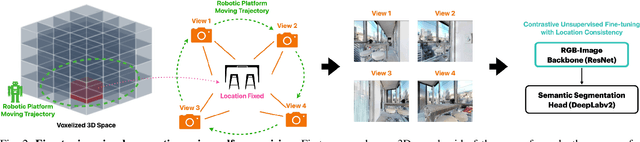
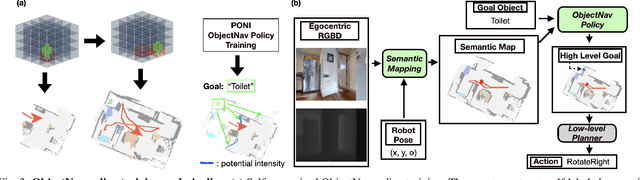
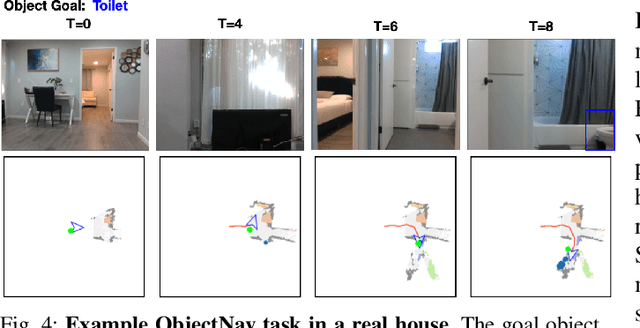
A household robot should be able to navigate to target locations without requiring users to first annotate everything in their home. Current approaches to this object navigation challenge do not test on real robots and rely on expensive semantically labeled 3D meshes. In this work, our aim is an agent that builds self-supervised models of the world via exploration, the same as a child might. We propose an end-to-end self-supervised embodied agent that leverages exploration to train a semantic segmentation model of 3D objects, and uses those representations to learn an object navigation policy purely from self-labeled 3D meshes. The key insight is that embodied agents can leverage location consistency as a supervision signal - collecting images from different views/angles and applying contrastive learning to fine-tune a semantic segmentation model. In our experiments, we observe that our framework performs better than other self-supervised baselines and competitively with supervised baselines, in both simulation and when deployed in real houses.
Editing Models with Task Arithmetic
Dec 08, 2022Changing how pre-trained models behave -- e.g., improving their performance on a downstream task or mitigating biases learned during pre-training -- is a common practice when developing machine learning systems. In this work, we propose a new paradigm for steering the behavior of neural networks, centered around \textit{task vectors}. A task vector specifies a direction in the weight space of a pre-trained model, such that movement in that direction improves performance on the task. We build task vectors by subtracting the weights of a pre-trained model from the weights of the same model after fine-tuning on a task. We show that these task vectors can be modified and combined together through arithmetic operations such as negation and addition, and the behavior of the resulting model is steered accordingly. Negating a task vector decreases performance on the target task, with little change in model behavior on control tasks. Moreover, adding task vectors together can improve performance on multiple tasks at once. Finally, when tasks are linked by an analogy relationship of the form ``A is to B as C is to D", combining task vectors from three of the tasks can improve performance on the fourth, even when no data from the fourth task is used for training. Overall, our experiments with several models, modalities and tasks show that task arithmetic is a simple, efficient and effective way of editing models.