 Add to Chrome
 Add to Firefox
 Add to Edge
Let AI Agents Translate Networks, Not Reason About Them
Jul 24, 2026
A formal model enables verifying reachability, localizing an outage, or anticipating the blast radius of a change. Yet, virtually no production network has one, since writing a model by hand demands rare expertise and is hard to keep current as the network changes frequently. At its core, network modeling is a typographical exercise: it translates network artifacts (e.g., configurations, topology, and routing state) into rules in formal logic. Translation of this kind is what large language models (LLMs) nowadays do well. Unlike free-form AI reasoning, such translation can be formally verified. Once modeling is no longer the bottleneck, trusting AI to reason over large, complex networks no longer makes sense. Our position therefore cuts against the prevailing race to put autonomous AI agents in charge end-to-end. We instead confine AI to translation and rely on a solver for reliable long-horizon reasoning, building a reusable formal model of general network behavior that can then be specialized to specific tasks, e.g., root-cause analysis (RCA). We build TypoNet that constructs and validates a symbolic model of an emulated production-scale WAN from the network's own artifacts. Our preliminary evaluation shows TypoNet helps in two ways. On its own, TypoNet answers operational questions (e.g., reachability verification and change-impact analysis) faster, more cheaply, and more reliably than an LLM. As a tool for an AI agent, TypoNet boosts fault localization at lower cost. The result makes the case for AI that builds verifiable network models and relies on a solver for reliable long-horizon reasoning.

Invariant Discovery for Networked Systems
Jul 24, 2026Invariants, the relations expected to hold among measured signals of a network, underpin applications from verification to traffic generation, telemetry imputation, and input validation, yet writing them by hand demands rare expertise in both formal logic and networking. Automatic miners can help but fall short on two fronts: they still require the hardest input (the grammar of admissible invariants) and they learn only exact, ``hard'' rules, struggling with real-world approximation caused by inherent noise in data. LLMs are tools that can provide semantic reasoning over data, but are non-deterministic and opaque in their learning. Our key idea is to partition the invariant search problem into an AI-driven grammar ``discovery'' problem, followed by a statistics-driven ``search'' problem within the learned grammar. Taken together, this allows non-deterministic, hallucination-prone AI to help produce auditable invariants with formal guarantees. We design and implement such a system, Autogram, and evaluate it on both public and production telemetry data, recovering expert-derived invariants with high coverage and low false positives. We close with discussion on open problems on the path toward fully open-ended discovery.
Worst-Case Discovery and Runtime Protection for RL-Based Network Controllers
May 06, 2026RL-based controllers achieve strong average-case performance in networking tasks such as congestion control and adaptive bitrate streaming. Yet their performance can degrade severely under network conditions where strong performance is still achievable. Identifying such conditions and quantifying the resulting performance gap is intractable by enumeration, while the sequential and closed-loop nature of RL controllers makes formal verification methods impractical. We present ReGuard, a framework that discovers worst-case scenarios for a given RL controller and protects it against them at inference time without retraining. Discovery is formulated as a bilevel regret-maximization problem, which yields a certified lower bound on the worst-case performance gap. The discovered trajectories are then analyzed as counterfactuals and compiled into lightweight logic rules that intervene only when a risky state is detected, leaving the controller's behavior unchanged otherwise. We evaluate ReGuard across three RL-based network controllers: Pensieve, Sage, and Park. ReGuard discovers scenarios in which the controller's performance is 43$-$64% worse than what is achievable. ReGuard not only discovers gaps 57% to 6$\times$ larger than those found by the strongest baselines but also shrinks them by 79$-$85% via lightweight rule-based protection while preserving nominal performance. ReGuard's protection extends beyond the scenarios it discovers, improving performance across a wider range of network conditions.
PerOS: Personalized Self-Adapting Operating Systems in the Cloud
Mar 26, 2024


Operating systems (OSes) are foundational to computer systems, managing hardware resources and ensuring secure environments for diverse applications. However, despite their enduring importance, the fundamental design objectives of OSes have seen minimal evolution over decades. Traditionally prioritizing aspects like speed, memory efficiency, security, and scalability, these objectives often overlook the crucial aspect of intelligence as well as personalized user experience. The lack of intelligence becomes increasingly critical amid technological revolutions, such as the remarkable advancements in machine learning (ML). Today's personal devices, evolving into intimate companions for users, pose unique challenges for traditional OSes like Linux and iOS, especially with the emergence of specialized hardware featuring heterogeneous components. Furthermore, the rise of large language models (LLMs) in ML has introduced transformative capabilities, reshaping user interactions and software development paradigms. While existing literature predominantly focuses on leveraging ML methods for system optimization or accelerating ML workloads, there is a significant gap in addressing personalized user experiences at the OS level. To tackle this challenge, this work proposes PerOS, a personalized OS ingrained with LLM capabilities. PerOS aims to provide tailored user experiences while safeguarding privacy and personal data through declarative interfaces, self-adaptive kernels, and secure data management in a scalable cloud-centric architecture; therein lies the main research question of this work: How can we develop intelligent, secure, and scalable OSes that deliver personalized experiences to thousands of users?
MM1: Methods, Analysis & Insights from Multimodal LLM Pre-training
Mar 22, 2024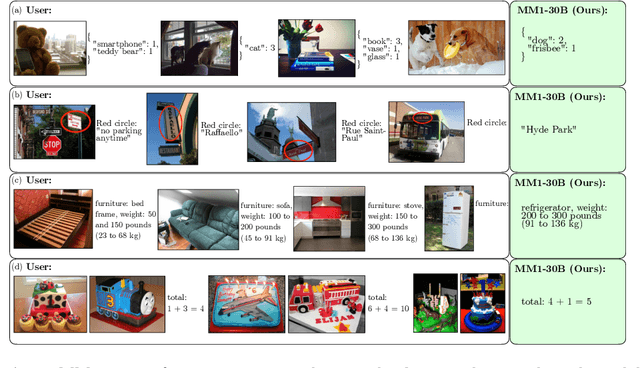
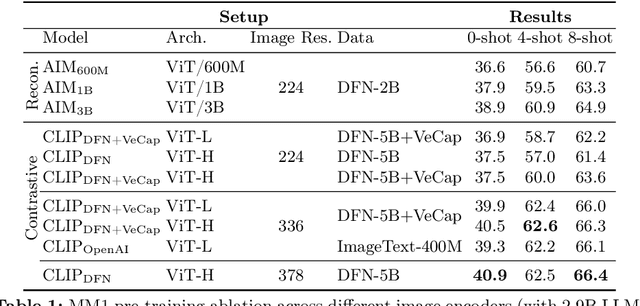
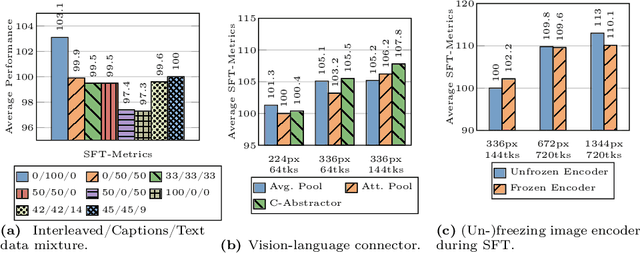
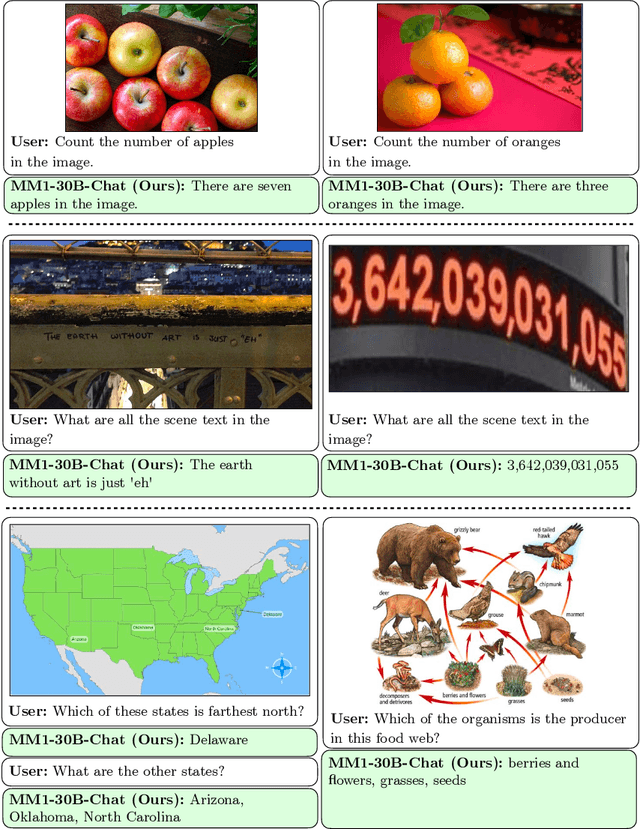
In this work, we discuss building performant Multimodal Large Language Models (MLLMs). In particular, we study the importance of various architecture components and data choices. Through careful and comprehensive ablations of the image encoder, the vision language connector, and various pre-training data choices, we identified several crucial design lessons. For example, we demonstrate that for large-scale multimodal pre-training using a careful mix of image-caption, interleaved image-text, and text-only data is crucial for achieving state-of-the-art (SOTA) few-shot results across multiple benchmarks, compared to other published pre-training results. Further, we show that the image encoder together with image resolution and the image token count has substantial impact, while the vision-language connector design is of comparatively negligible importance. By scaling up the presented recipe, we build MM1, a family of multimodal models up to 30B parameters, including both dense models and mixture-of-experts (MoE) variants, that are SOTA in pre-training metrics and achieve competitive performance after supervised fine-tuning on a range of established multimodal benchmarks. Thanks to large-scale pre-training, MM1 enjoys appealing properties such as enhanced in-context learning, and multi-image reasoning, enabling few-shot chain-of-thought prompting.
A Unified View of Long-Sequence Models towards Modeling Million-Scale Dependencies
Feb 16, 2023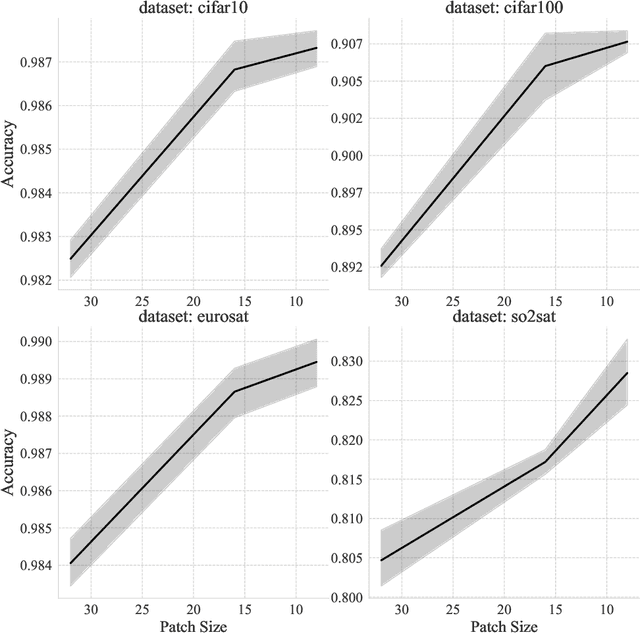
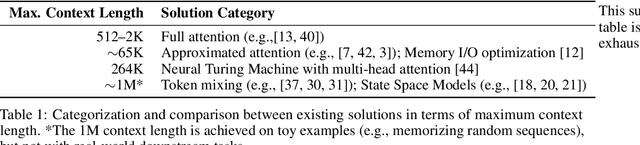
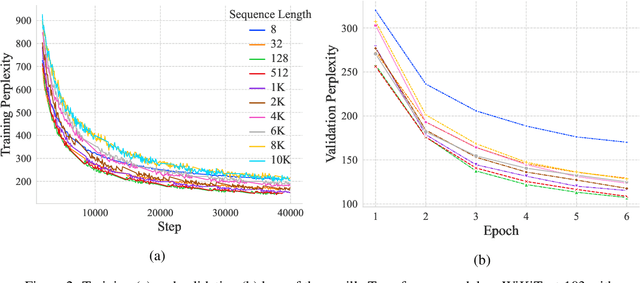
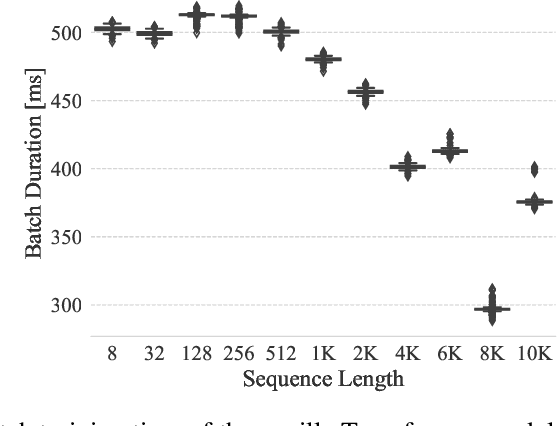
Ever since their conception, Transformers have taken over traditional sequence models in many tasks, such as NLP, image classification, and video/audio processing, for their fast training and superior performance. Much of the merit is attributable to positional encoding and multi-head attention. However, Transformers fall short in learning long-range dependencies mainly due to the quadratic complexity scaled with context length, in terms of both time and space. Consequently, over the past five years, a myriad of methods has been proposed to make Transformers more efficient. In this work, we first take a step back, study and compare existing solutions to long-sequence modeling in terms of their pure mathematical formulation. Specifically, we summarize them using a unified template, given their shared nature of token mixing. Through benchmarks, we then demonstrate that long context length does yield better performance, albeit application-dependent, and traditional Transformer models fall short in taking advantage of long-range dependencies. Next, inspired by emerging sparse models of huge capacity, we propose a machine learning system for handling million-scale dependencies. As a proof of concept, we evaluate the performance of one essential component of this system, namely, the distributed multi-head attention. We show that our algorithm can scale up attention computation by almost $40\times$ using four GeForce RTX 4090 GPUs, compared to vanilla multi-head attention mechanism. We believe this study is an instrumental step towards modeling million-scale dependencies.