 Add to Chrome
 Add to Firefox
 Add to Edge
Name That Part: 3D Part Segmentation and Naming
Dec 19, 2025
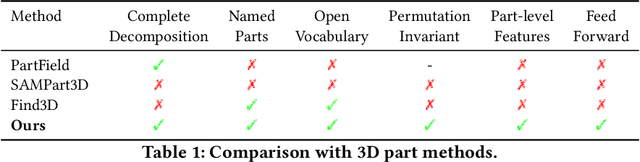
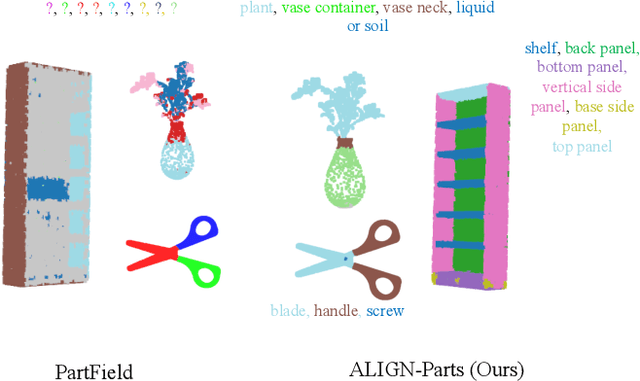

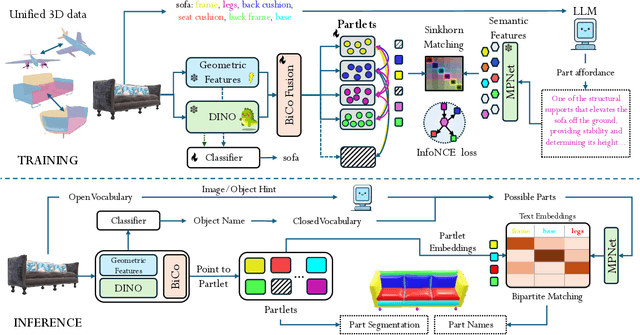
We address semantic 3D part segmentation: decomposing objects into parts with meaningful names. While datasets exist with part annotations, their definitions are inconsistent across datasets, limiting robust training. Previous methods produce unlabeled decompositions or retrieve single parts without complete shape annotations. We propose ALIGN-Parts, which formulates part naming as a direct set alignment task. Our method decomposes shapes into partlets - implicit 3D part representations - matched to part descriptions via bipartite assignment. We combine geometric cues from 3D part fields, appearance from multi-view vision features, and semantic knowledge from language-model-generated affordance descriptions. Text-alignment loss ensures partlets share embedding space with text, enabling a theoretically open-vocabulary matching setup, given sufficient data. Our efficient and novel, one-shot, 3D part segmentation and naming method finds applications in several downstream tasks, including serving as a scalable annotation engine. As our model supports zero-shot matching to arbitrary descriptions and confidence-calibrated predictions for known categories, with human verification, we create a unified ontology that aligns PartNet, 3DCoMPaT++, and Find3D, consisting of 1,794 unique 3D parts. We also show examples from our newly created Tex-Parts dataset. We also introduce 2 novel metrics appropriate for the named 3D part segmentation task.

Generative Adversarial Reasoner: Enhancing LLM Reasoning with Adversarial Reinforcement Learning
Dec 18, 2025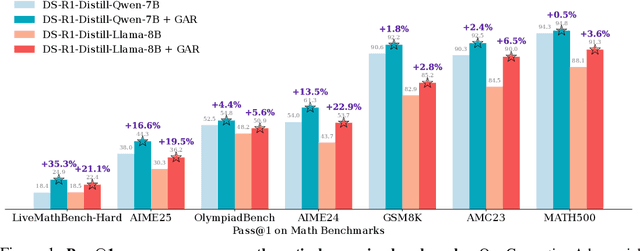

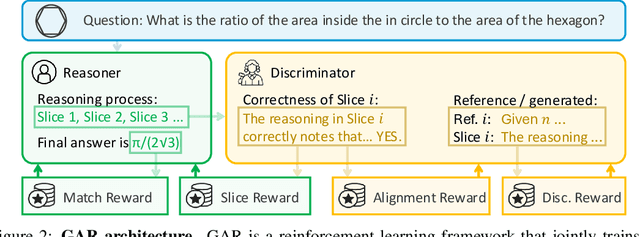
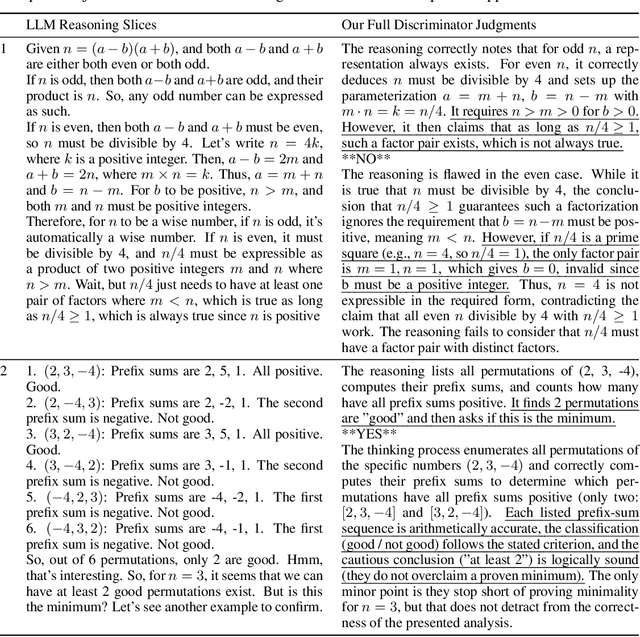
Large language models (LLMs) with explicit reasoning capabilities excel at mathematical reasoning yet still commit process errors, such as incorrect calculations, brittle logic, and superficially plausible but invalid steps. In this paper, we introduce Generative Adversarial Reasoner, an on-policy joint training framework designed to enhance reasoning by co-evolving an LLM reasoner and an LLM-based discriminator through adversarial reinforcement learning. A compute-efficient review schedule partitions each reasoning chain into logically complete slices of comparable length, and the discriminator evaluates each slice's soundness with concise, structured justifications. Learning couples complementary signals: the LLM reasoner is rewarded for logically consistent steps that yield correct answers, while the discriminator earns rewards for correctly detecting errors or distinguishing traces in the reasoning process. This produces dense, well-calibrated, on-policy step-level rewards that supplement sparse exact-match signals, improving credit assignment, increasing sample efficiency, and enhancing overall reasoning quality of LLMs. Across various mathematical benchmarks, the method delivers consistent gains over strong baselines with standard RL post-training. Specifically, on AIME24, we improve DeepSeek-R1-Distill-Qwen-7B from 54.0 to 61.3 (+7.3) and DeepSeek-R1-Distill-Llama-8B from 43.7 to 53.7 (+10.0). The modular discriminator also enables flexible reward shaping for objectives such as teacher distillation, preference alignment, and mathematical proof-based reasoning.
Differences That Matter: Auditing Models for Capability Gap Discovery and Rectification
Dec 18, 2025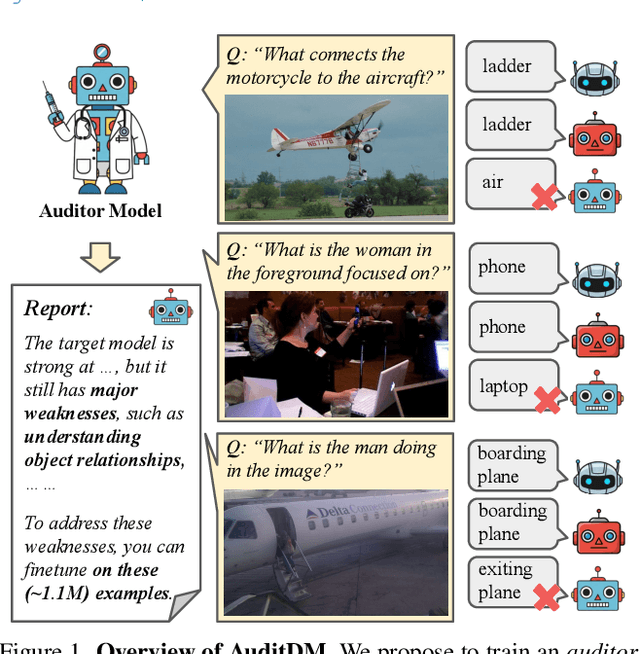
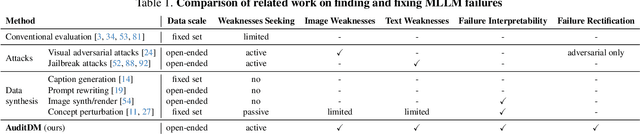
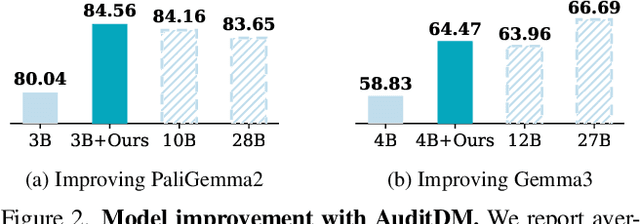
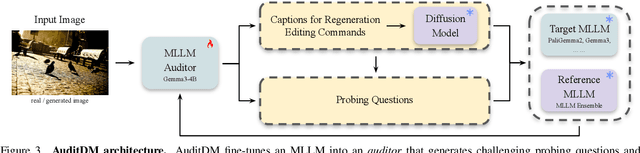
Conventional evaluation methods for multimodal LLMs (MLLMs) lack interpretability and are often insufficient to fully disclose significant capability gaps across models. To address this, we introduce AuditDM, an automated framework that actively discovers and rectifies MLLM failure modes by auditing their divergence. AuditDM fine-tunes an MLLM as an auditor via reinforcement learning to generate challenging questions and counterfactual images that maximize disagreement among target models. Once trained, the auditor uncovers diverse, interpretable exemplars that reveal model weaknesses and serve as annotation-free data for rectification. When applied to SoTA models like Gemma-3 and PaliGemma-2, AuditDM discovers more than 20 distinct failure types. Fine-tuning on these discoveries consistently improves all models across 16 benchmarks, and enables a 3B model to surpass its 28B counterpart. Our results suggest that as data scaling hits diminishing returns, targeted model auditing offers an effective path to model diagnosis and improvement.
Mixture of Contexts for Long Video Generation
Aug 28, 2025Long video generation is fundamentally a long context memory problem: models must retain and retrieve salient events across a long range without collapsing or drifting. However, scaling diffusion transformers to generate long-context videos is fundamentally limited by the quadratic cost of self-attention, which makes memory and computation intractable and difficult to optimize for long sequences. We recast long-context video generation as an internal information retrieval task and propose a simple, learnable sparse attention routing module, Mixture of Contexts (MoC), as an effective long-term memory retrieval engine. In MoC, each query dynamically selects a few informative chunks plus mandatory anchors (caption, local windows) to attend to, with causal routing that prevents loop closures. As we scale the data and gradually sparsify the routing, the model allocates compute to salient history, preserving identities, actions, and scenes over minutes of content. Efficiency follows as a byproduct of retrieval (near-linear scaling), which enables practical training and synthesis, and the emergence of memory and consistency at the scale of minutes.
Captain Cinema: Towards Short Movie Generation
Jul 24, 2025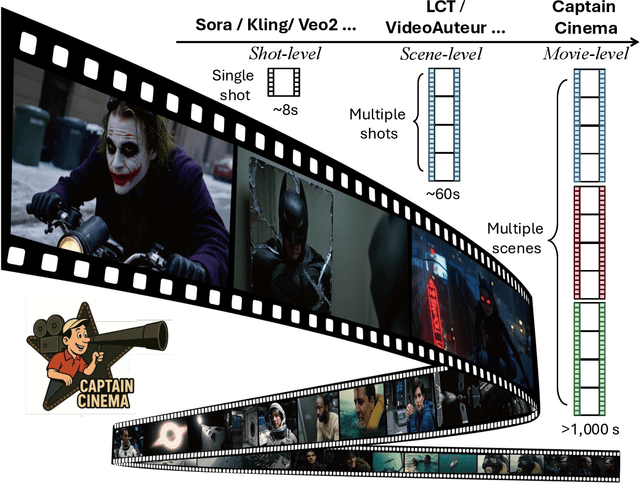
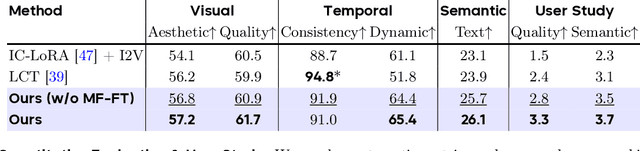
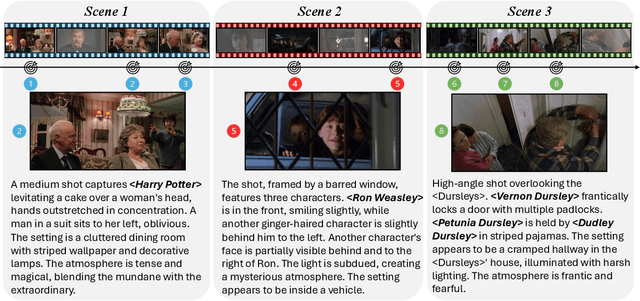
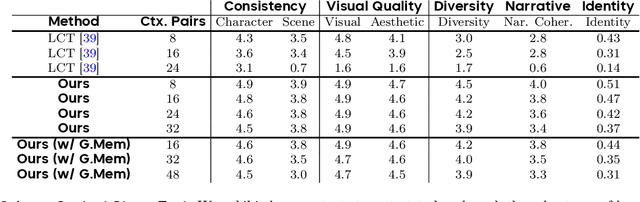
We present Captain Cinema, a generation framework for short movie generation. Given a detailed textual description of a movie storyline, our approach firstly generates a sequence of keyframes that outline the entire narrative, which ensures long-range coherence in both the storyline and visual appearance (e.g., scenes and characters). We refer to this step as top-down keyframe planning. These keyframes then serve as conditioning signals for a video synthesis model, which supports long context learning, to produce the spatio-temporal dynamics between them. This step is referred to as bottom-up video synthesis. To support stable and efficient generation of multi-scene long narrative cinematic works, we introduce an interleaved training strategy for Multimodal Diffusion Transformers (MM-DiT), specifically adapted for long-context video data. Our model is trained on a specially curated cinematic dataset consisting of interleaved data pairs. Our experiments demonstrate that Captain Cinema performs favorably in the automated creation of visually coherent and narrative consistent short movies in high quality and efficiency. Project page: https://thecinema.ai
Vision-Language-Vision Auto-Encoder: Scalable Knowledge Distillation from Diffusion Models
Jul 09, 2025Building state-of-the-art Vision-Language Models (VLMs) with strong captioning capabilities typically necessitates training on billions of high-quality image-text pairs, requiring millions of GPU hours. This paper introduces the Vision-Language-Vision (VLV) auto-encoder framework, which strategically leverages key pretrained components: a vision encoder, the decoder of a Text-to-Image (T2I) diffusion model, and subsequently, a Large Language Model (LLM). Specifically, we establish an information bottleneck by regularizing the language representation space, achieved through freezing the pretrained T2I diffusion decoder. Our VLV pipeline effectively distills knowledge from the text-conditioned diffusion model using continuous embeddings, demonstrating comprehensive semantic understanding via high-quality reconstructions. Furthermore, by fine-tuning a pretrained LLM to decode the intermediate language representations into detailed descriptions, we construct a state-of-the-art (SoTA) captioner comparable to leading models like GPT-4o and Gemini 2.0 Flash. Our method demonstrates exceptional cost-efficiency and significantly reduces data requirements; by primarily utilizing single-modal images for training and maximizing the utility of existing pretrained models (image encoder, T2I diffusion model, and LLM), it circumvents the need for massive paired image-text datasets, keeping the total training expenditure under $1,000 USD.
Pushing the Limits of Safety: A Technical Report on the ATLAS Challenge 2025
Jun 14, 2025Multimodal Large Language Models (MLLMs) have enabled transformative advancements across diverse applications but remain susceptible to safety threats, especially jailbreak attacks that induce harmful outputs. To systematically evaluate and improve their safety, we organized the Adversarial Testing & Large-model Alignment Safety Grand Challenge (ATLAS) 2025}. This technical report presents findings from the competition, which involved 86 teams testing MLLM vulnerabilities via adversarial image-text attacks in two phases: white-box and black-box evaluations. The competition results highlight ongoing challenges in securing MLLMs and provide valuable guidance for developing stronger defense mechanisms. The challenge establishes new benchmarks for MLLM safety evaluation and lays groundwork for advancing safer multimodal AI systems. The code and data for this challenge are openly available at https://github.com/NY1024/ATLAS_Challenge_2025.
Play to Generalize: Learning to Reason Through Game Play
Jun 09, 2025Developing generalizable reasoning capabilities in multimodal large language models (MLLMs) remains challenging. Motivated by cognitive science literature suggesting that gameplay promotes transferable cognitive skills, we propose a novel post-training paradigm, Visual Game Learning, or ViGaL, where MLLMs develop out-of-domain generalization of multimodal reasoning through playing arcade-like games. Specifically, we show that post-training a 7B-parameter MLLM via reinforcement learning (RL) on simple arcade-like games, e.g. Snake, significantly enhances its downstream performance on multimodal math benchmarks like MathVista, and on multi-discipline questions like MMMU, without seeing any worked solutions, equations, or diagrams during RL, suggesting the capture of transferable reasoning skills. Remarkably, our model outperforms specialist models tuned on multimodal reasoning data in multimodal reasoning benchmarks, while preserving the base model's performance on general visual benchmarks, a challenge where specialist models often fall short. Our findings suggest a new post-training paradigm: synthetic, rule-based games can serve as controllable and scalable pre-text tasks that unlock generalizable multimodal reasoning abilities in MLLMs.
PartInstruct: Part-level Instruction Following for Fine-grained Robot Manipulation
May 27, 2025Fine-grained robot manipulation, such as lifting and rotating a bottle to display the label on the cap, requires robust reasoning about object parts and their relationships with intended tasks. Despite recent advances in training general-purpose robot manipulation policies guided by language instructions, there is a notable lack of large-scale datasets for fine-grained manipulation tasks with part-level instructions and diverse 3D object instances annotated with part-level labels. In this work, we introduce PartInstruct, the first large-scale benchmark for training and evaluating fine-grained robot manipulation models using part-level instructions. PartInstruct comprises 513 object instances across 14 categories, each annotated with part-level information, and 1302 fine-grained manipulation tasks organized into 16 task classes. Our training set consists of over 10,000 expert demonstrations synthesized in a 3D simulator, where each demonstration is paired with a high-level task instruction, a chain of base part-based skill instructions, and ground-truth 3D information about the object and its parts. Additionally, we designed a comprehensive test suite to evaluate the generalizability of learned policies across new states, objects, and tasks. We evaluated several state-of-the-art robot manipulation approaches, including end-to-end vision-language policy learning and bi-level planning models for robot manipulation on our benchmark. The experimental results reveal that current models struggle to robustly ground part concepts and predict actions in 3D space, and face challenges when manipulating object parts in long-horizon tasks.
Are Vision Language Models Ready for Clinical Diagnosis? A 3D Medical Benchmark for Tumor-centric Visual Question Answering
May 25, 2025Vision-Language Models (VLMs) have shown promise in various 2D visual tasks, yet their readiness for 3D clinical diagnosis remains unclear due to stringent demands for recognition precision, reasoning ability, and domain knowledge. To systematically evaluate these dimensions, we present DeepTumorVQA, a diagnostic visual question answering (VQA) benchmark targeting abdominal tumors in CT scans. It comprises 9,262 CT volumes (3.7M slices) from 17 public datasets, with 395K expert-level questions spanning four categories: Recognition, Measurement, Visual Reasoning, and Medical Reasoning. DeepTumorVQA introduces unique challenges, including small tumor detection and clinical reasoning across 3D anatomy. Benchmarking four advanced VLMs (RadFM, M3D, Merlin, CT-CHAT), we find current models perform adequately on measurement tasks but struggle with lesion recognition and reasoning, and are still not meeting clinical needs. Two key insights emerge: (1) large-scale multimodal pretraining plays a crucial role in DeepTumorVQA testing performance, making RadFM stand out among all VLMs. (2) Our dataset exposes critical differences in VLM components, where proper image preprocessing and design of vision modules significantly affect 3D perception. To facilitate medical multimodal research, we have released DeepTumorVQA as a rigorous benchmark: https://github.com/Schuture/DeepTumorVQA.