 Add to Chrome
 Add to Firefox
 Add to Edge
Efficient Human Pose Estimation: Leveraging Advanced Techniques with MediaPipe
Jun 21, 2024
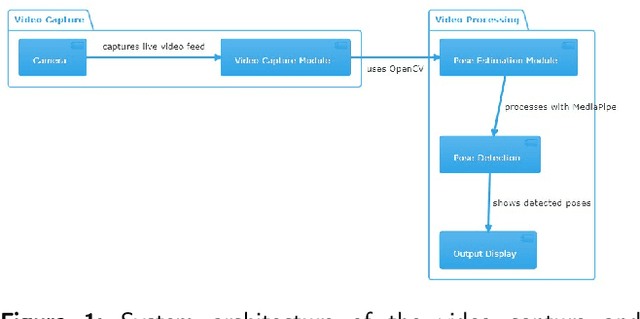
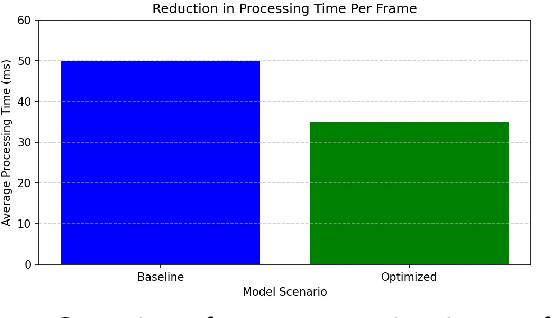
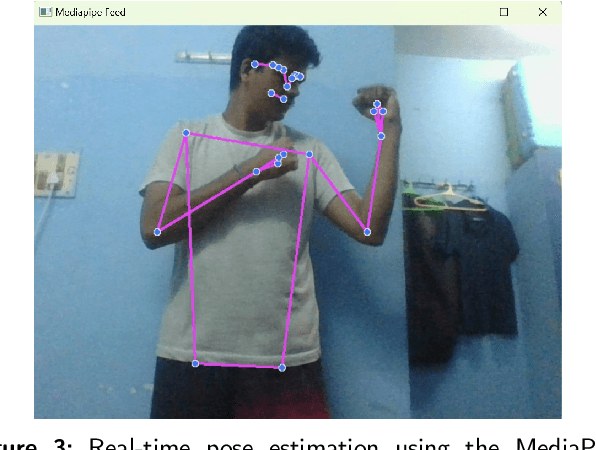
This study presents significant enhancements in human pose estimation using the MediaPipe framework. The research focuses on improving accuracy, computational efficiency, and real-time processing capabilities by comprehensively optimising the underlying algorithms. Novel modifications are introduced that substantially enhance pose estimation accuracy across challenging scenarios, such as dynamic movements and partial occlusions. The improved framework is benchmarked against traditional models, demonstrating considerable precision and computational speed gains. The advancements have wide-ranging applications in augmented reality, sports analytics, and healthcare, enabling more immersive experiences, refined performance analysis, and advanced patient monitoring. The study also explores the integration of these enhancements within mobile and embedded systems, addressing the need for computational efficiency and broader accessibility. The implications of this research set a new benchmark for real-time human pose estimation technologies and pave the way for future innovations in the field. The implementation code for the paper is available at https://github.com/avhixd/Human_pose_estimation.

Confidence Under the Hood: An Investigation into the Confidence-Probability Alignment in Large Language Models
May 29, 2024As the use of Large Language Models (LLMs) becomes more widespread, understanding their self-evaluation of confidence in generated responses becomes increasingly important as it is integral to the reliability of the output of these models. We introduce the concept of Confidence-Probability Alignment, that connects an LLM's internal confidence, quantified by token probabilities, to the confidence conveyed in the model's response when explicitly asked about its certainty. Using various datasets and prompting techniques that encourage model introspection, we probe the alignment between models' internal and expressed confidence. These techniques encompass using structured evaluation scales to rate confidence, including answer options when prompting, and eliciting the model's confidence level for outputs it does not recognize as its own. Notably, among the models analyzed, OpenAI's GPT-4 showed the strongest confidence-probability alignment, with an average Spearman's $\hat{\rho}$ of 0.42, across a wide range of tasks. Our work contributes to the ongoing efforts to facilitate risk assessment in the application of LLMs and to further our understanding of model trustworthiness.
RB-Modulation: Training-Free Personalization of Diffusion Models using Stochastic Optimal Control
May 27, 2024
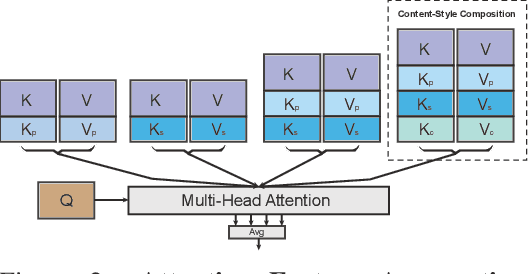
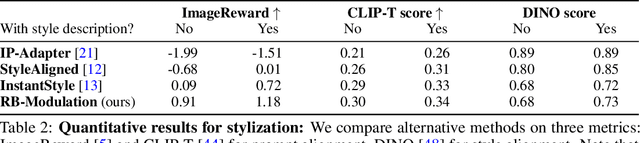
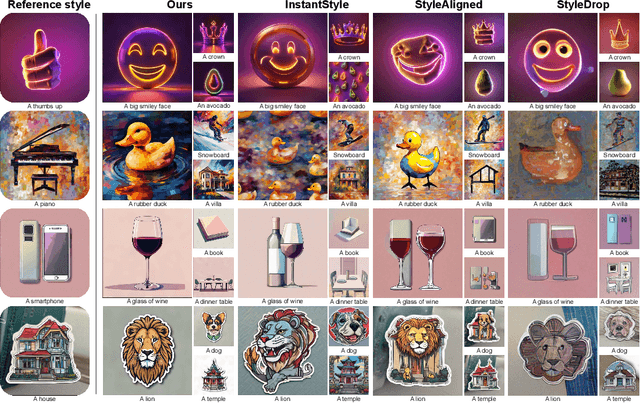
We propose Reference-Based Modulation (RB-Modulation), a new plug-and-play solution for training-free personalization of diffusion models. Existing training-free approaches exhibit difficulties in (a) style extraction from reference images in the absence of additional style or content text descriptions, (b) unwanted content leakage from reference style images, and (c) effective composition of style and content. RB-Modulation is built on a novel stochastic optimal controller where a style descriptor encodes the desired attributes through a terminal cost. The resulting drift not only overcomes the difficulties above, but also ensures high fidelity to the reference style and adheres to the given text prompt. We also introduce a cross-attention-based feature aggregation scheme that allows RB-Modulation to decouple content and style from the reference image. With theoretical justification and empirical evidence, our framework demonstrates precise extraction and control of content and style in a training-free manner. Further, our method allows a seamless composition of content and style, which marks a departure from the dependency on external adapters or ControlNets.
Subtle Biases Need Subtler Measures: Dual Metrics for Evaluating Representative and Affinity Bias in Large Language Models
May 23, 2024


Research on Large Language Models (LLMs) has often neglected subtle biases that, although less apparent, can significantly influence the models' outputs toward particular social narratives. This study addresses two such biases within LLMs: \textit{representative bias}, which denotes a tendency of LLMs to generate outputs that mirror the experiences of certain identity groups, and \textit{affinity bias}, reflecting the models' evaluative preferences for specific narratives or viewpoints. We introduce two novel metrics to measure these biases: the Representative Bias Score (RBS) and the Affinity Bias Score (ABS), and present the Creativity-Oriented Generation Suite (CoGS), a collection of open-ended tasks such as short story writing and poetry composition, designed with customized rubrics to detect these subtle biases. Our analysis uncovers marked representative biases in prominent LLMs, with a preference for identities associated with being white, straight, and men. Furthermore, our investigation of affinity bias reveals distinctive evaluative patterns within each model, akin to `bias fingerprints'. This trend is also seen in human evaluators, highlighting a complex interplay between human and machine bias perceptions.
Beyond Human Data: Scaling Self-Training for Problem-Solving with Language Models
Dec 22, 2023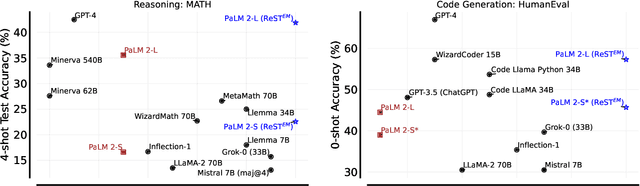
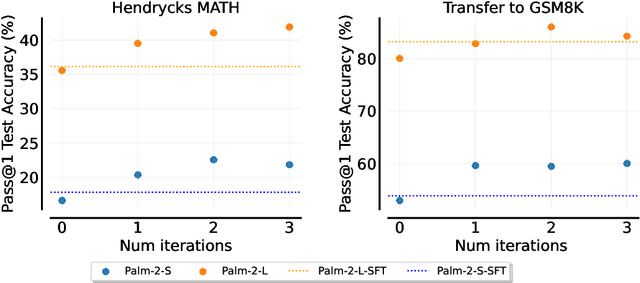
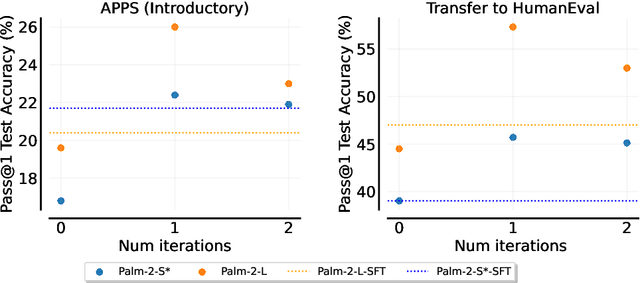
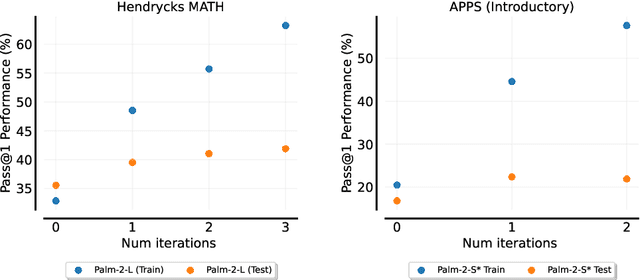
Fine-tuning language models~(LMs) on human-generated data remains a prevalent practice. However, the performance of such models is often limited by the quantity and diversity of high-quality human data. In this paper, we explore whether we can go beyond human data on tasks where we have access to scalar feedback, for example, on math problems where one can verify correctness. To do so, we investigate a simple self-training method based on expectation-maximization, which we call ReST$^{EM}$, where we (1) generate samples from the model and filter them using binary feedback, (2) fine-tune the model on these samples, and (3) repeat this process a few times. Testing on advanced MATH reasoning and APPS coding benchmarks using PaLM-2 models, we find that ReST$^{EM}$ scales favorably with model size and significantly surpasses fine-tuning only on human data. Overall, our findings suggest self-training with feedback can substantially reduce dependence on human-generated data.
Beyond First-Order Tweedie: Solving Inverse Problems using Latent Diffusion
Dec 01, 2023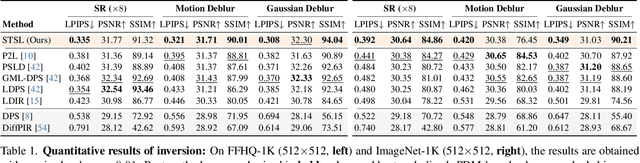
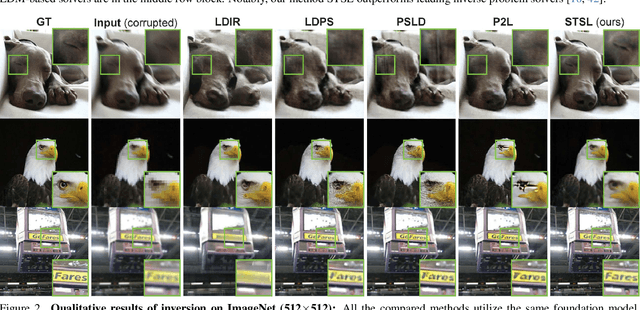
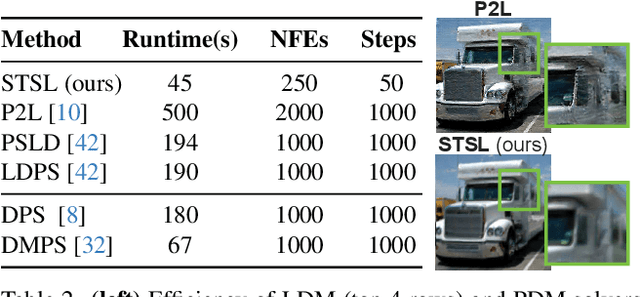
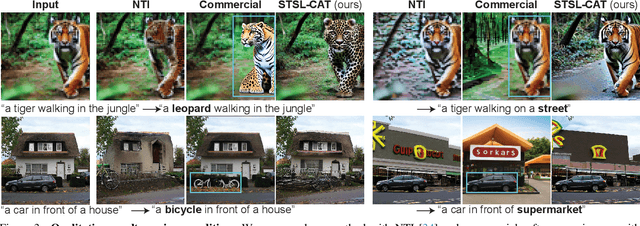
Sampling from the posterior distribution poses a major computational challenge in solving inverse problems using latent diffusion models. Common methods rely on Tweedie's first-order moments, which are known to induce a quality-limiting bias. Existing second-order approximations are impractical due to prohibitive computational costs, making standard reverse diffusion processes intractable for posterior sampling. This paper introduces Second-order Tweedie sampler from Surrogate Loss (STSL), a novel sampler that offers efficiency comparable to first-order Tweedie with a tractable reverse process using second-order approximation. Our theoretical results reveal that the second-order approximation is lower bounded by our surrogate loss that only requires $O(1)$ compute using the trace of the Hessian, and by the lower bound we derive a new drift term to make the reverse process tractable. Our method surpasses SoTA solvers PSLD and P2L, achieving 4X and 8X reduction in neural function evaluations, respectively, while notably enhancing sampling quality on FFHQ, ImageNet, and COCO benchmarks. In addition, we show STSL extends to text-guided image editing and addresses residual distortions present from corrupted images in leading text-guided image editing methods. To our best knowledge, this is the first work to offer an efficient second-order approximation in solving inverse problems using latent diffusion and editing real-world images with corruptions.
Enhancing Clustering Representations with Positive Proximity and Cluster Dispersion Learning
Nov 01, 2023Contemporary deep clustering approaches often rely on either contrastive or non-contrastive techniques to acquire effective representations for clustering tasks. Contrastive methods leverage negative pairs to achieve homogenous representations but can introduce class collision issues, potentially compromising clustering performance. On the contrary, non-contrastive techniques prevent class collisions but may produce non-uniform representations that lead to clustering collapse. In this work, we propose a novel end-to-end deep clustering approach named PIPCDR, designed to harness the strengths of both approaches while mitigating their limitations. PIPCDR incorporates a positive instance proximity loss and a cluster dispersion regularizer. The positive instance proximity loss ensures alignment between augmented views of instances and their sampled neighbors, enhancing within-cluster compactness by selecting genuinely positive pairs within the embedding space. Meanwhile, the cluster dispersion regularizer maximizes inter-cluster distances while minimizing within-cluster compactness, promoting uniformity in the learned representations. PIPCDR excels in producing well-separated clusters, generating uniform representations, avoiding class collision issues, and enhancing within-cluster compactness. We extensively validate the effectiveness of PIPCDR within an end-to-end Majorize-Minimization framework, demonstrating its competitive performance on moderate-scale clustering benchmark datasets and establishing new state-of-the-art results on large-scale datasets.
Player Re-Identification Using Body Part Appearences
Oct 23, 2023
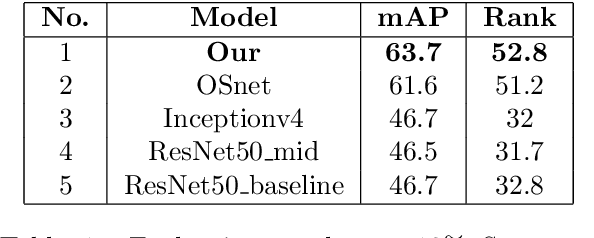

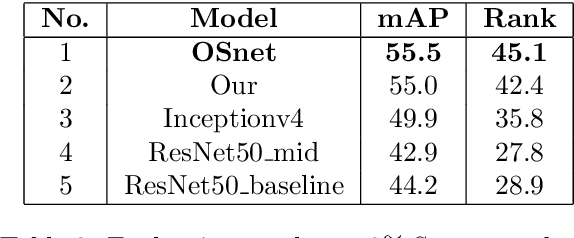
We propose a neural network architecture that learns body part appearances for soccer player re-identification. Our model consists of a two-stream network (one stream for appearance map extraction and the other for body part map extraction) and a bilinear-pooling layer that generates and spatially pools the body part map. Each local feature of the body part map is obtained by a bilinear mapping of the corresponding local appearance and body part descriptors. Our novel representation yields a robust image-matching feature map, which results from combining the local similarities of the relevant body parts with the weighted appearance similarity. Our model does not require any part annotation on the SoccerNet-V3 re-identification dataset to train the network. Instead, we use a sub-network of an existing pose estimation network (OpenPose) to initialize the part substream and then train the entire network to minimize the triplet loss. The appearance stream is pre-trained on the ImageNet dataset, and the part stream is trained from scratch for the SoccerNet-V3 dataset. We demonstrate the validity of our model by showing that it outperforms state-of-the-art models such as OsNet and InceptionNet.
Robust Unsupervised Domain Adaptation by Retaining Confident Entropy via Edge Concatenation
Oct 11, 2023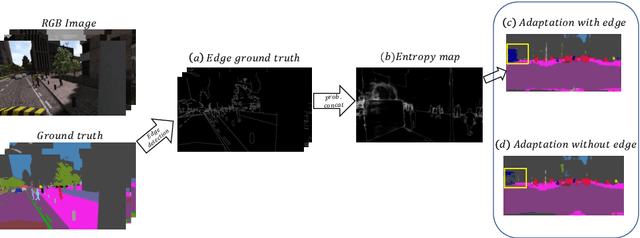
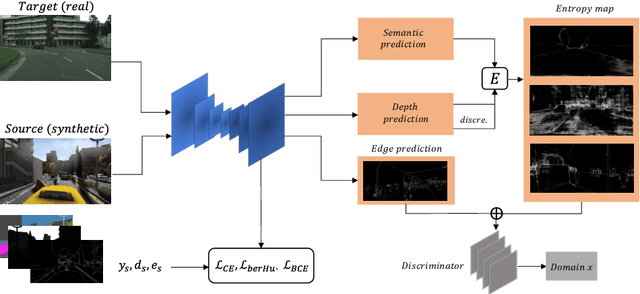
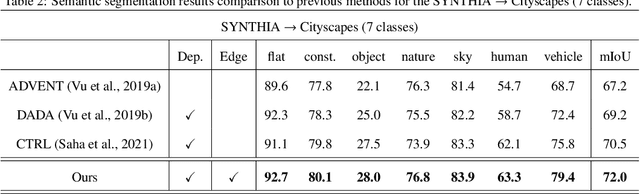
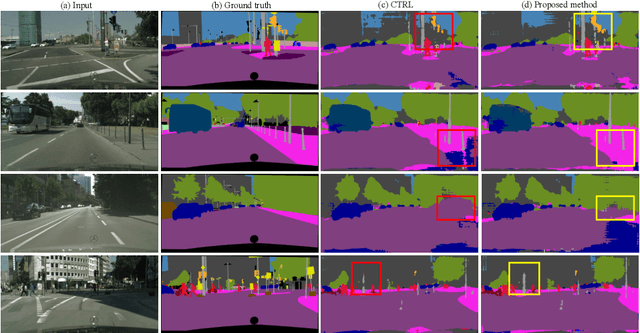
The generalization capability of unsupervised domain adaptation can mitigate the need for extensive pixel-level annotations to train semantic segmentation networks by training models on synthetic data as a source with computer-generated annotations. Entropy-based adversarial networks are proposed to improve source domain prediction; however, they disregard significant external information, such as edges, which have the potential to identify and distinguish various objects within an image accurately. To address this issue, we introduce a novel approach to domain adaptation, leveraging the synergy of internal and external information within entropy-based adversarial networks. In this approach, we enrich the discriminator network with edge-predicted probability values within this innovative framework to enhance the clarity of class boundaries. Furthermore, we devised a probability-sharing network that integrates diverse information for more effective segmentation. Incorporating object edges addresses a pivotal aspect of unsupervised domain adaptation that has frequently been neglected in the past -- the precise delineation of object boundaries. Conventional unsupervised domain adaptation methods usually center around aligning feature distributions and may not explicitly model object boundaries. Our approach effectively bridges this gap by offering clear guidance on object boundaries, thereby elevating the quality of domain adaptation. Our approach undergoes rigorous evaluation on the established unsupervised domain adaptation benchmarks, specifically in adapting SYNTHIA $\rightarrow$ Cityscapes and SYNTHIA $\rightarrow$ Mapillary. Experimental results show that the proposed model attains better performance than state-of-the-art methods. The superior performance across different unsupervised domain adaptation scenarios highlights the versatility and robustness of the proposed method.
Small-scale proxies for large-scale Transformer training instabilities
Sep 25, 2023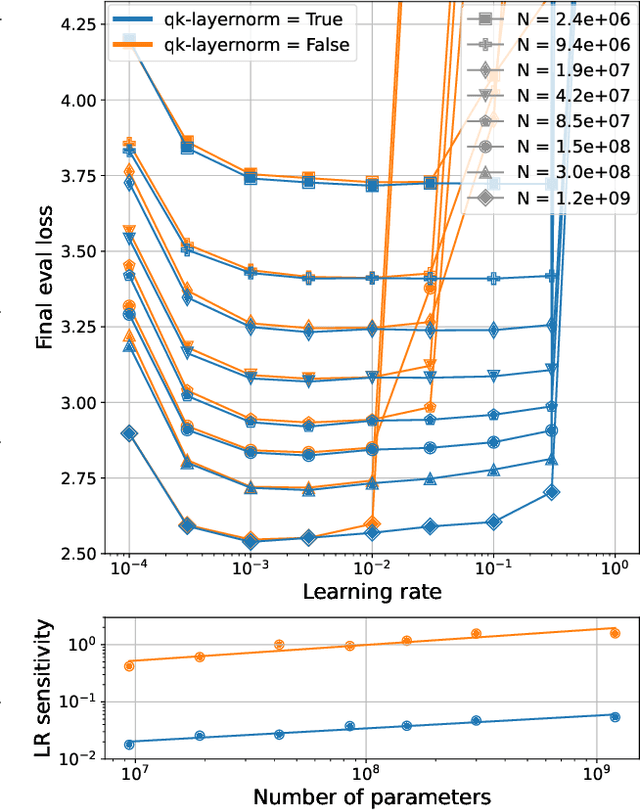


Teams that have trained large Transformer-based models have reported training instabilities at large scale that did not appear when training with the same hyperparameters at smaller scales. Although the causes of such instabilities are of scientific interest, the amount of resources required to reproduce them has made investigation difficult. In this work, we seek ways to reproduce and study training stability and instability at smaller scales. First, we focus on two sources of training instability described in previous work: the growth of logits in attention layers (Dehghani et al., 2023) and divergence of the output logits from the log probabilities (Chowdhery et al., 2022). By measuring the relationship between learning rate and loss across scales, we show that these instabilities also appear in small models when training at high learning rates, and that mitigations previously employed at large scales are equally effective in this regime. This prompts us to investigate the extent to which other known optimizer and model interventions influence the sensitivity of the final loss to changes in the learning rate. To this end, we study methods such as warm-up, weight decay, and the $\mu$Param (Yang et al., 2022), and combine techniques to train small models that achieve similar losses across orders of magnitude of learning rate variation. Finally, to conclude our exploration we study two cases where instabilities can be predicted before they emerge by examining the scaling behavior of model activation and gradient norms.