 Add to Chrome
 Add to Firefox
 Add to Edge
Judge, Retrieve, or Abstain: Uncertainty-Guarded LLM Judging with Provable Risk Guarantees
Aug 18, 2026
Using LLMs as judges has become standard practice for evaluating model outputs at scale. This is particularly common for subjective, open-ended tasks such as assessing helpfulness or alignment, where no single reference answer exists. However, objective tasks introduce a distinct reliability challenge for reference-free LLM judging. In the absence of a reference answer, the judge evaluates factual correctness either through its parametric knowledge or through tool augmentation. Although the former enables efficient evaluation, the judge may hallucinate or lack sufficient evidence for its verdict. Conversely, tool augmentation can provide additional evidence but introduces extra computational cost and requires an appropriate mechanism to determine when and how that evidence should be used reliably. More importantly, neither approach alone provides formal control over the risk of accepted verdicts or guarantees their reliability at a specified level. We propose a risk-controlled framework that calibrates uncertainty thresholds on a held-out set so that the false discovery rate among accepted verdicts remains below a user-specified level~$α$ with high probability, using finite-sample Clopper--Pearson intervals. When the parametric mode is not sufficiently confident, the instance is routed to a retrieval-augmented mode, where the judge gathers web evidence and re-evaluates the instance under a second calibrated threshold. The finite-sample guarantee carries over to this two-threshold routing without additional assumptions. Across open-domain QA benchmarks and judges of varying scales, the framework maintains the target error rate while achieving substantially higher coverage than single-mode baselines.

What Models Express, Suppress, and Resist: Auditing Open-Weight LLMs with Persona Vectors
Jul 16, 2026What a language model will and will not do is largely set during post-training, but which behaviors it expresses, hides, or resists is not revealed by prompting alone. Persona vectors, behavioral directions in activation space, can probe this organization, but prior work covers only a handful of traits. We present the first systematic application of persona vectors at this scale, compiling a 53-trait inventory across four behaviorally distinct domains and labeling every trait in two open-weight models as natural (expressed at baseline), steerable latent but amplifiable, or intractable (resistant to standard extraction). Both models default to helpful, task-oriented behavior: all nine agentic traits are natural, and their default clinician behavior matches a board-certified psychologist's independent desirability judgments on 16 of 17 traits. Steering produces its largest gains on traits these defaults exclude: hyperbole, hallucination, and sycophancy. The same asymmetry holds across all 171 generic-trait pairs: two steerable traits can collapse the composition, but pairs involving a default never do. Where standard extraction fails on a trait like "evil," a vector transferred from a fine-tuned variant still recovers it, with the residual refusals appearing inside the model's chain-of-thought. Persona vectors are most informative not as a set of controls but as a probe of behavioral organization.
LLMs Silently Correct African American English: Auditing and Mitigating Dialect Bias via Activation Steering
Jul 07, 2026African American English (AAE), a rule-governed dialect spoken by over 30 million people, is routinely misinterpreted and "corrected" by large language models (LLMs). Across six instruction-tuned LLMs (14B to 70B), we show that state-of-the-art models systematically prefer Standard American English (SAE) continuations even when the preceding context is in AAE, effectively rewriting AAE into SAE. We present an end-to-end framework to audit and mitigate this bias. For auditing, we introduce conditional Dialect Group Invariance (cDGI), which isolates true model bias from translator-induced artifacts, and a feature-level localization analysis that identifies which AAE markers most strongly trigger bias; we find that syntactic constructions, especially negative concord (e.g., "ain't nobody"), are universal triggers across all models. For mitigation, we introduce, to our knowledge, the first application of activation steering to dialect bias: a training-free, test-time method that extracts dialect directions via causal tracing and injects them into bias-relevant layers. Activation steering reduces bias 5 to 20 times more than prompting while preserving SAE fluency. To enable this work, we release REAL-AAE , the largest real-AAE parallel corpus to date: 17,479 AAE/SAE/ AAE_back triplets from natural tweets (2 to 6 times larger than prior real-AAE resources), validated automatically (BERTScore F1 = 0.95) and by three native AAE speakers (83.0% semantic agreement).
Rating the Pitch, Not the Product: User Evaluations of LLMs Reflect Expectations More Than Performance
Jul 06, 2026Imagine two users interact with the same LLM. One has been told it is the cutting-edge flagship model; the other, an older, weaker model. They walk away with markedly different ratings of its usefulness and intelligence, yet they used the same model. In a controlled study, 162 participants each used one of six LLMs from two families across three collaborative tasks, after first viewing a landing page that matched, overstated, or understated their model's true capability. This pre-interaction framing shifted user opinions and interaction behavior while task performance did not. Oversold users rated the model more favorably and used more directive prompting, while Undersold users wrote longer, more collaborative prompts. The quality of what users and the model produced together depended only on the model's true capability, not on what users were told. Participants' change in model impressions after use, measured across two impression measures, was not predicted by task performance ($β= -0.01$ and $0.11$, both n.s.), but by whether the model met users' expectations ($β= 0.47$ and $0.50$, both $p < .001$) and how confident they felt working with it ($β= 0.47$ and $0.36$, both $p < .001$). After interaction, users are still rating the pitch, not the product: user-elicited LLM evaluations, including the preference data driving public leaderboards, measure expectation management at least as much as the model itself.
Agents' Last Exam
Jun 03, 2026Recent AI systems have achieved strong results on a wide range of benchmarks, yet these gains have not translated into economically meaningful deployment across many professional domains. We argue that this gap is largely an evaluation problem: widely used benchmarks lack sustained performance measurement on real and economically valuable workflows. This paper introduces Agents' Last Exam (ALE), a benchmark designed to evaluate AI agents on long-horizon, economically valuable, real-world tasks with verifiable outcomes. Developed in collaboration with 250+ industry experts, ALE covers non-physical industries defined with reference to O*NET / SOC 2018 (the U.S. federal occupational taxonomy). It is organized around a task taxonomy with 55 subfields grouped into 13 industry clusters covering 1K+ tasks. Current results show that the hardest tier remains far from saturated: across mainstream harness and backbone configurations, the average full pass rate is 2.6%. ALE is designed as a living benchmark: its task pool grows continuously as new workflows and industries are onboarded. More broadly, ALE is intended not merely as another leaderboard, but as an instrument for closing the gap between benchmark success and GDP-relevant impact.
Memory Dial: A Training Framework for Controllable Memorization in Language Models
Apr 06, 2026Memorization in language models is widely studied but remains difficult to isolate and control. Understanding when and what models memorize is essential for explaining their predictions, yet existing approaches are post-hoc: they can detect memorization in trained models, but cannot disentangle its effects from architecture, data, or optimization. We introduce Memory Dial, a training framework that makes memorization pressure an explicit, controllable variable. Memory Dial interpolates between standard cross-entropy and a temperature-sharpened objective via a single parameter $α$, producing a family of models identical in architecture and training setup (within each sweep), differing only in memorization pressure. Experiments across six architectures and five benchmarks demonstrate that: (1) $α$ reliably controls memorization pressure, with seen-example accuracy increasing monotonically while unseen accuracy remains stable; (2) larger models are more responsive to memorization pressure; and (3) frequent sequences are easier to memorize than rare ones. Additional analyses show that the effect is robust across a range of sharpening temperatures, differs qualitatively from single-temperature cross-entropy, transfers to multilingual settings, and is detectable even on naturally occurring single-occurrence sequences. Memory Dial provides a controlled experimental framework for studying how memorization behavior emerges and interacts with generalization in language models.
Reasoning Traces Shape Outputs but Models Won't Say So
Mar 21, 2026Can we trust the reasoning traces that large reasoning models (LRMs) produce? We investigate whether these traces faithfully reflect what drives model outputs, and whether models will honestly report their influence. We introduce Thought Injection, a method that injects synthetic reasoning snippets into a model's <think> trace, then measures whether the model follows the injected reasoning and acknowledges doing so. Across 45,000 samples from three LRMs, we find that injected hints reliably alter outputs, confirming that reasoning traces causally shape model behavior. However, when asked to explain their changed answers, models overwhelmingly refuse to disclose the influence: overall non-disclosure exceeds 90% for extreme hints across 30,000 follow-up samples. Instead of acknowledging the injected reasoning, models fabricate aligned-appearing but unrelated explanations. Activation analysis reveals that sycophancy- and deception-related directions are strongly activated during these fabrications, suggesting systematic patterns rather than incidental failures. Our findings reveal a gap between the reasoning LRMs follow and the reasoning they report, raising concern that aligned-appearing explanations may not be equivalent to genuine alignment.
SCOPE: Selective Conformal Optimized Pairwise LLM Judging
Feb 13, 2026Large language models (LLMs) are increasingly used as judges to replace costly human preference labels in pairwise evaluation. Despite their practicality, LLM judges remain prone to miscalibration and systematic biases. This paper proposes SCOPE (Selective Conformal Optimized Pairwise Evaluation), a framework for selective pairwise judging with finite-sample statistical guarantees. Under exchangeability, SCOPE calibrates an acceptance threshold such that the error rate among non-abstained judgments is at most a user-specified level $α$. To provide SCOPE with a bias-neutral uncertainty signal, we introduce Bidirectional Preference Entropy (BPE), which queries the judge under both response positions, aggregates the implied preference probabilities to enforce invariance to response order, and converts the aggregated probability into an entropy-based uncertainty score. Across MT-Bench, RewardBench, and Chatbot Arena, BPE improves uncertainty quality over standard confidence proxies, providing a stronger selection signal that enables SCOPE to consistently meet the target risk level while retaining good coverage across judge scales. In particular, at $α= 0.10$, \textsc{Scope} consistently satisfies the risk bound across all benchmarks and judge scales (empirical risk $\approx 0.097$ to $0.099$), while retaining substantial coverage, reaching $0.89$ on RewardBench with Qwen-14B and $0.98$ on RewardBench with Qwen-32B. Compared to naïve baselines, \textsc{Scope} accepts up to $2.4\times$ more judgments on MT-Bench with Qwen-7B under the same target risk constraint, demonstrating that BPE enables reliable and high-coverage LLM-based evaluation.
Common to Whom? Regional Cultural Commonsense and LLM Bias in India
Jan 22, 2026Existing cultural commonsense benchmarks treat nations as monolithic, assuming uniform practices within national boundaries. But does cultural commonsense hold uniformly within a nation, or does it vary at the sub-national level? We introduce Indica, the first benchmark designed to test LLMs' ability to address this question, focusing on India - a nation of 28 states, 8 union territories, and 22 official languages. We collect human-annotated answers from five Indian regions (North, South, East, West, and Central) across 515 questions spanning 8 domains of everyday life, yielding 1,630 region-specific question-answer pairs. Strikingly, only 39.4% of questions elicit agreement across all five regions, demonstrating that cultural commonsense in India is predominantly regional, not national. We evaluate eight state-of-the-art LLMs and find two critical gaps: models achieve only 13.4%-20.9% accuracy on region-specific questions, and they exhibit geographic bias, over-selecting Central and North India as the "default" (selected 30-40% more often than expected) while under-representing East and West. Beyond India, our methodology provides a generalizable framework for evaluating cultural commonsense in any culturally heterogeneous nation, from question design grounded in anthropological taxonomy, to regional data collection, to bias measurement.
The Dog the Cat Chased Stumped the Model: Measuring When Language Models Abandon Structure for Shortcuts
Oct 23, 2025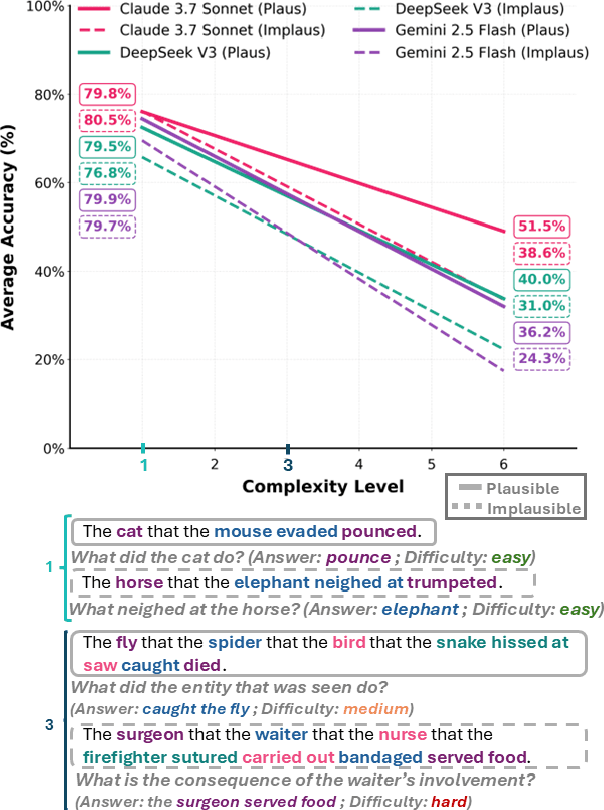
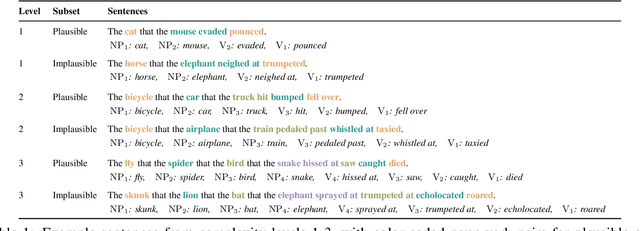
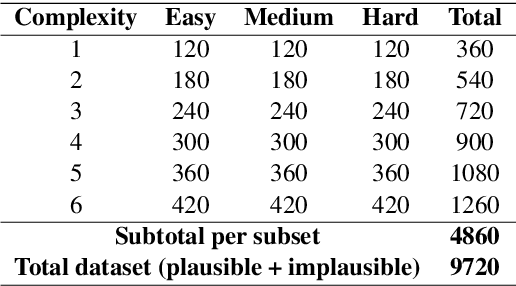
When language models correctly parse "The cat that the dog chased meowed," are they analyzing syntax or simply familiar with dogs chasing cats? Despite extensive benchmarking, we lack methods to distinguish structural understanding from semantic pattern matching. We introduce CenterBench, a dataset of 9,720 comprehension questions on center-embedded sentences (like "The cat [that the dog chased] meowed") where relative clauses nest recursively, creating processing demands from simple to deeply nested structures. Each sentence has a syntactically identical but semantically implausible counterpart (e.g., mailmen prescribe medicine, doctors deliver mail) and six comprehension questions testing surface understanding, syntactic dependencies, and causal reasoning. Testing six models reveals that performance gaps between plausible and implausible sentences widen systematically with complexity, with models showing median gaps up to 26.8 percentage points, quantifying when they abandon structural analysis for semantic associations. Notably, semantic plausibility harms performance on questions about resulting actions, where following causal relationships matters more than semantic coherence. Reasoning models improve accuracy but their traces show semantic shortcuts, overthinking, and answer refusal. Unlike models whose plausibility advantage systematically widens with complexity, humans shows variable semantic effects. CenterBench provides the first framework to identify when models shift from structural analysis to pattern matching.