 Add to Chrome
 Add to Firefox
 Add to Edge
AugCodec: A Low-Bitrate Disentangled Neural Speech Codec via Data Augmentation
Jun 20, 2026
We propose AugCodec, a low-bitrate disentangled neural speech codec that leverages data augmentation to decompose speech into three distinct components: semantic, speaker, and prosody tokens. Specifically, we employ tailored augmenta tion strategies to transform speech into distinct variants, each serving as input for extracting tokens that preserve the target attribute while suppressing others. This disentanglement strategy enables substantial reduction in token rate. Further more, we introduce an augmentation loss that aligns semantic encoder outputs between source and voice-converted speech, encouraging speaker-agnostic embeddings while mitigating the acoustic mismatch induced by voice conversion. Experiments on LibriSpeech test-clean demonstrate that AugCodec significantly outperforms state-of-the-art methods in both reconstruction quality and disentanglement, while operating at only 12.5Hz with three token streams.

Adaptive Turn-Taking for Real-time Multi-Party Voice Agents
Jun 11, 2026Turn-taking in multi-party spoken conversations remains a fundamental challenge for voice-based agents, particularly under dynamic floor competition and varying user expectations. We propose ModeratorLM, a role-playing voice agent that conditions turn-taking behavior on an explicitly assigned role in multi-party settings. The system is built on a speech large language model operating in chunk-wise streaming manner. We further introduce a reasoning-augmented variant that incorporates chain-of-thought reasoning over conversational context and the assigned role. We construct RolePlayConv, a large-scale synthetic dataset of spoken multi-party conversations with diverse assistant roles. Experiments on real-world meeting data and RolePlayConv show improved turn-taking precision by over 40% and recall by more than 70%, while substantially reducing false-positive interruptions compared to non-role-conditioned baselines.
End-to-End Text-to-SQL with Dataset Selection: Leveraging LLMs for Adaptive Query Generation
Aug 08, 2025Text-to-SQL bridges the gap between natural language and structured database language, thus allowing non-technical users to easily query databases. Traditional approaches model text-to-SQL as a direct translation task, where a given Natural Language Query (NLQ) is mapped to an SQL command. Recent advances in large language models (LLMs) have significantly improved translation accuracy, however, these methods all require that the target database is pre-specified. This becomes problematic in scenarios with multiple extensive databases, where identifying the correct database becomes a crucial yet overlooked step. In this paper, we propose a three-stage end-to-end text-to-SQL framework to identify the user's intended database before generating SQL queries. Our approach leverages LLMs and prompt engineering to extract implicit information from natural language queries (NLQs) in the form of a ruleset. We then train a large db\_id prediction model, which includes a RoBERTa-based finetuned encoder, to predict the correct Database identifier (db\_id) based on both the NLQ and the LLM-generated rules. Finally, we refine the generated SQL by using critic agents to correct errors. Experimental results demonstrate that our framework outperforms the current state-of-the-art models in both database intent prediction and SQL generation accuracy.
DOPPLER: Dual-Policy Learning for Device Assignment in Asynchronous Dataflow Graphs
May 29, 2025We study the problem of assigning operations in a dataflow graph to devices to minimize execution time in a work-conserving system, with emphasis on complex machine learning workloads. Prior learning-based methods often struggle due to three key limitations: (1) reliance on bulk-synchronous systems like TensorFlow, which under-utilize devices due to barrier synchronization; (2) lack of awareness of the scheduling mechanism of underlying systems when designing learning-based methods; and (3) exclusive dependence on reinforcement learning, ignoring the structure of effective heuristics designed by experts. In this paper, we propose \textsc{Doppler}, a three-stage framework for training dual-policy networks consisting of 1) a $\mathsf{SEL}$ policy for selecting operations and 2) a $\mathsf{PLC}$ policy for placing chosen operations on devices. Our experiments show that \textsc{Doppler} outperforms all baseline methods across tasks by reducing system execution time and additionally demonstrates sampling efficiency by reducing per-episode training time.
Beyond Speaker Identity: Text Guided Target Speech Extraction
Jan 15, 2025Target Speech Extraction (TSE) traditionally relies on explicit clues about the speaker's identity like enrollment audio, face images, or videos, which may not always be available. In this paper, we propose a text-guided TSE model StyleTSE that uses natural language descriptions of speaking style in addition to the audio clue to extract the desired speech from a given mixture. Our model integrates a speech separation network adapted from SepFormer with a bi-modality clue network that flexibly processes both audio and text clues. To train and evaluate our model, we introduce a new dataset TextrolMix with speech mixtures and natural language descriptions. Experimental results demonstrate that our method effectively separates speech based not only on who is speaking, but also on how they are speaking, enhancing TSE in scenarios where traditional audio clues are absent. Demos are at: https://mingyue66.github.io/TextrolMix/demo/
DiffSign: AI-Assisted Generation of Customizable Sign Language Videos With Enhanced Realism
Dec 05, 2024
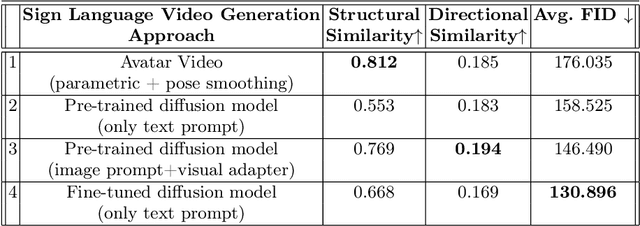


The proliferation of several streaming services in recent years has now made it possible for a diverse audience across the world to view the same media content, such as movies or TV shows. While translation and dubbing services are being added to make content accessible to the local audience, the support for making content accessible to people with different abilities, such as the Deaf and Hard of Hearing (DHH) community, is still lagging. Our goal is to make media content more accessible to the DHH community by generating sign language videos with synthetic signers that are realistic and expressive. Using the same signer for a given media content that is viewed globally may have limited appeal. Hence, our approach combines parametric modeling and generative modeling to generate realistic-looking synthetic signers and customize their appearance based on user preferences. We first retarget human sign language poses to 3D sign language avatars by optimizing a parametric model. The high-fidelity poses from the rendered avatars are then used to condition the poses of synthetic signers generated using a diffusion-based generative model. The appearance of the synthetic signer is controlled by an image prompt supplied through a visual adapter. Our results show that the sign language videos generated using our approach have better temporal consistency and realism than signing videos generated by a diffusion model conditioned only on text prompts. We also support multimodal prompts to allow users to further customize the appearance of the signer to accommodate diversity (e.g. skin tone, gender). Our approach is also useful for signer anonymization.
Prompt Tuning Strikes Back: Customizing Foundation Models with Low-Rank Prompt Adaptation
May 24, 2024
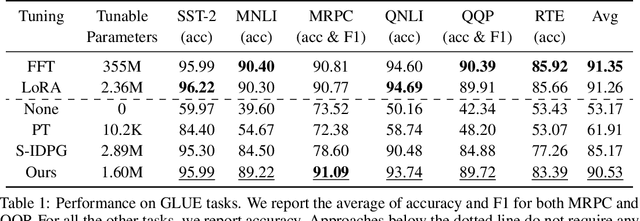


Parameter-Efficient Fine-Tuning (PEFT) has become the standard for customising Foundation Models (FMs) to user-specific downstream tasks. However, typical PEFT methods require storing multiple task-specific adapters, creating scalability issues as these adapters must be housed and run at the FM server. Traditional prompt tuning offers a potential solution by customising them through task-specific input prefixes, but it under-performs compared to other PEFT methods like LoRA. To address this gap, we propose Low-Rank Prompt Adaptation (LOPA), a prompt-tuning-based approach that performs on par with state-of-the-art PEFT methods and full fine-tuning while being more parameter-efficient and not requiring a server-based adapter. LOPA generates soft prompts by balancing between sharing task-specific information across instances and customization for each instance. It uses a low-rank decomposition of the soft-prompt component encoded for each instance to achieve parameter efficiency. We provide a comprehensive evaluation on multiple natural language understanding and code generation and understanding tasks across a wide range of foundation models with varying sizes.
Uncovering implementable dormant pruning decisions from three different stakeholder perspectives
May 07, 2024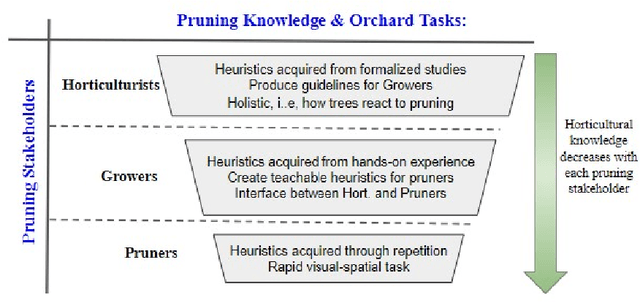
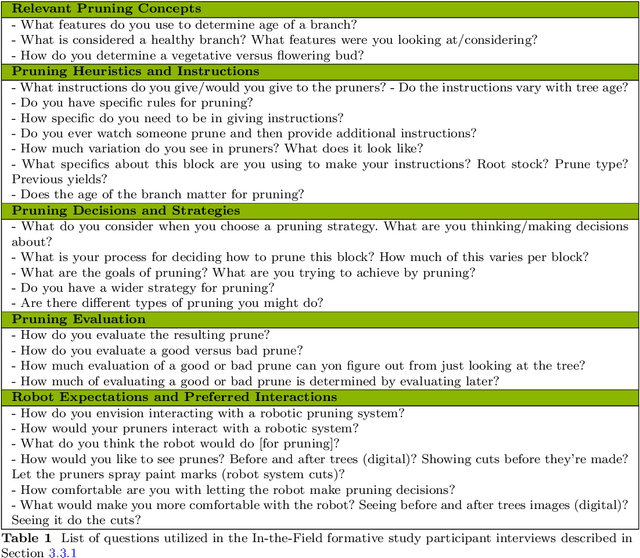
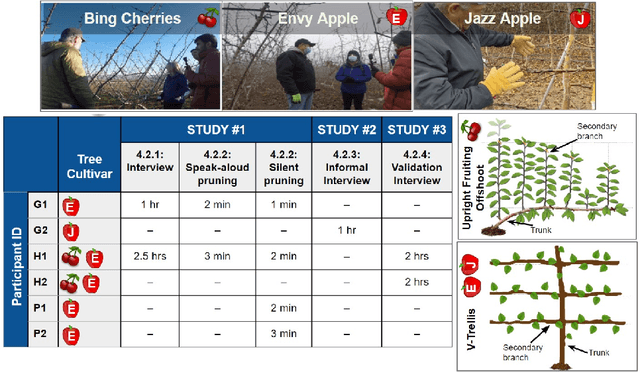
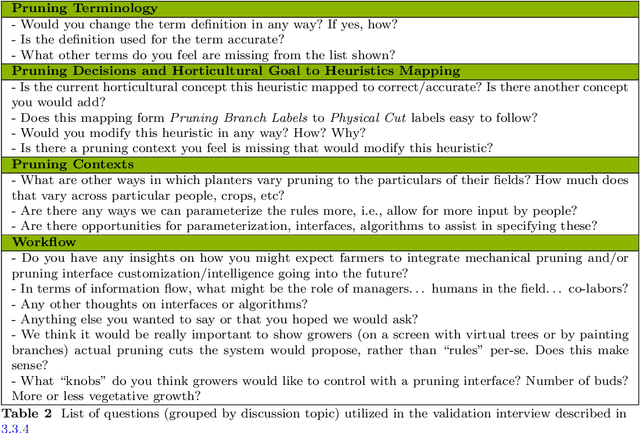
Dormant pruning, or the removal of unproductive portions of a tree while a tree is not actively growing, is an important orchard task to help maintain yield, requiring years to build expertise. Because of long training periods and an increasing labor shortage in agricultural jobs, pruning could benefit from robotic automation. However, to program robots to prune branches, we first need to understand how pruning decisions are made, and what variables in the environment (e.g., branch size and thickness) we need to capture. Working directly with three pruning stakeholders -- horticulturists, growers, and pruners -- we find that each group of human experts approaches pruning decision-making differently. To capture this knowledge, we present three studies and two extracted pruning protocols from field work conducted in Prosser, Washington in January 2022 and 2023. We interviewed six stakeholders (two in each group) and observed pruning across three cultivars -- Bing Cherries, Envy Apples, and Jazz Apples -- and two tree architectures -- Upright Fruiting Offshoot and V-Trellis. Leveraging participant interviews and video data, this analysis uses grounded coding to extract pruning terminology, discover horticultural contexts that influence pruning decisions, and find implementable pruning heuristics for autonomous systems. The results include a validated terminology set, which we offer for use by both pruning stakeholders and roboticists, to communicate general pruning concepts and heuristics. The results also highlight seven pruning heuristics utilizing this terminology set that would be relevant for use by future autonomous robot pruning systems, and characterize three discovered horticultural contexts (i.e., environmental management, crop-load management, and replacement wood) across all three cultivars.
GO-DICE: Goal-Conditioned Option-Aware Offline Imitation Learning via Stationary Distribution Correction Estimation
Dec 17, 2023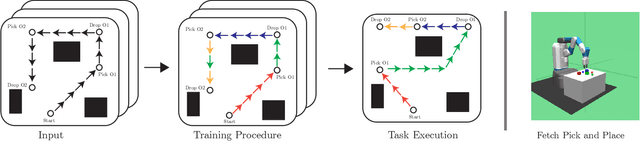
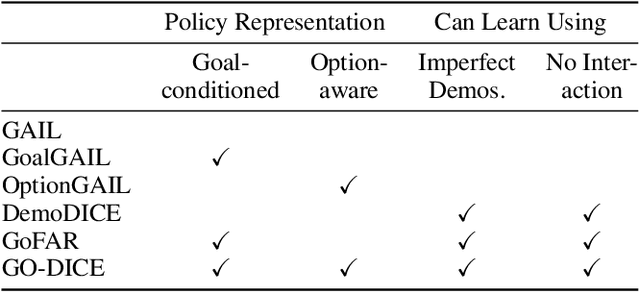
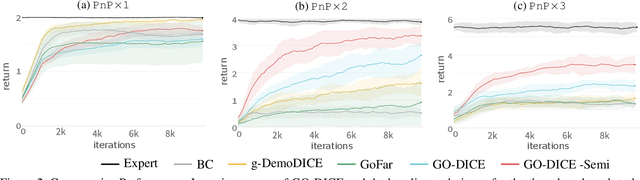
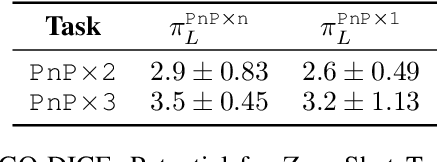
Offline imitation learning (IL) refers to learning expert behavior solely from demonstrations, without any additional interaction with the environment. Despite significant advances in offline IL, existing techniques find it challenging to learn policies for long-horizon tasks and require significant re-training when task specifications change. Towards addressing these limitations, we present GO-DICE an offline IL technique for goal-conditioned long-horizon sequential tasks. GO-DICE discerns a hierarchy of sub-tasks from demonstrations and uses these to learn separate policies for sub-task transitions and action execution, respectively; this hierarchical policy learning facilitates long-horizon reasoning. Inspired by the expansive DICE-family of techniques, policy learning at both the levels transpires within the space of stationary distributions. Further, both policies are learnt with goal conditioning to minimize need for retraining when task goals change. Experimental results substantiate that GO-DICE outperforms recent baselines, as evidenced by a marked improvement in the completion rate of increasingly challenging pick-and-place Mujoco robotic tasks. GO-DICE is also capable of leveraging imperfect demonstration and partial task segmentation when available, both of which boost task performance relative to learning from expert demonstrations alone.
Two Timin': Repairing Smart Contracts With A Two-Layered Approach
Sep 14, 2023Due to the modern relevance of blockchain technology, smart contracts present both substantial risks and benefits. Vulnerabilities within them can trigger a cascade of consequences, resulting in significant losses. Many current papers primarily focus on classifying smart contracts for malicious intent, often relying on limited contract characteristics, such as bytecode or opcode. This paper proposes a novel, two-layered framework: 1) classifying and 2) directly repairing malicious contracts. Slither's vulnerability report is combined with source code and passed through a pre-trained RandomForestClassifier (RFC) and Large Language Models (LLMs), classifying and repairing each suggested vulnerability. Experiments demonstrate the effectiveness of fine-tuned and prompt-engineered LLMs. The smart contract repair models, built from pre-trained GPT-3.5-Turbo and fine-tuned Llama-2-7B models, reduced the overall vulnerability count by 97.5% and 96.7% respectively. A manual inspection of repaired contracts shows that all retain functionality, indicating that the proposed method is appropriate for automatic batch classification and repair of vulnerabilities in smart contracts.