 Add to Chrome
 Add to Firefox
 Add to Edge
Legged Autonomous Surface Science In Analogue Environments (LASSIE): Making Every Robotic Step Count in Planetary Exploration
Mar 20, 2026
The ability to efficiently and effectively explore planetary surfaces is currently limited by the capability of wheeled rovers to traverse challenging terrains, and by pre-programmed data acquisition plans with limited in-situ flexibility. In this paper, we present two novel approaches to address these limitations: (i) high-mobility legged robots that use direct surface interactions to collect rich information about the terrain's mechanics to guide exploration; (ii) human-inspired data acquisition algorithms that enable robots to reason about scientific hypotheses and adapt exploration priorities based on incoming ground-sensing measurements. We successfully verify our approach through lab work and field deployments in two planetary analog environments. The new capability for legged robots to measure soil mechanical properties is shown to enable effective traversal of challenging terrains. When coupled with other geologic properties (e.g., composition, thermal properties, and grain size data etc), soil mechanical measurements reveal key factors governing the formation and development of geologic environments. We then demonstrate how human-inspired algorithms turn terrain-sensing robots into teammates, by supporting more flexible and adaptive data collection decisions with human scientists. Our approach therefore enables exploration of a wider range of planetary environments and new substrate investigation opportunities through integrated human-robot systems that support maximum scientific return.

Uncovering implementable dormant pruning decisions from three different stakeholder perspectives
May 07, 2024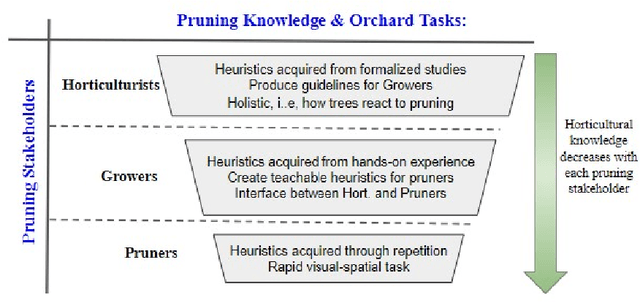

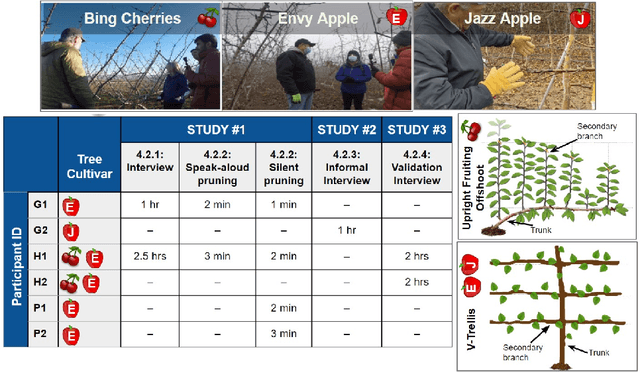
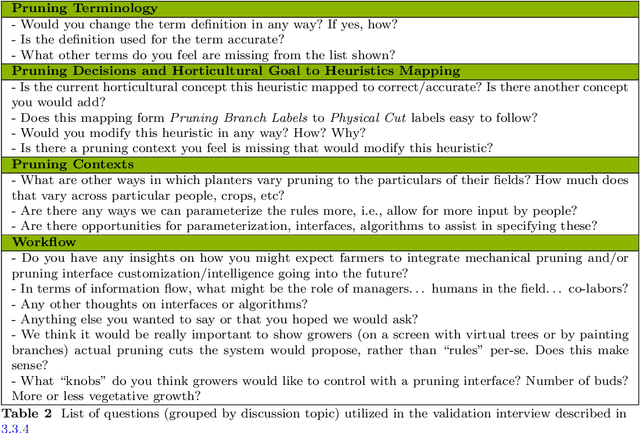
Dormant pruning, or the removal of unproductive portions of a tree while a tree is not actively growing, is an important orchard task to help maintain yield, requiring years to build expertise. Because of long training periods and an increasing labor shortage in agricultural jobs, pruning could benefit from robotic automation. However, to program robots to prune branches, we first need to understand how pruning decisions are made, and what variables in the environment (e.g., branch size and thickness) we need to capture. Working directly with three pruning stakeholders -- horticulturists, growers, and pruners -- we find that each group of human experts approaches pruning decision-making differently. To capture this knowledge, we present three studies and two extracted pruning protocols from field work conducted in Prosser, Washington in January 2022 and 2023. We interviewed six stakeholders (two in each group) and observed pruning across three cultivars -- Bing Cherries, Envy Apples, and Jazz Apples -- and two tree architectures -- Upright Fruiting Offshoot and V-Trellis. Leveraging participant interviews and video data, this analysis uses grounded coding to extract pruning terminology, discover horticultural contexts that influence pruning decisions, and find implementable pruning heuristics for autonomous systems. The results include a validated terminology set, which we offer for use by both pruning stakeholders and roboticists, to communicate general pruning concepts and heuristics. The results also highlight seven pruning heuristics utilizing this terminology set that would be relevant for use by future autonomous robot pruning systems, and characterize three discovered horticultural contexts (i.e., environmental management, crop-load management, and replacement wood) across all three cultivars.