 Add to Chrome
 Add to Firefox
 Add to Edge
magic
Papers and Code
Centering the Value of Every Modality: Towards Efficient and Resilient Modality-agnostic Semantic Segmentation
Jul 16, 2024
Fusing an arbitrary number of modalities is vital for achieving robust multi-modal fusion of semantic segmentation yet remains less explored to date. Recent endeavors regard RGB modality as the center and the others as the auxiliary, yielding an asymmetric architecture with two branches. However, the RGB modality may struggle in certain circumstances, e.g., nighttime, while others, e.g., event data, own their merits; thus, it is imperative for the fusion model to discern robust and fragile modalities, and incorporate the most robust and fragile ones to learn a resilient multi-modal framework. To this end, we propose a novel method, named MAGIC, that can be flexibly paired with various backbones, ranging from compact to high-performance models. Our method comprises two key plug-and-play modules. Firstly, we introduce a multi-modal aggregation module to efficiently process features from multi-modal batches and extract complementary scene information. On top, a unified arbitrary-modal selection module is proposed to utilize the aggregated features as the benchmark to rank the multi-modal features based on the similarity scores. This way, our method can eliminate the dependence on RGB modality and better overcome sensor failures while ensuring the segmentation performance. Under the commonly considered multi-modal setting, our method achieves state-of-the-art performance while reducing the model parameters by 60%. Moreover, our method is superior in the novel modality-agnostic setting, where it outperforms prior arts by a large margin of +19.41% mIoU

Amazing Things Come From Having Many Good Models
Jul 10, 2024
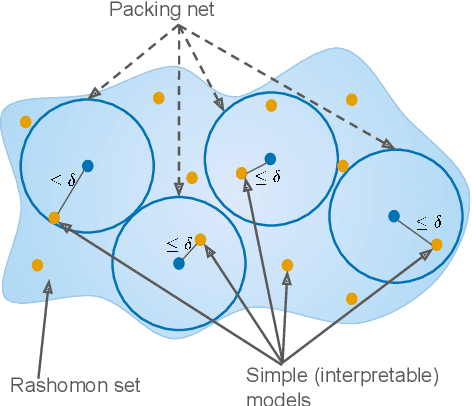
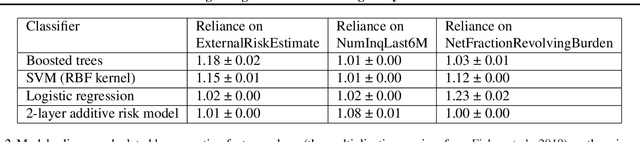

The Rashomon Effect, coined by Leo Breiman, describes the phenomenon that there exist many equally good predictive models for the same dataset. This phenomenon happens for many real datasets and when it does, it sparks both magic and consternation, but mostly magic. In light of the Rashomon Effect, this perspective piece proposes reshaping the way we think about machine learning, particularly for tabular data problems in the nondeterministic (noisy) setting. We address how the Rashomon Effect impacts (1) the existence of simple-yet-accurate models, (2) flexibility to address user preferences, such as fairness and monotonicity, without losing performance, (3) uncertainty in predictions, fairness, and explanations, (4) reliable variable importance, (5) algorithm choice, specifically, providing advanced knowledge of which algorithms might be suitable for a given problem, and (6) public policy. We also discuss a theory of when the Rashomon Effect occurs and why. Our goal is to illustrate how the Rashomon Effect can have a massive impact on the use of machine learning for complex problems in society.
Learning With Generalised Card Representations for "Magic: The Gathering"
Jul 08, 2024A defining feature of collectable card games is the deck building process prior to actual gameplay, in which players form their decks according to some restrictions. Learning to build decks is difficult for players and models alike due to the large card variety and highly complex semantics, as well as requiring meaningful card and deck representations when aiming to utilise AI. In addition, regular releases of new card sets lead to unforeseeable fluctuations in the available card pool, thus affecting possible deck configurations and requiring continuous updates. Previous Game AI approaches to building decks have often been limited to fixed sets of possible cards, which greatly limits their utility in practice. In this work, we explore possible card representations that generalise to unseen cards, thus greatly extending the real-world utility of AI-based deck building for the game "Magic: The Gathering".We study such representations based on numerical, nominal, and text-based features of cards, card images, and meta information about card usage from third-party services. Our results show that while the particular choice of generalised input representation has little effect on learning to predict human card selections among known cards, the performance on new, unseen cards can be greatly improved. Our generalised model is able to predict 55\% of human choices on completely unseen cards, thus showing a deep understanding of card quality and strategy.
Magic Insert: Style-Aware Drag-and-Drop
Jul 02, 2024We present Magic Insert, a method for dragging-and-dropping subjects from a user-provided image into a target image of a different style in a physically plausible manner while matching the style of the target image. This work formalizes the problem of style-aware drag-and-drop and presents a method for tackling it by addressing two sub-problems: style-aware personalization and realistic object insertion in stylized images. For style-aware personalization, our method first fine-tunes a pretrained text-to-image diffusion model using LoRA and learned text tokens on the subject image, and then infuses it with a CLIP representation of the target style. For object insertion, we use Bootstrapped Domain Adaption to adapt a domain-specific photorealistic object insertion model to the domain of diverse artistic styles. Overall, the method significantly outperforms traditional approaches such as inpainting. Finally, we present a dataset, SubjectPlop, to facilitate evaluation and future progress in this area. Project page: https://magicinsert.github.io/
MAGIC: Meta-Ability Guided Interactive Chain-of-Distillation for Effective-and-Efficient Vision-and-Language Navigation
Jun 25, 2024Despite the remarkable developments of recent large models in Embodied Artificial Intelligence (E-AI), their integration into robotics is hampered by their excessive parameter sizes and computational demands. Towards the Vision-and-Language Navigation (VLN) task, a core task in E-AI, this paper reveals the great potential of using knowledge distillation for obtaining lightweight student models by proposing a Meta-Ability Guided Interactive Chain-of-distillation (MAGIC) method. Specifically, a Meta-Ability Knowledge Distillation (MAKD) framework is proposed for decoupling and refining the necessary meta-abilities of VLN agents. A Meta-Knowledge Randomization Weighting (MKRW) and a Meta-Knowledge Transferable Determination (MKTD) module are incorporated to dynamically adjust aggregation weights at the meta-ability and sample levels, respectively. Move beyond the traditional one-step unidirectional distillation, an Interactive Chain-of-Distillation (ICoD) learning strategy is proposed to allow students to give feedback to teachers, forming a new multi-step teacher-student co-evolution pipeline. Remarkably, on the R2R test unseen public leaderboard, our smallest model, MAGIC-S, with only 5% (11M) of the teacher's size, outperforms all previous methods under the same training data. Additionally, our largest model, MAGIC-L, surpasses the previous state-of-the-art by 5.84% in SPL and 3.18% in SR. Furthermore, a new dataset was collected and annotated from our living environments, where MAGIC-S demonstrated superior performance and real-time efficiency. Our code is publicly available on https://github.com/CrystalSixone/VLN-MAGIC.
MAGIC: Generating Self-Correction Guideline for In-Context Text-to-SQL
Jun 18, 2024Self-correction in text-to-SQL is the process of prompting large language model (LLM) to revise its previously incorrectly generated SQL, and commonly relies on manually crafted self-correction guidelines by human experts that are not only labor-intensive to produce but also limited by the human ability in identifying all potential error patterns in LLM responses. We introduce MAGIC, a novel multi-agent method that automates the creation of the self-correction guideline. MAGIC uses three specialized agents: a manager, a correction, and a feedback agent. These agents collaborate on the failures of an LLM-based method on the training set to iteratively generate and refine a self-correction guideline tailored to LLM mistakes, mirroring human processes but without human involvement. Our extensive experiments show that MAGIC's guideline outperforms expert human's created ones. We empirically find out that the guideline produced by MAGIC enhance the interpretability of the corrections made, providing insights in analyzing the reason behind the failures and successes of LLMs in self-correction. We make all agent interactions publicly available to the research community, to foster further research in this area, offering a synthetic dataset for future explorations into automatic self-correction guideline generation.
SAGA: Synthesis Augmentation with Genetic Algorithms for In-Memory Sequence Optimization
Jun 14, 2024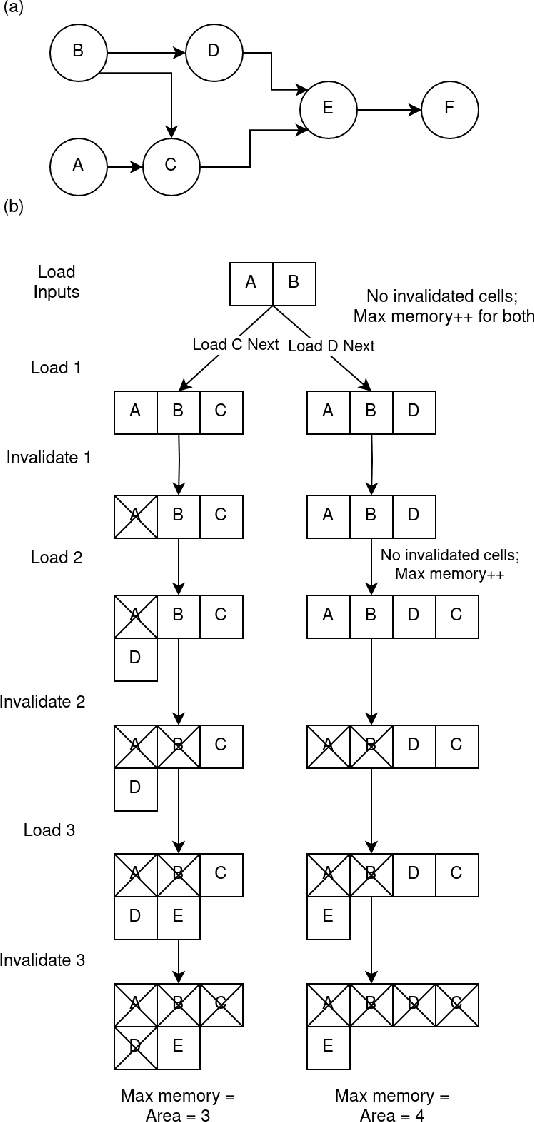
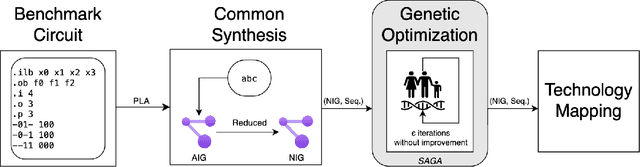
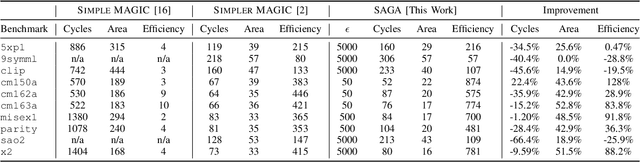
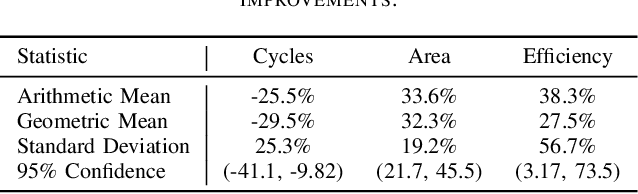
The von-Neumann architecture has a bottleneck which limits the speed at which data can be made available for computation. To combat this problem, novel paradigms for computing are being developed. One such paradigm, known as in-memory computing, interleaves computation with the storage of data within the same circuits. MAGIC, or Memristor Aided Logic, is an approach which uses memory circuits which physically perform computation through write operations to memory. Sequencing these operations is a computationally difficult problem which is directly correlated with the cost of solutions using MAGIC based in-memory computation. SAGA models the execution sequences as a topological sorting problem which makes the optimization well-suited for genetic algorithms. We then detail the formation and implementation of these genetic algorithms and evaluate them over a number of open circuit implementations. The memory-footprint needed for evaluating each of these circuits is decreased by up to 52% from existing, greedy-algorithm-based optimization solutions. Over the 10 benchmark circuits evaluated, these modifications lead to an overall improvement in the efficiency of in-memory circuit evaluation of 128% in the best case and 27.5% on average.
Open-World Human-Object Interaction Detection via Multi-modal Prompts
Jun 11, 2024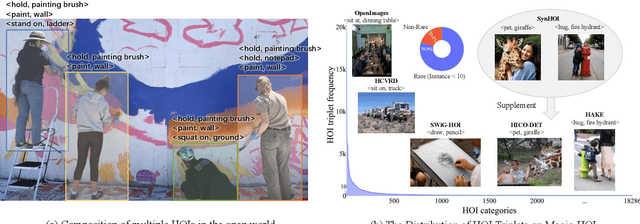
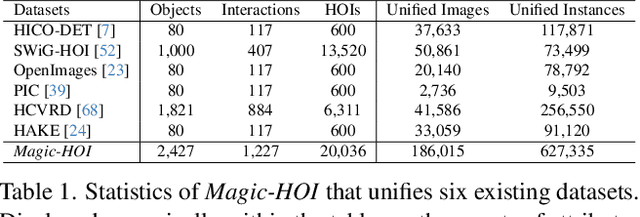
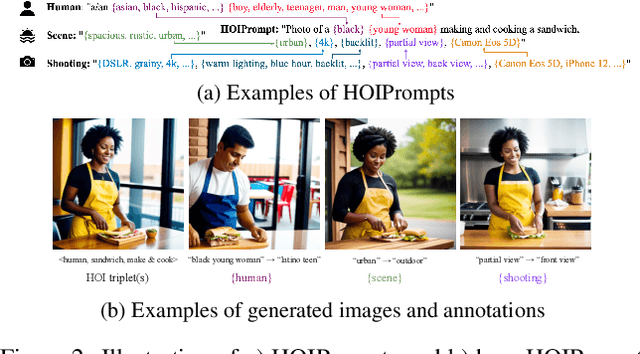
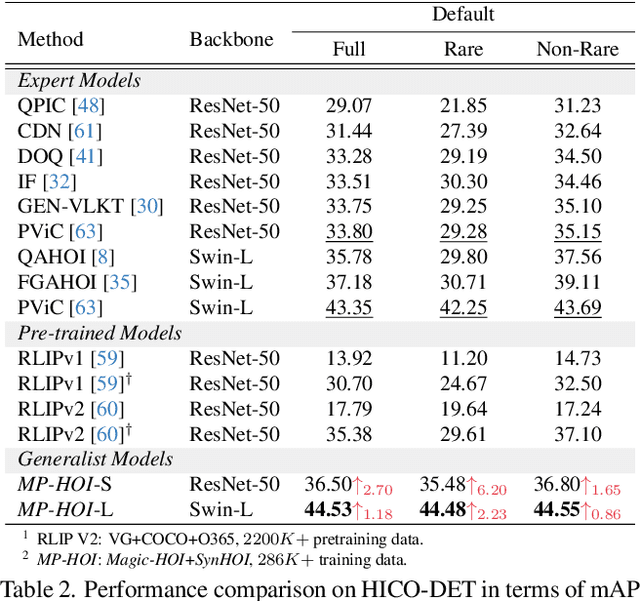
In this paper, we develop \textbf{MP-HOI}, a powerful Multi-modal Prompt-based HOI detector designed to leverage both textual descriptions for open-set generalization and visual exemplars for handling high ambiguity in descriptions, realizing HOI detection in the open world. Specifically, it integrates visual prompts into existing language-guided-only HOI detectors to handle situations where textual descriptions face difficulties in generalization and to address complex scenarios with high interaction ambiguity. To facilitate MP-HOI training, we build a large-scale HOI dataset named Magic-HOI, which gathers six existing datasets into a unified label space, forming over 186K images with 2.4K objects, 1.2K actions, and 20K HOI interactions. Furthermore, to tackle the long-tail issue within the Magic-HOI dataset, we introduce an automated pipeline for generating realistically annotated HOI images and present SynHOI, a high-quality synthetic HOI dataset containing 100K images. Leveraging these two datasets, MP-HOI optimizes the HOI task as a similarity learning process between multi-modal prompts and objects/interactions via a unified contrastive loss, to learn generalizable and transferable objects/interactions representations from large-scale data. MP-HOI could serve as a generalist HOI detector, surpassing the HOI vocabulary of existing expert models by more than 30 times. Concurrently, our results demonstrate that MP-HOI exhibits remarkable zero-shot capability in real-world scenarios and consistently achieves a new state-of-the-art performance across various benchmarks.
Navigating Efficiency in MobileViT through Gaussian Process on Global Architecture Factors
Jun 07, 2024Numerous techniques have been meticulously designed to achieve optimal architectures for convolutional neural networks (CNNs), yet a comparable focus on vision transformers (ViTs) has been somewhat lacking. Despite the remarkable success of ViTs in various vision tasks, their heavyweight nature presents challenges of computational costs. In this paper, we leverage the Gaussian process to systematically explore the nonlinear and uncertain relationship between performance and global architecture factors of MobileViT, such as resolution, width, and depth including the depth of in-verted residual blocks and the depth of ViT blocks, and joint factors including resolution-depth and resolution-width. We present design principles twisting magic 4D cube of the global architecture factors that minimize model sizes and computational costs with higher model accuracy. We introduce a formula for downsizing architectures by iteratively deriving smaller MobileViT V2, all while adhering to a specified constraint of multiply-accumulate operations (MACs). Experiment results show that our formula significantly outperforms CNNs and mobile ViTs across diversified datasets
L-MAGIC: Language Model Assisted Generation of Images with Coherence
Jun 03, 2024In the current era of generative AI breakthroughs, generating panoramic scenes from a single input image remains a key challenge. Most existing methods use diffusion-based iterative or simultaneous multi-view inpainting. However, the lack of global scene layout priors leads to subpar outputs with duplicated objects (e.g., multiple beds in a bedroom) or requires time-consuming human text inputs for each view. We propose L-MAGIC, a novel method leveraging large language models for guidance while diffusing multiple coherent views of 360 degree panoramic scenes. L-MAGIC harnesses pre-trained diffusion and language models without fine-tuning, ensuring zero-shot performance. The output quality is further enhanced by super-resolution and multi-view fusion techniques. Extensive experiments demonstrate that the resulting panoramic scenes feature better scene layouts and perspective view rendering quality compared to related works, with >70% preference in human evaluations. Combined with conditional diffusion models, L-MAGIC can accept various input modalities, including but not limited to text, depth maps, sketches, and colored scripts. Applying depth estimation further enables 3D point cloud generation and dynamic scene exploration with fluid camera motion. Code is available at https://github.com/IntelLabs/MMPano. The video presentation is available at https://youtu.be/XDMNEzH4-Ec?list=PLG9Zyvu7iBa0-a7ccNLO8LjcVRAoMn57s.