 Add to Chrome
 Add to Firefox
 Add to Edge
Weakly Supervised Semantic Segmentation
Papers and Code
Enhancing Weakly Supervised Semantic Segmentation with Multi-modal Foundation Models: An End-to-End Approach
May 10, 2024
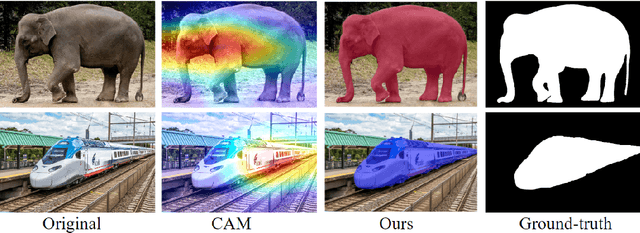
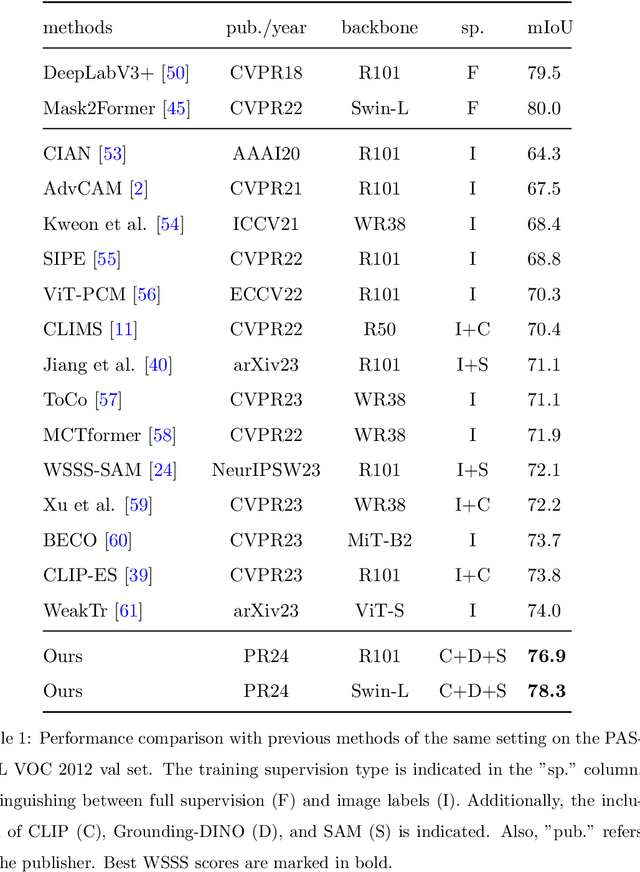

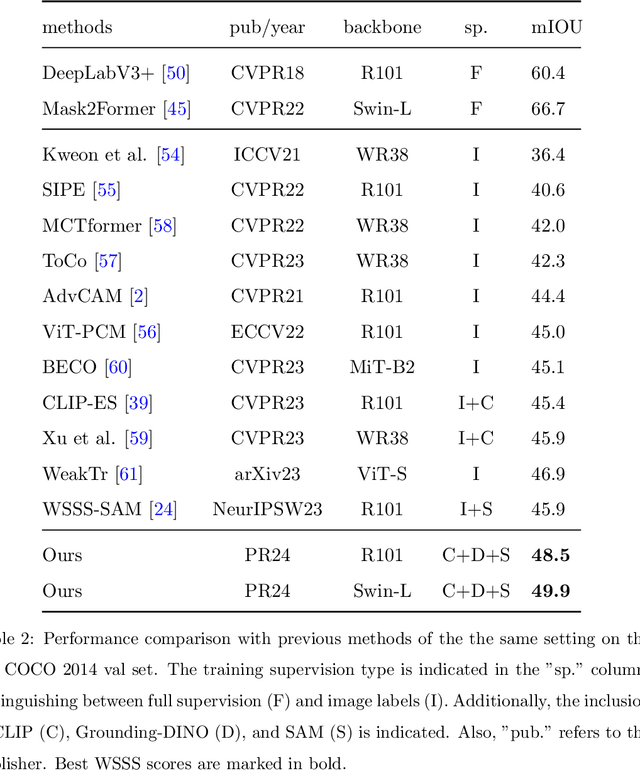
Semantic segmentation is a core computer vision problem, but the high costs of data annotation have hindered its wide application. Weakly-Supervised Semantic Segmentation (WSSS) offers a cost-efficient workaround to extensive labeling in comparison to fully-supervised methods by using partial or incomplete labels. Existing WSSS methods have difficulties in learning the boundaries of objects leading to poor segmentation results. We propose a novel and effective framework that addresses these issues by leveraging visual foundation models inside the bounding box. Adopting a two-stage WSSS framework, our proposed network consists of a pseudo-label generation module and a segmentation module. The first stage leverages Segment Anything Model (SAM) to generate high-quality pseudo-labels. To alleviate the problem of delineating precise boundaries, we adopt SAM inside the bounding box with the help of another pre-trained foundation model (e.g., Grounding-DINO). Furthermore, we eliminate the necessity of using the supervision of image labels, by employing CLIP in classification. Then in the second stage, the generated high-quality pseudo-labels are used to train an off-the-shelf segmenter that achieves the state-of-the-art performance on PASCAL VOC 2012 and MS COCO 2014.

DHR: Dual Features-Driven Hierarchical Rebalancing in Inter- and Intra-Class Regions for Weakly-Supervised Semantic Segmentation
Mar 30, 2024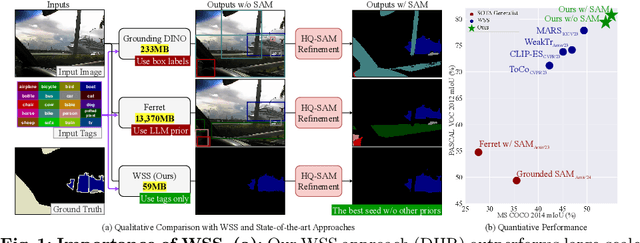

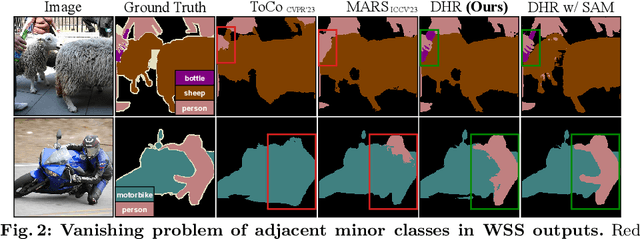
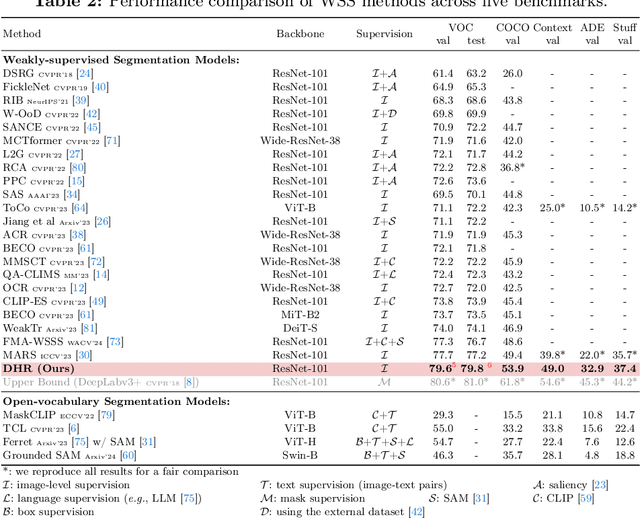
Weakly-supervised semantic segmentation (WSS) ensures high-quality segmentation with limited data and excels when employed as input seed masks for large-scale vision models such as Segment Anything. However, WSS faces challenges related to minor classes since those are overlooked in images with adjacent multiple classes, a limitation originating from the overfitting of traditional expansion methods like Random Walk. We first address this by employing unsupervised and weakly-supervised feature maps instead of conventional methodologies, allowing for hierarchical mask enhancement. This method distinctly categorizes higher-level classes and subsequently separates their associated lower-level classes, ensuring all classes are correctly restored in the mask without losing minor ones. Our approach, validated through extensive experimentation, significantly improves WSS across five benchmarks (VOC: 79.8\%, COCO: 53.9\%, Context: 49.0\%, ADE: 32.9\%, Stuff: 37.4\%), reducing the gap with fully supervised methods by over 84\% on the VOC validation set. Code is available at https://github.com/shjo-april/DHR.
Rethinking Saliency-Guided Weakly-Supervised Semantic Segmentation
Apr 02, 2024This paper presents a fresh perspective on the role of saliency maps in weakly-supervised semantic segmentation (WSSS) and offers new insights and research directions based on our empirical findings. We conduct comprehensive experiments and observe that the quality of the saliency map is a critical factor in saliency-guided WSSS approaches. Nonetheless, we find that the saliency maps used in previous works are often arbitrarily chosen, despite their significant impact on WSSS. Additionally, we observe that the choice of the threshold, which has received less attention before, is non-trivial in WSSS. To facilitate more meaningful and rigorous research for saliency-guided WSSS, we introduce \texttt{WSSS-BED}, a standardized framework for conducting research under unified conditions. \texttt{WSSS-BED} provides various saliency maps and activation maps for seven WSSS methods, as well as saliency maps from unsupervised salient object detection models.
INSIGHT: Explainable Weakly-Supervised Medical Image Analysis
Dec 02, 2024

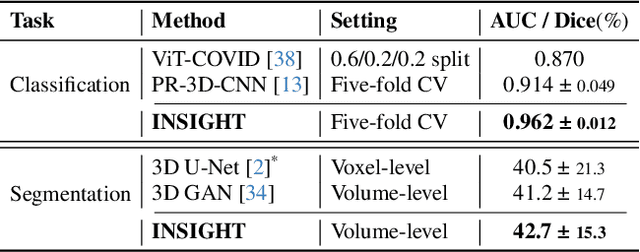

Due to their large sizes, volumetric scans and whole-slide pathology images (WSIs) are often processed by extracting embeddings from local regions and then an aggregator makes predictions from this set. However, current methods require post-hoc visualization techniques (e.g., Grad-CAM) and often fail to localize small yet clinically crucial details. To address these limitations, we introduce INSIGHT, a novel weakly-supervised aggregator that integrates heatmap generation as an inductive bias. Starting from pre-trained feature maps, INSIGHT employs a detection module with small convolutional kernels to capture fine details and a context module with a broader receptive field to suppress local false positives. The resulting internal heatmap highlights diagnostically relevant regions. On CT and WSI benchmarks, INSIGHT achieves state-of-the-art classification results and high weakly-labeled semantic segmentation performance. Project website and code are available at: https://zhangdylan83.github.io/ewsmia/
Weakly supervised deep learning model with size constraint for prostate cancer detection in multiparametric MRI and generalization to unseen domains
Nov 04, 2024Fully supervised deep models have shown promising performance for many medical segmentation tasks. Still, the deployment of these tools in clinics is limited by the very timeconsuming collection of manually expert-annotated data. Moreover, most of the state-ofthe-art models have been trained and validated on moderately homogeneous datasets. It is known that deep learning methods are often greatly degraded by domain or label shifts and are yet to be built in such a way as to be robust to unseen data or label distributions. In the clinical setting, this problematic is particularly relevant as the deployment institutions may have different scanners or acquisition protocols than those from which the data has been collected to train the model. In this work, we propose to address these two challenges on the detection of clinically significant prostate cancer (csPCa) from bi-parametric MRI. We evaluate the method proposed by (Kervadec et al., 2018), which introduces a size constaint loss to produce fine semantic cancer lesions segmentations from weak circle scribbles annotations. Performance of the model is based on two public (PI-CAI and Prostate158) and one private databases. First, we show that the model achieves on-par performance with strong fully supervised baseline models, both on in-distribution validation data and unseen test images. Second, we observe a performance decrease for both fully supervised and weakly supervised models when tested on unseen data domains. This confirms the crucial need for efficient domain adaptation methods if deep learning models are aimed to be deployed in a clinical environment. Finally, we show that ensemble predictions from multiple trainings increase generalization performance.
Integrating Deep Metric Learning with Coreset for Active Learning in 3D Segmentation
Nov 24, 2024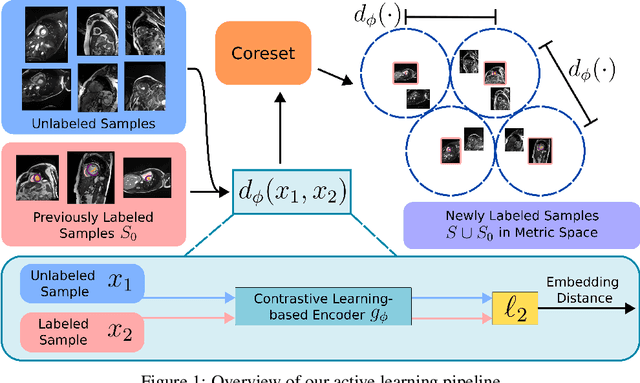
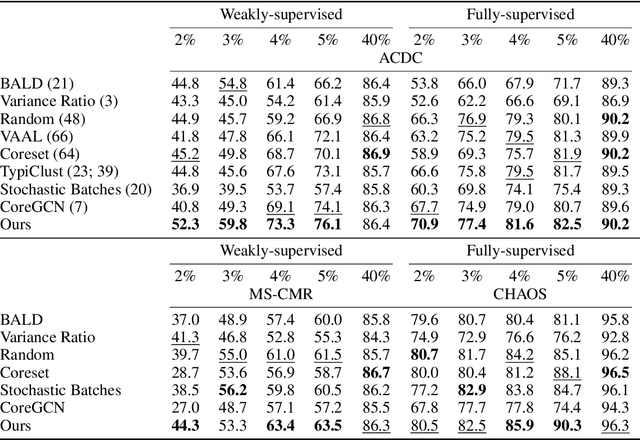


Deep learning has seen remarkable advancements in machine learning, yet it often demands extensive annotated data. Tasks like 3D semantic segmentation impose a substantial annotation burden, especially in domains like medicine, where expert annotations drive up the cost. Active learning (AL) holds great potential to alleviate this annotation burden in 3D medical segmentation. The majority of existing AL methods, however, are not tailored to the medical domain. While weakly-supervised methods have been explored to reduce annotation burden, the fusion of AL with weak supervision remains unexplored, despite its potential to significantly reduce annotation costs. Additionally, there is little focus on slice-based AL for 3D segmentation, which can also significantly reduce costs in comparison to conventional volume-based AL. This paper introduces a novel metric learning method for Coreset to perform slice-based active learning in 3D medical segmentation. By merging contrastive learning with inherent data groupings in medical imaging, we learn a metric that emphasizes the relevant differences in samples for training 3D medical segmentation models. We perform comprehensive evaluations using both weak and full annotations across four datasets (medical and non-medical). Our findings demonstrate that our approach surpasses existing active learning techniques on both weak and full annotations and obtains superior performance with low-annotation budgets which is crucial in medical imaging. Source code for this project is available in the supplementary materials and on GitHub: https://github.com/arvindmvepa/al-seg.
COIN: Counterfactual inpainting for weakly supervised semantic segmentation for medical images
Apr 19, 2024Deep learning is dramatically transforming the field of medical imaging and radiology, enabling the identification of pathologies in medical images, including computed tomography (CT) and X-ray scans. However, the performance of deep learning models, particularly in segmentation tasks, is often limited by the need for extensive annotated datasets. To address this challenge, the capabilities of weakly supervised semantic segmentation are explored through the lens of Explainable AI and the generation of counterfactual explanations. The scope of this research is development of a novel counterfactual inpainting approach (COIN) that flips the predicted classification label from abnormal to normal by using a generative model. For instance, if the classifier deems an input medical image X as abnormal, indicating the presence of a pathology, the generative model aims to inpaint the abnormal region, thus reversing the classifier's original prediction label. The approach enables us to produce precise segmentations for pathologies without depending on pre-existing segmentation masks. Crucially, image-level labels are utilized, which are substantially easier to acquire than creating detailed segmentation masks. The effectiveness of the method is demonstrated by segmenting synthetic targets and actual kidney tumors from CT images acquired from Tartu University Hospital in Estonia. The findings indicate that COIN greatly surpasses established attribution methods, such as RISE, ScoreCAM, and LayerCAM, as well as an alternative counterfactual explanation method introduced by Singla et al. This evidence suggests that COIN is a promising approach for semantic segmentation of tumors in CT images, and presents a step forward in making deep learning applications more accessible and effective in healthcare, where annotated data is scarce.
Modeling the Label Distributions for Weakly-Supervised Semantic Segmentation
Mar 20, 2024


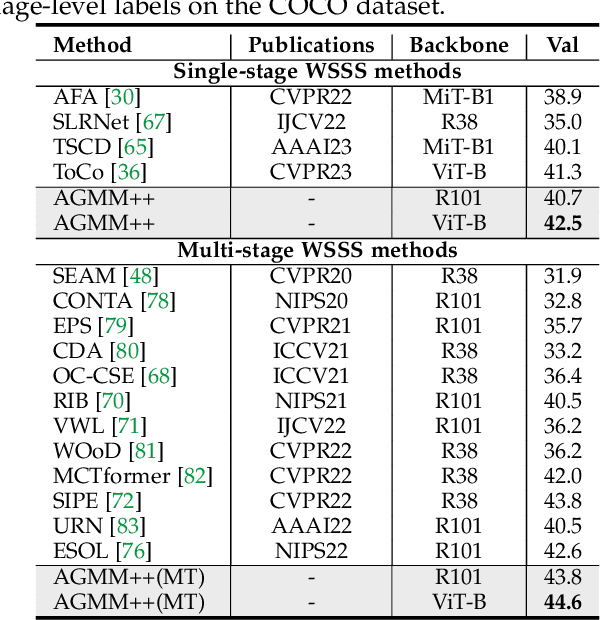
Weakly-Supervised Semantic Segmentation (WSSS) aims to train segmentation models by weak labels, which is receiving significant attention due to its low annotation cost. Existing approaches focus on generating pseudo labels for supervision while largely ignoring to leverage the inherent semantic correlation among different pseudo labels. We observe that pseudo-labeled pixels that are close to each other in the feature space are more likely to share the same class, and those closer to the distribution centers tend to have higher confidence. Motivated by this, we propose to model the underlying label distributions and employ cross-label constraints to generate more accurate pseudo labels. In this paper, we develop a unified WSSS framework named Adaptive Gaussian Mixtures Model, which leverages a GMM to model the label distributions. Specifically, we calculate the feature distribution centers of pseudo-labeled pixels and build the GMM by measuring the distance between the centers and each pseudo-labeled pixel. Then, we introduce an Online Expectation-Maximization (OEM) algorithm and a novel maximization loss to optimize the GMM adaptively, aiming to learn more discriminative decision boundaries between different class-wise Gaussian mixtures. Based on the label distributions, we leverage the GMM to generate high-quality pseudo labels for more reliable supervision. Our framework is capable of solving different forms of weak labels: image-level labels, points, scribbles, blocks, and bounding-boxes. Extensive experiments on PASCAL, COCO, Cityscapes, and ADE20K datasets demonstrate that our framework can effectively provide more reliable supervision and outperform the state-of-the-art methods under all settings. Code will be available at https://github.com/Luffy03/AGMM-SASS.
Hunting Attributes: Context Prototype-Aware Learning for Weakly Supervised Semantic Segmentation
Mar 12, 2024Recent weakly supervised semantic segmentation (WSSS) methods strive to incorporate contextual knowledge to improve the completeness of class activation maps (CAM). In this work, we argue that the knowledge bias between instances and contexts affects the capability of the prototype to sufficiently understand instance semantics. Inspired by prototype learning theory, we propose leveraging prototype awareness to capture diverse and fine-grained feature attributes of instances. The hypothesis is that contextual prototypes might erroneously activate similar and frequently co-occurring object categories due to this knowledge bias. Therefore, we propose to enhance the prototype representation ability by mitigating the bias to better capture spatial coverage in semantic object regions. With this goal, we present a Context Prototype-Aware Learning (CPAL) strategy, which leverages semantic context to enrich instance comprehension. The core of this method is to accurately capture intra-class variations in object features through context-aware prototypes, facilitating the adaptation to the semantic attributes of various instances. We design feature distribution alignment to optimize prototype awareness, aligning instance feature distributions with dense features. In addition, a unified training framework is proposed to combine label-guided classification supervision and prototypes-guided self-supervision. Experimental results on PASCAL VOC 2012 and MS COCO 2014 show that CPAL significantly improves off-the-shelf methods and achieves state-of-the-art performance. The project is available at https://github.com/Barrett-python/CPAL.
DuPL: Dual Student with Trustworthy Progressive Learning for Robust Weakly Supervised Semantic Segmentation
Mar 17, 2024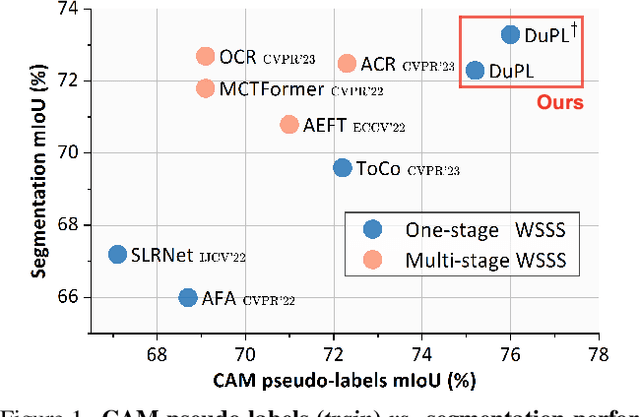
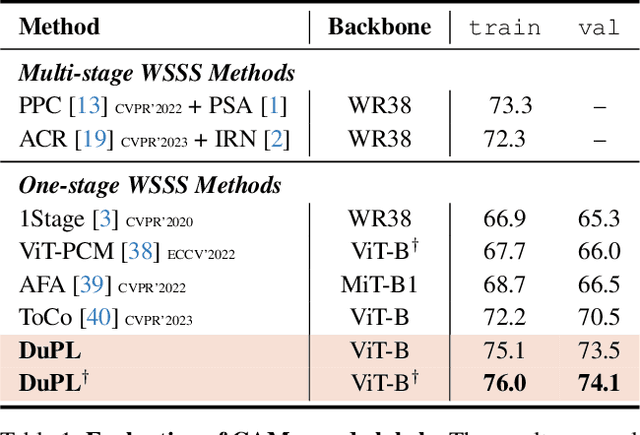
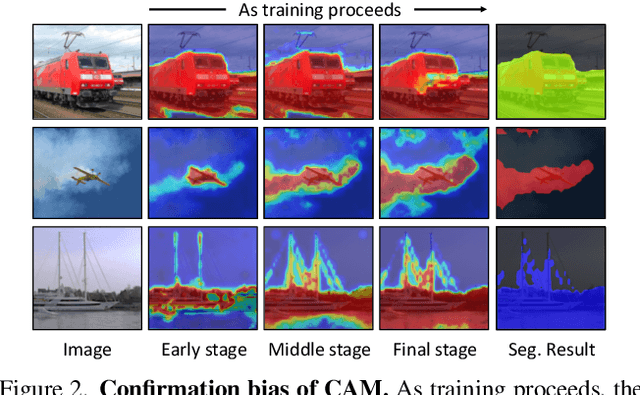
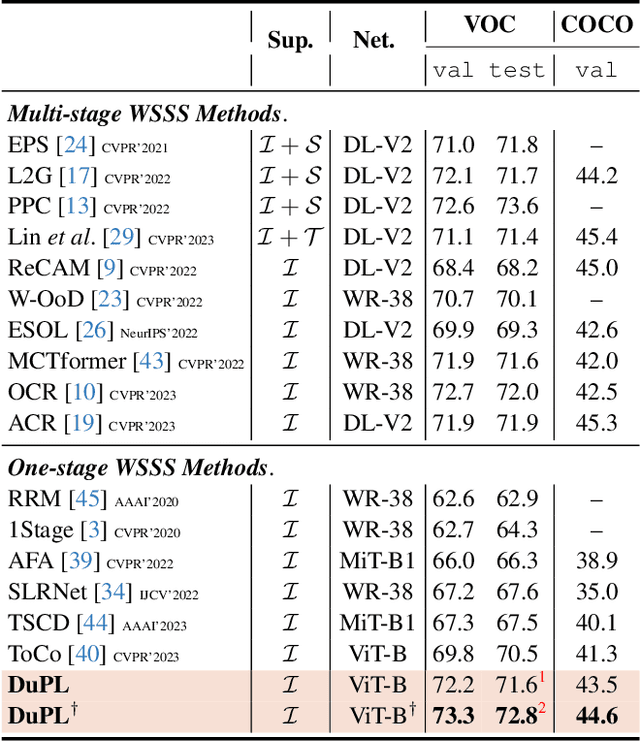
Recently, One-stage Weakly Supervised Semantic Segmentation (WSSS) with image-level labels has gained increasing interest due to simplification over its cumbersome multi-stage counterpart. Limited by the inherent ambiguity of Class Activation Map (CAM), we observe that one-stage pipelines often encounter confirmation bias caused by incorrect CAM pseudo-labels, impairing their final segmentation performance. Although recent works discard many unreliable pseudo-labels to implicitly alleviate this issue, they fail to exploit sufficient supervision for their models. To this end, we propose a dual student framework with trustworthy progressive learning (DuPL). Specifically, we propose a dual student network with a discrepancy loss to yield diverse CAMs for each sub-net. The two sub-nets generate supervision for each other, mitigating the confirmation bias caused by learning their own incorrect pseudo-labels. In this process, we progressively introduce more trustworthy pseudo-labels to be involved in the supervision through dynamic threshold adjustment with an adaptive noise filtering strategy. Moreover, we believe that every pixel, even discarded from supervision due to its unreliability, is important for WSSS. Thus, we develop consistency regularization on these discarded regions, providing supervision of every pixel. Experiment results demonstrate the superiority of the proposed DuPL over the recent state-of-the-art alternatives on PASCAL VOC 2012 and MS COCO datasets. Code is available at https://github.com/Wu0409/DuPL.