 Add to Chrome
 Add to Firefox
 Add to Edge
Vehicle Re Identification
Papers and Code
DCG ReID: Disentangling Collaboration and Guidance Fusion Representations for Multi-modal Vehicle Re-Identification
Jan 06, 2026
Multi-modal vehicle Re-Identification (ReID) aims to leverage complementary information from RGB, Near Infrared (NIR), and Thermal Infrared (TIR) modalities to retrieve the same vehicle. The challenges of multi-modal vehicle ReID arise from the uncertainty of modality quality distribution induced by inherent discrepancies across modalities, resulting in distinct conflicting fusion requirements for data with balanced and unbalanced quality distributions. Existing methods handle all multi-modal data within a single fusion model, overlooking the different needs of the two data types and making it difficult to decouple the conflict between intra-class consistency and inter-modal heterogeneity. To this end, we propose Disentangle Collaboration and Guidance Fusion Representations for Multi-modal Vehicle ReID (DCG-ReID). Specifically, to disentangle heterogeneous quality-distributed modal data without mutual interference, we first design the Dynamic Confidence-based Disentangling Weighting (DCDW) mechanism: dynamically reweighting three-modal contributions via interaction-derived modal confidence to build a disentangled fusion framework. Building on DCDW, we develop two scenario-specific fusion strategies: (1) for balanced quality distributions, Collaboration Fusion Module (CFM) mines pairwise consensus features to capture shared discriminative information and boost intra-class consistency; (2) for unbalanced distributions, Guidance Fusion Module (GFM) implements differential amplification of modal discriminative disparities to reinforce dominant modality advantages, guide auxiliary modalities to mine complementary discriminative info, and mitigate inter-modal divergence to boost multi-modal joint decision performance. Extensive experiments on three multi-modal ReID benchmarks (WMVeID863, MSVR310, RGBNT100) validate the effectiveness of our method. Code will be released upon acceptance.

CLIPVehicle: A Unified Framework for Vision-based Vehicle Search
Aug 06, 2025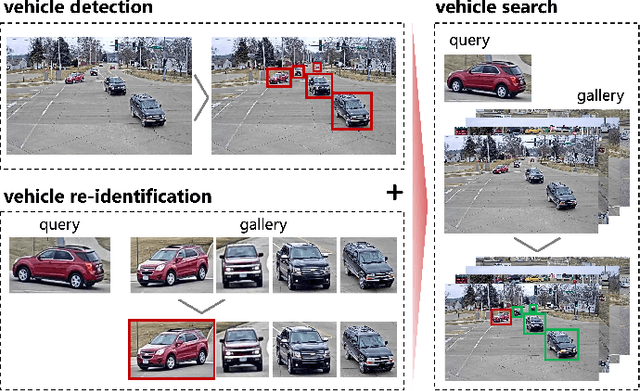
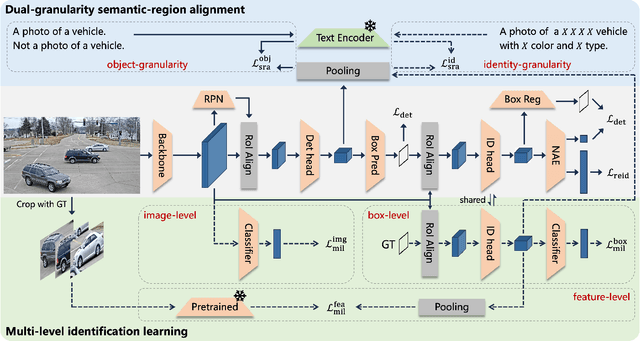
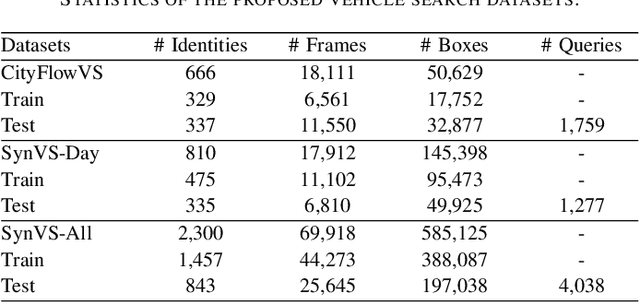

Vehicles, as one of the most common and significant objects in the real world, the researches on which using computer vision technologies have made remarkable progress, such as vehicle detection, vehicle re-identification, etc. To search an interested vehicle from the surveillance videos, existing methods first pre-detect and store all vehicle patches, and then apply vehicle re-identification models, which is resource-intensive and not very practical. In this work, we aim to achieve the joint detection and re-identification for vehicle search. However, the conflicting objectives between detection that focuses on shared vehicle commonness and re-identification that focuses on individual vehicle uniqueness make it challenging for a model to learn in an end-to-end system. For this problem, we propose a new unified framework, namely CLIPVehicle, which contains a dual-granularity semantic-region alignment module to leverage the VLMs (Vision-Language Models) for vehicle discrimination modeling, and a multi-level vehicle identification learning strategy to learn the identity representation from global, instance and feature levels. We also construct a new benchmark, including a real-world dataset CityFlowVS, and two synthetic datasets SynVS-Day and SynVS-All, for vehicle search. Extensive experimental results demonstrate that our method outperforms the state-of-the-art methods of both vehicle Re-ID and person search tasks.
Generalizable Object Re-Identification via Visual In-Context Prompting
Aug 28, 2025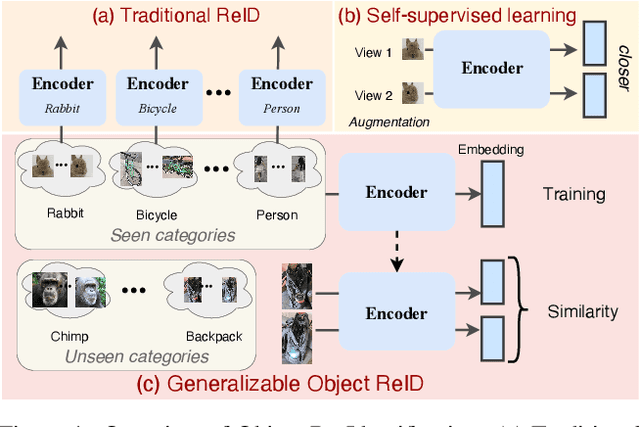
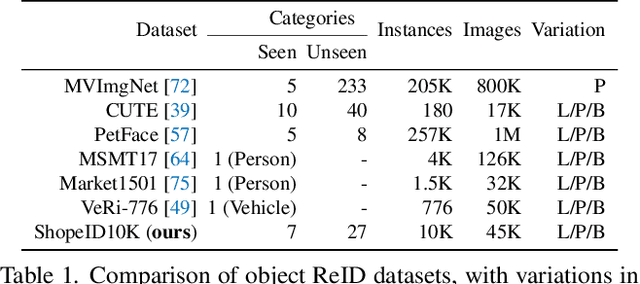
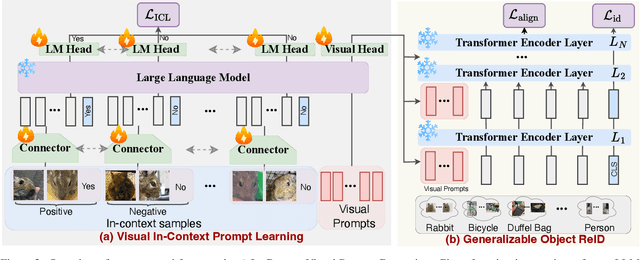
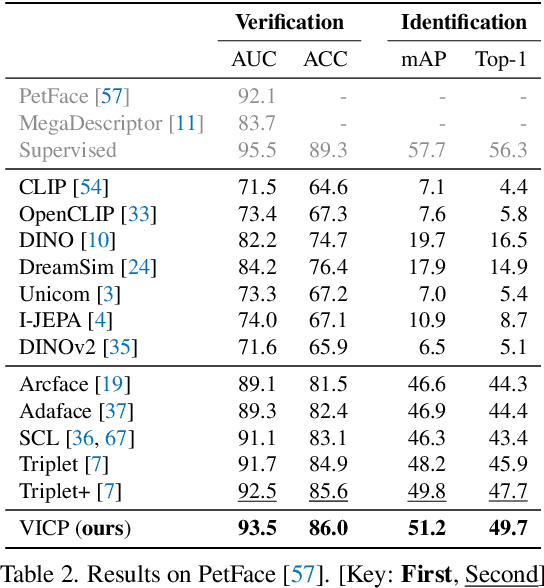
Current object re-identification (ReID) methods train domain-specific models (e.g., for persons or vehicles), which lack generalization and demand costly labeled data for new categories. While self-supervised learning reduces annotation needs by learning instance-wise invariance, it struggles to capture \textit{identity-sensitive} features critical for ReID. This paper proposes Visual In-Context Prompting~(VICP), a novel framework where models trained on seen categories can directly generalize to unseen novel categories using only \textit{in-context examples} as prompts, without requiring parameter adaptation. VICP synergizes LLMs and vision foundation models~(VFM): LLMs infer semantic identity rules from few-shot positive/negative pairs through task-specific prompting, which then guides a VFM (\eg, DINO) to extract ID-discriminative features via \textit{dynamic visual prompts}. By aligning LLM-derived semantic concepts with the VFM's pre-trained prior, VICP enables generalization to novel categories, eliminating the need for dataset-specific retraining. To support evaluation, we introduce ShopID10K, a dataset of 10K object instances from e-commerce platforms, featuring multi-view images and cross-domain testing. Experiments on ShopID10K and diverse ReID benchmarks demonstrate that VICP outperforms baselines by a clear margin on unseen categories. Code is available at https://github.com/Hzzone/VICP.
FastTracker: Real-Time and Accurate Visual Tracking
Aug 20, 2025Conventional multi-object tracking (MOT) systems are predominantly designed for pedestrian tracking and often exhibit limited generalization to other object categories. This paper presents a generalized tracking framework capable of handling multiple object types, with a particular emphasis on vehicle tracking in complex traffic scenes. The proposed method incorporates two key components: (1) an occlusion-aware re-identification mechanism that enhances identity preservation for heavily occluded objects, and (2) a road-structure-aware tracklet refinement strategy that utilizes semantic scene priors such as lane directions, crosswalks, and road boundaries to improve trajectory continuity and accuracy. In addition, we introduce a new benchmark dataset comprising diverse vehicle classes with frame-level tracking annotations, specifically curated to support evaluation of vehicle-focused tracking methods. Extensive experimental results demonstrate that the proposed approach achieves robust performance on both the newly introduced dataset and several public benchmarks, highlighting its effectiveness in general-purpose object tracking. While our framework is designed for generalized multi-class tracking, it also achieves strong performance on conventional benchmarks, with HOTA scores of 66.4 on MOT17 and 65.7 on MOT20 test sets. Code and Benchmark are available: github.com/Hamidreza-Hashempoor/FastTracker, huggingface.co/datasets/Hamidreza-Hashemp/FastTracker-Benchmark.
Similarity-based Outlier Detection for Noisy Object Re-Identification Using Beta Mixtures
Sep 10, 2025Object re-identification (Re-ID) methods are highly sensitive to label noise, which typically leads to significant performance degradation. We address this challenge by reframing Re-ID as a supervised image similarity task and adopting a Siamese network architecture trained to capture discriminative pairwise relationships. Central to our approach is a novel statistical outlier detection (OD) framework, termed Beta-SOD (Beta mixture Similarity-based Outlier Detection), which models the distribution of cosine similarities between embedding pairs using a two-component Beta distribution mixture model. We establish a novel identifiability result for mixtures of two Beta distributions, ensuring that our learning task is well-posed.The proposed OD step complements the Re-ID architecture combining binary cross-entropy, contrastive, and cosine embedding losses that jointly optimize feature-level similarity learning.We demonstrate the effectiveness of Beta-SOD in de-noising and Re-ID tasks for person Re-ID, on CUHK03 and Market-1501 datasets, and vehicle Re-ID, on VeRi-776 dataset. Our method shows superior performance compared to the state-of-the-art methods across various noise levels (10-30\%), demonstrating both robustness and broad applicability in noisy Re-ID scenarios. The implementation of Beta-SOD is available at: https://github.com/waqar3411/Beta-SOD
CORE-ReID V2: Advancing the Domain Adaptation for Object Re-Identification with Optimized Training and Ensemble Fusion
Aug 06, 2025This study presents CORE-ReID V2, an enhanced framework building upon CORE-ReID. The new framework extends its predecessor by addressing Unsupervised Domain Adaptation (UDA) challenges in Person ReID and Vehicle ReID, with further applicability to Object ReID. During pre-training, CycleGAN is employed to synthesize diverse data, bridging image characteristic gaps across different domains. In the fine-tuning, an advanced ensemble fusion mechanism, consisting of the Efficient Channel Attention Block (ECAB) and the Simplified Efficient Channel Attention Block (SECAB), enhances both local and global feature representations while reducing ambiguity in pseudo-labels for target samples. Experimental results on widely used UDA Person ReID and Vehicle ReID datasets demonstrate that the proposed framework outperforms state-of-the-art methods, achieving top performance in Mean Average Precision (mAP) and Rank-k Accuracy (Top-1, Top-5, Top-10). Moreover, the framework supports lightweight backbones such as ResNet18 and ResNet34, ensuring both scalability and efficiency. Our work not only pushes the boundaries of UDA-based Object ReID but also provides a solid foundation for further research and advancements in this domain. Our codes and models are available at https://github.com/TrinhQuocNguyen/CORE-ReID-V2.
* AI Sens. 2025, Submission received: 8 May 2025 / Revised: 4 June 2025 / Accepted: 30 June 2025 / Published: 4 July 2025. 3042-5999/1/1/4
Collaborative Enhancement Network for Low-quality Multi-spectral Vehicle Re-identification
Apr 21, 2025The performance of multi-spectral vehicle Re-identification (ReID) is significantly degraded when some important discriminative cues in visible, near infrared and thermal infrared spectra are lost. Existing methods generate or enhance missing details in low-quality spectra data using the high-quality one, generally called the primary spectrum, but how to justify the primary spectrum is a challenging problem. In addition, when the quality of the primary spectrum is low, the enhancement effect would be greatly degraded, thus limiting the performance of multi-spectral vehicle ReID. To address these problems, we propose the Collaborative Enhancement Network (CoEN), which generates a high-quality proxy from all spectra data and leverages it to supervise the selection of primary spectrum and enhance all spectra features in a collaborative manner, for robust multi-spectral vehicle ReID. First, to integrate the rich cues from all spectra data, we design the Proxy Generator (PG) to progressively aggregate multi-spectral features. Second, we design the Dynamic Quality Sort Module (DQSM), which sorts all spectra data by measuring their correlations with the proxy, to accurately select the primary spectra with the highest correlation. Finally, we design the Collaborative Enhancement Module (CEM) to effectively compensate for missing contents of all spectra by collaborating the primary spectra and the proxy, thereby mitigating the impact of low-quality primary spectra. Extensive experiments on three benchmark datasets are conducted to validate the efficacy of the proposed approach against other multi-spectral vehicle ReID methods. The codes will be released at https://github.com/yongqisun/CoEN.
CLIP-SENet: CLIP-based Semantic Enhancement Network for Vehicle Re-identification
Feb 24, 2025Vehicle re-identification (Re-ID) is a crucial task in intelligent transportation systems (ITS), aimed at retrieving and matching the same vehicle across different surveillance cameras. Numerous studies have explored methods to enhance vehicle Re-ID by focusing on semantic enhancement. However, these methods often rely on additional annotated information to enable models to extract effective semantic features, which brings many limitations. In this work, we propose a CLIP-based Semantic Enhancement Network (CLIP-SENet), an end-to-end framework designed to autonomously extract and refine vehicle semantic attributes, facilitating the generation of more robust semantic feature representations. Inspired by zero-shot solutions for downstream tasks presented by large-scale vision-language models, we leverage the powerful cross-modal descriptive capabilities of the CLIP image encoder to initially extract general semantic information. Instead of using a text encoder for semantic alignment, we design an adaptive fine-grained enhancement module (AFEM) to adaptively enhance this general semantic information at a fine-grained level to obtain robust semantic feature representations. These features are then fused with common Re-ID appearance features to further refine the distinctions between vehicles. Our comprehensive evaluation on three benchmark datasets demonstrates the effectiveness of CLIP-SENet. Our approach achieves new state-of-the-art performance, with 92.9% mAP and 98.7% Rank-1 on VeRi-776 dataset, 90.4% Rank-1 and 98.7% Rank-5 on VehicleID dataset, and 89.1% mAP and 97.9% Rank-1 on the more challenging VeRi-Wild dataset.
A Robust Deep Networks based Multi-Object MultiCamera Tracking System for City Scale Traffic
May 01, 2025Vision sensors are becoming more important in Intelligent Transportation Systems (ITS) for traffic monitoring, management, and optimization as the number of network cameras continues to rise. However, manual object tracking and matching across multiple non-overlapping cameras pose significant challenges in city-scale urban traffic scenarios. These challenges include handling diverse vehicle attributes, occlusions, illumination variations, shadows, and varying video resolutions. To address these issues, we propose an efficient and cost-effective deep learning-based framework for Multi-Object Multi-Camera Tracking (MO-MCT). The proposed framework utilizes Mask R-CNN for object detection and employs Non-Maximum Suppression (NMS) to select target objects from overlapping detections. Transfer learning is employed for re-identification, enabling the association and generation of vehicle tracklets across multiple cameras. Moreover, we leverage appropriate loss functions and distance measures to handle occlusion, illumination, and shadow challenges. The final solution identification module performs feature extraction using ResNet-152 coupled with Deep SORT based vehicle tracking. The proposed framework is evaluated on the 5th AI City Challenge dataset (Track 3), comprising 46 camera feeds. Among these 46 camera streams, 40 are used for model training and validation, while the remaining six are utilized for model testing. The proposed framework achieves competitive performance with an IDF1 score of 0.8289, and precision and recall scores of 0.9026 and 0.8527 respectively, demonstrating its effectiveness in robust and accurate vehicle tracking.
DINO-CoDT: Multi-class Collaborative Detection and Tracking with Vision Foundation Models
Jun 09, 2025Collaborative perception plays a crucial role in enhancing environmental understanding by expanding the perceptual range and improving robustness against sensor failures, which primarily involves collaborative 3D detection and tracking tasks. The former focuses on object recognition in individual frames, while the latter captures continuous instance tracklets over time. However, existing works in both areas predominantly focus on the vehicle superclass, lacking effective solutions for both multi-class collaborative detection and tracking. This limitation hinders their applicability in real-world scenarios, which involve diverse object classes with varying appearances and motion patterns. To overcome these limitations, we propose a multi-class collaborative detection and tracking framework tailored for diverse road users. We first present a detector with a global spatial attention fusion (GSAF) module, enhancing multi-scale feature learning for objects of varying sizes. Next, we introduce a tracklet RE-IDentification (REID) module that leverages visual semantics with a vision foundation model to effectively reduce ID SWitch (IDSW) errors, in cases of erroneous mismatches involving small objects like pedestrians. We further design a velocity-based adaptive tracklet management (VATM) module that adjusts the tracking interval dynamically based on object motion. Extensive experiments on the V2X-Real and OPV2V datasets show that our approach significantly outperforms existing state-of-the-art methods in both detection and tracking accuracy.