 Add to Chrome
 Add to Firefox
 Add to Edge
Unsupervised Image Classification
Papers and Code
Trigger Optimization and Event Classification for Dark Matter Searches in the CYGNO Experiment Using Machine Learning
Jan 28, 2026
The CYGNO experiment employs an optical-readout Time Projection Chamber (TPC) to search for rare low-energy interactions using finely resolved scintillation images. While the optical readout provides rich topological information, it produces large, sparse megapixel images that challenge real-time triggering, data reduction, and background discrimination. We summarize two complementary machine-learning approaches developed within CYGNO. First, we present a fast and fully unsupervised strategy for online data reduction based on reconstruction-based anomaly detection. A convolutional autoencoder trained exclusively on pedestal images (i.e. frames acquired with GEM amplification disabled) learns the detector noise morphology and highlights particle-induced structures through localized reconstruction residuals, from which compact Regions of Interest (ROIs) are extracted. On real prototype data, the selected configuration retains (93.0 +/- 0.2)% of reconstructed signal intensity while discarding (97.8 +/- 0.1)% of the image area, with ~25 ms per-frame inference time on a consumer GPU. Second, we report a weakly supervised application of the Classification Without Labels (CWoLa) framework to data acquired with an Americium--Beryllium neutron source. Using only mixed AmBe and standard datasets (no event-level labels), a convolutional classifier learns to identify nuclear-recoil-like topologies. The achieved performance approaches the theoretical limit imposed by the mixture composition and isolates a high-score population with compact, approximately circular morphologies consistent with nuclear recoils.

Interpretable and backpropagation-free Green Learning for efficient multi-task echocardiographic segmentation and classification
Jan 27, 2026Echocardiography is a cornerstone for managing heart failure (HF), with Left Ventricular Ejection Fraction (LVEF) being a critical metric for guiding therapy. However, manual LVEF assessment suffers from high inter-observer variability, while existing Deep Learning (DL) models are often computationally intensive and data-hungry "black boxes" that impede clinical trust and adoption. Here, we propose a backpropagation-free multi-task Green Learning (MTGL) framework that performs simultaneous Left Ventricle (LV) segmentation and LVEF classification. Our framework integrates an unsupervised VoxelHop encoder for hierarchical spatio-temporal feature extraction with a multi-level regression decoder and an XG-Boost classifier. On the EchoNet-Dynamic dataset, our MTGL model achieves state-of-the-art classification and segmentation performance, attaining a classification accuracy of 94.3% and a Dice Similarity Coefficient (DSC) of 0.912, significantly outperforming several advanced 3D DL models. Crucially, our model achieves this with over an order of magnitude fewer parameters, demonstrating exceptional computational efficiency. This work demonstrates that the GL paradigm can deliver highly accurate, efficient, and interpretable solutions for complex medical image analysis, paving the way for more sustainable and trustworthy artificial intelligence in clinical practice.
An efficient heuristic for geometric analysis of cell deformations
Jan 19, 2026Sickle cell disease causes erythrocytes to become sickle-shaped, affecting their movement in the bloodstream and reducing oxygen delivery. It has a high global prevalence and places a significant burden on healthcare systems, especially in resource-limited regions. Automated classification of sickle cells in blood images is crucial, allowing the specialist to reduce the effort required and avoid errors when quantifying the deformed cells and assessing the severity of a crisis. Recent studies have proposed various erythrocyte representation and classification methods. Since classification depends solely on cell shape, a suitable approach models erythrocytes as closed planar curves in shape space. This approach employs elastic distances between shapes, which are invariant under rotations, translations, scaling, and reparameterizations, ensuring consistent distance measurements regardless of the curves' position, starting point, or traversal speed. While previous methods exploiting shape space distances had achieved high accuracy, we refined the model by considering the geometric characteristics of healthy and sickled erythrocytes. Our method proposes (1) to employ a fixed parameterization based on the major axis of each cell to compute distances and (2) to align each cell with two templates using this parameterization before computing distances. Aligning shapes to templates before distance computation, a concept successfully applied in areas such as molecular dynamics, and using a fixed parameterization, instead of minimizing distances across all possible parameterizations, simplifies calculations. This strategy achieves 96.03\% accuracy rate in both supervised classification and unsupervised clustering. Our method ensures efficient erythrocyte classification, maintaining or improving accuracy over shape space models while significantly reducing computational costs.
Integrating Distribution Matching into Semi-Supervised Contrastive Learning for Labeled and Unlabeled Data
Jan 08, 2026The advancement of deep learning has greatly improved supervised image classification. However, labeling data is costly, prompting research into unsupervised learning methods such as contrastive learning. In real-world scenarios, fully unlabeled datasets are rare, making semi-supervised learning (SSL) highly relevant in scenarios where a small amount of labeled data coexists with a large volume of unlabeled data. A well-known semi-supervised contrastive learning approach involves assigning pseudo-labels to unlabeled data. This study aims to enhance pseudo-label-based SSL by incorporating distribution matching between labeled and unlabeled feature embeddings to improve image classification accuracy across multiple datasets.
* ITC-CSCC accepted
Unsupervised Modular Adaptive Region Growing and RegionMix Classification for Wind Turbine Segmentation
Jan 07, 2026Reliable operation of wind turbines requires frequent inspections, as even minor surface damages can degrade aerodynamic performance, reduce energy output, and accelerate blade wear. Central to automating these inspections is the accurate segmentation of turbine blades from visual data. This task is traditionally addressed through dense, pixel-wise deep learning models. However, such methods demand extensive annotated datasets, posing scalability challenges. In this work, we introduce an annotation-efficient segmentation approach that reframes the pixel-level task into a binary region classification problem. Image regions are generated using a fully unsupervised, interpretable Modular Adaptive Region Growing technique, guided by image-specific Adaptive Thresholding and enhanced by a Region Merging process that consolidates fragmented areas into coherent segments. To improve generalization and classification robustness, we introduce RegionMix, an augmentation strategy that synthesizes new training samples by combining distinct regions. Our framework demonstrates state-of-the-art segmentation accuracy and strong cross-site generalization by consistently segmenting turbine blades across distinct windfarms.
Advanced Machine Learning Approaches for Enhancing Person Re-Identification Performance
Jan 04, 2026Person re-identification (ReID) plays a critical role in intelligent surveillance systems by linking identities across multiple cameras in complex environments. However, ReID faces significant challenges such as appearance variations, domain shifts, and limited labeled data. This dissertation proposes three advanced approaches to enhance ReID performance under supervised, unsupervised domain adaptation (UDA), and fully unsupervised settings. First, SCM-ReID integrates supervised contrastive learning with hybrid loss optimization (classification, center, triplet, and centroid-triplet losses), improving discriminative feature representation and achieving state-of-the-art accuracy on Market-1501 and CUHK03 datasets. Second, for UDA, IQAGA and DAPRH combine GAN-based image augmentation, domain-invariant mapping, and pseudo-label refinement to mitigate domain discrepancies and enhance cross-domain generalization. Experiments demonstrate substantial gains over baseline methods, with mAP and Rank-1 improvements up to 12% in challenging transfer scenarios. Finally, ViTC-UReID leverages Vision Transformer-based feature encoding and camera-aware proxy learning to boost unsupervised ReID. By integrating global and local attention with camera identity constraints, this method significantly outperforms existing unsupervised approaches on large-scale benchmarks. Comprehensive evaluations across CUHK03, Market-1501, DukeMTMC-reID, and MSMT17 confirm the effectiveness of the proposed methods. The contributions advance ReID research by addressing key limitations in feature learning, domain adaptation, and label noise handling, paving the way for robust deployment in real-world surveillance systems.
Le Cam Distortion: A Decision-Theoretic Framework for Robust Transfer Learning
Dec 29, 2025Distribution shift is the defining challenge of real-world machine learning. The dominant paradigm--Unsupervised Domain Adaptation (UDA)--enforces feature invariance, aligning source and target representations via symmetric divergence minimization [Ganin et al., 2016]. We demonstrate that this approach is fundamentally flawed: when domains are unequally informative (e.g., high-quality vs degraded sensors), strict invariance necessitates information destruction, causing "negative transfer" that can be catastrophic in safety-critical applications [Wang et al., 2019]. We propose a decision-theoretic framework grounded in Le Cam's theory of statistical experiments [Le Cam, 1986], using constructive approximations to replace symmetric invariance with directional simulability. We introduce Le Cam Distortion, quantified by the Deficiency Distance $δ(E_1, E_2)$, as a rigorous upper bound for transfer risk conditional on simulability. Our framework enables transfer without source degradation by learning a kernel that simulates the target from the source. Across five experiments (genomics, vision, reinforcement learning), Le Cam Distortion achieves: (1) near-perfect frequency estimation in HLA genomics (correlation $r=0.999$, matching classical methods), (2) zero source utility loss in CIFAR-10 image classification (81.2% accuracy preserved vs 34.7% drop for CycleGAN), and (3) safe policy transfer in RL control where invariance-based methods suffer catastrophic collapse. Le Cam Distortion provides the first principled framework for risk-controlled transfer learning in domains where negative transfer is unacceptable: medical imaging, autonomous systems, and precision medicine.
Stylized Meta-Album: Group-bias injection with style transfer to study robustness against distribution shifts
Dec 10, 2025We introduce Stylized Meta-Album (SMA), a new image classification meta-dataset comprising 24 datasets (12 content datasets, and 12 stylized datasets), designed to advance studies on out-of-distribution (OOD) generalization and related topics. Created using style transfer techniques from 12 subject classification datasets, SMA provides a diverse and extensive set of 4800 groups, combining various subjects (objects, plants, animals, human actions, textures) with multiple styles. SMA enables flexible control over groups and classes, allowing us to configure datasets to reflect diverse benchmark scenarios. While ideally, data collection would capture extensive group diversity, practical constraints often make this infeasible. SMA addresses this by enabling large and configurable group structures through flexible control over styles, subject classes, and domains-allowing datasets to reflect a wide range of real-world benchmark scenarios. This design not only expands group and class diversity, but also opens new methodological directions for evaluating model performance across diverse group and domain configurations-including scenarios with many minority groups, varying group imbalance, and complex domain shifts-and for studying fairness, robustness, and adaptation under a broader range of realistic conditions. To demonstrate SMA's effectiveness, we implemented two benchmarks: (1) a novel OOD generalization and group fairness benchmark leveraging SMA's domain, class, and group diversity to evaluate existing benchmarks. Our findings reveal that while simple balancing and algorithms utilizing group information remain competitive as claimed in previous benchmarks, increasing group diversity significantly impacts fairness, altering the superiority and relative rankings of algorithms. We also propose to use \textit{Top-M worst group accuracy} as a new hyperparameter tuning metric, demonstrating broader fairness during optimization and delivering better final worst-group accuracy for larger group diversity. (2) An unsupervised domain adaptation (UDA) benchmark utilizing SMA's group diversity to evaluate UDA algorithms across more scenarios, offering a more comprehensive benchmark with lower error bars (reduced by 73\% and 28\% in closed-set setting and UniDA setting, respectively) compared to existing efforts. These use cases highlight SMA's potential to significantly impact the outcomes of conventional benchmarks.
MAUGIF: Mechanism-Aware Unsupervised General Image Fusion via Dual Cross-Image Autoencoders
Nov 13, 2025Image fusion aims to integrate structural and complementary information from multi-source images. However, existing fusion methods are often either highly task-specific, or general frameworks that apply uniform strategies across diverse tasks, ignoring their distinct fusion mechanisms. To address this issue, we propose a mechanism-aware unsupervised general image fusion (MAUGIF) method based on dual cross-image autoencoders. Initially, we introduce a classification of additive and multiplicative fusion according to the inherent mechanisms of different fusion tasks. Then, dual encoders map source images into a shared latent space, capturing common content while isolating modality-specific details. During the decoding phase, dual decoders act as feature injectors, selectively reintegrating the unique characteristics of each modality into the shared content for reconstruction. The modality-specific features are injected into the source image in the fusion process, generating the fused image that integrates information from both modalities. The architecture of decoders varies according to their fusion mechanisms, enhancing both performance and interpretability. Extensive experiments are conducted on diverse fusion tasks to validate the effectiveness and generalization ability of our method. The code is available at https://anonymous.4open.science/r/MAUGIF.
Multimodal Optical Imaging Platform for Quantitative Burn Assessment
Nov 19, 2025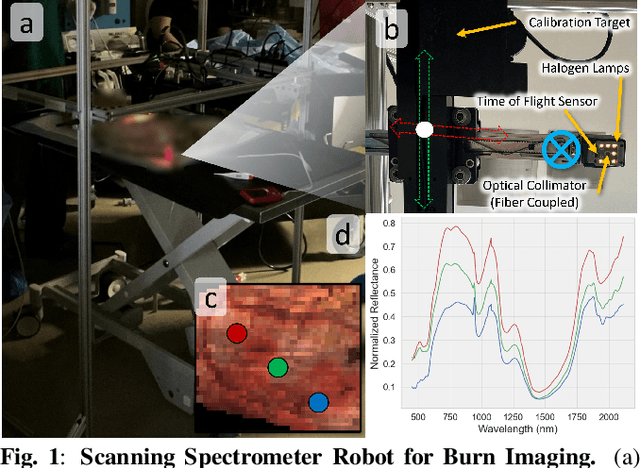
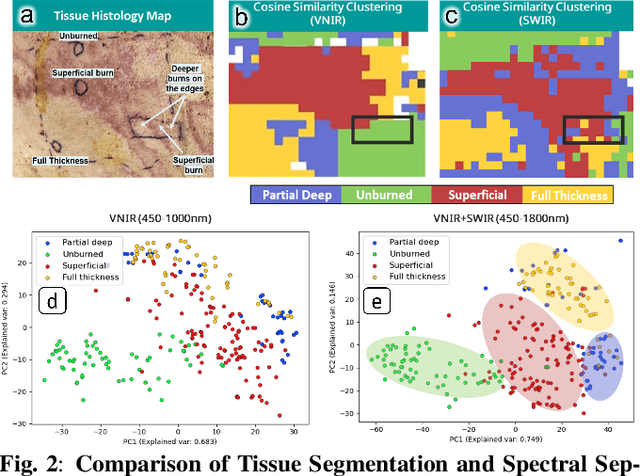
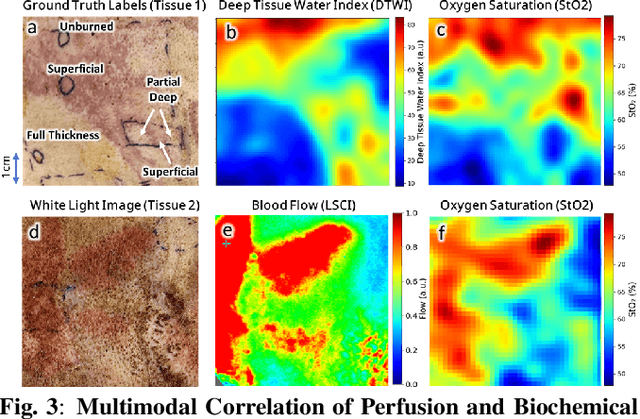
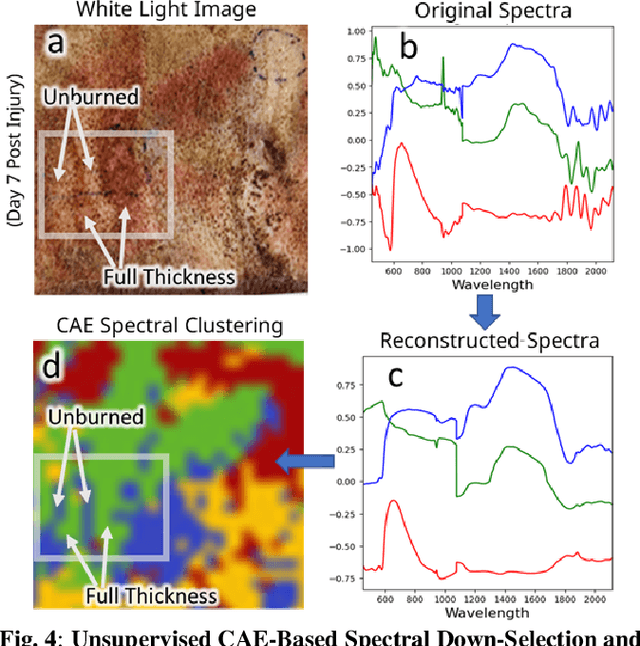
Accurate assessment of burn severity at injury onset remains a major clinical challenge due to the lack of objective methods for detecting subsurface tissue damage. This limitation is critical in battlefield and mass-casualty settings, where rapid and reliable evaluation of burn depth is essential for triage and surgical decision-making. We present a multimodal optical imaging framework that establishes the foundation for a compact, low-size, weight, and power (low-SWaP) field-deployable device for quantitative burn assessment. The system integrates broadband hyperspectral imaging (VSWIR, 400 -- 2100 nm) with laser speckle contrast imaging to jointly evaluate biochemical composition and microvascular perfusion. Using short-wave infrared (SWIR, >1000 nm) wavelengths, we developed and validated novel deep-tissue parameters linked to water, lipid, and collagen absorption features that enhance burn-tissue separability and burn severity classification. We implemented and validated unsupervised learning methods for spectral feature extraction, band down-selection, and clustering against histology, establishing a foundation for a rugged, data-driven device for early quantitative burn evaluation in austere environments.