 Add to Chrome
 Add to Firefox
 Add to Edge
Stylized Meta-Album: Group-bias injection with style transfer to study robustness against distribution shifts
Dec 10, 2025
We introduce Stylized Meta-Album (SMA), a new image classification meta-dataset comprising 24 datasets (12 content datasets, and 12 stylized datasets), designed to advance studies on out-of-distribution (OOD) generalization and related topics. Created using style transfer techniques from 12 subject classification datasets, SMA provides a diverse and extensive set of 4800 groups, combining various subjects (objects, plants, animals, human actions, textures) with multiple styles. SMA enables flexible control over groups and classes, allowing us to configure datasets to reflect diverse benchmark scenarios. While ideally, data collection would capture extensive group diversity, practical constraints often make this infeasible. SMA addresses this by enabling large and configurable group structures through flexible control over styles, subject classes, and domains-allowing datasets to reflect a wide range of real-world benchmark scenarios. This design not only expands group and class diversity, but also opens new methodological directions for evaluating model performance across diverse group and domain configurations-including scenarios with many minority groups, varying group imbalance, and complex domain shifts-and for studying fairness, robustness, and adaptation under a broader range of realistic conditions. To demonstrate SMA's effectiveness, we implemented two benchmarks: (1) a novel OOD generalization and group fairness benchmark leveraging SMA's domain, class, and group diversity to evaluate existing benchmarks. Our findings reveal that while simple balancing and algorithms utilizing group information remain competitive as claimed in previous benchmarks, increasing group diversity significantly impacts fairness, altering the superiority and relative rankings of algorithms. We also propose to use \textit{Top-M worst group accuracy} as a new hyperparameter tuning metric, demonstrating broader fairness during optimization and delivering better final worst-group accuracy for larger group diversity. (2) An unsupervised domain adaptation (UDA) benchmark utilizing SMA's group diversity to evaluate UDA algorithms across more scenarios, offering a more comprehensive benchmark with lower error bars (reduced by 73\% and 28\% in closed-set setting and UniDA setting, respectively) compared to existing efforts. These use cases highlight SMA's potential to significantly impact the outcomes of conventional benchmarks.

Universal Domain Adaptation Benchmark for Time Series Data Representation
May 23, 2025Deep learning models have significantly improved the ability to detect novelties in time series (TS) data. This success is attributed to their strong representation capabilities. However, due to the inherent variability in TS data, these models often struggle with generalization and robustness. To address this, a common approach is to perform Unsupervised Domain Adaptation, particularly Universal Domain Adaptation (UniDA), to handle domain shifts and emerging novel classes. While extensively studied in computer vision, UniDA remains underexplored for TS data. This work provides a comprehensive implementation and comparison of state-of-the-art TS backbones in a UniDA framework. We propose a reliable protocol to evaluate their robustness and generalization across different domains. The goal is to provide practitioners with a framework that can be easily extended to incorporate future advancements in UniDA and TS architectures. Our results highlight the critical influence of backbone selection in UniDA performance and enable a robustness analysis across various datasets and architectures.
Optimal Transport and Adaptive Thresholding for Universal Domain Adaptation on Time Series
Mar 14, 2025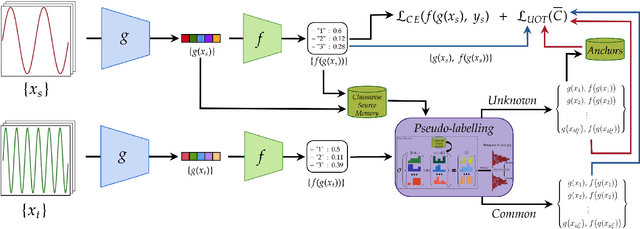
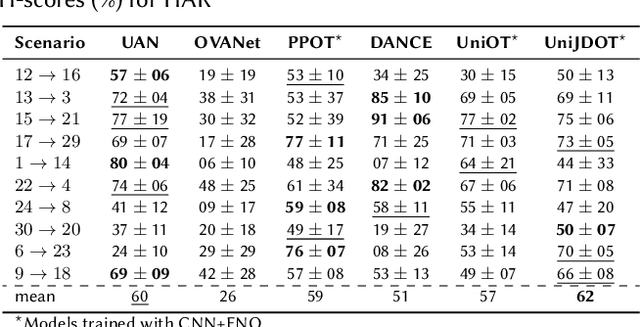
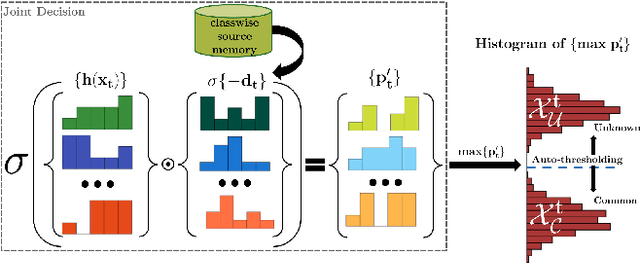
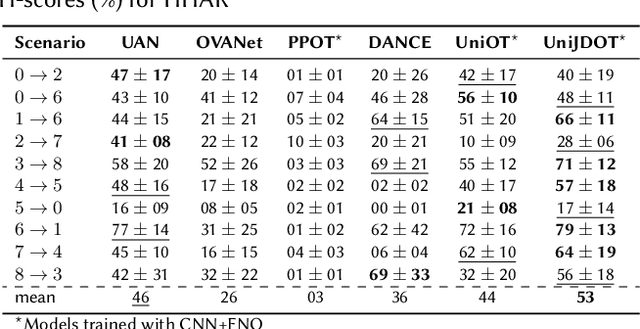
Universal Domain Adaptation (UniDA) aims to transfer knowledge from a labeled source domain to an unlabeled target domain, even when their classes are not fully shared. Few dedicated UniDA methods exist for Time Series (TS), which remains a challenging case. In general, UniDA approaches align common class samples and detect unknown target samples from emerging classes. Such detection often results from thresholding a discriminability metric. The threshold value is typically either a fine-tuned hyperparameter or a fixed value, which limits the ability of the model to adapt to new data. Furthermore, discriminability metrics exhibit overconfidence for unknown samples, leading to misclassifications. This paper introduces UniJDOT, an optimal-transport-based method that accounts for the unknown target samples in the transport cost. Our method also proposes a joint decision space to improve the discriminability of the detection module. In addition, we use an auto-thresholding algorithm to reduce the dependence on fixed or fine-tuned thresholds. Finally, we rely on a Fourier transform-based layer inspired by the Fourier Neural Operator for better TS representation. Experiments on TS benchmarks demonstrate the discriminability, robustness, and state-of-the-art performance of UniJDOT.