 Add to Chrome
 Add to Firefox
 Add to Edge
Stylized Meta-Album: Group-bias injection with style transfer to study robustness against distribution shifts
Dec 10, 2025
We introduce Stylized Meta-Album (SMA), a new image classification meta-dataset comprising 24 datasets (12 content datasets, and 12 stylized datasets), designed to advance studies on out-of-distribution (OOD) generalization and related topics. Created using style transfer techniques from 12 subject classification datasets, SMA provides a diverse and extensive set of 4800 groups, combining various subjects (objects, plants, animals, human actions, textures) with multiple styles. SMA enables flexible control over groups and classes, allowing us to configure datasets to reflect diverse benchmark scenarios. While ideally, data collection would capture extensive group diversity, practical constraints often make this infeasible. SMA addresses this by enabling large and configurable group structures through flexible control over styles, subject classes, and domains-allowing datasets to reflect a wide range of real-world benchmark scenarios. This design not only expands group and class diversity, but also opens new methodological directions for evaluating model performance across diverse group and domain configurations-including scenarios with many minority groups, varying group imbalance, and complex domain shifts-and for studying fairness, robustness, and adaptation under a broader range of realistic conditions. To demonstrate SMA's effectiveness, we implemented two benchmarks: (1) a novel OOD generalization and group fairness benchmark leveraging SMA's domain, class, and group diversity to evaluate existing benchmarks. Our findings reveal that while simple balancing and algorithms utilizing group information remain competitive as claimed in previous benchmarks, increasing group diversity significantly impacts fairness, altering the superiority and relative rankings of algorithms. We also propose to use \textit{Top-M worst group accuracy} as a new hyperparameter tuning metric, demonstrating broader fairness during optimization and delivering better final worst-group accuracy for larger group diversity. (2) An unsupervised domain adaptation (UDA) benchmark utilizing SMA's group diversity to evaluate UDA algorithms across more scenarios, offering a more comprehensive benchmark with lower error bars (reduced by 73\% and 28\% in closed-set setting and UniDA setting, respectively) compared to existing efforts. These use cases highlight SMA's potential to significantly impact the outcomes of conventional benchmarks.

Multi-Label Contrastive Learning : A Comprehensive Study
Nov 27, 2024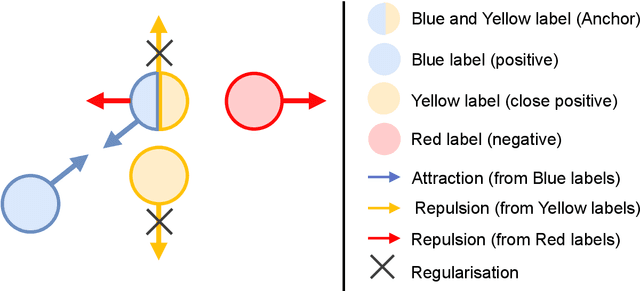
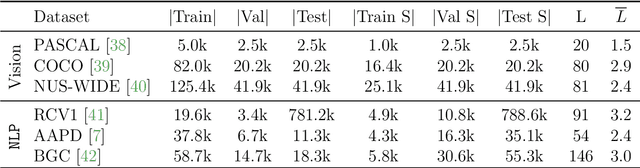
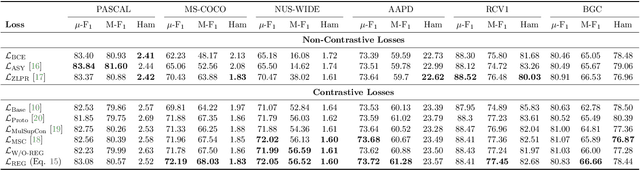
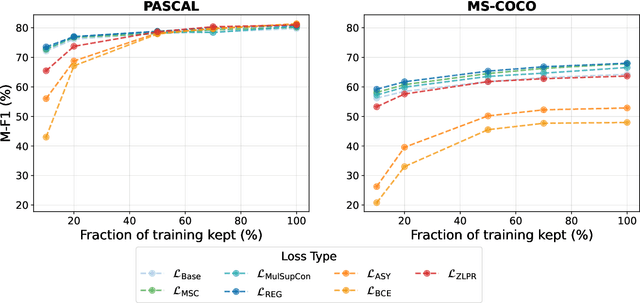
Multi-label classification, which involves assigning multiple labels to a single input, has emerged as a key area in both research and industry due to its wide-ranging applications. Designing effective loss functions is crucial for optimizing deep neural networks for this task, as they significantly influence model performance and efficiency. Traditional loss functions, which often maximize likelihood under the assumption of label independence, may struggle to capture complex label relationships. Recent research has turned to supervised contrastive learning, a method that aims to create a structured representation space by bringing similar instances closer together and pushing dissimilar ones apart. Although contrastive learning offers a promising approach, applying it to multi-label classification presents unique challenges, particularly in managing label interactions and data structure. In this paper, we conduct an in-depth study of contrastive learning loss for multi-label classification across diverse settings. These include datasets with both small and large numbers of labels, datasets with varying amounts of training data, and applications in both computer vision and natural language processing. Our empirical results indicate that the promising outcomes of contrastive learning are attributable not only to the consideration of label interactions but also to the robust optimization scheme of the contrastive loss. Furthermore, while the supervised contrastive loss function faces challenges with datasets containing a small number of labels and ranking-based metrics, it demonstrates excellent performance, particularly in terms of Macro-F1, on datasets with a large number of labels.
Exploring Contrastive Learning for Long-Tailed Multi-Label Text Classification
Apr 12, 2024Learning an effective representation in multi-label text classification (MLTC) is a significant challenge in NLP. This challenge arises from the inherent complexity of the task, which is shaped by two key factors: the intricate connections between labels and the widespread long-tailed distribution of the data. To overcome this issue, one potential approach involves integrating supervised contrastive learning with classical supervised loss functions. Although contrastive learning has shown remarkable performance in multi-class classification, its impact in the multi-label framework has not been thoroughly investigated. In this paper, we conduct an in-depth study of supervised contrastive learning and its influence on representation in MLTC context. We emphasize the importance of considering long-tailed data distributions to build a robust representation space, which effectively addresses two critical challenges associated with contrastive learning that we identify: the "lack of positives" and the "attraction-repulsion imbalance". Building on this insight, we introduce a novel contrastive loss function for MLTC. It attains Micro-F1 scores that either match or surpass those obtained with other frequently employed loss functions, and demonstrates a significant improvement in Macro-F1 scores across three multi-label datasets.