 Add to Chrome
 Add to Firefox
 Add to Edge
Semantic Role Labeling
Papers and Code
SPARK: Stochastic Propagation via Affinity-guided Random walK for training-free unsupervised segmentation
Jan 31, 2026
We argue that existing training-free segmentation methods rely on an implicit and limiting assumption, that segmentation is a spectral graph partitioning problem over diffusion-derived affinities. Such approaches, based on global graph partitioning and eigenvector-based formulations of affinity matrices, suffer from several fundamental drawbacks, they require pre-selecting the number of clusters, induce boundary oversmoothing due to spectral relaxation, and remain highly sensitive to noisy or multi-modal affinity distributions. Moreover, many prior works neglect the importance of local neighborhood structure, which plays a crucial role in stabilizing affinity propagation and preserving fine-grained contours. To address these limitations, we reformulate training-free segmentation as a stochastic flow equilibrium problem over diffusion-induced affinity graphs, where segmentation emerges from a stochastic propagation process that integrates global diffusion attention with local neighborhoods extracted from stable diffusion, yielding a sparse yet expressive affinity structure. Building on this formulation, we introduce a Markov propagation scheme that performs random-walk-based label diffusion with an adaptive pruning strategy that suppresses unreliable transitions while reinforcing confident affinity paths. Experiments across seven widely used semantic segmentation benchmarks demonstrate that our method achieves state-of-the-art zero-shot performance, producing sharper boundaries, more coherent regions, and significantly more stable masks compared to prior spectral-clustering-based approaches.

OWLEYE: Zero-Shot Learner for Cross-Domain Graph Data Anomaly Detection
Jan 27, 2026Graph data is informative to represent complex relationships such as transactions between accounts, communications between devices, and dependencies among machines or processes. Correspondingly, graph anomaly detection (GAD) plays a critical role in identifying anomalies across various domains, including finance, cybersecurity, manufacturing, etc. Facing the large-volume and multi-domain graph data, nascent efforts attempt to develop foundational generalist models capable of detecting anomalies in unseen graphs without retraining. To the best of our knowledge, the different feature semantics and dimensions of cross-domain graph data heavily hinder the development of the graph foundation model, leaving further in-depth continual learning and inference capabilities a quite open problem. Hence, we propose OWLEYE, a novel zero-shot GAD framework that learns transferable patterns of normal behavior from multiple graphs, with a threefold contribution. First, OWLEYE proposes a cross-domain feature alignment module to harmonize feature distributions, which preserves domain-specific semantics during alignment. Second, with aligned features, to enable continuous learning capabilities, OWLEYE designs the multi-domain multi-pattern dictionary learning to encode shared structural and attribute-based patterns. Third, for achieving the in-context learning ability, OWLEYE develops a truncated attention-based reconstruction module to robustly detect anomalies without requiring labeled data for unseen graph-structured data. Extensive experiments on real-world datasets demonstrate that OWLEYE achieves superior performance and generalizability compared to state-of-the-art baselines, establishing a strong foundation for scalable and label-efficient anomaly detection.
Interpretability of the Intent Detection Problem: A New Approach
Jan 23, 2026Intent detection, a fundamental text classification task, aims to identify and label the semantics of user queries, playing a vital role in numerous business applications. Despite the dominance of deep learning techniques in this field, the internal mechanisms enabling Recurrent Neural Networks (RNNs) to solve intent detection tasks are poorly understood. In this work, we apply dynamical systems theory to analyze how RNN architectures address this problem, using both the balanced SNIPS and the imbalanced ATIS datasets. By interpreting sentences as trajectories in the hidden state space, we first show that on the balanced SNIPS dataset, the network learns an ideal solution: the state space, constrained to a low-dimensional manifold, is partitioned into distinct clusters corresponding to each intent. The application of this framework to the imbalanced ATIS dataset then reveals how this ideal geometric solution is distorted by class imbalance, causing the clusters for low-frequency intents to degrade. Our framework decouples geometric separation from readout alignment, providing a novel, mechanistic explanation for real world performance disparities. These findings provide new insights into RNN dynamics, offering a geometric interpretation of how dataset properties directly shape a network's computational solution.
CLIP-Guided Adaptable Self-Supervised Learning for Human-Centric Visual Tasks
Jan 19, 2026Human-centric visual analysis plays a pivotal role in diverse applications, including surveillance, healthcare, and human-computer interaction. With the emergence of large-scale unlabeled human image datasets, there is an increasing need for a general unsupervised pre-training model capable of supporting diverse human-centric downstream tasks. To achieve this goal, we propose CLASP (CLIP-guided Adaptable Self-suPervised learning), a novel framework designed for unsupervised pre-training in human-centric visual tasks. CLASP leverages the powerful vision-language model CLIP to generate both low-level (e.g., body parts) and high-level (e.g., attributes) semantic pseudo-labels. These multi-level semantic cues are then integrated into the learned visual representations, enriching their expressiveness and generalizability. Recognizing that different downstream tasks demand varying levels of semantic granularity, CLASP incorporates a Prompt-Controlled Mixture-of-Experts (MoE) module. MoE dynamically adapts feature extraction based on task-specific prompts, mitigating potential feature conflicts and enhancing transferability. Furthermore, CLASP employs a multi-task pre-training strategy, where part- and attribute-level pseudo-labels derived from CLIP guide the representation learning process. Extensive experiments across multiple benchmarks demonstrate that CLASP consistently outperforms existing unsupervised pre-training methods, advancing the field of human-centric visual analysis.
Paid Voices vs. Public Feeds: Interpretable Cross-Platform Theme Modeling of Climate Discourse
Jan 19, 2026Climate discourse online plays a crucial role in shaping public understanding of climate change and influencing political and policy outcomes. However, climate communication unfolds across structurally distinct platforms with fundamentally different incentive structures: paid advertising ecosystems incentivize targeted, strategic persuasion, while public social media platforms host largely organic, user-driven discourse. Existing computational studies typically analyze these environments in isolation, limiting our ability to distinguish institutional messaging from public expression. In this work, we present a comparative analysis of climate discourse across paid advertisements on Meta (previously known as Facebook) and public posts on Bluesky from July 2024 to September 2025. We introduce an interpretable, end-to-end thematic discovery and assignment framework that clusters texts by semantic similarity and leverages large language models (LLMs) to generate concise, human-interpretable theme labels. We evaluate the quality of the induced themes against traditional topic modeling baselines using both human judgments and an LLM-based evaluator, and further validate their semantic coherence through downstream stance prediction and theme-guided retrieval tasks. Applying the resulting themes, we characterize systematic differences between paid climate messaging and public climate discourse and examine how thematic prevalence shifts around major political events. Our findings show that platform-level incentives are reflected in the thematic structure, stance alignment, and temporal responsiveness of climate narratives. While our empirical analysis focuses on climate communication, the proposed framework is designed to support comparative narrative analysis across heterogeneous communication environments.
Explainable Autoencoder-Based Anomaly Detection in IEC 61850 GOOSE Networks
Jan 14, 2026The IEC 61850 Generic Object-Oriented Substation Event (GOOSE) protocol plays a critical role in real-time protection and automation of digital substations, yet its lack of native security mechanisms can expose power systems to sophisticated cyberattacks. Traditional rule-based and supervised intrusion detection techniques struggle to detect protocol-compliant and zero-day attacks under significant class imbalance and limited availability of labeled data. This paper proposes an explainable, unsupervised multi-view anomaly detection framework for IEC 61850 GOOSE networks that explicitly separates semantic integrity and temporal availability. The approach employs asymmetric autoencoders trained only on real operational GOOSE traffic to learn distinct latent representations of sequence-based protocol semantics and timing-related transmission dynamics in normal traffic. Anomaly detection is implemented using reconstruction errors mixed with statistically grounded thresholds, enabling robust detection without specified attack types. Feature-level reconstruction analysis provides intrinsic explainability by directly linking detection outcomes to IEC 61850 protocol characteristics. The proposed framework is evaluated using real substation traffic for training and a public dataset containing normal traffic and message suppression, data manipulation, and denial-of-service attacks for testing. Experimental results show attack detection rates above 99% with false positives remaining below 5% of total traffic, demonstrating strong generalization across environments and effective operation under extreme class imbalance and interpretable anomaly attribution.
Hard Labels In! Rethinking the Role of Hard Labels in Mitigating Local Semantic Drift
Dec 22, 2025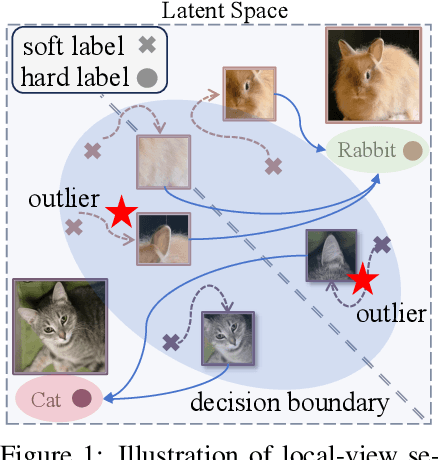
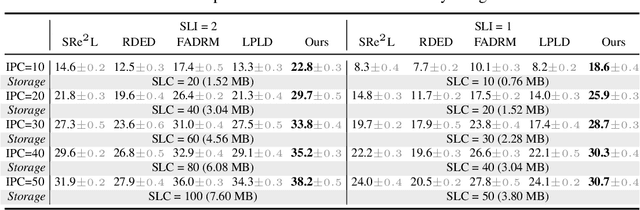
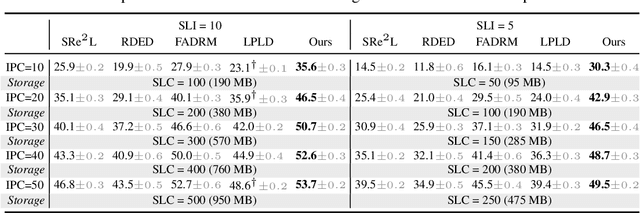
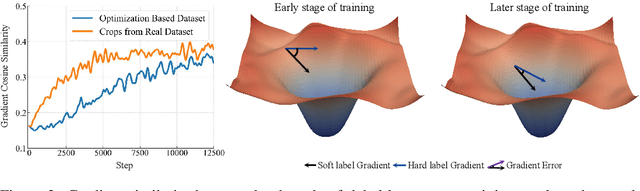
Soft labels generated by teacher models have become a dominant paradigm for knowledge transfer and recent large-scale dataset distillation such as SRe2L, RDED, LPLD, offering richer supervision than conventional hard labels. However, we observe that when only a limited number of crops per image are used, soft labels are prone to local semantic drift: a crop may visually resemble another class, causing its soft embedding to deviate from the ground-truth semantics of the original image. This mismatch between local visual content and global semantic meaning introduces systematic errors and distribution misalignment between training and testing. In this work, we revisit the overlooked role of hard labels and show that, when appropriately integrated, they provide a powerful content-agnostic anchor to calibrate semantic drift. We theoretically characterize the emergence of drift under few soft-label supervision and demonstrate that hybridizing soft and hard labels restores alignment between visual content and semantic supervision. Building on this insight, we propose a new training paradigm, Hard Label for Alleviating Local Semantic Drift (HALD), which leverages hard labels as intermediate corrective signals while retaining the fine-grained advantages of soft labels. Extensive experiments on dataset distillation and large-scale conventional classification benchmarks validate our approach, showing consistent improvements in generalization. On ImageNet-1K, we achieve 42.7% with only 285M storage for soft labels, outperforming prior state-of-the-art LPLD by 9.0%. Our findings re-establish the importance of hard labels as a complementary tool, and call for a rethinking of their role in soft-label-dominated training.
Let the Model Learn to Feel: Mode-Guided Tonality Injection for Symbolic Music Emotion Recognition
Dec 15, 2025Music emotion recognition is a key task in symbolic music understanding (SMER). Recent approaches have shown promising results by fine-tuning large-scale pre-trained models (e.g., MIDIBERT, a benchmark in symbolic music understanding) to map musical semantics to emotional labels. While these models effectively capture distributional musical semantics, they often overlook tonal structures, particularly musical modes, which play a critical role in emotional perception according to music psychology. In this paper, we investigate the representational capacity of MIDIBERT and identify its limitations in capturing mode-emotion associations. To address this issue, we propose a Mode-Guided Enhancement (MoGE) strategy that incorporates psychological insights on mode into the model. Specifically, we first conduct a mode augmentation analysis, which reveals that MIDIBERT fails to effectively encode emotion-mode correlations. We then identify the least emotion-relevant layer within MIDIBERT and introduce a Mode-guided Feature-wise linear modulation injection (MoFi) framework to inject explicit mode features, thereby enhancing the model's capability in emotional representation and inference. Extensive experiments on the EMOPIA and VGMIDI datasets demonstrate that our mode injection strategy significantly improves SMER performance, achieving accuracies of 75.2% and 59.1%, respectively. These results validate the effectiveness of mode-guided modeling in symbolic music emotion recognition.
Merge on workspaces as Hopf algebra Markov chain
Dec 21, 2025We study the dynamical properties of a Hopf algebra Markov chain with state space the binary rooted forests with labelled leaves. This Markovian dynamical system describes the core computational process of structure formation and transformation in syntax via the Merge operation, according to Chomsky's Minimalism model of generative linguistics. The dynamics decomposes into an ergodic dynamical system with uniform stationary distribution, given by the action of Internal Merge, while the contributions of External Merge and (a minimal form of) Sideward Merge reduce to a simpler Markov chain with state space the set of partitions and with combinatorial weights. The Sideward Merge part of the dynamics prevents convergence to fully formed connected structures (trees), unless the different forms of Merge are weighted by a cost function, as predicted by linguistic theory. Results on the asymptotic behavior of the Perron-Frobenius eigenvalue and eigenvector in this weighted case, obtained in terms of an associated Perron-Frobenius problem in the tropical semiring, show that the usual cost functions (Minimal Search and Resource Restrictions) proposed in the linguistic literature do not suffice to obtain convergence to the tree structures, while an additional optimization property based on the Shannon entropy achieves the expected result for the dynamics. We also comment on the introduction of continuous parameters related to semantic embedding and other computational models, and also on some filtering of the dynamics by coloring rules that model the linguistic filtering by theta roles and phase structure, and on parametric variation and the process of parameter setting in Externalization.
Ask, Answer, and Detect: Role-Playing LLMs for Personality Detection with Question-Conditioned Mixture-of-Experts
Dec 09, 2025Understanding human personality is crucial for web applications such as personalized recommendation and mental health assessment. Existing studies on personality detection predominantly adopt a "posts -> user vector -> labels" modeling paradigm, which encodes social media posts into user representations for predicting personality labels (e.g., MBTI labels). While recent advances in large language models (LLMs) have improved text encoding capacities, these approaches remain constrained by limited supervision signals due to label scarcity, and under-specified semantic mappings between user language and abstract psychological constructs. We address these challenges by proposing ROME, a novel framework that explicitly injects psychological knowledge into personality detection. Inspired by standardized self-assessment tests, ROME leverages LLMs' role-play capability to simulate user responses to validated psychometric questionnaires. These generated question-level answers transform free-form user posts into interpretable, questionnaire-grounded evidence linking linguistic cues to personality labels, thereby providing rich intermediate supervision to mitigate label scarcity while offering a semantic reasoning chain that guides and simplifies the text-to-personality mapping learning. A question-conditioned Mixture-of-Experts module then jointly routes over post and question representations, learning to answer questionnaire items under explicit supervision. The predicted answers are summarized into an interpretable answer vector and fused with the user representation for final prediction within a multi-task learning framework, where question answering serves as a powerful auxiliary task for personality detection. Extensive experiments on two real-world datasets demonstrate that ROME consistently outperforms state-of-the-art baselines, achieving improvements (15.41% on Kaggle dataset).