 Add to Chrome
 Add to Firefox
 Add to Edge
LLMSurgeon: Diagnosing Data Mixture of Large Language Models
May 28, 2026
The pretraining data mixture of Large Language Models (LLMs) constitutes their "digital DNA", shaping model behaviors, capabilities, and failure modes. Yet this composition is rarely disclosed, making post-hoc auditing of data combination or provenance difficult. In this work, we formalize $\textbf{Data Mixture Surgery (DMS)}$: given only generated text from a target LLM, estimate the domain-level distribution of its pretraining corpus under a predefined taxonomy. We propose $\textbf{LLMSurgeon}$, a strong framework that casts DMS as an inverse problem under the label-shift assumption. Rather than directly aggregating classifier outputs, LLMSurgeon estimates a calibrated $\textit{soft}$ confusion matrix and solves a constrained inverse problem to correct systematic domain confusion and recover the latent mixture prior. To evaluate, we introduce $\textbf{LLMScan}$, a recipe-verifiable evaluation suite built from open-source LLMs with transparent pretraining mixtures. Across LLMScan, LLMSurgeon recovers domain mixtures with high fidelity under fixed protocols. Our work presents a practical, post-hoc approach for auditing the digital DNA of foundation models without access to their training data.

Hard Labels In! Rethinking the Role of Hard Labels in Mitigating Local Semantic Drift
Dec 22, 2025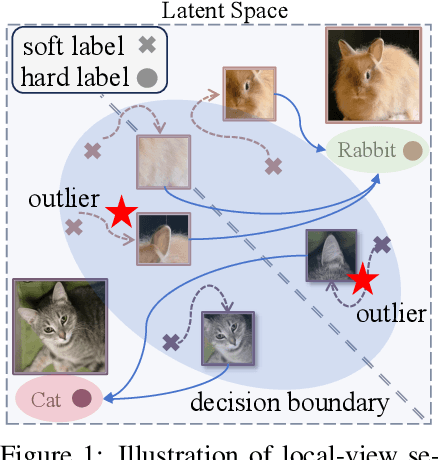
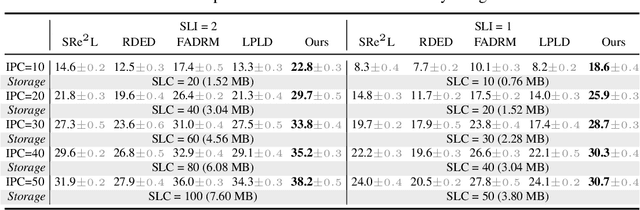
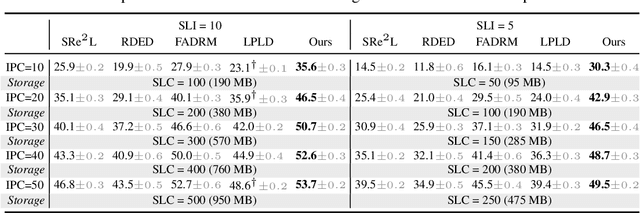
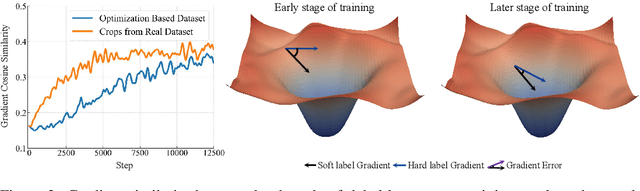
Soft labels generated by teacher models have become a dominant paradigm for knowledge transfer and recent large-scale dataset distillation such as SRe2L, RDED, LPLD, offering richer supervision than conventional hard labels. However, we observe that when only a limited number of crops per image are used, soft labels are prone to local semantic drift: a crop may visually resemble another class, causing its soft embedding to deviate from the ground-truth semantics of the original image. This mismatch between local visual content and global semantic meaning introduces systematic errors and distribution misalignment between training and testing. In this work, we revisit the overlooked role of hard labels and show that, when appropriately integrated, they provide a powerful content-agnostic anchor to calibrate semantic drift. We theoretically characterize the emergence of drift under few soft-label supervision and demonstrate that hybridizing soft and hard labels restores alignment between visual content and semantic supervision. Building on this insight, we propose a new training paradigm, Hard Label for Alleviating Local Semantic Drift (HALD), which leverages hard labels as intermediate corrective signals while retaining the fine-grained advantages of soft labels. Extensive experiments on dataset distillation and large-scale conventional classification benchmarks validate our approach, showing consistent improvements in generalization. On ImageNet-1K, we achieve 42.7% with only 285M storage for soft labels, outperforming prior state-of-the-art LPLD by 9.0%. Our findings re-establish the importance of hard labels as a complementary tool, and call for a rethinking of their role in soft-label-dominated training.
Dataset Distillation via Committee Voting
Jan 13, 2025Dataset distillation aims to synthesize a smaller, representative dataset that preserves the essential properties of the original data, enabling efficient model training with reduced computational resources. Prior work has primarily focused on improving the alignment or matching process between original and synthetic data, or on enhancing the efficiency of distilling large datasets. In this work, we introduce ${\bf C}$ommittee ${\bf V}$oting for ${\bf D}$ataset ${\bf D}$istillation (CV-DD), a novel and orthogonal approach that leverages the collective wisdom of multiple models or experts to create high-quality distilled datasets. We start by showing how to establish a strong baseline that already achieves state-of-the-art accuracy through leveraging recent advancements and thoughtful adjustments in model design and optimization processes. By integrating distributions and predictions from a committee of models while generating high-quality soft labels, our method captures a wider spectrum of data features, reduces model-specific biases and the adverse effects of distribution shifts, leading to significant improvements in generalization. This voting-based strategy not only promotes diversity and robustness within the distilled dataset but also significantly reduces overfitting, resulting in improved performance on post-eval tasks. Extensive experiments across various datasets and IPCs (images per class) demonstrate that Committee Voting leads to more reliable and adaptable distilled data compared to single/multi-model distillation methods, demonstrating its potential for efficient and accurate dataset distillation. Code is available at: https://github.com/Jiacheng8/CV-DD.