 Add to Chrome
 Add to Firefox
 Add to Edge
Rtc
Papers and Code
Tokenization Disparities as Infrastructure Bias: How Subword Systems Create Inequities in LLM Access and Efficiency
Oct 14, 2025
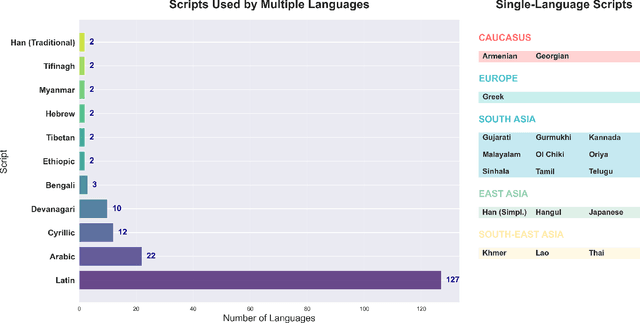
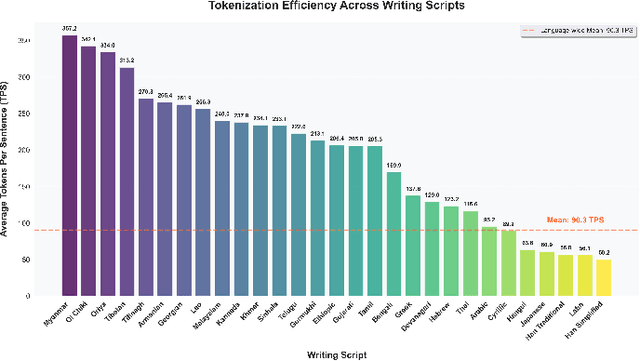
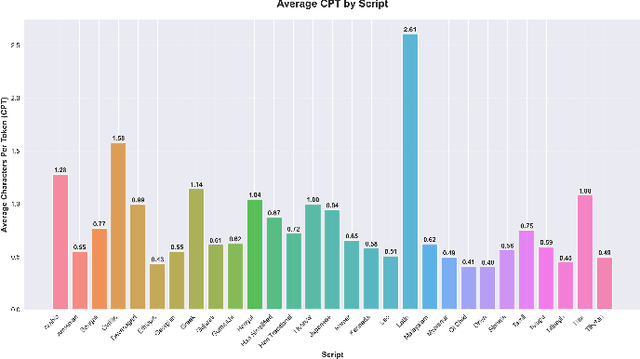
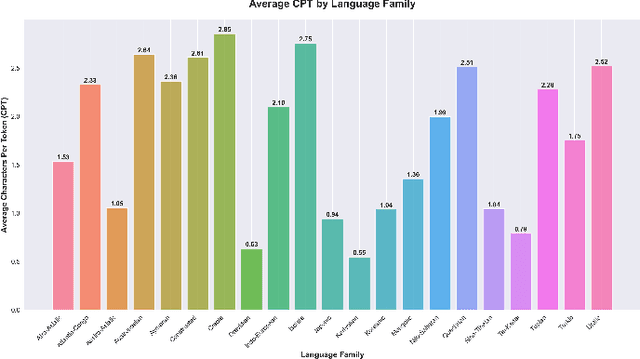
Tokenization disparities pose a significant barrier to achieving equitable access to artificial intelligence across linguistically diverse populations. This study conducts a large-scale cross-linguistic evaluation of tokenization efficiency in over 200 languages to systematically quantify computational inequities in large language models (LLMs). Using a standardized experimental framework, we applied consistent preprocessing and normalization protocols, followed by uniform tokenization through the tiktoken library across all language samples. Comprehensive tokenization statistics were collected using established evaluation metrics, including Tokens Per Sentence (TPS) and Relative Tokenization Cost (RTC), benchmarked against English baselines. Our cross-linguistic analysis reveals substantial and systematic disparities: Latin-script languages consistently exhibit higher tokenization efficiency, while non-Latin and morphologically complex languages incur significantly greater token inflation, often 3-5 times higher RTC ratios. These inefficiencies translate into increased computational costs and reduced effective context utilization for underrepresented languages. Overall, the findings highlight structural inequities in current AI systems, where speakers of low-resource and non-Latin languages face disproportionate computational disadvantages. Future research should prioritize the development of linguistically informed tokenization strategies and adaptive vocabulary construction methods that incorporate typological diversity, ensuring more inclusive and computationally equitable multilingual AI systems.

Make a Video Call with LLM: A Measurement Campaign over Five Mainstream Apps
Oct 01, 2025In 2025, Large Language Model (LLM) services have launched a new feature -- AI video chat -- allowing users to interact with AI agents via real-time video communication (RTC), just like chatting with real people. Despite its significance, no systematic study has characterized the performance of existing AI video chat systems. To address this gap, this paper proposes a comprehensive benchmark with carefully designed metrics across four dimensions: quality, latency, internal mechanisms, and system overhead. Using custom testbeds, we further evaluate five mainstream AI video chatbots with this benchmark. This work provides the research community a baseline of real-world performance and identifies unique system bottlenecks. In the meantime, our benchmarking results also open up several research questions for future optimizations of AI video chatbots.
Real-Time Execution of Action Chunking Flow Policies
Jun 09, 2025Modern AI systems, especially those interacting with the physical world, increasingly require real-time performance. However, the high latency of state-of-the-art generalist models, including recent vision-language action models (VLAs), poses a significant challenge. While action chunking has enabled temporal consistency in high-frequency control tasks, it does not fully address the latency problem, leading to pauses or out-of-distribution jerky movements at chunk boundaries. This paper presents a novel inference-time algorithm that enables smooth asynchronous execution of action chunking policies. Our method, real-time chunking (RTC), is applicable to any diffusion- or flow-based VLA out of the box with no re-training. It generates the next action chunk while executing the current one, "freezing" actions guaranteed to execute and "inpainting" the rest. To test RTC, we introduce a new benchmark of 12 highly dynamic tasks in the Kinetix simulator, as well as evaluate 6 challenging real-world bimanual manipulation tasks. Results demonstrate that RTC is fast, performant, and uniquely robust to inference delay, significantly improving task throughput and enabling high success rates in precise tasks $\unicode{x2013}$ such as lighting a match $\unicode{x2013}$ even in the presence of significant latency. See https://pi.website/research/real_time_chunking for videos.
RedTeamCUA: Realistic Adversarial Testing of Computer-Use Agents in Hybrid Web-OS Environments
May 28, 2025Computer-use agents (CUAs) promise to automate complex tasks across operating systems (OS) and the web, but remain vulnerable to indirect prompt injection. Current evaluations of this threat either lack support realistic but controlled environments or ignore hybrid web-OS attack scenarios involving both interfaces. To address this, we propose RedTeamCUA, an adversarial testing framework featuring a novel hybrid sandbox that integrates a VM-based OS environment with Docker-based web platforms. Our sandbox supports key features tailored for red teaming, such as flexible adversarial scenario configuration, and a setting that decouples adversarial evaluation from navigational limitations of CUAs by initializing tests directly at the point of an adversarial injection. Using RedTeamCUA, we develop RTC-Bench, a comprehensive benchmark with 864 examples that investigate realistic, hybrid web-OS attack scenarios and fundamental security vulnerabilities. Benchmarking current frontier CUAs identifies significant vulnerabilities: Claude 3.7 Sonnet | CUA demonstrates an ASR of 42.9%, while Operator, the most secure CUA evaluated, still exhibits an ASR of 7.6%. Notably, CUAs often attempt to execute adversarial tasks with an Attempt Rate as high as 92.5%, although failing to complete them due to capability limitations. Nevertheless, we observe concerning ASRs of up to 50% in realistic end-to-end settings, with the recently released frontier Claude 4 Opus | CUA showing an alarming ASR of 48%, demonstrating that indirect prompt injection presents tangible risks for even advanced CUAs despite their capabilities and safeguards. Overall, RedTeamCUA provides an essential framework for advancing realistic, controlled, and systematic analysis of CUA vulnerabilities, highlighting the urgent need for robust defenses to indirect prompt injection prior to real-world deployment.
Demonstrating a Control Framework for Physical Human-Robot Interaction Toward Industrial Applications
Feb 05, 2025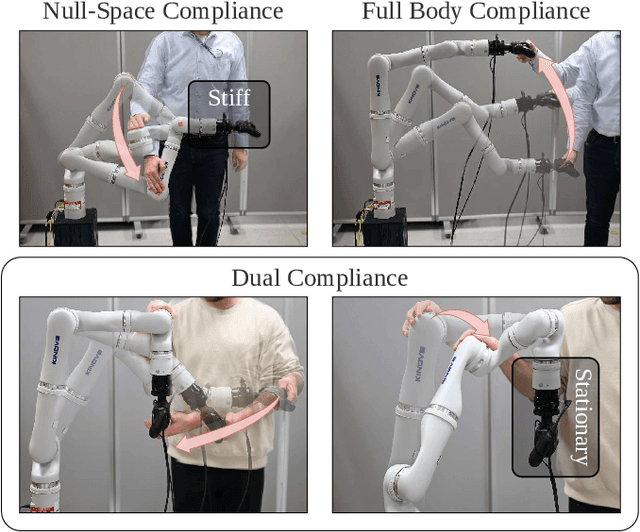
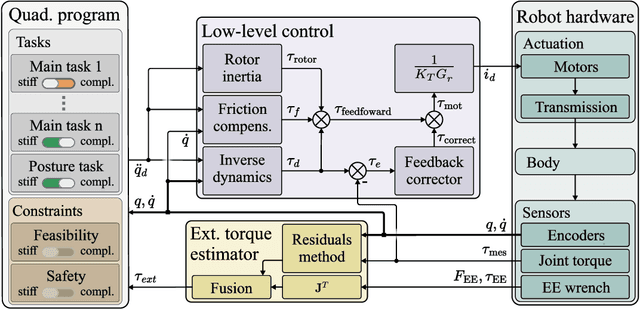
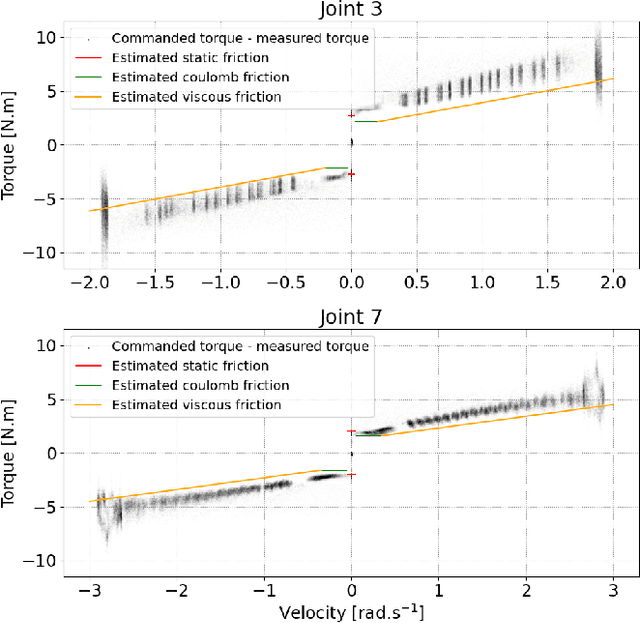
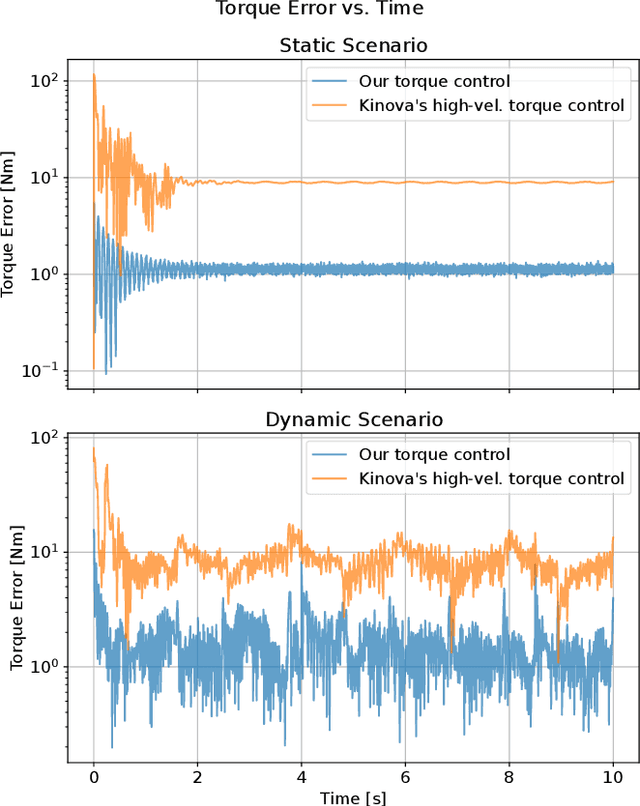
Human-Robot Interaction (pHRI) is critical for implementing Industry 5.0 which focuses on human-centric approaches. However, few studies explore the practical alignment of pHRI to industrial grade performance. This paper introduces a versatile control framework designed to bridge this gap by incorporating the torque-based control modes: compliance control, null-space compliance, dual compliance, all in static and dynamic scenarios. Thanks to our second-order Quadratic Programming (QP) formulation, strict kinematic and collision constraints are integrated into the system as safety features, and a weighted hierarchy guarantees singularity-robust task tracking performance. The framework is implemented on a Kinova Gen3 collaborative robot (cobot) equipped with a Bota force/torque sensor. A DualShock 4 game controller is attached at the robot's end-effector to demonstrate the framework's capabilities. This setup enables seamless dynamic switching between the modes, and real-time adjustment of parameters, such as transitioning between position and torque control or selecting a more robust custom-developed low-level torque controller over the default one.Built on the open-source robotic control software mc_rtc, to ensure reproducibility for both research and industrial deployment, this framework demonstrates industrial-grade performance and repeatability, showcasing its potential as a robust pHRI control system for industrial environments.
Crystal Oscillators in OSNMA-Enabled Receivers: An Implementation View for Automotive Applications
Jan 25, 2025To ensure the authenticity of navigation data, Galileo Open Service navigation message authentication (OSNMA) requires loose synchronization between the receiver clock and the system time. This means that during the period between clock calibrations, the receiver clock error needs to be smaller than a pre-defined threshold, currently up to 165s for OSNMA. On the other hand, relying on the PVT solution to steer the receiver clock or correct its bias may not be possible since this would depend on the very same signals we intend to authenticate. This work aims to investigate the causes of the frequency accuracy loss leading to clock errors and to build a model that, from the datasheet of a real-time clock (RTC) device, allows to bound the error clock during a certain period. The model's main contributors are temperature changes, long-term aging, and offset at calibration, but it includes other factors. We then apply the model to several RTCs from different manufacturers and bound the maximum error for certain periods, with a focus on the two-year between-calibration period expected for the smart tachograph, an automotive application that will integrate OSNMA.
Deep Self-Supervised Disturbance Mapping with the OPERA Sentinel-1 Radiometric Terrain Corrected SAR Backscatter Product
Jan 15, 2025Mapping land surface disturbances supports disaster response, resource and ecosystem management, and climate adaptation efforts. Synthetic aperture radar (SAR) is an invaluable tool for disturbance mapping, providing consistent time-series images of the ground regardless of weather or illumination conditions. Despite SAR's potential for disturbance mapping, processing SAR data to an analysis-ready format requires expertise and significant compute resources, particularly for large-scale global analysis. In October 2023, NASA's Observational Products for End-Users from Remote Sensing Analysis (OPERA) project released the near-global Radiometric Terrain Corrected SAR backscatter from Sentinel-1 (RTC-S1) dataset, providing publicly available, analysis-ready SAR imagery. In this work, we utilize this new dataset to systematically analyze land surface disturbances. As labeling SAR data is often prohibitively time-consuming, we train a self-supervised vision transformer - which requires no labels to train - on OPERA RTC-S1 data to estimate a per-pixel distribution from the set of baseline imagery and assess disturbances when there is significant deviation from the modeled distribution. To test our model's capability and generality, we evaluate three different natural disasters - which represent high-intensity, abrupt disturbances - from three different regions of the world. Across events, our approach yields high quality delineations: F1 scores exceeding 0.6 and Areas Under the Precision-Recall Curve exceeding 0.65, consistently outperforming existing SAR disturbance methods. Our findings suggest that a self-supervised vision transformer is well-suited for global disturbance mapping and can be a valuable tool for operational, near-global disturbance monitoring, particularly when labeled data does not exist.
Streetwise Agents: Empowering Offline RL Policies to Outsmart Exogenous Stochastic Disturbances in RTC
Nov 11, 2024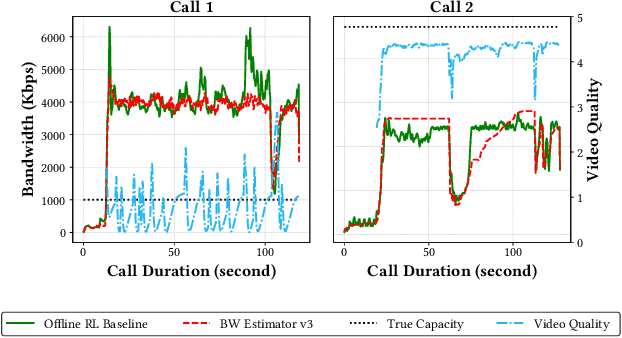
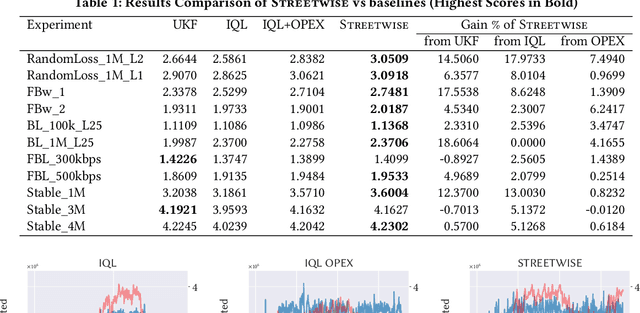
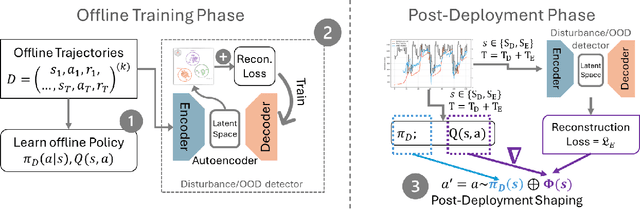
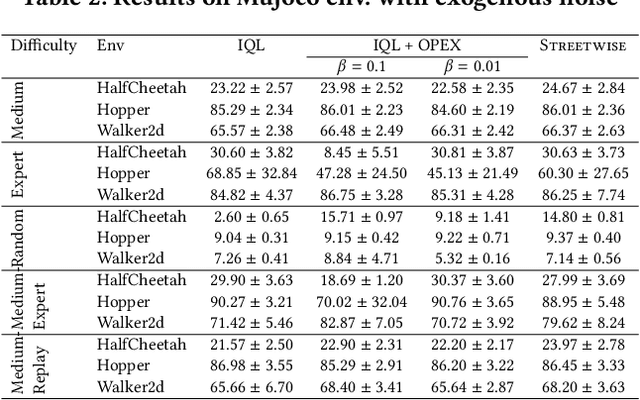
The difficulty of exploring and training online on real production systems limits the scope of real-time online data/feedback-driven decision making. The most feasible approach is to adopt offline reinforcement learning from limited trajectory samples. However, after deployment, such policies fail due to exogenous factors that temporarily or permanently disturb/alter the transition distribution of the assumed decision process structure induced by offline samples. This results in critical policy failures and generalization errors in sensitive domains like Real-Time Communication (RTC). We solve this crucial problem of identifying robust actions in presence of domain shifts due to unseen exogenous stochastic factors in the wild. As it is impossible to learn generalized offline policies within the support of offline data that are robust to these unseen exogenous disturbances, we propose a novel post-deployment shaping of policies (Streetwise), conditioned on real-time characterization of out-of-distribution sub-spaces. This leads to robust actions in bandwidth estimation (BWE) of network bottlenecks in RTC and in standard benchmarks. Our extensive experimental results on BWE and other standard offline RL benchmark environments demonstrate a significant improvement ($\approx$ 18% on some scenarios) in final returns wrt. end-user metrics over state-of-the-art baselines.
Modelling Concurrent RTP Flows for End-to-end Predictions of QoS in Real Time Communications
Oct 21, 2024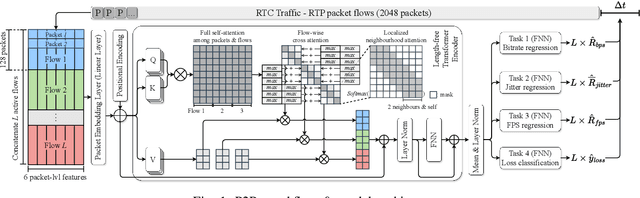
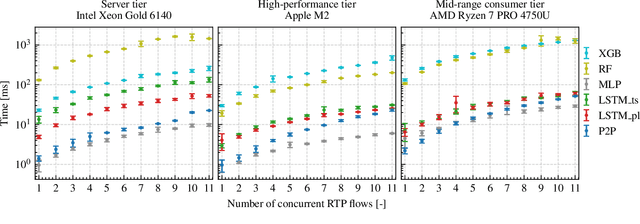

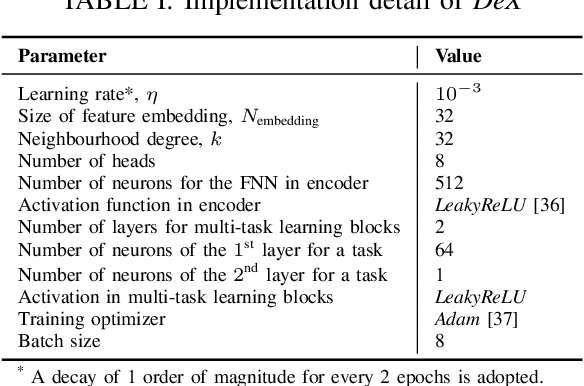
The Real-time Transport Protocol (RTP)-based real-time communications (RTC) applications, exemplified by video conferencing, have experienced an unparalleled surge in popularity and development in recent years. In pursuit of optimizing their performance, the prediction of Quality of Service (QoS) metrics emerges as a pivotal endeavor, bolstering network monitoring and proactive solutions. However, contemporary approaches are confined to individual RTP flows and metrics, falling short in relationship capture and computational efficiency. To this end, we propose Packet-to-Prediction (P2P), a novel deep learning (DL) framework that hinges on raw packets to simultaneously process concurrent RTP flows and perform end-to-end prediction of multiple QoS metrics. Specifically, we implement a streamlined architecture, namely length-free Transformer with cross and neighbourhood attention, capable of handling an unlimited number of RTP flows, and employ a multi-task learning paradigm to forecast four key metrics in a single shot. Our work is based on extensive traffic collected during real video calls, and conclusively, P2P excels comparative models in both prediction performance and temporal efficiency.
MPADA: Open source framework for multimodal time series antenna array measurements
Aug 29, 2024This paper presents an open-source framework for collecting time series S-parameter measurements across multiple antenna elements, dubbed MPADA: Multi-Port Antenna Data Acquisition. The core of MPADA relies on the standard SCPI protocol to be compatible with a wide range of hardware platforms. Time series measurements are enabled through the use of a high-precision real-time clock (RTC), allowing MPADA to periodically trigger the VNA and simultaneously acquire other sensor data for synchronized cross-modal data fusion. A web-based user interface has been developed to offer flexibility in instrumentation, visualization, and analysis. The interface is accessible from a broad range of devices, including mobile ones. Experiments are performed to validate the reliability and accuracy of the data collected using the proposed framework. First, we show the framework's capacity to collect highly repeatable measurements from a complex measurement protocol using a microwave tomography imaging system. The data collected from a test phantom attain high fidelity where a position-varying clutter is visible through coherent subtraction. Second, we demonstrate timestamp accuracy for collecting time series motion data jointly from an RF kinematic sensor and an angle sensor. We achieved an average of 11.8 ms MSE timestamp accuracy at a mixed sampling rate of 10 to 20 Hz over a total of 16-minute test data. We make the framework openly available to benefit the antenna measurement community, providing researchers and engineers with a versatile tool for research and instrumentation. Additionally, we offer a potential education tool to engage engineering students in the subject, fostering hands-on learning through remote experimentation.