 Add to Chrome
 Add to Firefox
 Add to Edge
Safe Execution of RL Policies Via Acceleration-Based CBF-QP Constraint Enforcement for Real-World Robotic Deployments
Jul 16, 2026
Reinforcement Learning (RL) has demonstrated remarkable capabilities for solving complex robotic control problems, but its lack of safety guarantees severely limits deployment on hardware. In particular, as legged robots and manipulators often operate near safety-critical boundaries, out-of-distribution states can lead to failure upon deployment. To address this, we introduce Acc-CBF-QP, an acceleration-based Quadratic Program (QP) safety filter using Control Barrier Functions (CBFs) that constrains any RL policy onto a safe set at runtime without modifying training. The method applies to unconstrained and Safe-RL policies, and enforces joint position, velocity, torque, and collision constraints within a unified optimization framework. A key contribution is the formulation of RL+QP tasks that regulate deviation from the RL command when constraints would otherwise be violated. We introduce a TorqueTask, minimizing torque deviation, and a Forward Dynamics Task, minimizing induced acceleration deviation, thus providing principled control over safety-performance trade-offs. Experiments on a 7-DoF Kinova Gen3 manipulator and a 19-DoF Unitree H1 humanoid, both in simulation and on hardware, highlight substantial reductions in constraint violations. On the real H1 hardware, a Safe-RL policy alone yielded 10.04 violations/s, which were reduced by 92% to 0.80 violations/s when augmented with Acc-CBF-QP. On the Kinova Gen3, Acc-CBF-QP fully eliminated violations. Nominal task performance of the RL objective is preserved in violation-free regimes. Under aggressive velocity commands on H1, Acc-CBF-QP improves execution by preventing constraint-induced shutdowns, yielding longer survival times. The full pipeline is open-source.

Demonstrating a Control Framework for Physical Human-Robot Interaction Toward Industrial Applications
Feb 05, 2025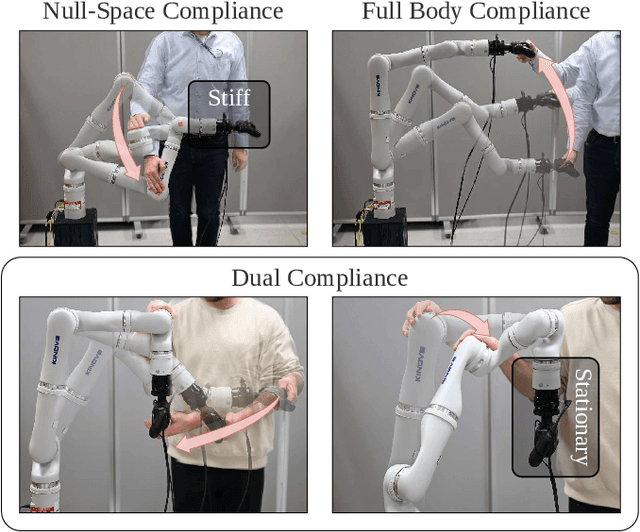
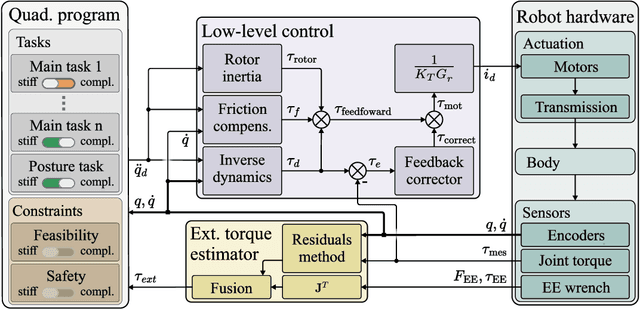
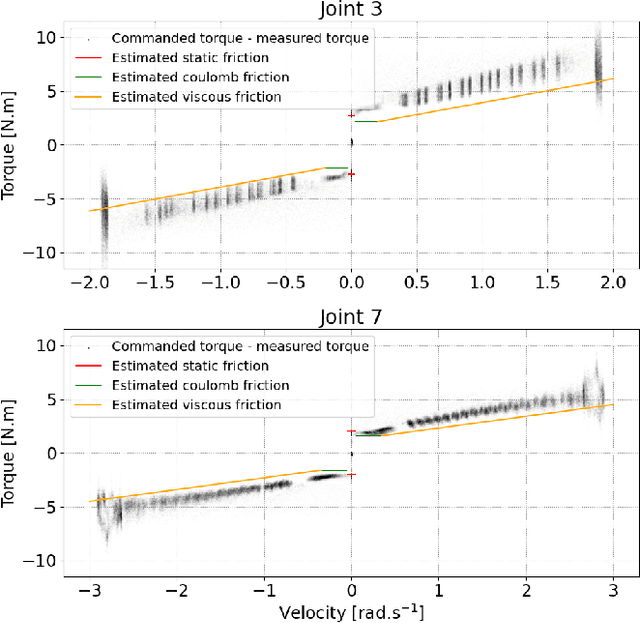
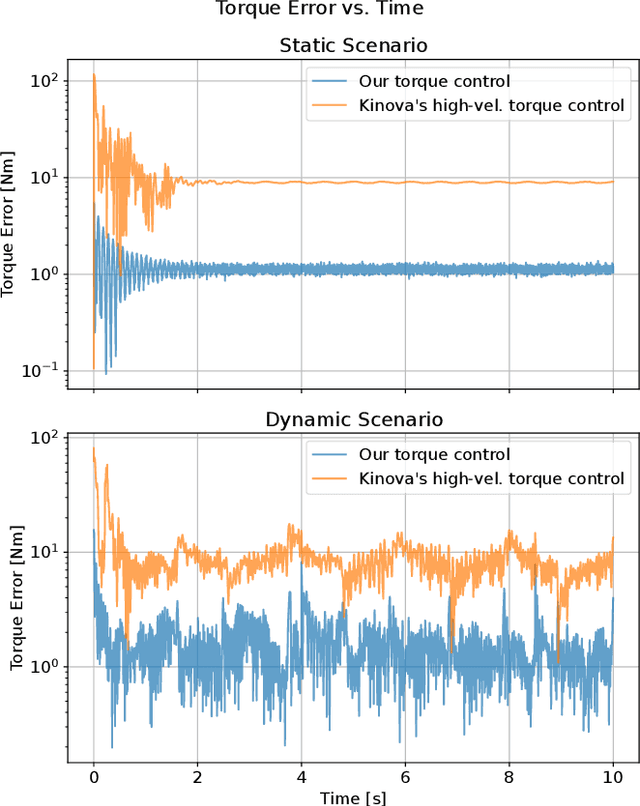
Human-Robot Interaction (pHRI) is critical for implementing Industry 5.0 which focuses on human-centric approaches. However, few studies explore the practical alignment of pHRI to industrial grade performance. This paper introduces a versatile control framework designed to bridge this gap by incorporating the torque-based control modes: compliance control, null-space compliance, dual compliance, all in static and dynamic scenarios. Thanks to our second-order Quadratic Programming (QP) formulation, strict kinematic and collision constraints are integrated into the system as safety features, and a weighted hierarchy guarantees singularity-robust task tracking performance. The framework is implemented on a Kinova Gen3 collaborative robot (cobot) equipped with a Bota force/torque sensor. A DualShock 4 game controller is attached at the robot's end-effector to demonstrate the framework's capabilities. This setup enables seamless dynamic switching between the modes, and real-time adjustment of parameters, such as transitioning between position and torque control or selecting a more robust custom-developed low-level torque controller over the default one.Built on the open-source robotic control software mc_rtc, to ensure reproducibility for both research and industrial deployment, this framework demonstrates industrial-grade performance and repeatability, showcasing its potential as a robust pHRI control system for industrial environments.
Scalable, Training-Free Visual Language Robotics: A Modular Multi-Model Framework for Consumer-Grade GPUs
Feb 03, 2025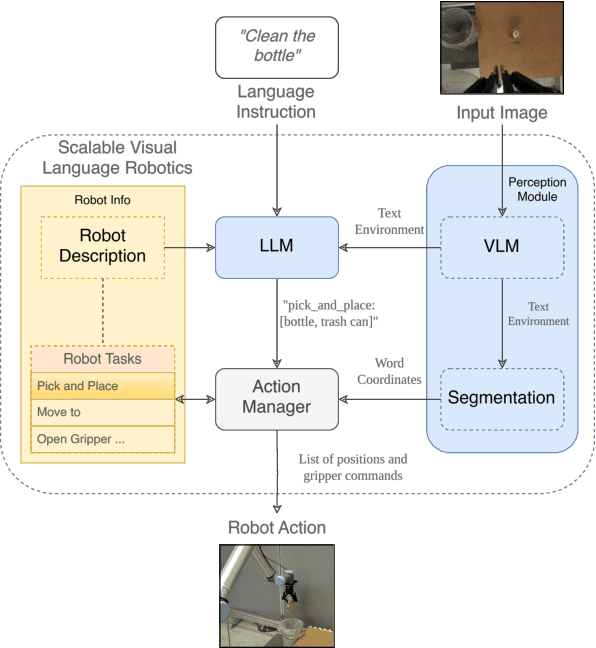
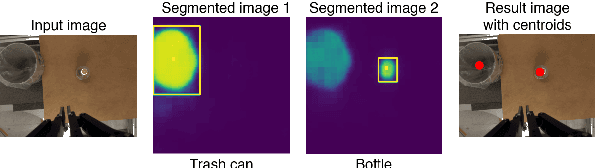
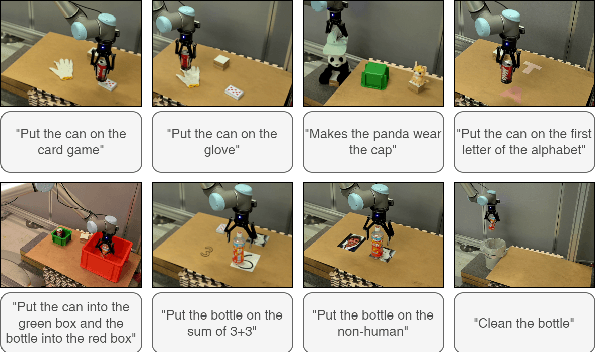
The integration of language instructions with robotic control, particularly through Vision Language Action (VLA) models, has shown significant potential. However, these systems are often hindered by high computational costs, the need for extensive retraining, and limited scalability, making them less accessible for widespread use. In this paper, we introduce SVLR (Scalable Visual Language Robotics), an open-source, modular framework that operates without the need for retraining, providing a scalable solution for robotic control. SVLR leverages a combination of lightweight, open-source AI models including the Vision-Language Model (VLM) Mini-InternVL, zero-shot image segmentation model CLIPSeg, Large Language Model Phi-3, and sentence similarity model all-MiniLM to process visual and language inputs. These models work together to identify objects in an unknown environment, use them as parameters for task execution, and generate a sequence of actions in response to natural language instructions. A key strength of SVLR is its scalability. The framework allows for easy integration of new robotic tasks and robots by simply adding text descriptions and task definitions, without the need for retraining. This modularity ensures that SVLR can continuously adapt to the latest advancements in AI technologies and support a wide range of robots and tasks. SVLR operates effectively on an NVIDIA RTX 2070 (mobile) GPU, demonstrating promising performance in executing pick-and-place tasks. While these initial results are encouraging, further evaluation across a broader set of tasks and comparisons with existing VLA models are needed to assess SVLR's generalization capabilities and performance in more complex scenarios.