 Add to Chrome
 Add to Firefox
 Add to Edge
Near-Real-Time InSAR Phase Estimation for Large-Scale Surface Displacement Monitoring
Nov 15, 2025
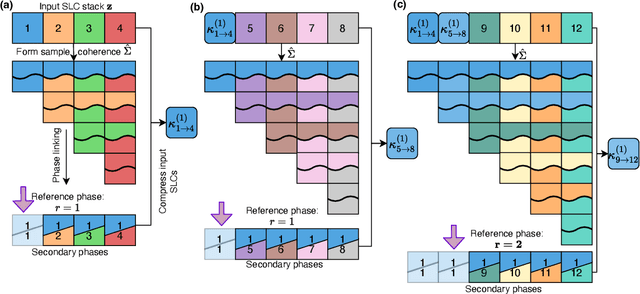
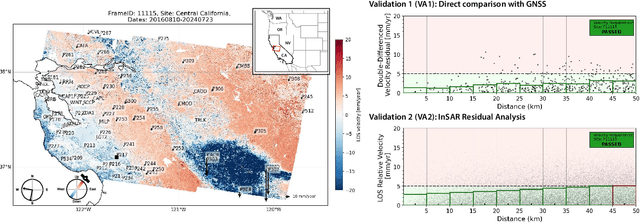
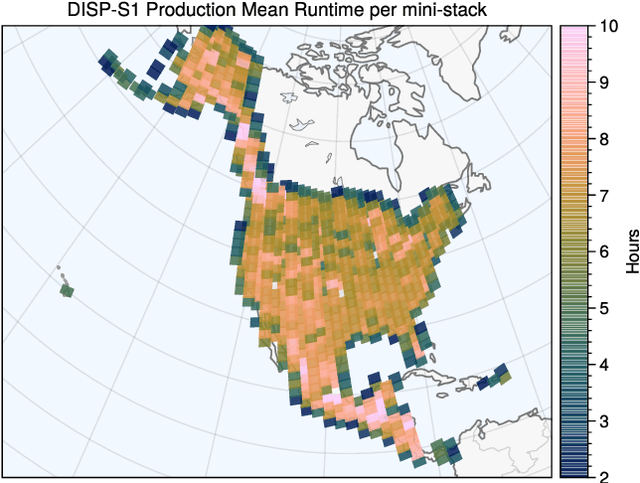
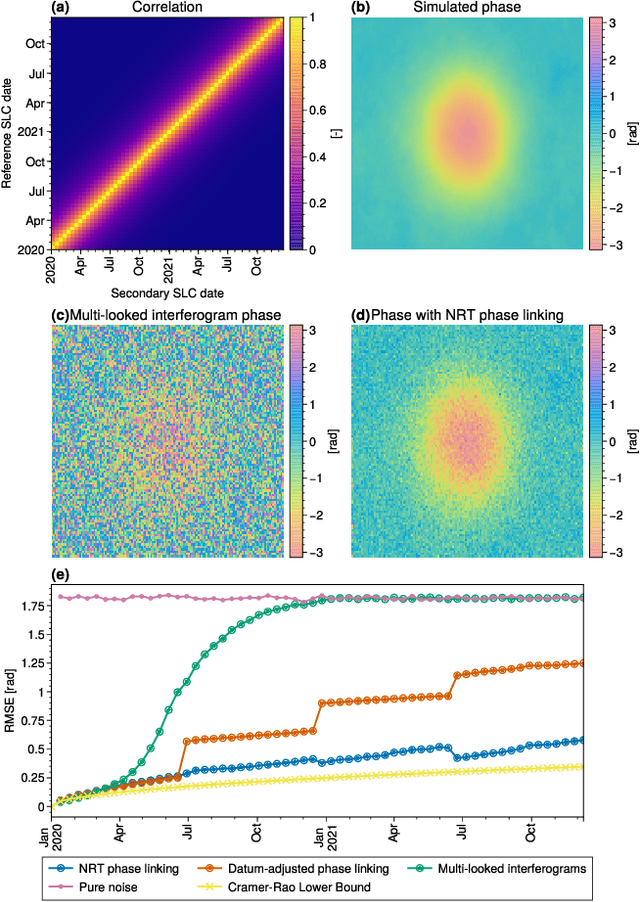
Operational near-real-time monitoring of Earth's surface deformation using Interferometric Synthetic Aperture Radar (InSAR) requires processing algorithms that efficiently incorporate new acquisitions without reprocessing historical archives. We present sequential phase linking approach using compressed single-look-complex images (SLCs) capable of producing surface displacement estimates within hours of the time of a new acquisition. Our key algorithmic contribution is a mini-stack reference scheme that maintains phase consistency across processing batches without adjusting or re-estimating previous time steps, enabling straightforward operational deployment. We introduce online methods for persistent and distributed scatterer identification that adapt to temporal changes in surface properties through incremental amplitude statistics updates. The processing chain incorporates multiple complementary metrics for pixel quality that are reliable for small SLC stack sizes, and an L1-norm network inversion to limit propagation of unwrapping errors across the time series. We use our algorithm to produce OPERA Surface Displacement from Sentinel-1 product, the first continental-scale surface displacement product over North America. Validation against GPS measurements and InSAR residual analysis demonstrates millimeter-level agreement in velocity estimates in varying environmental conditions. We demonstrate our algorithm's capabilities with a successful recovery of meter-scale co-eruptive displacement at Kilauea volcano during the 2018 eruption, as well as detection of subtle uplift at Three Sisters volcano, Oregon- a challenging environment for C-band InSAR due to dense vegetation and seasonal snow. We have made all software available as open source libraries, providing a significant advancement to the open scientific community's ability to process large InSAR data sets in a cloud environment.

Deep Self-Supervised Disturbance Mapping with the OPERA Sentinel-1 Radiometric Terrain Corrected SAR Backscatter Product
Jan 15, 2025
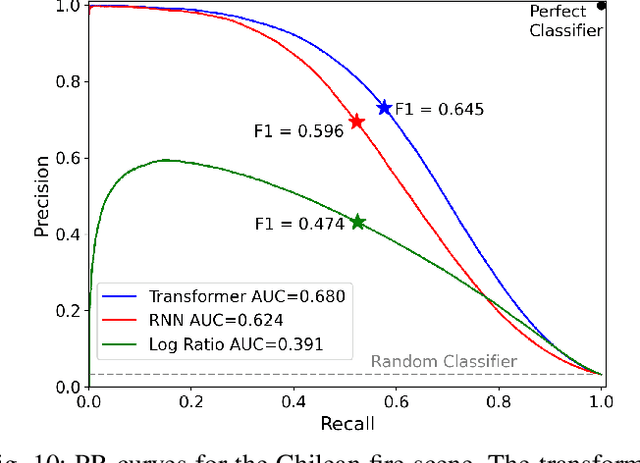
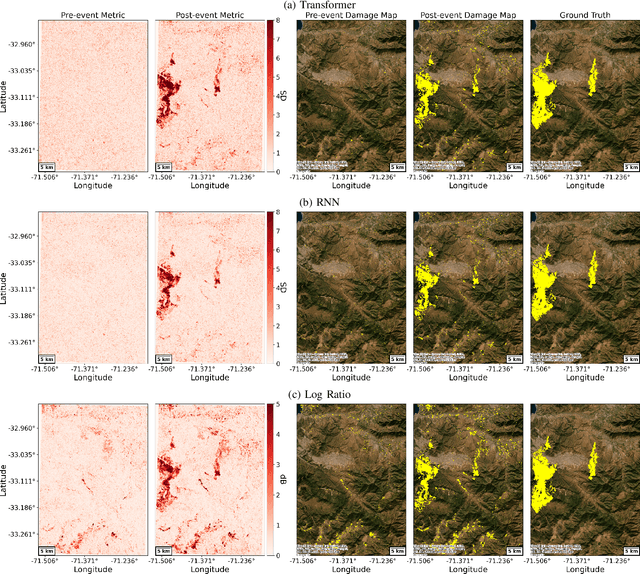
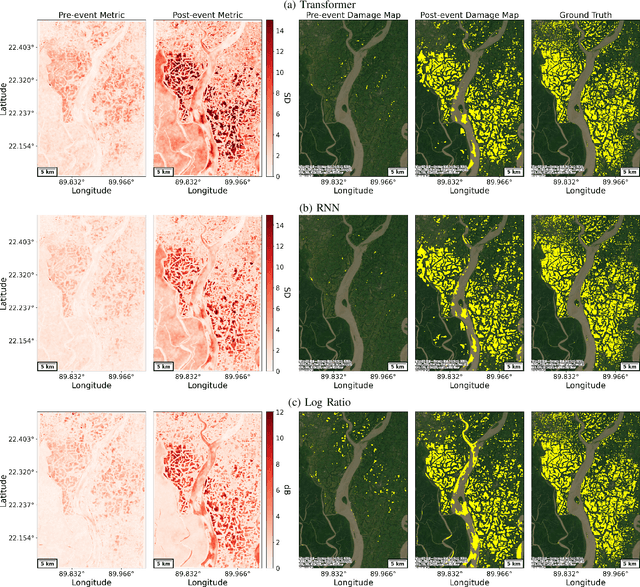
Mapping land surface disturbances supports disaster response, resource and ecosystem management, and climate adaptation efforts. Synthetic aperture radar (SAR) is an invaluable tool for disturbance mapping, providing consistent time-series images of the ground regardless of weather or illumination conditions. Despite SAR's potential for disturbance mapping, processing SAR data to an analysis-ready format requires expertise and significant compute resources, particularly for large-scale global analysis. In October 2023, NASA's Observational Products for End-Users from Remote Sensing Analysis (OPERA) project released the near-global Radiometric Terrain Corrected SAR backscatter from Sentinel-1 (RTC-S1) dataset, providing publicly available, analysis-ready SAR imagery. In this work, we utilize this new dataset to systematically analyze land surface disturbances. As labeling SAR data is often prohibitively time-consuming, we train a self-supervised vision transformer - which requires no labels to train - on OPERA RTC-S1 data to estimate a per-pixel distribution from the set of baseline imagery and assess disturbances when there is significant deviation from the modeled distribution. To test our model's capability and generality, we evaluate three different natural disasters - which represent high-intensity, abrupt disturbances - from three different regions of the world. Across events, our approach yields high quality delineations: F1 scores exceeding 0.6 and Areas Under the Precision-Recall Curve exceeding 0.65, consistently outperforming existing SAR disturbance methods. Our findings suggest that a self-supervised vision transformer is well-suited for global disturbance mapping and can be a valuable tool for operational, near-global disturbance monitoring, particularly when labeled data does not exist.