 Add to Chrome
 Add to Firefox
 Add to Edge
Phishing the Phishers with SpecularNet: Hierarchical Graph Autoencoding for Reference-Free Web Phishing Detection
Mar 02, 2026
Phishing remains the most pervasive threat to the Web, enabling large-scale credential theft and financial fraud through deceptive webpages. While recent reference-based and generative-AI-driven phishing detectors achieve strong accuracy, their reliance on external knowledge bases, cloud services, and complex multimodal pipelines fundamentally limits practicality, scalability, and reproducibility. In contrast, conventional deep learning approaches often fail to generalize to evolving phishing campaigns. We introduce SpecularNet, a novel lightweight framework for reference-free web phishing detection that demonstrates how carefully designed compact architectures can rival heavyweight systems. SpecularNet operates solely on the domain name and HTML structure, modeling the Document Object Model (DOM) as a tree and leveraging a hierarchical graph autoencoding architecture with directional, level-wise message passing. This design captures higher-order structural invariants of phishing webpages while enabling fast, end-to-end inference on standard CPUs. Extensive evaluation against 13 state of the art phishing detectors, including leading reference-based systems, shows that SpecularNet achieves competitive detection performance with dramatically lower computational cost. On benchmark datasets, it reaches an F1 score of 93.9%, trailing the best reference-based method slightly while reducing inference time from several seconds to approximately 20 milliseconds per webpage. Field and robustness evaluations further validate SpecularNet in real-world deployments, on a newly collected 2026 open-world dataset, and against adversarial attacks.

Modelling Concurrent RTP Flows for End-to-end Predictions of QoS in Real Time Communications
Oct 21, 2024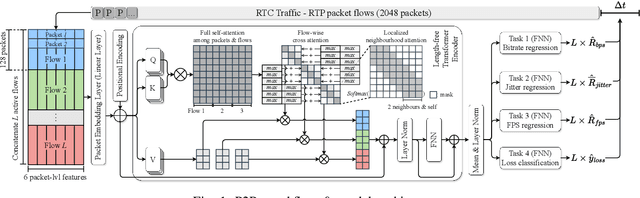
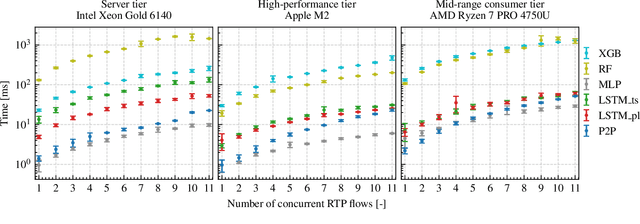

The Real-time Transport Protocol (RTP)-based real-time communications (RTC) applications, exemplified by video conferencing, have experienced an unparalleled surge in popularity and development in recent years. In pursuit of optimizing their performance, the prediction of Quality of Service (QoS) metrics emerges as a pivotal endeavor, bolstering network monitoring and proactive solutions. However, contemporary approaches are confined to individual RTP flows and metrics, falling short in relationship capture and computational efficiency. To this end, we propose Packet-to-Prediction (P2P), a novel deep learning (DL) framework that hinges on raw packets to simultaneously process concurrent RTP flows and perform end-to-end prediction of multiple QoS metrics. Specifically, we implement a streamlined architecture, namely length-free Transformer with cross and neighbourhood attention, capable of handling an unlimited number of RTP flows, and employ a multi-task learning paradigm to forecast four key metrics in a single shot. Our work is based on extensive traffic collected during real video calls, and conclusively, P2P excels comparative models in both prediction performance and temporal efficiency.