 Add to Chrome
 Add to Firefox
 Add to Edge
SibylSense: Adaptive Rubric Learning via Memory Tuning and Adversarial Probing
Feb 24, 2026
Designing aligned and robust rewards for open-ended generation remains a key barrier to RL post-training. Rubrics provide structured, interpretable supervision, but scaling rubric construction is difficult: expert rubrics are costly, prompted rubrics are often superficial or inconsistent, and fixed-pool discriminative rubrics can saturate and drift, enabling reward hacking. We present SibylSense, an inference-time learning approach that adapts a frozen rubric generator through a tunable memory bank of validated rubric items. Memory is updated via verifier-based item rewards measured by reference-candidate answer discriminative gaps from a handful of examples. SibylSense alternates memory tuning with a rubric-adversarial policy update that produces rubric-satisfying candidate answers, shrinking discriminative gaps and driving the rubric generator to capture new quality dimensions. Experiments on two open-ended tasks show that SibylSense yields more discriminative rubrics and improves downstream RL performance over static and non-adaptive baselines.

Streetwise Agents: Empowering Offline RL Policies to Outsmart Exogenous Stochastic Disturbances in RTC
Nov 11, 2024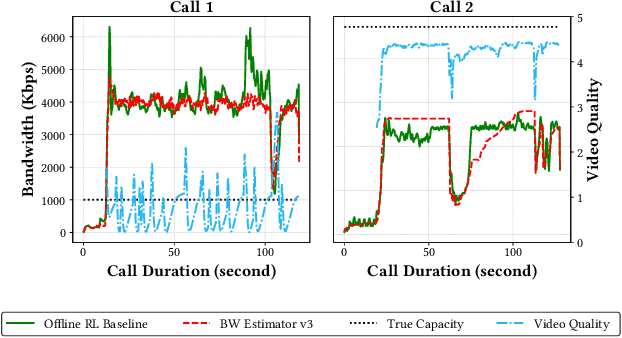
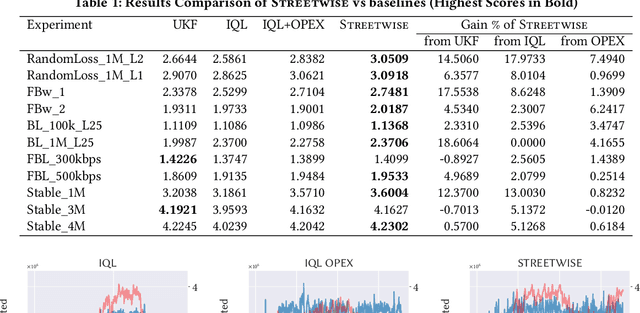
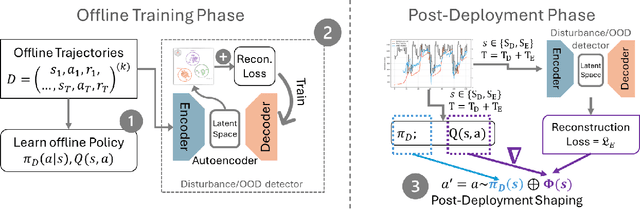
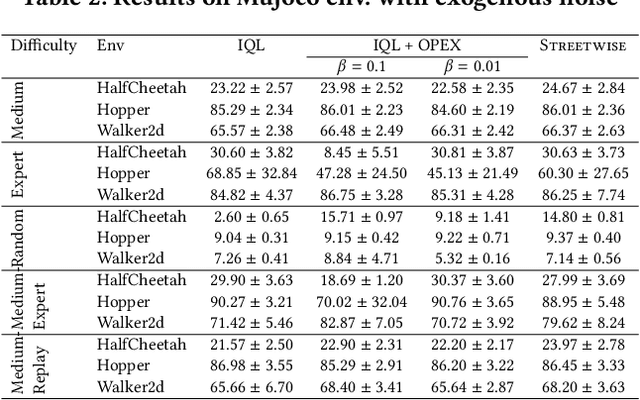
The difficulty of exploring and training online on real production systems limits the scope of real-time online data/feedback-driven decision making. The most feasible approach is to adopt offline reinforcement learning from limited trajectory samples. However, after deployment, such policies fail due to exogenous factors that temporarily or permanently disturb/alter the transition distribution of the assumed decision process structure induced by offline samples. This results in critical policy failures and generalization errors in sensitive domains like Real-Time Communication (RTC). We solve this crucial problem of identifying robust actions in presence of domain shifts due to unseen exogenous stochastic factors in the wild. As it is impossible to learn generalized offline policies within the support of offline data that are robust to these unseen exogenous disturbances, we propose a novel post-deployment shaping of policies (Streetwise), conditioned on real-time characterization of out-of-distribution sub-spaces. This leads to robust actions in bandwidth estimation (BWE) of network bottlenecks in RTC and in standard benchmarks. Our extensive experimental results on BWE and other standard offline RL benchmark environments demonstrate a significant improvement ($\approx$ 18% on some scenarios) in final returns wrt. end-user metrics over state-of-the-art baselines.
Unveiling Context-Aware Criteria in Self-Assessing LLMs
Oct 28, 2024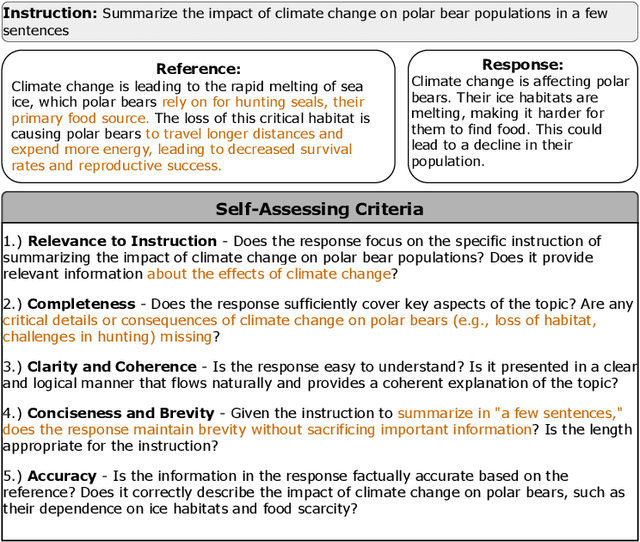
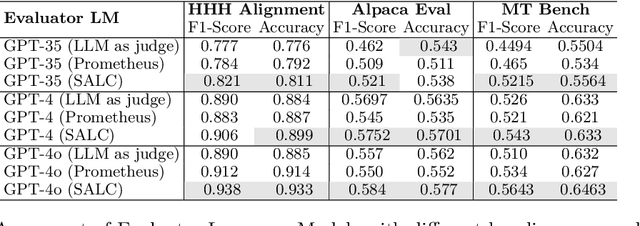
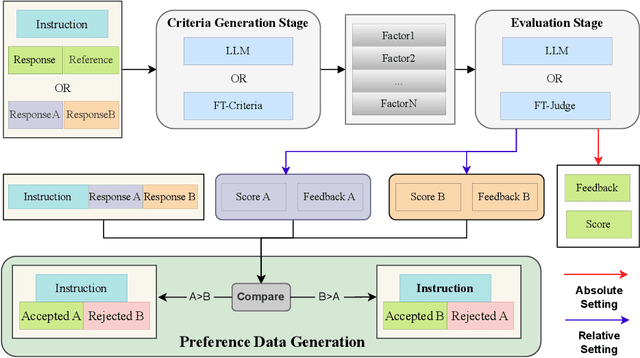
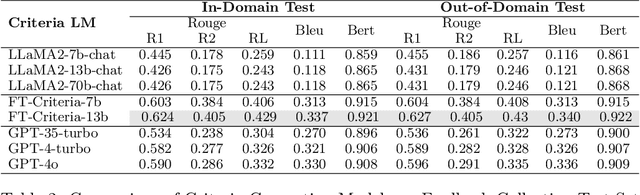
The use of large language models (LLMs) as evaluators has garnered significant attention due to their potential to rival human-level evaluations in long-form response assessments. However, current LLM evaluators rely heavily on static, human-defined criteria, limiting their ability to generalize across diverse generative tasks and incorporate context-specific knowledge. In this paper, we propose a novel Self-Assessing LLM framework that integrates Context-Aware Criteria (SALC) with dynamic knowledge tailored to each evaluation instance. This instance-level knowledge enhances the LLM evaluator's performance by providing relevant and context-aware insights that pinpoint the important criteria specific to the current instance. Additionally, the proposed framework adapts seamlessly to various tasks without relying on predefined human criteria, offering a more flexible evaluation approach. Empirical evaluations demonstrate that our approach significantly outperforms existing baseline evaluation frameworks, yielding improvements on average 4.8% across a wide variety of datasets. Furthermore, by leveraging knowledge distillation techniques, we fine-tuned smaller language models for criteria generation and evaluation, achieving comparable or superior performance to larger models with much lower cost. Our method also exhibits a improvement in LC Win-Rate in AlpacaEval2 leaderboard up to a 12% when employed for preference data generation in Direct Preference Optimization (DPO), underscoring its efficacy as a robust and scalable evaluation framework.