 Add to Chrome
 Add to Firefox
 Add to Edge
Multi Word Expression Embedding
Papers and Code
ADE: Adaptive Dictionary Embeddings -- Scaling Multi-Anchor Representations to Large Language Models
Apr 27, 2026
Word embeddings are fundamental to natural language processing, yet traditional approaches represent each word with a single vector, creating representational bottlenecks for polysemous words and limiting semantic expressiveness. While multi-anchor representations have shown promise by representing words as combinations of multiple vectors, they have been limited to small-scale models due to computational inefficiency and lack of integration with modern transformer architectures. We introduce Adaptive Dictionary Embeddings (ADE), a framework that successfully scales multi-anchor word representations to large language models. ADE makes three key contributions: (1) Vocabulary Projection (VP), which transforms the costly two-stage anchor lookup into a single efficient matrix operation; (2) Grouped Positional Encoding (GPE), a novel positional encoding scheme where anchors of the same word share positional information, preserving semantic coherence while enabling anchor-level variation; and (3) context-aware anchor reweighting, which leverages self-attention to dynamically compose anchor contributions based on sequence context. We integrate these components into the Segment-Aware Transformer (SAT), which provides context-aware reweighting of anchor contributions at inference time. We evaluate ADE on AG News and DBpedia-14 text classification benchmarks. With 98.7% fewer trainable parameters than DeBERTa-v3-base, ADE surpasses DeBERTa on DBpedia-14 (98.06% vs. 97.80%) and approaches it on AG News (90.64% vs. 94.50%), while compressing the embedding layer over 40x -- demonstrating that multi-anchor representations are a practical and parameter-efficient alternative to single-vector embeddings in modern transformer architectures.

MApLe: Multi-instance Alignment of Diagnostic Reports and Large Medical Images
Apr 15, 2026In diagnostic reports, experts encode complex imaging data into clinically actionable information. They describe subtle pathological findings that are meaningful in their anatomical context. Reports follow relatively consistent structures, expressing diagnostic information with few words that are often associated with tiny but consequential image observations. Standard vision language models struggle to identify the associations between these informative text components and small locations in the images. Here, we propose "MApLe", a multi-task, multi-instance vision language alignment approach that overcomes these limitations. It disentangles the concepts of anatomical region and diagnostic finding, and links local image information to sentences in a patch-wise approach. Our method consists of a text embedding trained to capture anatomical and diagnostic concepts in sentences, a patch-wise image encoder conditioned on anatomical structures, and a multi-instance alignment of these representations. We demonstrate that MApLe can successfully align different image regions and multiple diagnostic findings in free-text reports. We show that our model improves the alignment performance compared to state-of-the-art baseline models when evaluated on several downstream tasks. The code is available at https://github.com/cirmuw/MApLe.
Span Modeling for Idiomaticity and Figurative Language Detection with Span Contrastive Loss
Mar 24, 2026The category of figurative language contains many varieties, some of which are non-compositional in nature. This type of phrase or multi-word expression (MWE) includes idioms, which represent a single meaning that does not consist of the sum of its words. For language models, this presents a unique problem due to tokenization and adjacent contextual embeddings. Many large language models have overcome this issue with large phrase vocabulary, though immediate recognition frequently fails without one- or few-shot prompting or instruction finetuning. The best results have been achieved with BERT-based or LSTM finetuning approaches. The model in this paper contains one such variety. We propose BERT- and RoBERTa-based models finetuned with a combination of slot loss and span contrastive loss (SCL) with hard negative reweighting to improve idiomaticity detection, attaining state of the art sequence accuracy performance on existing datasets. Comparative ablation studies show the effectiveness of SCL and its generalizability. The geometric mean of F1 and sequence accuracy (SA) is also proposed to assess a model's span awareness and general performance together.
Multi-context principal component analysis
Jan 21, 2026Principal component analysis (PCA) is a tool to capture factors that explain variation in data. Across domains, data are now collected across multiple contexts (for example, individuals with different diseases, cells of different types, or words across texts). While the factors explaining variation in data are undoubtedly shared across subsets of contexts, no tools currently exist to systematically recover such factors. We develop multi-context principal component analysis (MCPCA), a theoretical and algorithmic framework that decomposes data into factors shared across subsets of contexts. Applied to gene expression, MCPCA reveals axes of variation shared across subsets of cancer types and an axis whose variability in tumor cells, but not mean, is associated with lung cancer progression. Applied to contextualized word embeddings from language models, MCPCA maps stages of a debate on human nature, revealing a discussion between science and fiction over decades. These axes are not found by combining data across contexts or by restricting to individual contexts. MCPCA is a principled generalization of PCA to address the challenge of understanding factors underlying data across contexts.
Multimodal Chain of Continuous Thought for Latent-Space Reasoning in Vision-Language Models
Aug 18, 2025Many reasoning techniques for large multimodal models adapt language model approaches, such as Chain-of-Thought (CoT) prompting, which express reasoning as word sequences. While effective for text, these methods are suboptimal for multimodal contexts, struggling to align audio, visual, and textual information dynamically. To explore an alternative paradigm, we propose the Multimodal Chain of Continuous Thought (MCOUT), which enables reasoning directly in a joint latent space rather than in natural language. In MCOUT, the reasoning state is represented as a continuous hidden vector, iteratively refined and aligned with visual and textual embeddings, inspired by human reflective cognition. We develop two variants: MCOUT-Base, which reuses the language model`s last hidden state as the continuous thought for iterative reasoning, and MCOUT-Multi, which integrates multimodal latent attention to strengthen cross-modal alignment between visual and textual features. Experiments on benchmarks including MMMU, ScienceQA, and MMStar show that MCOUT consistently improves multimodal reasoning, yielding up to 8.23% accuracy gains over strong baselines and improving BLEU scores up to 8.27% across multiple-choice and open-ended tasks. These findings highlight latent continuous reasoning as a promising direction for advancing LMMs beyond language-bound CoT, offering a scalable framework for human-like reflective multimodal inference. Code is available at https://github.com/Hanhpt23/OmniMod.
Rhetorical Text-to-Image Generation via Two-layer Diffusion Policy Optimization
May 28, 2025Generating images from rhetorical languages remains a critical challenge for text-to-image models. Even state-of-the-art (SOTA) multimodal large language models (MLLM) fail to generate images based on the hidden meaning inherent in rhetorical language--despite such content being readily mappable to visual representations by humans. A key limitation is that current models emphasize object-level word embedding alignment, causing metaphorical expressions to steer image generation towards their literal visuals and overlook the intended semantic meaning. To address this, we propose Rhet2Pix, a framework that formulates rhetorical text-to-image generation as a multi-step policy optimization problem, incorporating a two-layer MDP diffusion module. In the outer layer, Rhet2Pix converts the input prompt into incrementally elaborated sub-sentences and executes corresponding image-generation actions, constructing semantically richer visuals. In the inner layer, Rhet2Pix mitigates reward sparsity during image generation by discounting the final reward and optimizing every adjacent action pair along the diffusion denoising trajectory. Extensive experiments demonstrate the effectiveness of Rhet2Pix in rhetorical text-to-image generation. Our model outperforms SOTA MLLMs such as GPT-4o, Grok-3 and leading academic baselines across both qualitative and quantitative evaluations. The code and dataset used in this work are publicly available.
Analyzing Fine-Grained Alignment and Enhancing Vision Understanding in Multimodal Language Models
May 22, 2025Achieving better alignment between vision embeddings and Large Language Models (LLMs) is crucial for enhancing the abilities of Multimodal LLMs (MLLMs), particularly for recent models that rely on powerful pretrained vision encoders and LLMs. A common approach to connect the pretrained vision encoder and LLM is through a projector applied after the vision encoder. However, the projector is often trained to enable the LLM to generate captions, and hence the mechanism by which LLMs understand each vision token remains unclear. In this work, we first investigate the role of the projector in compressing vision embeddings and aligning them with word embeddings. We show that the projector significantly compresses visual information, removing redundant details while preserving essential elements necessary for the LLM to understand visual content. We then examine patch-level alignment -- the alignment between each vision patch and its corresponding semantic words -- and propose a *multi-semantic alignment hypothesis*. Our analysis indicates that the projector trained by caption loss improves patch-level alignment but only to a limited extent, resulting in weak and coarse alignment. To address this issue, we propose *patch-aligned training* to efficiently enhance patch-level alignment. Our experiments show that patch-aligned training (1) achieves stronger compression capability and improved patch-level alignment, enabling the MLLM to generate higher-quality captions, (2) improves the MLLM's performance by 16% on referring expression grounding tasks, 4% on question-answering tasks, and 3% on modern instruction-following benchmarks when using the same supervised fine-tuning (SFT) setting. The proposed method can be easily extended to other multimodal models.
Compositional Reasoning with Transformers, RNNs, and Chain of Thought
Mar 03, 2025
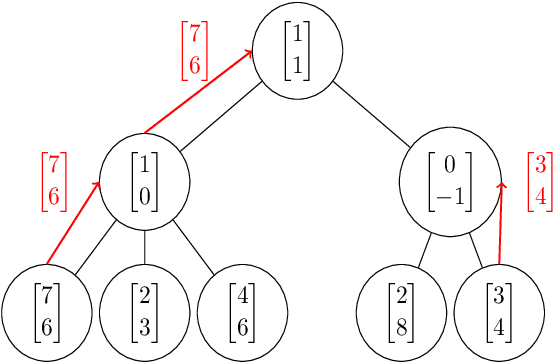
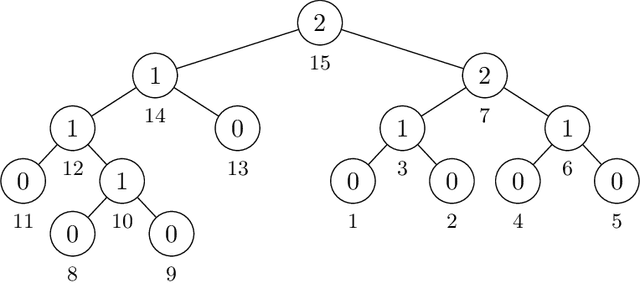
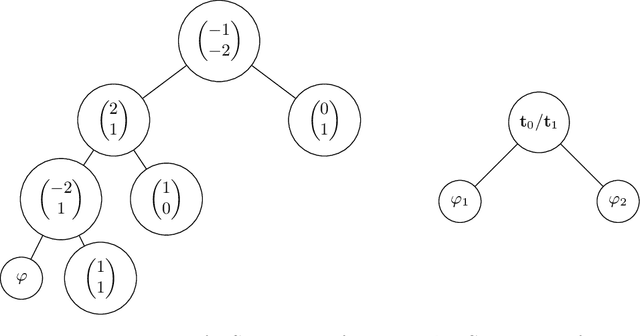
We study and compare the expressive power of transformers, RNNs, and transformers with chain of thought tokens on a simple and natural class of problems we term Compositional Reasoning Questions (CRQ). This family captures problems like evaluating Boolean formulas and multi-step word problems. Assuming standard hardness assumptions from circuit complexity and communication complexity, we prove that none of these three architectures is capable of solving CRQs unless some hyperparameter (depth, embedding dimension, and number of chain of thought tokens, respectively) grows with the size of the input. We also provide a construction for each architecture that solves CRQs. For transformers, our construction uses depth that is logarithmic in the problem size. For RNNs, logarithmic embedding dimension is necessary and sufficient, so long as the inputs are provided in a certain order. (Otherwise, a linear dimension is necessary). For transformers with chain of thought, our construction uses $n$ CoT tokens. These results show that, while CRQs are inherently hard, there are several different ways for language models to overcome this hardness. Even for a single class of problems, each architecture has strengths and weaknesses, and none is strictly better than the others.
Hierarchical Control of Emotion Rendering in Speech Synthesis
Dec 17, 2024
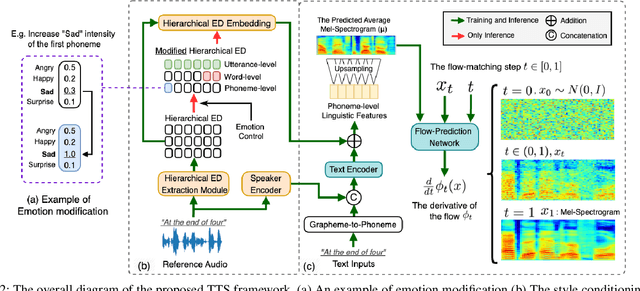

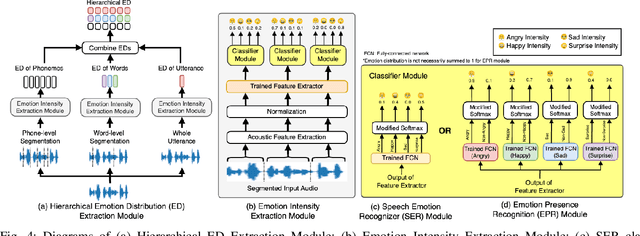
Emotional text-to-speech synthesis (TTS) aims to generate realistic emotional speech from input text. However, quantitatively controlling multi-level emotion rendering remains challenging. In this paper, we propose a diffusion-based emotional TTS framework with a novel approach for emotion intensity modeling to facilitate fine-grained control over emotion rendering at the phoneme, word, and utterance levels. We introduce a hierarchical emotion distribution (ED) extractor that captures a quantifiable ED embedding across different speech segment levels. Additionally, we explore various acoustic features and assess their impact on emotion intensity modeling. During TTS training, the hierarchical ED embedding effectively captures the variance in emotion intensity from the reference audio and correlates it with linguistic and speaker information. The TTS model not only generates emotional speech during inference, but also quantitatively controls the emotion rendering over the speech constituents. Both objective and subjective evaluations demonstrate the effectiveness of our framework in terms of speech quality, emotional expressiveness, and hierarchical emotion control.
UnMA-CapSumT: Unified and Multi-Head Attention-driven Caption Summarization Transformer
Dec 16, 2024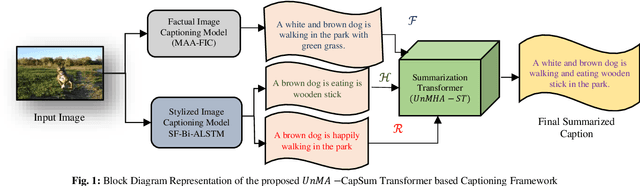
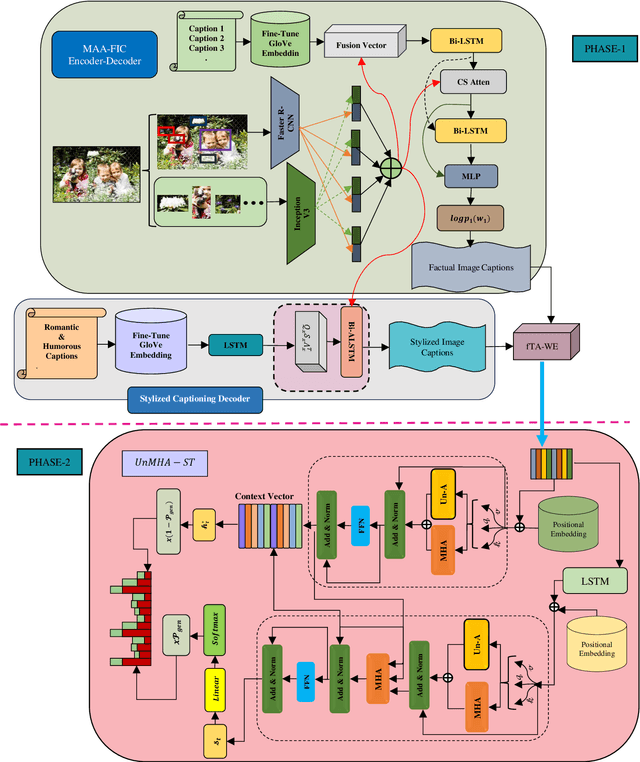
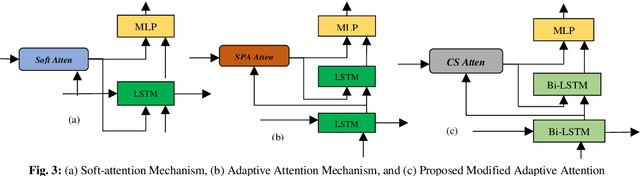
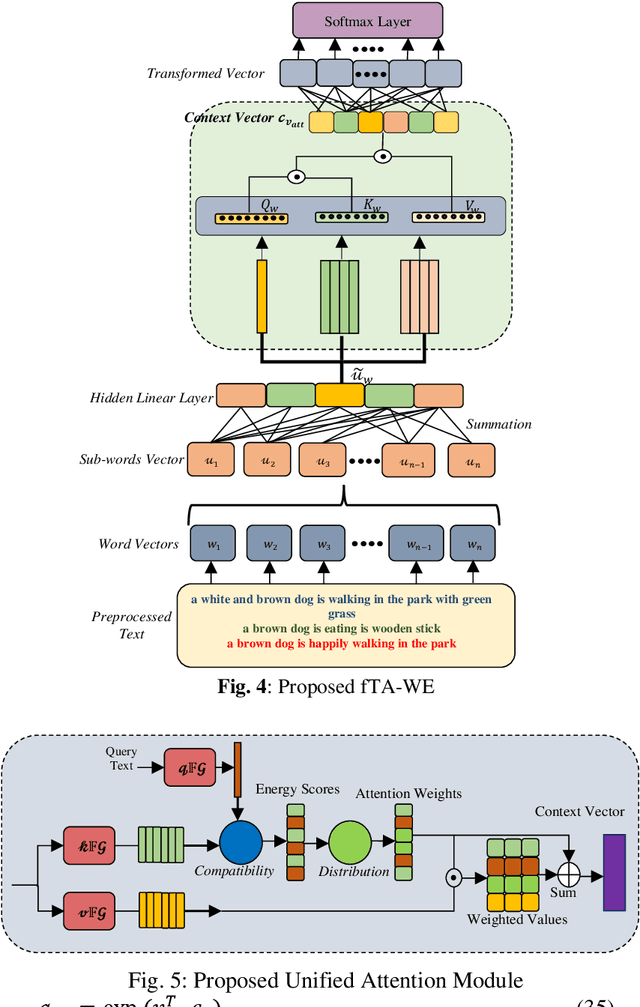
Image captioning is the generation of natural language descriptions of images which have increased immense popularity in the recent past. With this different deep-learning techniques are devised for the development of factual and stylized image captioning models. Previous models focused more on the generation of factual and stylized captions separately providing more than one caption for a single image. The descriptions generated from these suffer from out-of-vocabulary and repetition issues. To the best of our knowledge, no such work exists that provided a description that integrates different captioning methods to describe the contents of an image with factual and stylized (romantic and humorous) elements. To overcome these limitations, this paper presents a novel Unified Attention and Multi-Head Attention-driven Caption Summarization Transformer (UnMA-CapSumT) based Captioning Framework. It utilizes both factual captions and stylized captions generated by the Modified Adaptive Attention-based factual image captioning model (MAA-FIC) and Style Factored Bi-LSTM with attention (SF-Bi-ALSTM) driven stylized image captioning model respectively. SF-Bi-ALSTM-based stylized IC model generates two prominent styles of expression- {romance, and humor}. The proposed summarizer UnMHA-ST combines both factual and stylized descriptions of an input image to generate styled rich coherent summarized captions. The proposed UnMHA-ST transformer learns and summarizes different linguistic styles efficiently by incorporating proposed word embedding fastText with Attention Word Embedding (fTA-WE) and pointer-generator network with coverage mechanism concept to solve the out-of-vocabulary issues and repetition problem. Extensive experiments are conducted on Flickr8K and a subset of FlickrStyle10K with supporting ablation studies to prove the efficiency and efficacy of the proposed framework.