 Add to Chrome
 Add to Firefox
 Add to Edge
ClickGuard: A Trustworthy Adaptive Fusion Framework for Clickbait Detection
Apr 08, 2026
The widespread use of clickbait headlines, crafted to mislead and maximize engagement, poses a significant challenge to online credibility. These headlines employ sensationalism, misleading claims, and vague language, underscoring the need for effective detection to ensure trustworthy digital content. The paper introduces, ClickGuard: a trustworthy adaptive fusion framework for clickbait detection. It combines BERT embeddings and structural features using a Syntactic-Semantic Adaptive Fusion Block (SSAFB) for dynamic integration. The framework incorporates a hybrid CNN-BiLSTM to capture patterns and dependencies. The model achieved 96.93% testing accuracy, outperforming state-of-the-art approaches. The model's trustworthiness is evaluated using LIME and Permutation Feature Importance (PFI) for interpretability and perturbation analysis. These methods assess the model's robustness and sensitivity to feature changes by measuring the average prediction variation. Ablation studies validated the SSAFB's effectiveness in optimizing feature fusion. The model demonstrated robust performance across diverse datasets, providing a scalable, reliable solution for enhancing online content credibility by addressing syntactic-semantic modelling challenges. Code of the work is available at: https://github.com/palindromeRice/ClickBait_Detection_Architecture

UnMA-CapSumT: Unified and Multi-Head Attention-driven Caption Summarization Transformer
Dec 16, 2024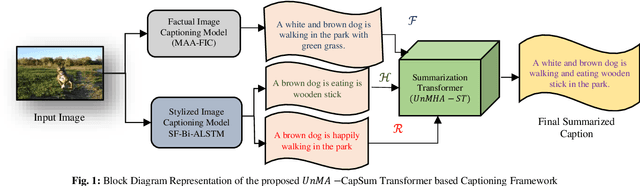
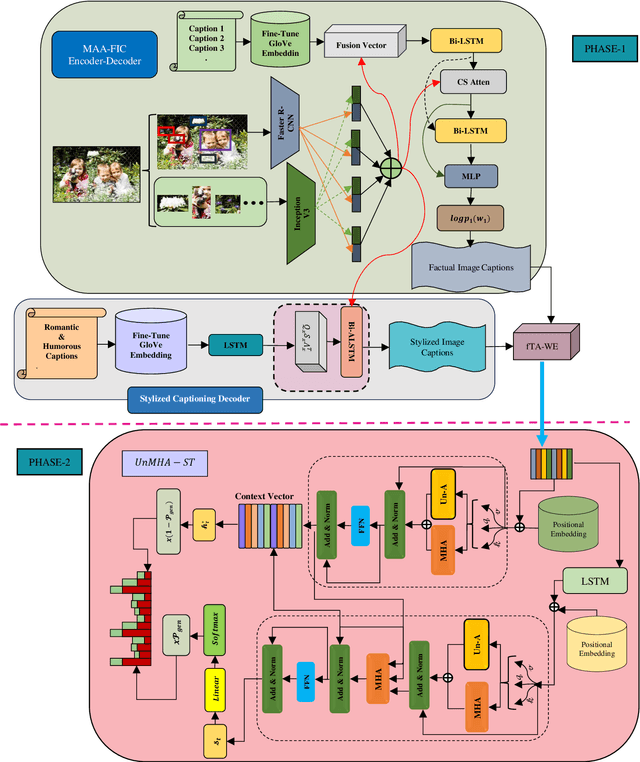
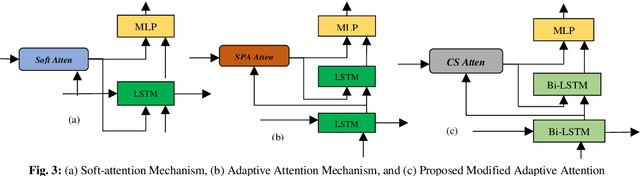
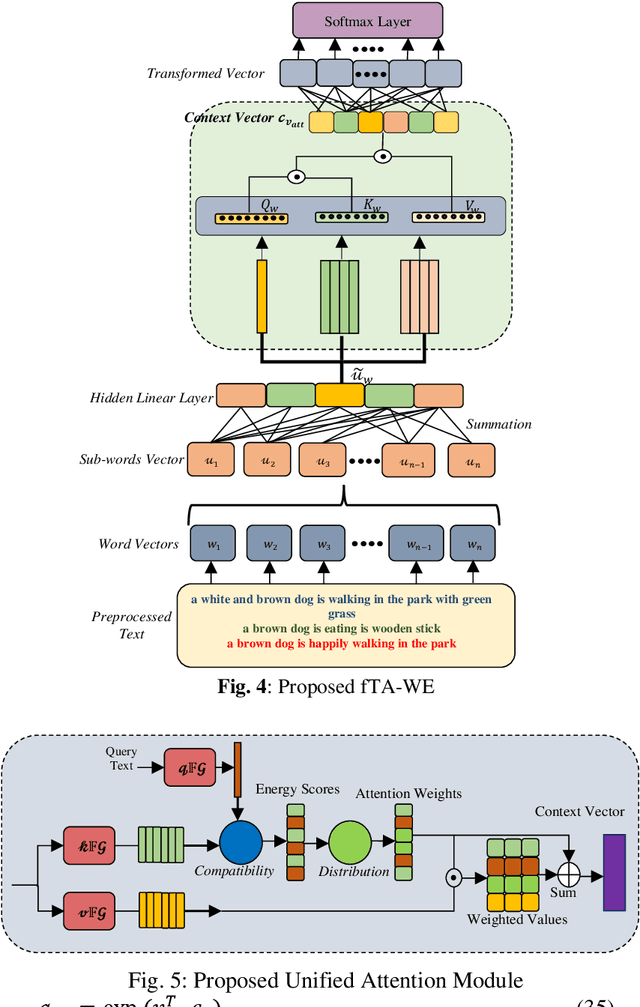
Image captioning is the generation of natural language descriptions of images which have increased immense popularity in the recent past. With this different deep-learning techniques are devised for the development of factual and stylized image captioning models. Previous models focused more on the generation of factual and stylized captions separately providing more than one caption for a single image. The descriptions generated from these suffer from out-of-vocabulary and repetition issues. To the best of our knowledge, no such work exists that provided a description that integrates different captioning methods to describe the contents of an image with factual and stylized (romantic and humorous) elements. To overcome these limitations, this paper presents a novel Unified Attention and Multi-Head Attention-driven Caption Summarization Transformer (UnMA-CapSumT) based Captioning Framework. It utilizes both factual captions and stylized captions generated by the Modified Adaptive Attention-based factual image captioning model (MAA-FIC) and Style Factored Bi-LSTM with attention (SF-Bi-ALSTM) driven stylized image captioning model respectively. SF-Bi-ALSTM-based stylized IC model generates two prominent styles of expression- {romance, and humor}. The proposed summarizer UnMHA-ST combines both factual and stylized descriptions of an input image to generate styled rich coherent summarized captions. The proposed UnMHA-ST transformer learns and summarizes different linguistic styles efficiently by incorporating proposed word embedding fastText with Attention Word Embedding (fTA-WE) and pointer-generator network with coverage mechanism concept to solve the out-of-vocabulary issues and repetition problem. Extensive experiments are conducted on Flickr8K and a subset of FlickrStyle10K with supporting ablation studies to prove the efficiency and efficacy of the proposed framework.
View-invariant Deep Architecture for Human Action Recognition using late fusion
Dec 08, 2019


Human action Recognition for unknown views is a challenging task. We propose a view-invariant deep human action recognition framework, which is a novel integration of two important action cues: motion and shape temporal dynamics (STD). The motion stream encapsulates the motion content of action as RGB Dynamic Images (RGB-DIs) which are processed by the fine-tuned InceptionV3 model. The STD stream learns long-term view-invariant shape dynamics of action using human pose model (HPM) based view-invariant features mined from structural similarity index matrix (SSIM) based key depth human pose frames. To predict the score of the test sample, three types of late fusion (maximum, average and product) techniques are applied on individual stream scores. To validate the performance of the proposed novel framework the experiments are performed using both cross subject and cross-view validation schemes on three publically available benchmarks- NUCLA multi-view dataset, UWA3D-II Activity dataset and NTU RGB-D Activity dataset. Our algorithm outperforms with existing state-of-the-arts significantly that is reported in terms of accuracy, receiver operating characteristic (ROC) curve and area under the curve (AUC).
Skeleton based Activity Recognition by Fusing Part-wise Spatio-temporal and Attention Driven Residues
Dec 02, 2019


There exist a wide range of intra class variations of the same actions and inter class similarity among the actions, at the same time, which makes the action recognition in videos very challenging. In this paper, we present a novel skeleton-based part-wise Spatiotemporal CNN RIAC Network-based 3D human action recognition framework to visualise the action dynamics in part wise manner and utilise each part for action recognition by applying weighted late fusion mechanism. Part wise skeleton based motion dynamics helps to highlight local features of the skeleton which is performed by partitioning the complete skeleton in five parts such as Head to Spine, Left Leg, Right Leg, Left Hand, Right Hand. The RIAFNet architecture is greatly inspired by the InceptionV4 architecture which unified the ResNet and Inception based Spatio-temporal feature representation concept and achieving the highest top-1 accuracy till date. To extract and learn salient features for action recognition, attention driven residues are used which enhance the performance of residual components for effective 3D skeleton-based Spatio-temporal action representation. The robustness of the proposed framework is evaluated by performing extensive experiments on three challenging datasets such as UT Kinect Action 3D, Florence 3D action Dataset, and MSR Daily Action3D datasets, which consistently demonstrate the superiority of our method