 Add to Chrome
 Add to Firefox
 Add to Edge
ADE: Adaptive Dictionary Embeddings -- Scaling Multi-Anchor Representations to Large Language Models
Apr 27, 2026
Word embeddings are fundamental to natural language processing, yet traditional approaches represent each word with a single vector, creating representational bottlenecks for polysemous words and limiting semantic expressiveness. While multi-anchor representations have shown promise by representing words as combinations of multiple vectors, they have been limited to small-scale models due to computational inefficiency and lack of integration with modern transformer architectures. We introduce Adaptive Dictionary Embeddings (ADE), a framework that successfully scales multi-anchor word representations to large language models. ADE makes three key contributions: (1) Vocabulary Projection (VP), which transforms the costly two-stage anchor lookup into a single efficient matrix operation; (2) Grouped Positional Encoding (GPE), a novel positional encoding scheme where anchors of the same word share positional information, preserving semantic coherence while enabling anchor-level variation; and (3) context-aware anchor reweighting, which leverages self-attention to dynamically compose anchor contributions based on sequence context. We integrate these components into the Segment-Aware Transformer (SAT), which provides context-aware reweighting of anchor contributions at inference time. We evaluate ADE on AG News and DBpedia-14 text classification benchmarks. With 98.7% fewer trainable parameters than DeBERTa-v3-base, ADE surpasses DeBERTa on DBpedia-14 (98.06% vs. 97.80%) and approaches it on AG News (90.64% vs. 94.50%), while compressing the embedding layer over 40x -- demonstrating that multi-anchor representations are a practical and parameter-efficient alternative to single-vector embeddings in modern transformer architectures.

Tree-NET: Enhancing Medical Image Segmentation Through Efficient Low-Level Feature Training
Jan 03, 2025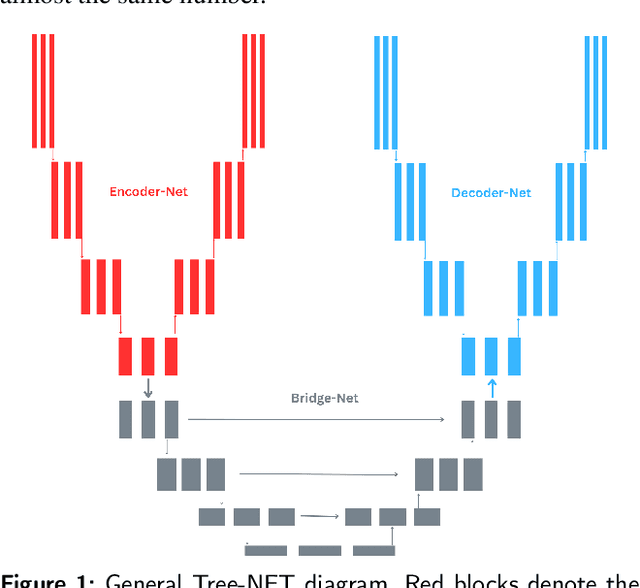
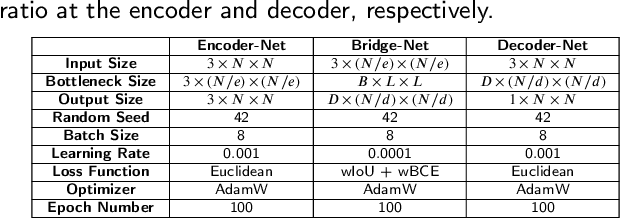

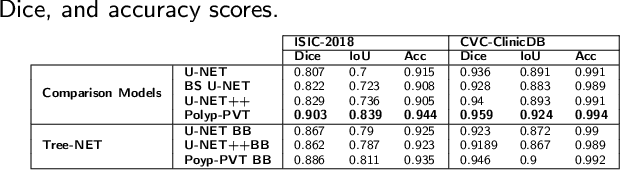
This paper introduces Tree-NET, a novel framework for medical image segmentation that leverages bottleneck feature supervision to enhance both segmentation accuracy and computational efficiency. While previous studies have employed bottleneck feature supervision, their applications have largely been limited to the training phase, offering no computational benefits during training or evaluation. To the best of our knowledge, this study is the first to propose a framework that incorporates two additional training phases for segmentation models, utilizing bottleneck features at both input and output stages. This approach significantly improves computational performance by reducing input and output dimensions with a negligible addition to parameter count, without compromising accuracy. Tree-NET features a three-layer architecture comprising Encoder-Net and Decoder-Net, which are autoencoders designed to compress input and label data, respectively, and Bridge-Net, a segmentation framework that supervises the bottleneck features. By focusing on dense, compressed representations, Tree-NET enhances operational efficiency and can be seamlessly integrated into existing segmentation models without altering their internal structures or increasing model size. We evaluate Tree-NET on two critical segmentation tasks -- skin lesion and polyp segmentation -- using various backbone models, including U-NET variants and Polyp-PVT. Experimental results demonstrate that Tree-NET reduces FLOPs by a factor of 4 to 13 and decreases memory usage, while achieving comparable or superior accuracy compared to the original architectures. These findings underscore Tree-NET's potential as a robust and efficient solution for medical image segmentation.
When IoT Meet LLMs: Applications and Challenges
Nov 20, 2024
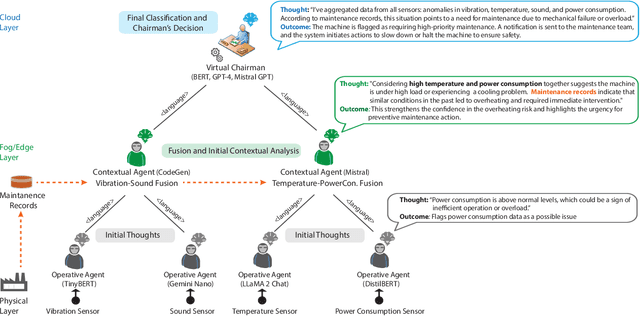
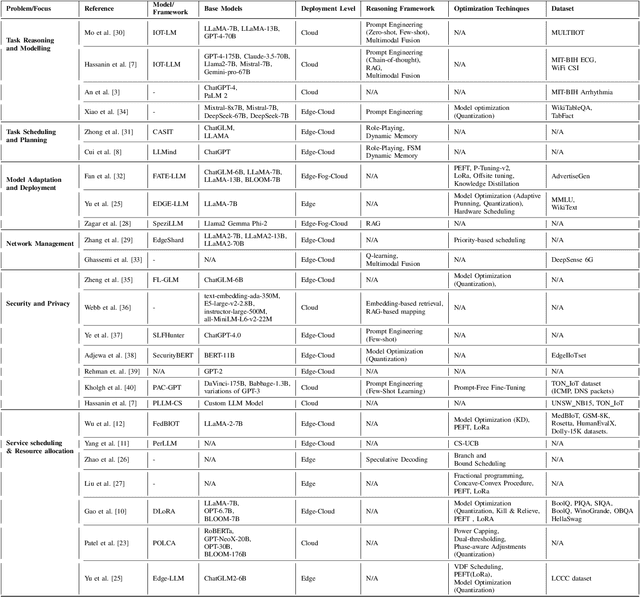
Recent advances in Large Language Models (LLMs) have positively and efficiently transformed workflows in many domains. One such domain with significant potential for LLM integration is the Internet of Things (IoT), where this integration brings new opportunities for improved decision making and system interaction. In this paper, we explore the various roles of LLMs in IoT, with a focus on their reasoning capabilities. We show how LLM-IoT integration can facilitate advanced decision making and contextual understanding in a variety of IoT scenarios. Furthermore, we explore the integration of LLMs with edge, fog, and cloud computing paradigms, and show how this synergy can optimize resource utilization, enhance real-time processing, and provide scalable solutions for complex IoT applications. To the best of our knowledge, this is the first comprehensive study covering IoT-LLM integration between edge, fog, and cloud systems. Additionally, we propose a novel system model for industrial IoT applications that leverages LLM-based collective intelligence to enable predictive maintenance and condition monitoring. Finally, we highlight key challenges and open issues that provide insights for future research in the field of LLM-IoT integration.