 Add to Chrome
 Add to Firefox
 Add to Edge
Inverted Residual Block
Papers and Code
Reversible Deep Learning for 13C NMR in Chemoinformatics: On Structures and Spectra
Feb 05, 2026
We introduce a reversible deep learning model for 13C NMR that uses a single conditional invertible neural network for both directions between molecular structures and spectra. The network is built from i-RevNet style bijective blocks, so the forward map and its inverse are available by construction. We train the model to predict a 128-bit binned spectrum code from a graph-based structure encoding, while the remaining latent dimensions capture residual variability. At inference time, we invert the same trained network to generate structure candidates from a spectrum code, which explicitly represents the one-to-many nature of spectrum-to-structure inference. On a filtered subset, the model is numerically invertible on trained examples, achieves spectrum-code prediction above chance, and produces coarse but meaningful structural signals when inverted on validation spectra. These results demonstrate that invertible architectures can unify spectrum prediction and uncertainty-aware candidate generation within one end-to-end model.

Human-inspired Global-to-Parallel Multi-scale Encoding for Lightweight Vision Models
Jan 13, 2026Lightweight vision networks have witnessed remarkable progress in recent years, yet achieving a satisfactory balance among parameter scale, computational overhead, and task performance remains difficult. Although many existing lightweight models manage to reduce computation considerably, they often do so at the expense of a substantial increase in parameter count (e.g., LSNet, MobileMamba), which still poses obstacles for deployment on resource-limited devices. In parallel, some studies attempt to draw inspiration from human visual perception, but their modeling tends to oversimplify the visual process, making it hard to reflect how perception truly operates. Revisiting the cooperative mechanism of the human visual system, we propose GPM (Global-to-Parallel Multi-scale Encoding). GPM first employs a Global Insight Generator (GIG) to extract holistic cues, and subsequently processes features of different scales through parallel branches: LSAE emphasizes mid-/large-scale semantic relations, while IRB (Inverted Residual Block) preserves fine-grained texture information, jointly enabling coherent representation of global and local features. As such, GPM conforms to two characteristic behaviors of human vision perceiving the whole before focusing on details, and maintaining broad contextual awareness even during local attention. Built upon GPM, we further develop the lightweight H-GPE network. Experiments on image classification, object detection, and semantic segmentation show that H-GPE achieves strong performance while maintaining a balanced footprint in both FLOPs and parameters, delivering a more favorable accuracy-efficiency trade-off compared with recent state-of-the-art lightweight models.
Multi-objective hybrid knowledge distillation for efficient deep learning in smart agriculture
Dec 23, 2025Deploying deep learning models on resource-constrained edge devices remains a major challenge in smart agriculture due to the trade-off between computational efficiency and recognition accuracy. To address this challenge, this study proposes a hybrid knowledge distillation framework for developing a lightweight yet high-performance convolutional neural network. The proposed approach designs a customized student model that combines inverted residual blocks with dense connectivity and trains it under the guidance of a ResNet18 teacher network using a multi-objective strategy that integrates hard-label supervision, feature-level distillation, response-level distillation, and self-distillation. Experiments are conducted on a rice seed variety identification dataset containing nine varieties and further extended to four plant leaf disease datasets, including rice, potato, coffee, and corn, to evaluate generalization capability. On the rice seed variety classification task, the distilled student model achieves an accuracy of 98.56%, which is only 0.09% lower than the teacher model (98.65%), while requiring only 0.68 GFLOPs and approximately 1.07 million parameters. This corresponds to a reduction of about 2.7 times in computational cost and more than 10 times in model size compared with the ResNet18 teacher model. In addition, compared with representative pretrained models, the proposed student reduces the number of parameters by more than 6 times relative to DenseNet121 and by over 80 times compared with the Vision Transformer (ViT) architecture, while maintaining comparable or superior classification accuracy. Consistent performance gains across multiple plant leaf disease datasets further demonstrate the robustness, efficiency, and strong deployment potential of the proposed framework for hardware-limited smart agriculture systems.
MI-to-Mid Distilled Compression (M2M-DC): An Hybrid-Information-Guided-Block Pruning with Progressive Inner Slicing Approach to Model Compression
Nov 18, 2025We introduce MI-to-Mid Distilled Compression (M2M-DC), a two-scale, shape-safe compression framework that interleaves information-guided block pruning with progressive inner slicing and staged knowledge distillation (KD). First, M2M-DC ranks residual (or inverted-residual) blocks by a label-aware mutual information (MI) signal and removes the least informative units (structured prune-after-training). It then alternates short KD phases with stage-coherent, residual-safe channel slicing: (i) stage "planes" (co-slicing conv2 out-channels with the downsample path and next-stage inputs), and (ii) an optional mid-channel trim (conv1 out / bn1 / conv2 in). This targets complementary redundancy, whole computational motifs and within-stage width while preserving residual shape invariants. On CIFAR-100, M2M-DC yields a clean accuracy-compute frontier. For ResNet-18, we obtain 85.46% Top-1 with 3.09M parameters and 0.0139 GMacs (72% params, 63% GMacs vs. teacher; mean final 85.29% over three seeds). For ResNet-34, we reach 85.02% Top-1 with 5.46M params and 0.0195 GMacs (74% / 74% vs. teacher; mean final 84.62%). Extending to inverted-residuals, MobileNetV2 achieves a mean final 68.54% Top-1 at 1.71M params (27%) and 0.0186 conv GMacs (24%), improving over the teacher's 66.03% by +2.5 points across three seeds. Because M2M-DC exposes only a thin, architecture-aware interface (blocks, stages, and down sample/skip wiring), it generalizes across residual CNNs and extends to inverted-residual families with minor legalization rules. The result is a compact, practical recipe for deployment-ready models that match or surpass teacher accuracy at a fraction of the compute.
HDW-SR: High-Frequency Guided Diffusion Model based on Wavelet Decomposition for Image Super-Resolution
Nov 17, 2025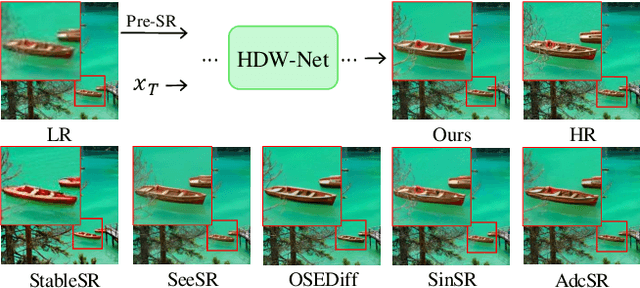
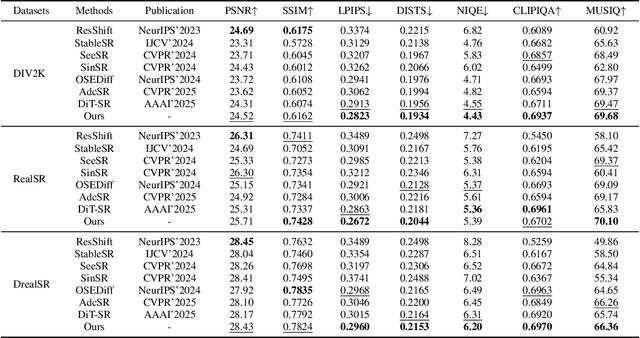
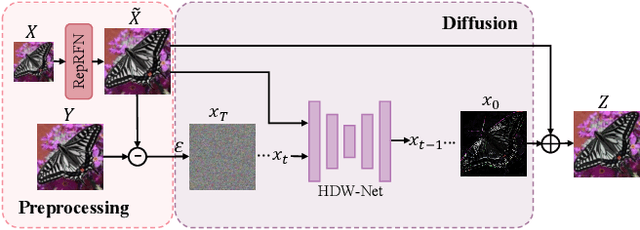
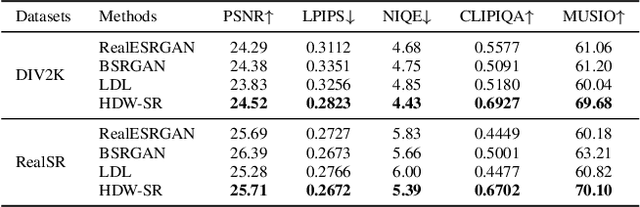
Diffusion-based methods have shown great promise in single image super-resolution (SISR); however, existing approaches often produce blurred fine details due to insufficient guidance in the high-frequency domain. To address this issue, we propose a High-Frequency Guided Diffusion Network based on Wavelet Decomposition (HDW-SR), which replaces the conventional U-Net backbone in diffusion frameworks. Specifically, we perform diffusion only on the residual map, allowing the network to focus more effectively on high-frequency information restoration. We then introduce wavelet-based downsampling in place of standard CNN downsampling to achieve multi-scale frequency decomposition, enabling sparse cross-attention between the high-frequency subbands of the pre-super-resolved image and the low-frequency subbands of the diffused image for explicit high-frequency guidance. Moreover, a Dynamic Thresholding Block (DTB) is designed to refine high-frequency selection during the sparse attention process. During upsampling, the invertibility of the wavelet transform ensures low-loss feature reconstruction. Experiments on both synthetic and real-world datasets demonstrate that HDW-SR achieves competitive super-resolution performance, excelling particularly in recovering fine-grained image details. The code will be available after acceptance.
HierLight-YOLO: A Hierarchical and Lightweight Object Detection Network for UAV Photography
Sep 26, 2025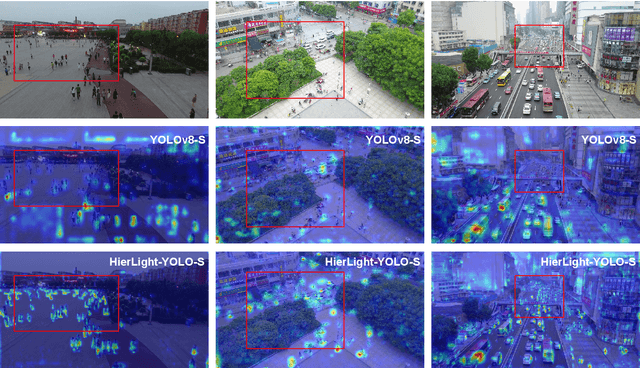
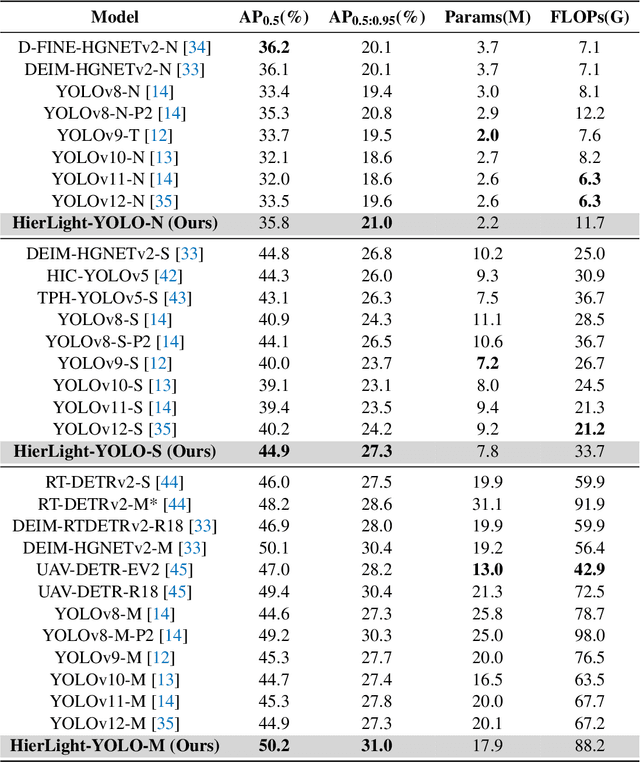
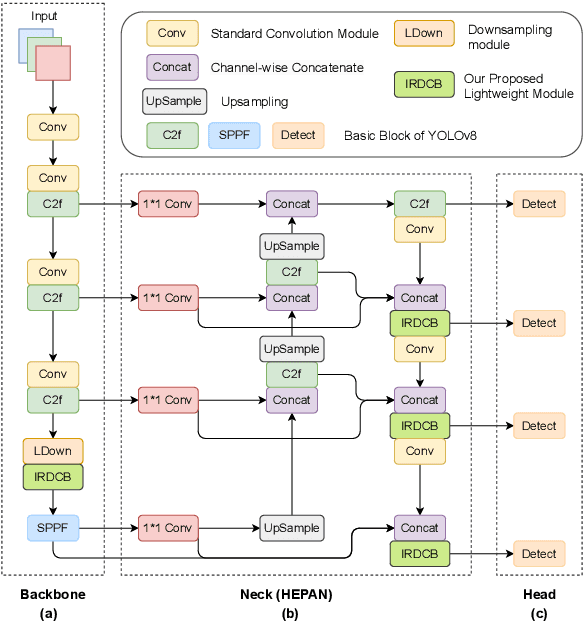
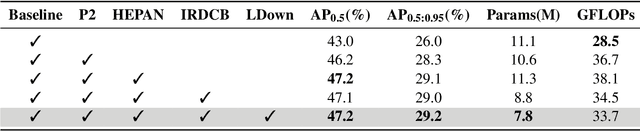
The real-time detection of small objects in complex scenes, such as the unmanned aerial vehicle (UAV) photography captured by drones, has dual challenges of detecting small targets (<32 pixels) and maintaining real-time efficiency on resource-constrained platforms. While YOLO-series detectors have achieved remarkable success in real-time large object detection, they suffer from significantly higher false negative rates for drone-based detection where small objects dominate, compared to large object scenarios. This paper proposes HierLight-YOLO, a hierarchical feature fusion and lightweight model that enhances the real-time detection of small objects, based on the YOLOv8 architecture. We propose the Hierarchical Extended Path Aggregation Network (HEPAN), a multi-scale feature fusion method through hierarchical cross-level connections, enhancing the small object detection accuracy. HierLight-YOLO includes two innovative lightweight modules: Inverted Residual Depthwise Convolution Block (IRDCB) and Lightweight Downsample (LDown) module, which significantly reduce the model's parameters and computational complexity without sacrificing detection capabilities. Small object detection head is designed to further enhance spatial resolution and feature fusion to tackle the tiny object (4 pixels) detection. Comparison experiments and ablation studies on the VisDrone2019 benchmark demonstrate state-of-the-art performance of HierLight-YOLO.
YOLO-FireAD: Efficient Fire Detection via Attention-Guided Inverted Residual Learning and Dual-Pooling Feature Preservation
May 27, 2025Fire detection in dynamic environments faces continuous challenges, including the interference of illumination changes, many false detections or missed detections, and it is difficult to achieve both efficiency and accuracy. To address the problem of feature extraction limitation and information loss in the existing YOLO-based models, this study propose You Only Look Once for Fire Detection with Attention-guided Inverted Residual and Dual-pooling Downscale Fusion (YOLO-FireAD) with two core innovations: (1) Attention-guided Inverted Residual Block (AIR) integrates hybrid channel-spatial attention with inverted residuals to adaptively enhance fire features and suppress environmental noise; (2) Dual Pool Downscale Fusion Block (DPDF) preserves multi-scale fire patterns through learnable fusion of max-average pooling outputs, mitigating small-fire detection failures. Extensive evaluation on two public datasets shows the efficient performance of our model. Our proposed model keeps the sum amount of parameters (1.45M, 51.8% lower than YOLOv8n) (4.6G, 43.2% lower than YOLOv8n), and mAP75 is higher than the mainstream real-time object detection models YOLOv8n, YOL-Ov9t, YOLOv10n, YOLO11n, YOLOv12n and other YOLOv8 variants 1.3-5.5%.
Deep Brain Net: An Optimized Deep Learning Model for Brain tumor Detection in MRI Images Using EfficientNetB0 and ResNet50 with Transfer Learning
Jul 09, 2025In recent years, deep learning has shown great promise in the automated detection and classification of brain tumors from MRI images. However, achieving high accuracy and computational efficiency remains a challenge. In this research, we propose Deep Brain Net, a novel deep learning system designed to optimize performance in the detection of brain tumors. The model integrates the strengths of two advanced neural network architectures which are EfficientNetB0 and ResNet50, combined with transfer learning to improve generalization and reduce training time. The EfficientNetB0 architecture enhances model efficiency by utilizing mobile inverted bottleneck blocks, which incorporate depth wise separable convolutions. This design significantly reduces the number of parameters and computational cost while preserving the ability of models to learn complex feature representations. The ResNet50 architecture, pre trained on large scale datasets like ImageNet, is fine tuned for brain tumor classification. Its use of residual connections allows for training deeper networks by mitigating the vanishing gradient problem and avoiding performance degradation. The integration of these components ensures that the proposed system is both computationally efficient and highly accurate. Extensive experiments performed on publicly available MRI datasets demonstrate that Deep Brain Net consistently outperforms existing state of the art methods in terms of classification accuracy, precision, recall, and computational efficiency. The result is an accuracy of 88 percent, a weighted F1 score of 88.75 percent, and a macro AUC ROC score of 98.17 percent which demonstrates the robustness and clinical potential of Deep Brain Net in assisting radiologists with brain tumor diagnosis.
Camera Model Identification with SPAIR-Swin and Entropy based Non-Homogeneous Patches
Mar 28, 2025Source camera model identification (SCMI) plays a pivotal role in image forensics with applications including authenticity verification and copyright protection. For identifying the camera model used to capture a given image, we propose SPAIR-Swin, a novel model combining a modified spatial attention mechanism and inverted residual block (SPAIR) with a Swin Transformer. SPAIR-Swin effectively captures both global and local features, enabling robust identification of artifacts such as noise patterns that are particularly effective for SCMI. Additionally, unlike conventional methods focusing on homogeneous patches, we propose a patch selection strategy for SCMI that emphasizes high-entropy regions rich in patterns and textures. Extensive evaluations on four benchmark SCMI datasets demonstrate that SPAIR-Swin outperforms existing methods, achieving patch-level accuracies of 99.45%, 98.39%, 99.45%, and 97.46% and image-level accuracies of 99.87%, 99.32%, 100%, and 98.61% on the Dresden, Vision, Forchheim, and Socrates datasets, respectively. Our findings highlight that high-entropy patches, which contain high-frequency information such as edge sharpness, noise, and compression artifacts, are more favorable in improving SCMI accuracy. Code will be made available upon request.
EMOv2: Pushing 5M Vision Model Frontier
Dec 09, 2024
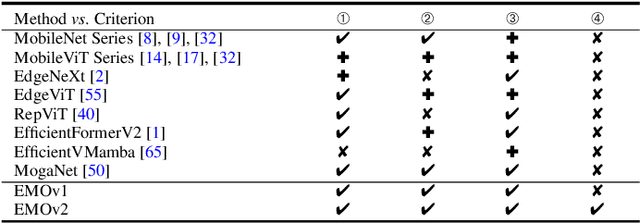


This work focuses on developing parameter-efficient and lightweight models for dense predictions while trading off parameters, FLOPs, and performance. Our goal is to set up the new frontier of the 5M magnitude lightweight model on various downstream tasks. Inverted Residual Block (IRB) serves as the infrastructure for lightweight CNNs, but no counterparts have been recognized by attention-based design. Our work rethinks the lightweight infrastructure of efficient IRB and practical components in Transformer from a unified perspective, extending CNN-based IRB to attention-based models and abstracting a one-residual Meta Mobile Block (MMBlock) for lightweight model design. Following neat but effective design criterion, we deduce a modern Improved Inverted Residual Mobile Block (i2RMB) and improve a hierarchical Efficient MOdel (EMOv2) with no elaborate complex structures. Considering the imperceptible latency for mobile users when downloading models under 4G/5G bandwidth and ensuring model performance, we investigate the performance upper limit of lightweight models with a magnitude of 5M. Extensive experiments on various vision recognition, dense prediction, and image generation tasks demonstrate the superiority of our EMOv2 over state-of-the-art methods, e.g., EMOv2-1M/2M/5M achieve 72.3, 75.8, and 79.4 Top-1 that surpass equal-order CNN-/Attention-based models significantly. At the same time, EMOv2-5M equipped RetinaNet achieves 41.5 mAP for object detection tasks that surpasses the previous EMO-5M by +2.6. When employing the more robust training recipe, our EMOv2-5M eventually achieves 82.9 Top-1 accuracy, which elevates the performance of 5M magnitude models to a new level. Code is available at https://github.com/zhangzjn/EMOv2.