 Add to Chrome
 Add to Firefox
 Add to Edge
A Multiscale Network with Supervised Contrastive Learning for Real-Time Facial Emotion Recognition
May 31, 2026
Real-time emotion recognition from facial expressions is a challenging task, particularly in video-based scenarios where multiple emotional states may occur over time. The difficulty increases further due to the fact that each emotional state is associated with facial expressions that vary significantly across individuals. The change of facial expressions portraying emotional state is not discrete, but rather continuous, which is very challenging to represent through computational aids. A system with the ability to detect variations in facial expressions can have a significant impact on determining the emotional state of an individual. Such a system can be very beneficial for psychologists during counseling by providing additional insights into the emotional state of a subject. In this paper, a deep learning-based system is presented to detect emotional changes in real-time video of a person by modeling the change in facial expressions. The current study is conducted on a standard dataset for training of the deep learning system and the system has provided very satisfactory outcomes in this respect.

DRG-Font: Dynamic Reference-Guided Few-shot Font Generation via Contrastive Style-Content Disentanglement
Apr 15, 2026Few-shot Font Generation aims to generate stylistically consistent glyphs from a few reference glyphs. However, capturing complex font styles from a few exemplars remains challenging, and the existing methods often struggle to retain discernible local characteristics in generated samples. This paper introduces DRG-Font, a contrastive font generation strategy that learns complex glyph attributes by decomposing style and content embedding spaces. For optimal style supervision, the proposed architecture incorporates a Reference Selection (RS) Module to dynamically select the best style reference from an available pool of candidates. The network learns to decompose glyph attributes into style and shape priors through a Multi-scale Style Head Block (MSHB) and a Multi-scale Content Head Block (MCHB). For style adaptation, a Multi-Fusion Upsampling Block (MFUB) produces the target glyph by combining the reference style prior and target content prior. The proposed method demonstrates significant improvements over state-of-the-art approaches across multiple visual and analytical benchmarks.
Camera Model Identification with SPAIR-Swin and Entropy based Non-Homogeneous Patches
Mar 28, 2025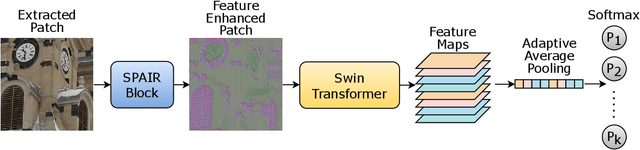
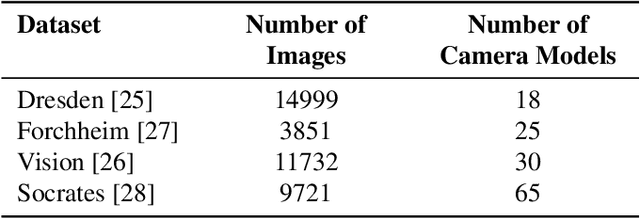
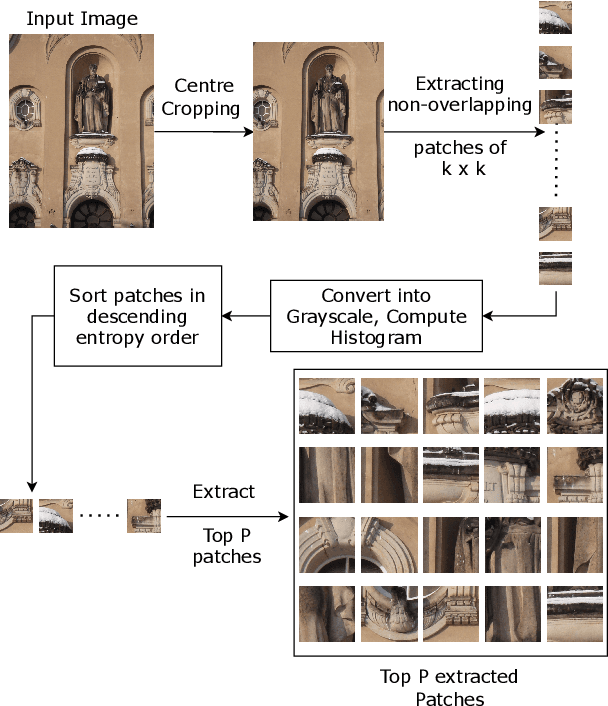
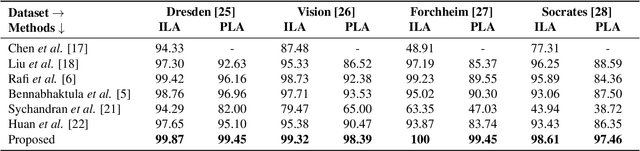
Source camera model identification (SCMI) plays a pivotal role in image forensics with applications including authenticity verification and copyright protection. For identifying the camera model used to capture a given image, we propose SPAIR-Swin, a novel model combining a modified spatial attention mechanism and inverted residual block (SPAIR) with a Swin Transformer. SPAIR-Swin effectively captures both global and local features, enabling robust identification of artifacts such as noise patterns that are particularly effective for SCMI. Additionally, unlike conventional methods focusing on homogeneous patches, we propose a patch selection strategy for SCMI that emphasizes high-entropy regions rich in patterns and textures. Extensive evaluations on four benchmark SCMI datasets demonstrate that SPAIR-Swin outperforms existing methods, achieving patch-level accuracies of 99.45%, 98.39%, 99.45%, and 97.46% and image-level accuracies of 99.87%, 99.32%, 100%, and 98.61% on the Dresden, Vision, Forchheim, and Socrates datasets, respectively. Our findings highlight that high-entropy patches, which contain high-frequency information such as edge sharpness, noise, and compression artifacts, are more favorable in improving SCMI accuracy. Code will be made available upon request.