 Add to Chrome
 Add to Firefox
 Add to Edge
ZOMP: Zeroth-Order Multi-Modal Prompt Tuning for Vision-Language Models
Aug 08, 2026
Fine-tuning vision-language models such as CLIP typically requires backpropagation (BP) through the full model, which is infeasible when only forward-pass access is available, as is common for memory-constrained edge devices and proprietary model deployments. Prior BP-free, zeroth-order prompt-tuning methods avoid this requirement but often tune prompts in a single modality or optimize over a search space large enough that convergence requires thousands of forward passes, which is impractical under realistic query budgets. We propose ZOMP (Zeroth-Order Multimodal Prompt tuning), a query-efficient, fully forward-only method that tunes deep prompts in both the vision and text branches of a frozen CLIP model using simultaneous perturbation stochastic approximation. ZOMP combines three ingredients: a cross-modal low-rank reparameterization that ties the two branches through a shared factor and keeps the effective search dimensionality small, a gradient-correction momentum term that stabilizes the noisy zeroth-order estimate, and a budget-indexed rank schedule that unlocks capacity as the query budget is spent. Across 13 vision-language benchmarks under a matched 5,000-query budget, ZOMP consistently outperforms prior BP-free prompt-tuning methods in both few-shot accuracy and query efficiency, and it generalizes better across base-to-new, cross-dataset transfer, and out-of-distribution settings. Our results show that jointly exploiting multimodality and low-rank structure is an effective route to practical, query-efficient BP-free prompt tuning.

GRASP: Reinforcing Language Model Anonymizers with Group Relative Policy Optimization
Aug 06, 2026Large language models can infer sensitive personal attributes, such as age, location, and occupation, from ordinary text, turning everyday writing into a privacy risk. Adversarial anonymization defends against this by rewriting a text with a capable language model that also plays the attacker, but it needs a powerful model at inference time and thus sends private text to a third party, the very exposure anonymization should prevent. Recent work distills this behavior into a small on-device model using supervised fine-tuning and direct preference optimization (DPO), but DPO only imitates the teacher's offline choices and never directly optimizes the privacy--utility objective we care about. We introduce \textbf{GRASP} (\textbf{G}roup-\textbf{R}elative \textbf{A}nonymization via \textbf{S}elf-refinement \textbf{P}olicy-optimization), which reinforces the local anonymizer online with Group Relative Policy Optimization. A single small model acts as anonymizer, adversary, and utility judge, trained against a self-generated reward that hides attributes while preserving meaning, with a design that guards against reward hacking. Trained on Llama-3.1-8B, \ours{} improves the privacy--utility trade-off over the DPO-distilled baseline, consistently across three independent LLM judges. Against adversarial anonymization driven by frontier models such as Gemini~2.5~Flash and Claude, it achieves a comparable or better overall trade-off while removing substantially more private information, and it runs entirely on-device at roughly $1\%$ of the GPT-4o teacher's cost.
Can MLLMs Critique Like Humans? Evaluating Open-Ended Aesthetic Reasoning in Multimodal Large Language Models
Jun 29, 2026Open-ended aesthetic critique is a challenge for multimodal large language models (MLLMs): unlike multiple-choice aesthetic benchmarks, it has no single correct answer, and most aesthetic evaluation has measured models against numeric scores rather than the written critiques people actually give. We evaluate MLLM critiques against ranked human references and ask whether they are close to human ones. Using the Reddit Photo Critique Dataset, we score five open-weight MLLMs against multiple ranked human critiques per photo with reference-based similarity metrics, under six prompt conditions that disentangle persona framing, aspect hinting, length control, and single- versus multi-pass generation, and add an image-grounding control that feeds each model the wrong photograph. We find that reference-based similarity gives a misleading picture. Stricter lexical and learned metrics show only weak alignment with human critiques, while a coarse embedding cosine reports broad topical overlap that the grounding control traces to a stable house style rather than image-specific observation. Behaviorally, the models diverge from humans in consistent ways the scores do not surface: even under a length cap they write two to three times as much, cover nearly every aesthetic aspect where humans are selective, engage each aspect more uniformly and at greater depth, and repeat themselves across critiques of the same photo where humans vary. We argue that reference-based similarity rewards a fluent, comprehensive critique style rather than the selectivity and specificity of human critique, and discuss implications for evaluating and training open-ended multimodal generation.
MMLoP: Multi-Modal Low-Rank Prompting for Efficient Vision-Language Adaptation
Feb 24, 2026Prompt learning has become a dominant paradigm for adapting vision-language models (VLMs) such as CLIP to downstream tasks without modifying pretrained weights. While extending prompts to both vision and text encoders across multiple transformer layers significantly boosts performance, it dramatically increases the number of trainable parameters, with state-of-the-art methods requiring millions of parameters and abandoning the parameter efficiency that makes prompt tuning attractive. In this work, we propose \textbf{MMLoP} (\textbf{M}ulti-\textbf{M}odal \textbf{Lo}w-Rank \textbf{P}rompting), a framework that achieves deep multi-modal prompting with only \textbf{11.5K trainable parameters}, comparable to early text-only methods like CoOp. MMLoP parameterizes vision and text prompts at each transformer layer through a low-rank factorization, which serves as an implicit regularizer against overfitting on few-shot training data. To further close the accuracy gap with state-of-the-art methods, we introduce three complementary components: a self-regulating consistency loss that anchors prompted representations to frozen zero-shot CLIP features at both the feature and logit levels, a uniform drift correction that removes the global embedding shift induced by prompt tuning to preserve class-discriminative structure, and a shared up-projection that couples vision and text prompts through a common low-rank factor to enforce cross-modal alignment. Extensive experiments across three benchmarks and 11 diverse datasets demonstrate that MMLoP achieves a highly favorable accuracy-efficiency tradeoff, outperforming the majority of existing methods including those with orders of magnitude more parameters, while achieving a harmonic mean of 79.70\% on base-to-novel generalization.
MI-to-Mid Distilled Compression (M2M-DC): An Hybrid-Information-Guided-Block Pruning with Progressive Inner Slicing Approach to Model Compression
Nov 18, 2025We introduce MI-to-Mid Distilled Compression (M2M-DC), a two-scale, shape-safe compression framework that interleaves information-guided block pruning with progressive inner slicing and staged knowledge distillation (KD). First, M2M-DC ranks residual (or inverted-residual) blocks by a label-aware mutual information (MI) signal and removes the least informative units (structured prune-after-training). It then alternates short KD phases with stage-coherent, residual-safe channel slicing: (i) stage "planes" (co-slicing conv2 out-channels with the downsample path and next-stage inputs), and (ii) an optional mid-channel trim (conv1 out / bn1 / conv2 in). This targets complementary redundancy, whole computational motifs and within-stage width while preserving residual shape invariants. On CIFAR-100, M2M-DC yields a clean accuracy-compute frontier. For ResNet-18, we obtain 85.46% Top-1 with 3.09M parameters and 0.0139 GMacs (72% params, 63% GMacs vs. teacher; mean final 85.29% over three seeds). For ResNet-34, we reach 85.02% Top-1 with 5.46M params and 0.0195 GMacs (74% / 74% vs. teacher; mean final 84.62%). Extending to inverted-residuals, MobileNetV2 achieves a mean final 68.54% Top-1 at 1.71M params (27%) and 0.0186 conv GMacs (24%), improving over the teacher's 66.03% by +2.5 points across three seeds. Because M2M-DC exposes only a thin, architecture-aware interface (blocks, stages, and down sample/skip wiring), it generalizes across residual CNNs and extends to inverted-residual families with minor legalization rules. The result is a compact, practical recipe for deployment-ready models that match or surpass teacher accuracy at a fraction of the compute.
Few-Shot Adversarial Low-Rank Fine-Tuning of Vision-Language Models
May 21, 2025Vision-Language Models (VLMs) such as CLIP have shown remarkable performance in cross-modal tasks through large-scale contrastive pre-training. To adapt these large transformer-based models efficiently for downstream tasks, Parameter-Efficient Fine-Tuning (PEFT) techniques like LoRA have emerged as scalable alternatives to full fine-tuning, especially in few-shot scenarios. However, like traditional deep neural networks, VLMs are highly vulnerable to adversarial attacks, where imperceptible perturbations can significantly degrade model performance. Adversarial training remains the most effective strategy for improving model robustness in PEFT. In this work, we propose AdvCLIP-LoRA, the first algorithm designed to enhance the adversarial robustness of CLIP models fine-tuned with LoRA in few-shot settings. Our method formulates adversarial fine-tuning as a minimax optimization problem and provides theoretical guarantees for convergence under smoothness and nonconvex-strong-concavity assumptions. Empirical results across eight datasets using ViT-B/16 and ViT-B/32 models show that AdvCLIP-LoRA significantly improves robustness against common adversarial attacks (e.g., FGSM, PGD), without sacrificing much clean accuracy. These findings highlight AdvCLIP-LoRA as a practical and theoretically grounded approach for robust adaptation of VLMs in resource-constrained settings.
Decentralized Low-Rank Fine-Tuning of Large Language Models
Jan 26, 2025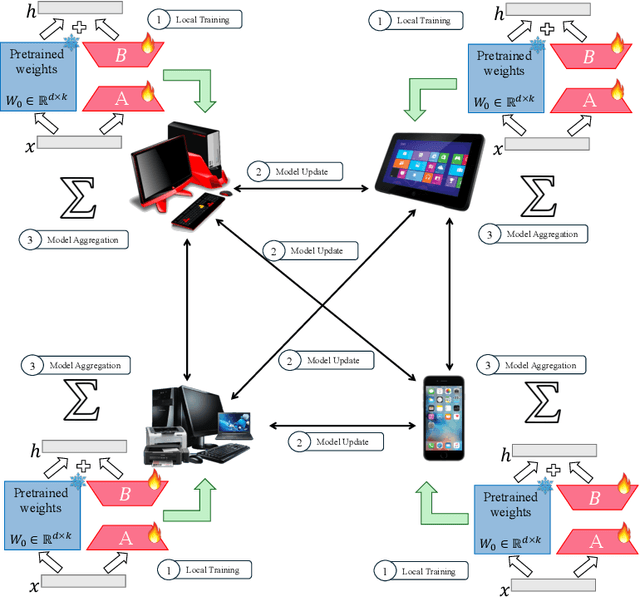

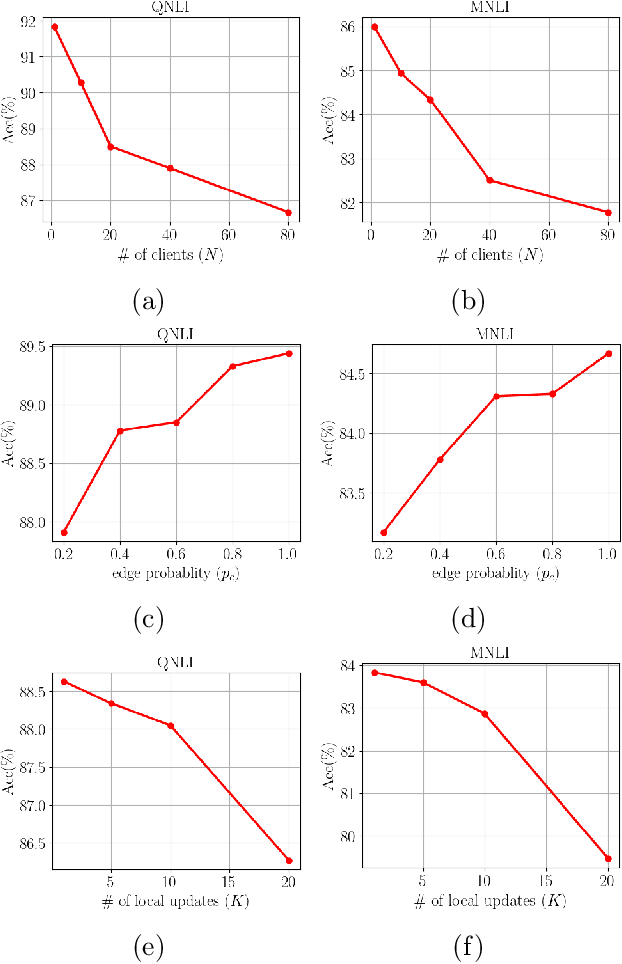

The emergence of Large Language Models (LLMs) such as GPT-4, LLaMA, and BERT has transformed artificial intelligence, enabling advanced capabilities across diverse applications. While parameter-efficient fine-tuning (PEFT) techniques like LoRA offer computationally efficient adaptations of these models, their practical deployment often assumes centralized data and training environments. However, real-world scenarios frequently involve distributed, privacy-sensitive datasets that require decentralized solutions. Federated learning (FL) addresses data privacy by coordinating model updates across clients, but it is typically based on centralized aggregation through a parameter server, which can introduce bottlenecks and communication constraints. Decentralized learning, in contrast, eliminates this dependency by enabling direct collaboration between clients, improving scalability and efficiency in distributed environments. Despite its advantages, decentralized LLM fine-tuning remains underexplored. In this work, we propose \texttt{Dec-LoRA}, an algorithm for decentralized fine-tuning of LLMs based on low-rank adaptation (LoRA). Through extensive experiments on BERT and LLaMA-2 models, we evaluate \texttt{Dec-LoRA}'s performance in handling data heterogeneity and quantization constraints, enabling scalable, privacy-preserving LLM fine-tuning in decentralized settings.
Communication-Efficient and Tensorized Federated Fine-Tuning of Large Language Models
Oct 16, 2024Parameter-efficient fine-tuning (PEFT) methods typically assume that Large Language Models (LLMs) are trained on data from a single device or client. However, real-world scenarios often require fine-tuning these models on private data distributed across multiple devices. Federated Learning (FL) offers an appealing solution by preserving user privacy, as sensitive data remains on local devices during training. Nonetheless, integrating PEFT methods into FL introduces two main challenges: communication overhead and data heterogeneity. In this paper, we introduce FedTT and FedTT+, methods for adapting LLMs by integrating tensorized adapters into client-side models' encoder/decoder blocks. FedTT is versatile and can be applied to both cross-silo FL and large-scale cross-device FL. FedTT+, an extension of FedTT tailored for cross-silo FL, enhances robustness against data heterogeneity by adaptively freezing portions of tensor factors, further reducing the number of trainable parameters. Experiments on BERT and LLaMA models demonstrate that our proposed methods successfully address data heterogeneity challenges and perform on par or even better than existing federated PEFT approaches while achieving up to 10$\times$ reduction in communication cost.
Robust Decentralized Learning with Local Updates and Gradient Tracking
May 02, 2024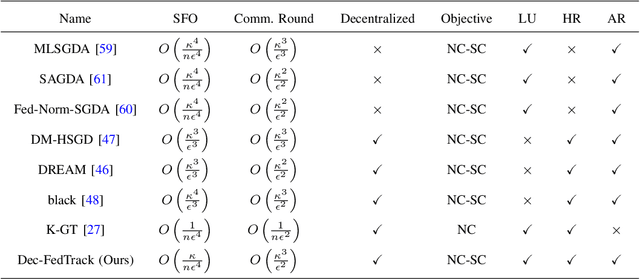


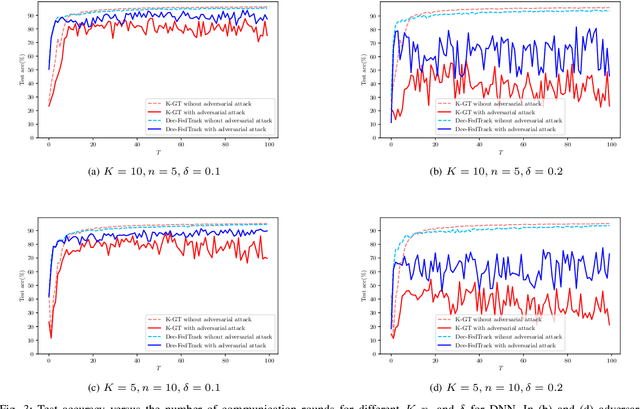
As distributed learning applications such as Federated Learning, the Internet of Things (IoT), and Edge Computing grow, it is critical to address the shortcomings of such technologies from a theoretical perspective. As an abstraction, we consider decentralized learning over a network of communicating clients or nodes and tackle two major challenges: data heterogeneity and adversarial robustness. We propose a decentralized minimax optimization method that employs two important modules: local updates and gradient tracking. Minimax optimization is the key tool to enable adversarial training for ensuring robustness. Having local updates is essential in Federated Learning (FL) applications to mitigate the communication bottleneck, and utilizing gradient tracking is essential to proving convergence in the case of data heterogeneity. We analyze the performance of the proposed algorithm, Dec-FedTrack, in the case of nonconvex-strongly concave minimax optimization, and prove that it converges a stationary point. We also conduct numerical experiments to support our theoretical findings.
MISO Wireless Localization in The Presence of Reconfigurable Intelligent Surface
Aug 19, 2022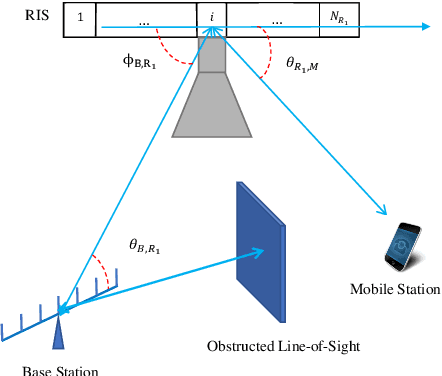
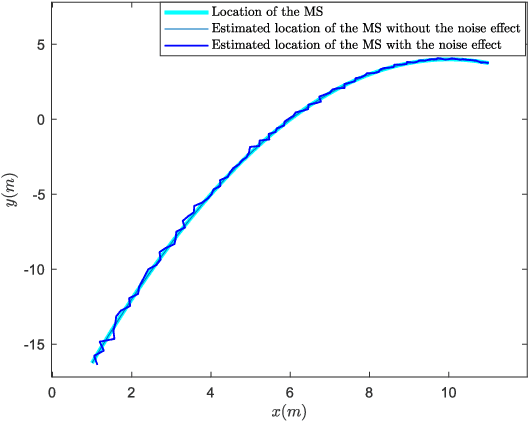
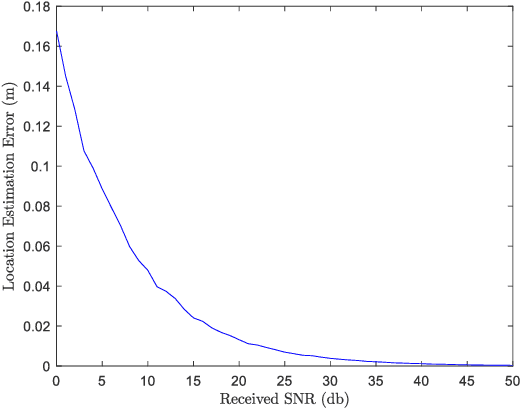
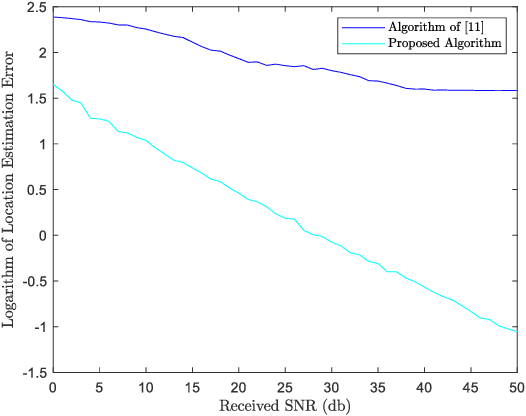
Reconfigurable Intelligent Surface (RIS) plays a pivotal role in the sixth generation networks to enhance communication rate and localization accuracy. In this letter, we propose a positioning algorithm in a RIS-assisted environment, where the Base Station (BS) is multi-antenna, and the Mobile Station (MS) is single-antenna. We show that our method can achieve a high-precision positioning if the line-of-sight (LOS) is obstructed and three RISs are available. We send several known signals to the receiver in different time slots and change the phase shifters of the RISs simultaneously in a proper way, and we propose a technique to eliminate the destructive effect of the angle-of-departure (AoD) in order to determine the distances between each RISs and the MS. The accuracy of the proposed algorithm is better than the algorithms which do not estimate the AoD, shown in the numerical result section.