 Add to Chrome
 Add to Firefox
 Add to Edge
HDW-SR: High-Frequency Guided Diffusion Model based on Wavelet Decomposition for Image Super-Resolution
Nov 17, 2025
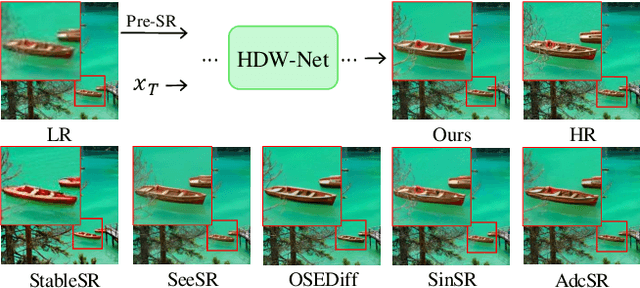
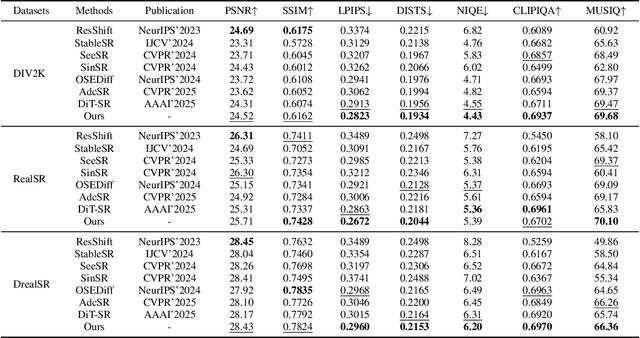
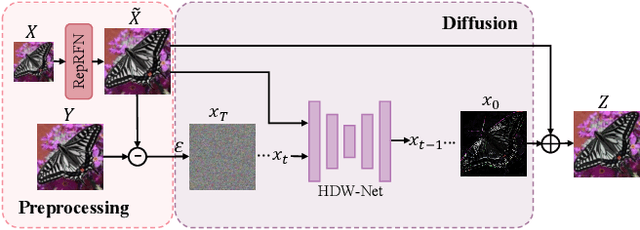
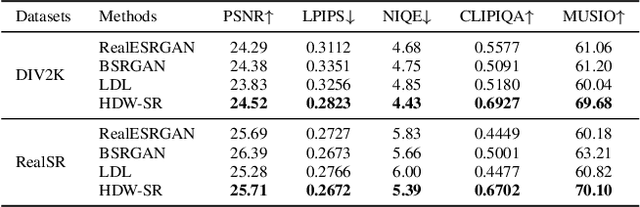
Diffusion-based methods have shown great promise in single image super-resolution (SISR); however, existing approaches often produce blurred fine details due to insufficient guidance in the high-frequency domain. To address this issue, we propose a High-Frequency Guided Diffusion Network based on Wavelet Decomposition (HDW-SR), which replaces the conventional U-Net backbone in diffusion frameworks. Specifically, we perform diffusion only on the residual map, allowing the network to focus more effectively on high-frequency information restoration. We then introduce wavelet-based downsampling in place of standard CNN downsampling to achieve multi-scale frequency decomposition, enabling sparse cross-attention between the high-frequency subbands of the pre-super-resolved image and the low-frequency subbands of the diffused image for explicit high-frequency guidance. Moreover, a Dynamic Thresholding Block (DTB) is designed to refine high-frequency selection during the sparse attention process. During upsampling, the invertibility of the wavelet transform ensures low-loss feature reconstruction. Experiments on both synthetic and real-world datasets demonstrate that HDW-SR achieves competitive super-resolution performance, excelling particularly in recovering fine-grained image details. The code will be available after acceptance.

CTSR: Cartesian tensor-based sparse regression for data-driven discovery of high-dimensional invariant governing equations
Apr 10, 2025
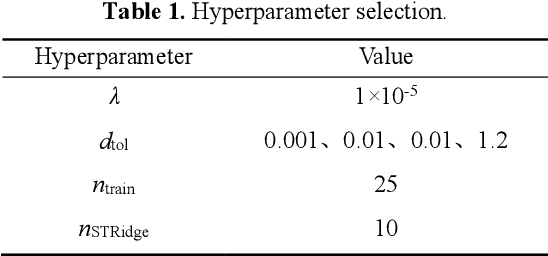
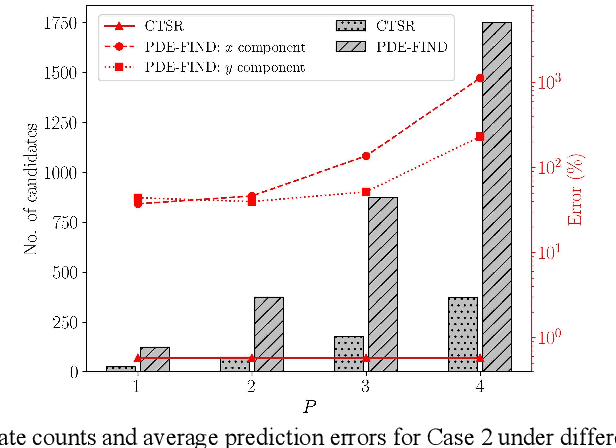

Accurate and concise governing equations are crucial for understanding system dynamics. Recently, data-driven methods such as sparse regression have been employed to automatically uncover governing equations from data, representing a significant shift from traditional first-principles modeling. However, most existing methods focus on scalar equations, limiting their applicability to simple, low-dimensional scenarios, and failing to ensure rotation and reflection invariance without incurring significant computational cost or requiring additional prior knowledge. This paper proposes a Cartesian tensor-based sparse regression (CTSR) technique to accurately and efficiently uncover complex, high-dimensional governing equations while ensuring invariance. Evaluations on two two-dimensional (2D) and two three-dimensional (3D) test cases demonstrate that the proposed method achieves superior accuracy and efficiency compared to the conventional technique.