 Add to Chrome
 Add to Firefox
 Add to Edge
Financial Relation Extraction
Papers and Code
Hallucination Detection and Mitigation in Large Language Models
Jan 14, 2026
Large Language Models (LLMs) and Large Reasoning Models (LRMs) offer transformative potential for high-stakes domains like finance and law, but their tendency to hallucinate, generating factually incorrect or unsupported content, poses a critical reliability risk. This paper introduces a comprehensive operational framework for hallucination management, built on a continuous improvement cycle driven by root cause awareness. We categorize hallucination sources into model, data, and context-related factors, allowing targeted interventions over generic fixes. The framework integrates multi-faceted detection methods (e.g., uncertainty estimation, reasoning consistency) with stratified mitigation strategies (e.g., knowledge grounding, confidence calibration). We demonstrate its application through a tiered architecture and a financial data extraction case study, where model, context, and data tiers form a closed feedback loop for progressive reliability enhancement. This approach provides a systematic, scalable methodology for building trustworthy generative AI systems in regulated environments.

Structure First, Reason Next: Enhancing a Large Language Model using Knowledge Graph for Numerical Reasoning in Financial Documents
Jan 12, 2026Numerical reasoning is an important task in the analysis of financial documents. It helps in understanding and performing numerical predictions with logical conclusions for the given query seeking answers from financial texts. Recently, Large Language Models (LLMs) have shown promising results in multiple Question-Answering (Q-A) systems with the capability of logical reasoning. As documents related to finance often consist of long and complex financial contexts, LLMs appear well-suited for building high-quality automated financial question-answering systems. However, LLMs often face challenges in accurately processing the various numbers within financial reports. Extracting numerical data from unstructured text and semi-structured tables, and reliably performing accurate calculations, remains a significant bottleneck for numerical reasoning in most state-of-the-art LLMs. Recent studies have shown that structured data augmentations, such as Knowledge Graphs (KGs), have notably improved the predictions of LLMs along with logical explanations. Thus, it is an important requirement to consider inherent structured information in financial reports while using LLMs for various financial analytics. This paper proposes a framework to incorporate structured information using KGs along with LLM predictions for numerical reasoning tasks. The KGs are extracted using a proposed schema inherently from the document under processing. We evaluated our proposed framework over the benchmark data FinQA, using an open-source LLM, namely Llama 3.1 8B Instruct. We observed that the proposed framework improved execution accuracy by approximately 12% relative to the vanilla LLM.
Machine Learning Algorithms: Detection Official Hajj and Umrah Travel Agency Based on Text and Metadata Analysis
Dec 18, 2025The rapid digitalization of Hajj and Umrah services in Indonesia has significantly facilitated pilgrims but has concurrently opened avenues for digital fraud through counterfeit mobile applications. These fraudulent applications not only inflict financial losses but also pose severe privacy risks by harvesting sensitive personal data. This research aims to address this critical issue by implementing and evaluating machine learning algorithms to verify application authenticity automatically. Using a comprehensive dataset comprising both official applications registered with the Ministry of Religious Affairs and unofficial applications circulating on app stores, we compare the performance of three robust classifiers: Support Vector Machine (SVM), Random Forest (RF), and Na"ive Bayes (NB). The study utilizes a hybrid feature extraction methodology that combines Textual Analysis (TF-IDF) of application descriptions with Metadata Analysis of sensitive access permissions. The experimental results indicate that the SVM algorithm achieves the highest performance with an accuracy of 92.3%, a precision of 91.5%, and an F1-score of 92.0%. Detailed feature analysis reveals that specific keywords related to legality and high-risk permissions (e.g., READ PHONE STATE) are the most significant discriminators. This system is proposed as a proactive, scalable solution to enhance digital trust in the religious tourism sector, potentially serving as a prototype for a national verification system.
Multi-Stage Field Extraction of Financial Documents with OCR and Compact Vision-Language Models
Oct 27, 2025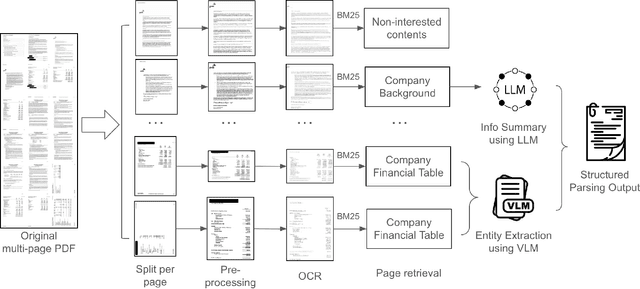
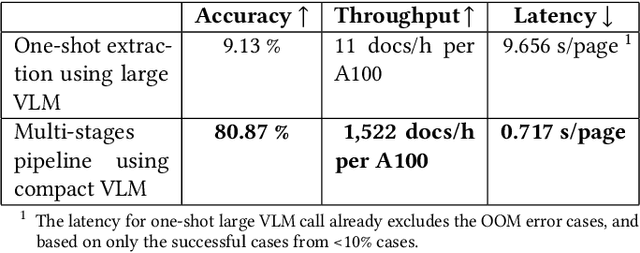
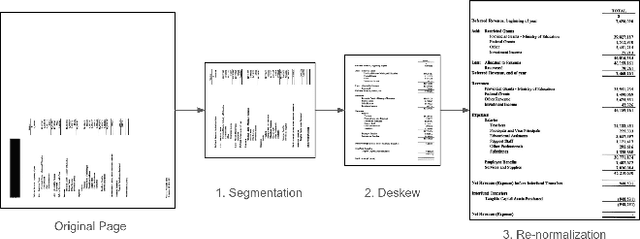
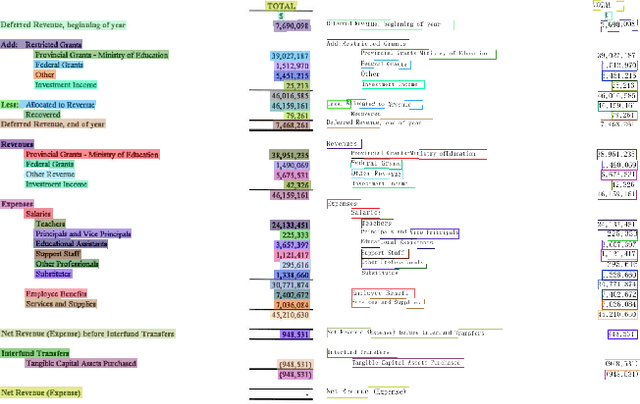
Financial documents are essential sources of information for regulators, auditors, and financial institutions, particularly for assessing the wealth and compliance of Small and Medium-sized Businesses. However, SMB documents are often difficult to parse. They are rarely born digital and instead are distributed as scanned images that are none machine readable. The scans themselves are low in resolution, affected by skew or rotation, and often contain noisy backgrounds. These documents also tend to be heterogeneous, mixing narratives, tables, figures, and multilingual content within the same report. Such characteristics pose major challenges for automated information extraction, especially when relying on end to end large Vision Language Models, which are computationally expensive, sensitive to noise, and slow when applied to files with hundreds of pages. We propose a multistage pipeline that leverages traditional image processing models and OCR extraction, together with compact VLMs for structured field extraction of large-scale financial documents. Our approach begins with image pre-processing, including segmentation, orientation detection, and size normalization. Multilingual OCR is then applied to recover page-level text. Upon analyzing the text information, pages are retrieved for coherent sections. Finally, compact VLMs are operated within these narrowed-down scopes to extract structured financial indicators. Our approach is evaluated using an internal corpus of multi-lingual, scanned financial documents. The results demonstrate that compact VLMs, together with a multistage pipeline, achieves 8.8 times higher field level accuracy relative to directly feeding the whole document into large VLMs, only at 0.7 percent of the GPU cost and 92.6 percent less end-to-end service latency.
A Pluggable Multi-Task Learning Framework for Sentiment-Aware Financial Relation Extraction
Jun 14, 2025Relation Extraction (RE) aims to extract semantic relationships in texts from given entity pairs, and has achieved significant improvements. However, in different domains, the RE task can be influenced by various factors. For example, in the financial domain, sentiment can affect RE results, yet this factor has been overlooked by modern RE models. To address this gap, this paper proposes a Sentiment-aware-SDP-Enhanced-Module (SSDP-SEM), a multi-task learning approach for enhancing financial RE. Specifically, SSDP-SEM integrates the RE models with a pluggable auxiliary sentiment perception (ASP) task, enabling the RE models to concurrently navigate their attention weights with the text's sentiment. We first generate detailed sentiment tokens through a sentiment model and insert these tokens into an instance. Then, the ASP task focuses on capturing nuanced sentiment information through predicting the sentiment token positions, combining both sentiment insights and the Shortest Dependency Path (SDP) of syntactic information. Moreover, this work employs a sentiment attention information bottleneck regularization method to regulate the reasoning process. Our experiment integrates this auxiliary task with several prevalent frameworks, and the results demonstrate that most previous models benefit from the auxiliary task, thereby achieving better results. These findings highlight the importance of effectively leveraging sentiment in the financial RE task.
A Variational Approach for Mitigating Entity Bias in Relation Extraction
Jun 13, 2025Mitigating entity bias is a critical challenge in Relation Extraction (RE), where models often rely excessively on entities, resulting in poor generalization. This paper presents a novel approach to address this issue by adapting a Variational Information Bottleneck (VIB) framework. Our method compresses entity-specific information while preserving task-relevant features. It achieves state-of-the-art performance on relation extraction datasets across general, financial, and biomedical domains, in both indomain (original test sets) and out-of-domain (modified test sets with type-constrained entity replacements) settings. Our approach offers a robust, interpretable, and theoretically grounded methodology.
"So, Tell Me About Your Policy...": Distillation of interpretable policies from Deep Reinforcement Learning agents
Jul 10, 2025Recent advances in Reinforcement Learning (RL) largely benefit from the inclusion of Deep Neural Networks, boosting the number of novel approaches proposed in the field of Deep Reinforcement Learning (DRL). These techniques demonstrate the ability to tackle complex games such as Atari, Go, and other real-world applications, including financial trading. Nevertheless, a significant challenge emerges from the lack of interpretability, particularly when attempting to comprehend the underlying patterns learned, the relative importance of the state features, and how they are integrated to generate the policy's output. For this reason, in mission-critical and real-world settings, it is often preferred to deploy a simpler and more interpretable algorithm, although at the cost of performance. In this paper, we propose a novel algorithm, supported by theoretical guarantees, that can extract an interpretable policy (e.g., a linear policy) without disregarding the peculiarities of expert behavior. This result is obtained by considering the advantage function, which includes information about why an action is superior to the others. In contrast to previous works, our approach enables the training of an interpretable policy using previously collected experience. The proposed algorithm is empirically evaluated on classic control environments and on a financial trading scenario, demonstrating its ability to extract meaningful information from complex expert policies.
Advanced fraud detection using machine learning models: enhancing financial transaction security
Jun 12, 2025The rise of digital payments has accelerated the need for intelligent and scalable systems to detect fraud. This research presents an end-to-end, feature-rich machine learning framework for detecting credit card transaction anomalies and fraud using real-world data. The study begins by merging transactional, cardholder, merchant, and merchant category datasets from a relational database to create a unified analytical view. Through the feature engineering process, we extract behavioural signals such as average spending, deviation from historical patterns, transaction timing irregularities, and category frequency metrics. These features are enriched with temporal markers such as hour, day of week, and weekend indicators to expose all latent patterns that indicate fraudulent behaviours. Exploratory data analysis reveals contextual transaction trends across all the dataset features. Using the transactional data, we train and evaluate a range of unsupervised models: Isolation Forest, One Class SVM, and a deep autoencoder trained to reconstruct normal behavior. These models flag the top 1% of reconstruction errors as outliers. PCA visualizations illustrate each models ability to separate anomalies into a two-dimensional latent space. We further segment the transaction landscape using K-Means clustering and DBSCAN to identify dense clusters of normal activity and isolate sparse, suspicious regions.
FinTagging: An LLM-ready Benchmark for Extracting and Structuring Financial Information
May 27, 2025We introduce FinTagging, the first full-scope, table-aware XBRL benchmark designed to evaluate the structured information extraction and semantic alignment capabilities of large language models (LLMs) in the context of XBRL-based financial reporting. Unlike prior benchmarks that oversimplify XBRL tagging as flat multi-class classification and focus solely on narrative text, FinTagging decomposes the XBRL tagging problem into two subtasks: FinNI for financial entity extraction and FinCL for taxonomy-driven concept alignment. It requires models to jointly extract facts and align them with the full 10k+ US-GAAP taxonomy across both unstructured text and structured tables, enabling realistic, fine-grained evaluation. We assess a diverse set of LLMs under zero-shot settings, systematically analyzing their performance on both subtasks and overall tagging accuracy. Our results reveal that, while LLMs demonstrate strong generalization in information extraction, they struggle with fine-grained concept alignment, particularly in disambiguating closely related taxonomy entries. These findings highlight the limitations of existing LLMs in fully automating XBRL tagging and underscore the need for improved semantic reasoning and schema-aware modeling to meet the demands of accurate financial disclosure. Code is available at our GitHub repository and data is at our Hugging Face repository.
KG-QAGen: A Knowledge-Graph-Based Framework for Systematic Question Generation and Long-Context LLM Evaluation
May 18, 2025The increasing context length of modern language models has created a need for evaluating their ability to retrieve and process information across extensive documents. While existing benchmarks test long-context capabilities, they often lack a structured way to systematically vary question complexity. We introduce KG-QAGen (Knowledge-Graph-based Question-Answer Generation), a framework that (1) extracts QA pairs at multiple complexity levels (2) by leveraging structured representations of financial agreements (3) along three key dimensions -- multi-hop retrieval, set operations, and answer plurality -- enabling fine-grained assessment of model performance across controlled difficulty levels. Using this framework, we construct a dataset of 20,139 QA pairs (the largest number among the long-context benchmarks) and open-source a part of it. We evaluate 13 proprietary and open-source LLMs and observe that even the best-performing models are struggling with set-based comparisons and multi-hop logical inference. Our analysis reveals systematic failure modes tied to semantic misinterpretation and inability to handle implicit relations.