 Add to Chrome
 Add to Firefox
 Add to Edge
Detection, Attribution, Narration: An End-to-End Pipeline for Explainable Money Mule Identification
Jul 20, 2026
Money mule accounts are critical facilitators of financial fraud, yet detecting them at scale remains challenging due to the heterogeneous nature of transactional and behavioural data. We present an end-to-end pipeline for customer-level mule detection comprising three stages: (1) a LightGBM classifier trained on 280 engineered features spanning transaction patterns, account demographics, network topology, and temporal behaviour; (2) a TreeSHAP attribution layer that decomposes each prediction into feature contributions; and (3) a large language model (LLM) module that converts SHAP attributions into analyst-facing natural-language narratives. We evaluate across three open-weight LLM families and assess explanation quality through analyst feedback. In a live production deployment, the system achieves a yield rate of 89%, up from 61% under the incumbent rule-based system, with monthly alert volume expanding from 211 to 302, reflecting broader true-positive coverage rather than increased noise. This corresponds to a 60% incremental adverse detection beyond existing review workflows, substantially outperforming the rule-based approach. Qualitative feedback from analysts indicates that LLM-generated narratives reduce cognitive load during alert triage. We further discuss implications of deploying LLM-augmented explainability in regulated financial environments.

Beyond Semantic Similarity: A Two-Phase Non-Parametric Retrieval Workflow for Corporate Credit Underwriting
May 20, 2026Corporate credit underwriting requires analysts to extract actionable evidence from long, heterogeneous financial documents spanning hundreds of pages and multiple languages. Standard Retrieval-Augmented Generation (RAG) pipelines optimize for semantic similarity, which frequently surfaces passages that are topically related but lack decision utility, a problem we term the similarity-utility gap. We propose a two-phase non-parametric retrieval architecture that separates high-recall candidate retrieval from high-precision utility ranking. The first phase combines lexical and dense multilingual retrieval to construct a broad candidate pool. The second phase applies an adaptive retrieval controller that filters candidates using query intent and document structure signals, followed by an LLM-as-a-Judge utility scoring mechanism that ranks passages by analytical usefulness rather than semantic proximity. A context-aware extraction module preserves structural fidelity across narrative text and complex financial tables. The system is deployed entirely on-premise to satisfy enterprise data governance requirements. Evaluated on a multilingual corpus of proprietary financial documents with analyst-curated relevance labels, the system significantly outperforms naive retrieval baselines. In production deployment across more than 800 credit analysts, document review time was reduced from several hours to approximately three minutes, demonstrating the practical value of utility-aware RAG architectures for document-intensive decision-support workflows.
Multi-Stage Field Extraction of Financial Documents with OCR and Compact Vision-Language Models
Oct 27, 2025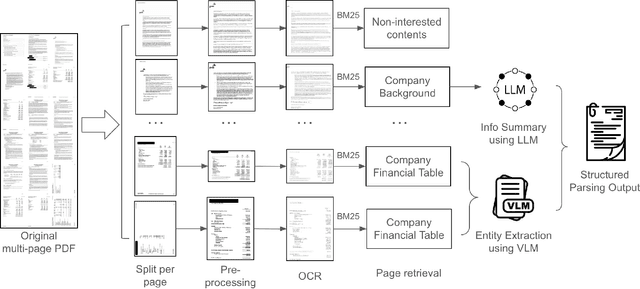
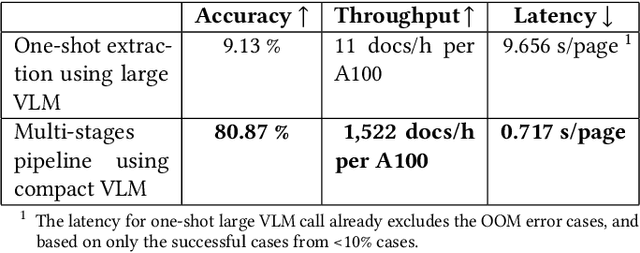
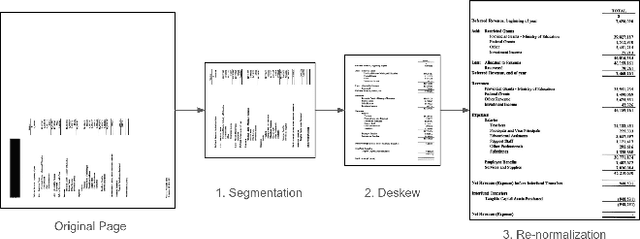
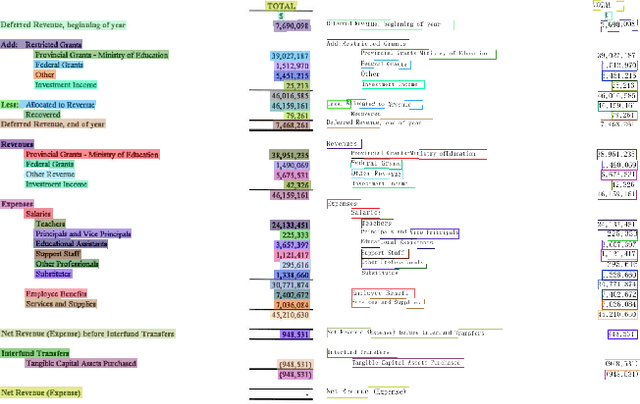
Financial documents are essential sources of information for regulators, auditors, and financial institutions, particularly for assessing the wealth and compliance of Small and Medium-sized Businesses. However, SMB documents are often difficult to parse. They are rarely born digital and instead are distributed as scanned images that are none machine readable. The scans themselves are low in resolution, affected by skew or rotation, and often contain noisy backgrounds. These documents also tend to be heterogeneous, mixing narratives, tables, figures, and multilingual content within the same report. Such characteristics pose major challenges for automated information extraction, especially when relying on end to end large Vision Language Models, which are computationally expensive, sensitive to noise, and slow when applied to files with hundreds of pages. We propose a multistage pipeline that leverages traditional image processing models and OCR extraction, together with compact VLMs for structured field extraction of large-scale financial documents. Our approach begins with image pre-processing, including segmentation, orientation detection, and size normalization. Multilingual OCR is then applied to recover page-level text. Upon analyzing the text information, pages are retrieved for coherent sections. Finally, compact VLMs are operated within these narrowed-down scopes to extract structured financial indicators. Our approach is evaluated using an internal corpus of multi-lingual, scanned financial documents. The results demonstrate that compact VLMs, together with a multistage pipeline, achieves 8.8 times higher field level accuracy relative to directly feeding the whole document into large VLMs, only at 0.7 percent of the GPU cost and 92.6 percent less end-to-end service latency.