 Add to Chrome
 Add to Firefox
 Add to Edge
Hallucination Detection and Mitigation in Large Language Models
Jan 14, 2026
Large Language Models (LLMs) and Large Reasoning Models (LRMs) offer transformative potential for high-stakes domains like finance and law, but their tendency to hallucinate, generating factually incorrect or unsupported content, poses a critical reliability risk. This paper introduces a comprehensive operational framework for hallucination management, built on a continuous improvement cycle driven by root cause awareness. We categorize hallucination sources into model, data, and context-related factors, allowing targeted interventions over generic fixes. The framework integrates multi-faceted detection methods (e.g., uncertainty estimation, reasoning consistency) with stratified mitigation strategies (e.g., knowledge grounding, confidence calibration). We demonstrate its application through a tiered architecture and a financial data extraction case study, where model, context, and data tiers form a closed feedback loop for progressive reliability enhancement. This approach provides a systematic, scalable methodology for building trustworthy generative AI systems in regulated environments.

Bringing the State-of-the-Art to Customers: A Neural Agent Assistant Framework for Customer Service Support
Feb 07, 2023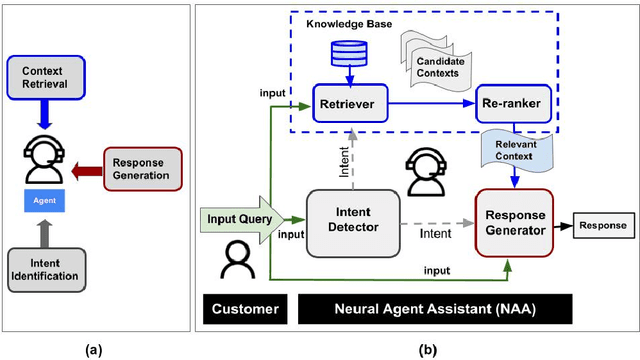
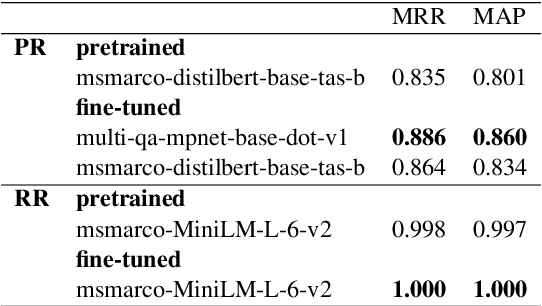
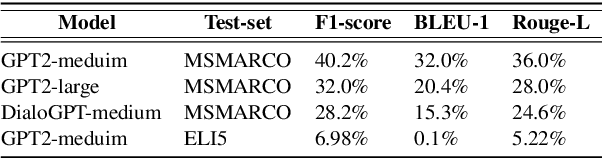

Building Agent Assistants that can help improve customer service support requires inputs from industry users and their customers, as well as knowledge about state-of-the-art Natural Language Processing (NLP) technology. We combine expertise from academia and industry to bridge the gap and build task/domain-specific Neural Agent Assistants (NAA) with three high-level components for: (1) Intent Identification, (2) Context Retrieval, and (3) Response Generation. In this paper, we outline the pipeline of the NAA's core system and also present three case studies in which three industry partners successfully adapt the framework to find solutions to their unique challenges. Our findings suggest that a collaborative process is instrumental in spurring the development of emerging NLP models for Conversational AI tasks in industry. The full reference implementation code and results are available at \url{https://github.com/VectorInstitute/NAA}