 Add to Chrome
 Add to Firefox
 Add to Edge
Facial Attribute Classification
Facial attribute classification is the process of identifying and categorizing different facial attributes in images.
Papers and Code
LatRef-Diff: Latent and Reference-Guided Diffusion for Facial Attribute Editing and Style Manipulation
Apr 23, 2026
Facial attribute editing and style manipulation are crucial for applications like virtual avatars and photo editing. However, achieving precise control over facial attributes without altering unrelated features is challenging due to the complexity of facial structures and the strong correlations between attributes. While conditional GANs have shown progress, they are limited by accuracy issues and training instability. Diffusion models, though promising, face challenges in style manipulation due to the limited expressiveness of semantic directions. In this paper, we propose LatRef-Diff, a novel diffusion-based framework that addresses these limitations. We replace the traditional semantic directions in diffusion models with style codes and propose two methods for generating them: latent and reference guidance. Based on these style codes, we design a style modulation module that integrates them into the target image, enabling both random and customized style manipulation. This module incorporates learnable vectors, cross-attention mechanisms, and a hierarchical design to improve accuracy and image quality. Additionally, to enhance training stability while eliminating the need for paired images (e.g., before and after editing), we propose a forward-backward consistency training strategy. This strategy first removes the target attribute approximately using image-specific semantic directions and then restores it via style modulation, guided by perceptual and classification losses. Extensive experiments on CelebA-HQ demonstrate that LatRef-Diff achieves state-of-the-art performance in both qualitative and quantitative evaluations. Ablation studies validate the effectiveness of our model's design choices.

From Pixels to Privacy: Temporally Consistent Video Anonymization via Token Pruning for Privacy Preserving Action Recognition
Mar 27, 2026Recent advances in large-scale video models have significantly improved video understanding across domains such as surveillance, healthcare, and entertainment. However, these models also amplify privacy risks by encoding sensitive attributes, including facial identity, race, and gender. While image anonymization has been extensively studied, video anonymization remains relatively underexplored, even though modern video models can leverage spatiotemporal motion patterns as biometric identifiers. To address this challenge, we propose a novel attention-driven spatiotemporal video anonymization framework based on systematic disentanglement of utility and privacy features. Our key insight is that attention mechanisms in Vision Transformers (ViTs) can be explicitly structured to separate action-relevant information from privacy-sensitive content. Building on this insight, we introduce two task-specific classification tokens, an action CLS token and a privacy CLS token, that learn complementary representations within a shared Transformer backbone. We contrast their attention distributions to compute a utility-privacy score for each spatiotemporal tubelet, and keep the top-k tubelets with the highest scores. This selectively prunes tubelets dominated by privacy cues while preserving those most critical for action recognition. Extensive experiments demonstrate that our approach maintains action recognition performance comparable to models trained on raw videos, while substantially reducing privacy leakage. These results indicate that attention-driven spatiotemporal pruning offers an effective and principled solution for privacy-preserving video analytics.
Real-time Appearance-based Gaze Estimation for Open Domains
Mar 27, 2026Appearance-based gaze estimation (AGE) has achieved remarkable performance in constrained settings, yet we reveal a significant generalization gap where existing AGE models often fail in practical, unconstrained scenarios, particularly those involving facial wearables and poor lighting conditions. We attribute this failure to two core factors: limited image diversity and inconsistent label fidelity across different datasets, especially along the pitch axis. To address these, we propose a robust AGE framework that enhances generalization without requiring additional human-annotated data. First, we expand the image manifold via an ensemble of augmentation techniques, including synthesis of eyeglasses, masks, and varied lighting. Second, to mitigate the impact of anisotropic inter-dataset label deviation, we reformulate gaze regression as a multi-task learning problem, incorporating multi-view supervised contrastive (SupCon) learning, discretized label classification, and eye-region segmentation as auxiliary objectives. To rigorously validate our approach, we curate new benchmark datasets designed to evaluate gaze robustness under challenging conditions, a dimension largely overlooked by existing evaluation protocols. Our MobileNet-based lightweight model achieves generalization performance competitive with the state-of-the-art (SOTA) UniGaze-H, while utilizing less than 1\% of its parameters, enabling high-fidelity, real-time gaze tracking on mobile devices.
Aesthetics as Structural Harm: Algorithmic Lookism Across Text-to-Image Generation and Classification
Jan 15, 2026This paper examines algorithmic lookism-the systematic preferential treatment based on physical appearance-in text-to-image (T2I) generative AI and a downstream gender classification task. Through the analysis of 26,400 synthetic faces created with Stable Diffusion 2.1 and 3.5 Medium, we demonstrate how generative AI models systematically associate facial attractiveness with positive attributes and vice-versa, mirroring socially constructed biases rather than evidence-based correlations. Furthermore, we find significant gender bias in three gender classification algorithms depending on the attributes of the input faces. Our findings reveal three critical harms: (1) the systematic encoding of attractiveness-positive attribute associations in T2I models; (2) gender disparities in classification systems, where women's faces, particularly those generated with negative attributes, suffer substantially higher misclassification rates than men's; and (3) intensifying aesthetic constraints in newer models through age homogenization, gendered exposure patterns, and geographic reductionism. These convergent patterns reveal algorithmic lookism as systematic infrastructure operating across AI vision systems, compounding existing inequalities through both representation and recognition. Disclaimer: This work includes visual and textual content that reflects stereotypical associations between physical appearance and socially constructed attributes, including gender, race, and traits associated with social desirability. Any such associations found in this study emerge from the biases embedded in generative AI systems-not from empirical truths or the authors' views.
Mask-Guided Multi-Task Network for Face Attribute Recognition
Jan 04, 2026Face Attribute Recognition (FAR) plays a crucial role in applications such as person re-identification, face retrieval, and face editing. Conventional multi-task attribute recognition methods often process the entire feature map for feature extraction and attribute classification, which can produce redundant features due to reliance on global regions. To address these challenges, we propose a novel approach emphasizing the selection of specific feature regions for efficient feature learning. We introduce the Mask-Guided Multi-Task Network (MGMTN), which integrates Adaptive Mask Learning (AML) and Group-Global Feature Fusion (G2FF) to address the aforementioned limitations. Leveraging a pre-trained keypoint annotation model and a fully convolutional network, AML accurately localizes critical facial parts (e.g., eye and mouth groups) and generates group masks that delineate meaningful feature regions, thereby mitigating negative transfer from global region usage. Furthermore, G2FF combines group and global features to enhance FAR learning, enabling more precise attribute identification. Extensive experiments on two challenging facial attribute recognition datasets demonstrate the effectiveness of MGMTN in improving FAR performance.
A Study of Gender Classification Techniques Based on Iris Images: A Deep Survey and Analysis
Aug 07, 2025Gender classification is attractive in a range of applications, including surveillance and monitoring, corporate profiling, and human-computer interaction. Individuals' identities may be gleaned from information about their gender, which is a kind of soft biometric.Over the years, several methods for determining a person's gender have been devised. Some of the most well-known ones are based on physical characteristics like face, fingerprint, palmprint, DNA, ears, gait, and iris. On the other hand, facial features account for the vast majority of gender classification methods. Also, the iris is a significant biometric trait because the iris, according to research, remains basically constant during an individual's life. Besides that, the iris is externally visible and is non-invasive to the user, which is important for practical applications. Furthermore, there are already high-quality methods for segmenting and encoding iris images, and the current methods facilitate selecting and extracting attribute vectors from iris textures. This study discusses several approaches to determining gender. The previous works of literature are briefly reviewed. Additionally, there are a variety of methodologies for different steps of gender classification. This study provides researchers with knowledge and analysis of the existing gender classification approaches. Also, it will assist researchers who are interested in this specific area, as well as highlight the gaps and challenges in the field, and finally provide suggestions and future paths for improvement.
* 13 Pages, 8 Figures, 1 Table
TrustSkin: A Fairness Pipeline for Trustworthy Facial Affect Analysis Across Skin Tone
May 27, 2025Understanding how facial affect analysis (FAA) systems perform across different demographic groups requires reliable measurement of sensitive attributes such as ancestry, often approximated by skin tone, which itself is highly influenced by lighting conditions. This study compares two objective skin tone classification methods: the widely used Individual Typology Angle (ITA) and a perceptually grounded alternative based on Lightness ($L^*$) and Hue ($H^*$). Using AffectNet and a MobileNet-based model, we assess fairness across skin tone groups defined by each method. Results reveal a severe underrepresentation of dark skin tones ($\sim 2 \%$), alongside fairness disparities in F1-score (up to 0.08) and TPR (up to 0.11) across groups. While ITA shows limitations due to its sensitivity to lighting, the $H^*$-$L^*$ method yields more consistent subgrouping and enables clearer diagnostics through metrics such as Equal Opportunity. Grad-CAM analysis further highlights differences in model attention patterns by skin tone, suggesting variation in feature encoding. To support future mitigation efforts, we also propose a modular fairness-aware pipeline that integrates perceptual skin tone estimation, model interpretability, and fairness evaluation. These findings emphasize the relevance of skin tone measurement choices in fairness assessment and suggest that ITA-based evaluations may overlook disparities affecting darker-skinned individuals.
* 10 pages
Gone With the Bits: Revealing Racial Bias in Low-Rate Neural Compression for Facial Images
May 05, 2025Neural compression methods are gaining popularity due to their superior rate-distortion performance over traditional methods, even at extremely low bitrates below 0.1 bpp. As deep learning architectures, these models are prone to bias during the training process, potentially leading to unfair outcomes for individuals in different groups. In this paper, we present a general, structured, scalable framework for evaluating bias in neural image compression models. Using this framework, we investigate racial bias in neural compression algorithms by analyzing nine popular models and their variants. Through this investigation, we first demonstrate that traditional distortion metrics are ineffective in capturing bias in neural compression models. Next, we highlight that racial bias is present in all neural compression models and can be captured by examining facial phenotype degradation in image reconstructions. We then examine the relationship between bias and realism in the decoded images and demonstrate a trade-off across models. Finally, we show that utilizing a racially balanced training set can reduce bias but is not a sufficient bias mitigation strategy. We additionally show the bias can be attributed to compression model bias and classification model bias. We believe that this work is a first step towards evaluating and eliminating bias in neural image compression models.
Impact of Face Alignment on Face Image Quality
Dec 16, 2024Face alignment is a crucial step in preparing face images for feature extraction in facial analysis tasks. For applications such as face recognition, facial expression recognition, and facial attribute classification, alignment is widely utilized during both training and inference to standardize the positions of key landmarks in the face. It is well known that the application and method of face alignment significantly affect the performance of facial analysis models. However, the impact of alignment on face image quality has not been thoroughly investigated. Current FIQA studies often assume alignment as a prerequisite but do not explicitly evaluate how alignment affects quality metrics, especially with the advent of modern deep learning-based detectors that integrate detection and landmark localization. To address this need, our study examines the impact of face alignment on face image quality scores. We conducted experiments on the LFW, IJB-B, and SCFace datasets, employing MTCNN and RetinaFace models for face detection and alignment. To evaluate face image quality, we utilized several assessment methods, including SER-FIQ, FaceQAN, DifFIQA, and SDD-FIQA. Our analysis included examining quality score distributions for the LFW and IJB-B datasets and analyzing average quality scores at varying distances in the SCFace dataset. Our findings reveal that face image quality assessment methods are sensitive to alignment. Moreover, this sensitivity increases under challenging real-life conditions, highlighting the importance of evaluating alignment's role in quality assessment.
Improving Bias in Facial Attribute Classification: A Combined Impact of KL Divergence induced Loss Function and Dual Attention
Oct 15, 2024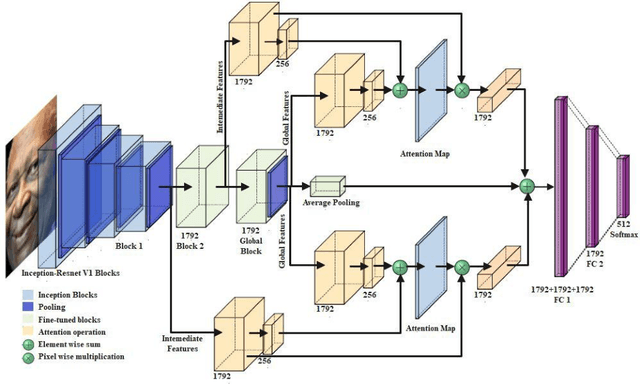
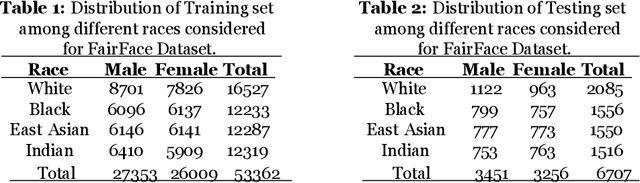
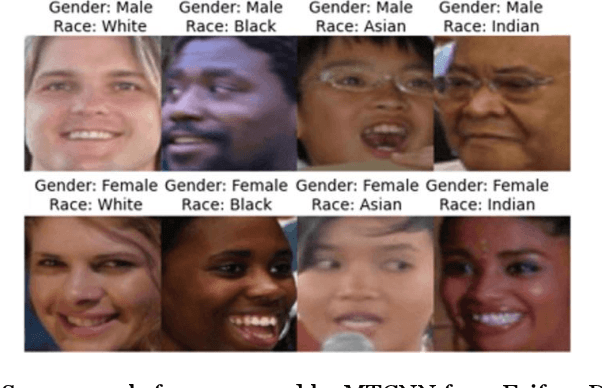
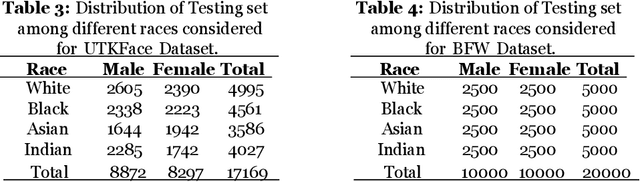
Ensuring that AI-based facial recognition systems produce fair predictions and work equally well across all demographic groups is crucial. Earlier systems often exhibited demographic bias, particularly in gender and racial classification, with lower accuracy for women and individuals with darker skin tones. To tackle this issue and promote fairness in facial recognition, researchers have introduced several bias-mitigation techniques for gender classification and related algorithms. However, many challenges remain, such as data diversity, balancing fairness with accuracy, disparity, and bias measurement. This paper presents a method using a dual attention mechanism with a pre-trained Inception-ResNet V1 model, enhanced by KL-divergence regularization and a cross-entropy loss function. This approach reduces bias while improving accuracy and computational efficiency through transfer learning. The experimental results show significant improvements in both fairness and classification accuracy, providing promising advances in addressing bias and enhancing the reliability of facial recognition systems.