 Add to Chrome
 Add to Firefox
 Add to Edge
Cuhk Pedes
Papers and Code
Harnessing Weak Pair Uncertainty for Text-based Person Search
Apr 10, 2026
In this paper, we study the text-based person search, which is to retrieve the person of interest via natural language description. Prevailing methods usually focus on the strict one-to-one correspondence pair matching between the visual and textual modality, such as contrastive learning. However, such a paradigm unintentionally disregards the weak positive image-text pairs, which are of the same person but the text descriptions are annotated from different views (cameras). To take full use of weak positives, we introduce an uncertainty-aware method to explicitly estimate image-text pair uncertainty, and incorporate the uncertainty into the optimization procedure in a smooth manner. Specifically, our method contains two modules: uncertainty estimation and uncertainty regularization. (1) Uncertainty estimation is to obtain the relative confidence on the given positive pairs; (2) Based on the predicted uncertainty, we propose the uncertainty regularization to adaptively adjust loss weight. Additionally, we introduce a group-wise image-text matching loss to further facilitate the representation space among the weak pairs. Compared with existing methods, the proposed method explicitly prevents the model from pushing away potentially weak positive candidates. Extensive experiments on three widely-used datasets, .e.g, CUHK-PEDES, RSTPReid and ICFG-PEDES, verify the mAP improvement of our method against existing competitive methods +3.06%, +3.55% and +6.94%, respectively.

Pretrain-then-Adapt: Uncertainty-Aware Test-Time Adaptation for Text-based Person Search
Apr 07, 2026Text-based person search faces inherent limitations due to data scarcity, driven by stringent privacy constraints and the high cost of manual annotation. To mitigate this, existing methods usually rely on a Pretrain-then-Finetune paradigm, where models are first pretrained on synthetic person-caption data to establish cross-modal alignment, followed by fine-tuning on labeled real-world datasets. However, this paradigm lacks practicality in real-world deployment scenarios, where large-scale annotated target-domain data is typically inaccessible. In this work, we propose a new Pretrain-then-Adapt paradigm that eliminates reliance on extensive target-domain supervision through an offline test-time adaptation manner, enabling dynamic model adaptation using only unlabeled test data with minimal post-train time cost. To mitigate overconfidence with false positives of previous entropy-based test-time adaptation, we propose an Uncertainty-Aware Test-Time Adaptation (UATTA) framework, which introduces a bidirectional retrieval disagreement mechanism to estimate uncertainty, i.e., low uncertainty is assigned when an image-text pair ranks highly in both image-to-text and text-to-image retrieval, indicating high alignment; otherwise, high uncertainty is detected. This indicator drives offline test-time model recalibration without labels, effectively mitigating domain shift. We validate UATTA on four benchmarks, i.e., CUHK-PEDES, ICFG-PEDES, RSTPReid, and PAB, showing consistent improvements across both CLIP-based (one-stage) and XVLM-based (two-stage) frameworks. Ablation studies confirm that UATTA outperforms existing offline test-time adaptation strategies, establishing a new benchmark for label-efficient, deployable person search systems. Our code is available at https://github.com/nkuzjh/UATTA.
CONQUER: Context-Aware Representation with Query Enhancement for Text-Based Person Search
Jan 26, 2026Text-Based Person Search (TBPS) aims to retrieve pedestrian images from large galleries using natural language descriptions. This task, essential for public safety applications, is hindered by cross-modal discrepancies and ambiguous user queries. We introduce CONQUER, a two-stage framework designed to address these challenges by enhancing cross-modal alignment during training and adaptively refining queries at inference. During training, CONQUER employs multi-granularity encoding, complementary pair mining, and context-guided optimal matching based on Optimal Transport to learn robust embeddings. At inference, a plug-and-play query enhancement module refines vague or incomplete queries via anchor selection and attribute-driven enrichment, without requiring retraining of the backbone. Extensive experiments on CUHK-PEDES, ICFG-PEDES, and RSTPReid demonstrate that CONQUER consistently outperforms strong baselines in both Rank-1 accuracy and mAP, yielding notable improvements in cross-domain and incomplete-query scenarios. These results highlight CONQUER as a practical and effective solution for real-world TBPS deployment. Source code is available at https://github.com/zqxie77/CONQUER.
Unified Multi-Dataset Training for TBPS
Jan 21, 2026Text-Based Person Search (TBPS) has seen significant progress with vision-language models (VLMs), yet it remains constrained by limited training data and the fact that VLMs are not inherently pre-trained for pedestrian-centric recognition. Existing TBPS methods therefore rely on dataset-centric fine-tuning to handle distribution shift, resulting in multiple independently trained models for different datasets. While synthetic data can increase the scale needed to fine-tune VLMs, it does not eliminate dataset-specific adaptation. This motivates a fundamental question: can we train a single unified TBPS model across multiple datasets? We show that naive joint training over all datasets remains sub-optimal because current training paradigms do not scale to a large number of unique person identities and are vulnerable to noisy image-text pairs. To address these challenges, we propose Scale-TBPS with two contributions: (i) a noise-aware unified dataset curation strategy that cohesively merges diverse TBPS datasets; and (ii) a scalable discriminative identity learning framework that remains effective under a large number of unique identities. Extensive experiments on CUHK-PEDES, ICFG-PEDES, RSTPReid, IIITD-20K, and UFine6926 demonstrate that a single Scale-TBPS model outperforms dataset-centric optimized models and naive joint training.
Disentangled Concept Representation for Text-to-image Person Re-identification
Jan 15, 2026Text-to-image person re-identification (TIReID) aims to retrieve person images from a large gallery given free-form textual descriptions. TIReID is challenging due to the substantial modality gap between visual appearances and textual expressions, as well as the need to model fine-grained correspondences that distinguish individuals with similar attributes such as clothing color, texture, or outfit style. To address these issues, we propose DiCo (Disentangled Concept Representation), a novel framework that achieves hierarchical and disentangled cross-modal alignment. DiCo introduces a shared slot-based representation, where each slot acts as a part-level anchor across modalities and is further decomposed into multiple concept blocks. This design enables the disentanglement of complementary attributes (\textit{e.g.}, color, texture, shape) while maintaining consistent part-level correspondence between image and text. Extensive experiments on CUHK-PEDES, ICFG-PEDES, and RSTPReid demonstrate that our framework achieves competitive performance with state-of-the-art methods, while also enhancing interpretability through explicit slot- and block-level representations for more fine-grained retrieval results.
GEA: Generation-Enhanced Alignment for Text-to-Image Person Retrieval
Nov 13, 2025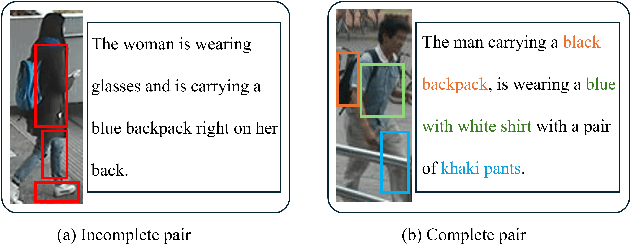
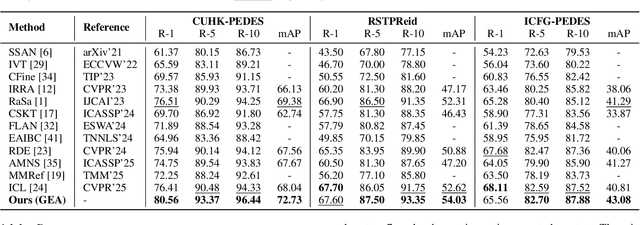
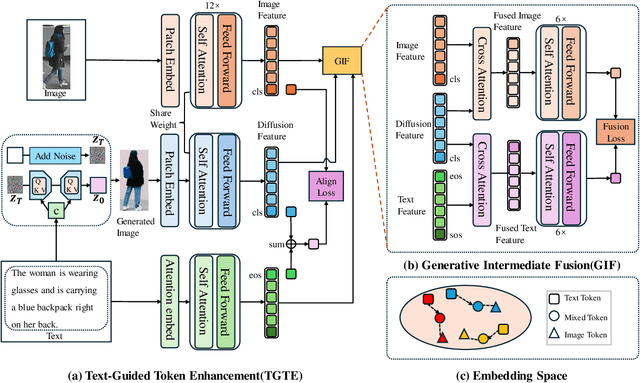
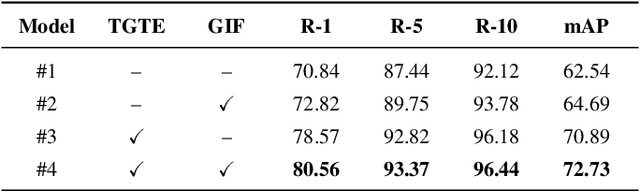
Text-to-Image Person Retrieval (TIPR) aims to retrieve person images based on natural language descriptions. Although many TIPR methods have achieved promising results, sometimes textual queries cannot accurately and comprehensively reflect the content of the image, leading to poor cross-modal alignment and overfitting to limited datasets. Moreover, the inherent modality gap between text and image further amplifies these issues, making accurate cross-modal retrieval even more challenging. To address these limitations, we propose the Generation-Enhanced Alignment (GEA) from a generative perspective. GEA contains two parallel modules: (1) Text-Guided Token Enhancement (TGTE), which introduces diffusion-generated images as intermediate semantic representations to bridge the gap between text and visual patterns. These generated images enrich the semantic representation of text and facilitate cross-modal alignment. (2) Generative Intermediate Fusion (GIF), which combines cross-attention between generated images, original images, and text features to generate a unified representation optimized by triplet alignment loss. We conduct extensive experiments on three public TIPR datasets, CUHK-PEDES, RSTPReid, and ICFG-PEDES, to evaluate the performance of GEA. The results justify the effectiveness of our method. More implementation details and extended results are available at https://github.com/sugelamyd123/Sup-for-GEA.
CAMeL: Cross-modality Adaptive Meta-Learning for Text-based Person Retrieval
Apr 26, 2025Text-based person retrieval aims to identify specific individuals within an image database using textual descriptions. Due to the high cost of annotation and privacy protection, researchers resort to synthesized data for the paradigm of pretraining and fine-tuning. However, these generated data often exhibit domain biases in both images and textual annotations, which largely compromise the scalability of the pre-trained model. Therefore, we introduce a domain-agnostic pretraining framework based on Cross-modality Adaptive Meta-Learning (CAMeL) to enhance the model generalization capability during pretraining to facilitate the subsequent downstream tasks. In particular, we develop a series of tasks that reflect the diversity and complexity of real-world scenarios, and introduce a dynamic error sample memory unit to memorize the history for errors encountered within multiple tasks. To further ensure multi-task adaptation, we also adopt an adaptive dual-speed update strategy, balancing fast adaptation to new tasks and slow weight updates for historical tasks. Albeit simple, our proposed model not only surpasses existing state-of-the-art methods on real-world benchmarks, including CUHK-PEDES, ICFG-PEDES, and RSTPReid, but also showcases robustness and scalability in handling biased synthetic images and noisy text annotations. Our code is available at https://github.com/Jahawn-Wen/CAMeL-reID.
UP-Person: Unified Parameter-Efficient Transfer Learning for Text-based Person Retrieval
Apr 14, 2025Text-based Person Retrieval (TPR) as a multi-modal task, which aims to retrieve the target person from a pool of candidate images given a text description, has recently garnered considerable attention due to the progress of contrastive visual-language pre-trained model. Prior works leverage pre-trained CLIP to extract person visual and textual features and fully fine-tune the entire network, which have shown notable performance improvements compared to uni-modal pre-training models. However, full-tuning a large model is prone to overfitting and hinders the generalization ability. In this paper, we propose a novel Unified Parameter-Efficient Transfer Learning (PETL) method for Text-based Person Retrieval (UP-Person) to thoroughly transfer the multi-modal knowledge from CLIP. Specifically, UP-Person simultaneously integrates three lightweight PETL components including Prefix, LoRA and Adapter, where Prefix and LoRA are devised together to mine local information with task-specific information prompts, and Adapter is designed to adjust global feature representations. Additionally, two vanilla submodules are optimized to adapt to the unified architecture of TPR. For one thing, S-Prefix is proposed to boost attention of prefix and enhance the gradient propagation of prefix tokens, which improves the flexibility and performance of the vanilla prefix. For another thing, L-Adapter is designed in parallel with layer normalization to adjust the overall distribution, which can resolve conflicts caused by overlap and interaction among multiple submodules. Extensive experimental results demonstrate that our UP-Person achieves state-of-the-art results across various person retrieval datasets, including CUHK-PEDES, ICFG-PEDES and RSTPReid while merely fine-tuning 4.7\% parameters. Code is available at https://github.com/Liu-Yating/UP-Person.
Knowing Where to Focus: Attention-Guided Alignment for Text-based Person Search
Dec 19, 2024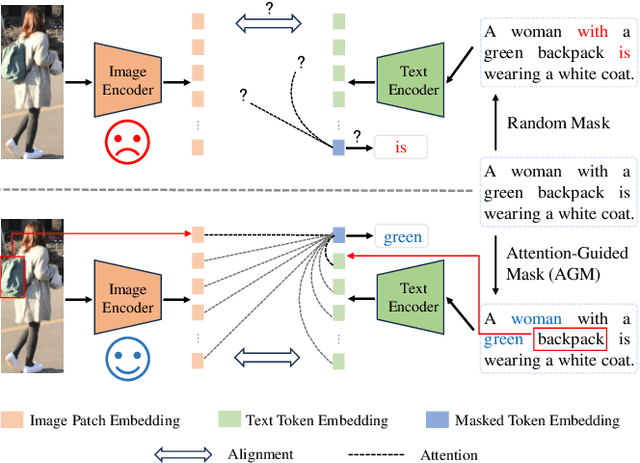
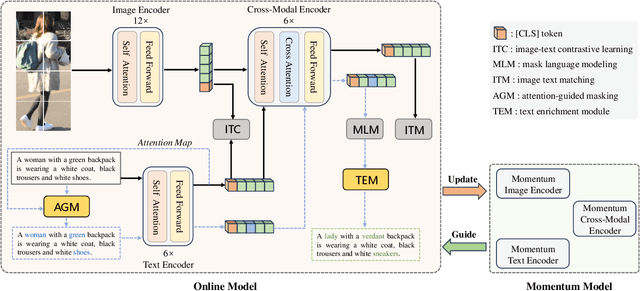
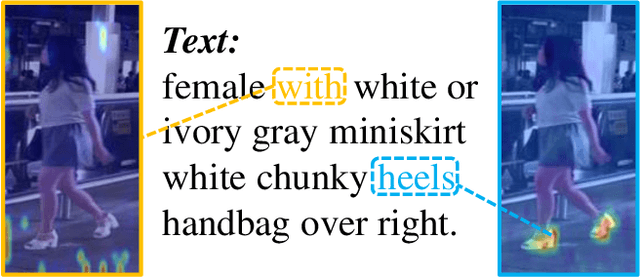
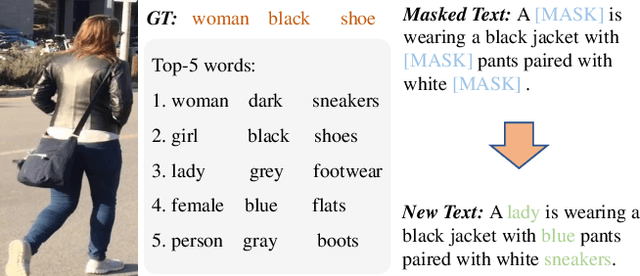
In the realm of Text-Based Person Search (TBPS), mainstream methods aim to explore more efficient interaction frameworks between text descriptions and visual data. However, recent approaches encounter two principal challenges. Firstly, the widely used random-based Masked Language Modeling (MLM) considers all the words in the text equally during training. However, massive semantically vacuous words ('with', 'the', etc.) be masked fail to contribute efficient interaction in the cross-modal MLM and hampers the representation alignment. Secondly, manual descriptions in TBPS datasets are tedious and inevitably contain several inaccuracies. To address these issues, we introduce an Attention-Guided Alignment (AGA) framework featuring two innovative components: Attention-Guided Mask (AGM) Modeling and Text Enrichment Module (TEM). AGM dynamically masks semantically meaningful words by aggregating the attention weight derived from the text encoding process, thereby cross-modal MLM can capture information related to the masked word from text context and images and align their representations. Meanwhile, TEM alleviates low-quality representations caused by repetitive and erroneous text descriptions by replacing those semantically meaningful words with MLM's prediction. It not only enriches text descriptions but also prevents overfitting. Extensive experiments across three challenging benchmarks demonstrate the effectiveness of our AGA, achieving new state-of-the-art results with Rank-1 accuracy reaching 78.36%, 67.31%, and 67.4% on CUHK-PEDES, ICFG-PEDES, and RSTPReid, respectively.
MARS: Paying more attention to visual attributes for text-based person search
Jul 05, 2024Text-based person search (TBPS) is a problem that gained significant interest within the research community. The task is that of retrieving one or more images of a specific individual based on a textual description. The multi-modal nature of the task requires learning representations that bridge text and image data within a shared latent space. Existing TBPS systems face two major challenges. One is defined as inter-identity noise that is due to the inherent vagueness and imprecision of text descriptions and it indicates how descriptions of visual attributes can be generally associated to different people; the other is the intra-identity variations, which are all those nuisances e.g. pose, illumination, that can alter the visual appearance of the same textual attributes for a given subject. To address these issues, this paper presents a novel TBPS architecture named MARS (Mae-Attribute-Relation-Sensitive), which enhances current state-of-the-art models by introducing two key components: a Visual Reconstruction Loss and an Attribute Loss. The former employs a Masked AutoEncoder trained to reconstruct randomly masked image patches with the aid of the textual description. In doing so the model is encouraged to learn more expressive representations and textual-visual relations in the latent space. The Attribute Loss, instead, balances the contribution of different types of attributes, defined as adjective-noun chunks of text. This loss ensures that every attribute is taken into consideration in the person retrieval process. Extensive experiments on three commonly used datasets, namely CUHK-PEDES, ICFG-PEDES, and RSTPReid, report performance improvements, with significant gains in the mean Average Precision (mAP) metric w.r.t. the current state of the art.