 Add to Chrome
 Add to Firefox
 Add to Edge
Crowd Flows Prediction
Papers and Code
HiCrowd: Hierarchical Crowd Flow Alignment for Dense Human Environments
Feb 05, 2026
Navigating through dense human crowds remains a significant challenge for mobile robots. A key issue is the freezing robot problem, where the robot struggles to find safe motions and becomes stuck within the crowd. To address this, we propose HiCrowd, a hierarchical framework that integrates reinforcement learning (RL) with model predictive control (MPC). HiCrowd leverages surrounding pedestrian motion as guidance, enabling the robot to align with compatible crowd flows. A high-level RL policy generates a follow point to align the robot with a suitable pedestrian group, while a low-level MPC safely tracks this guidance with short horizon planning. The method combines long-term crowd aware decision making with safe short-term execution. We evaluate HiCrowd against reactive and learning-based baselines in offline setting (replaying recorded human trajectories) and online setting (human trajectories are updated to react to the robot in simulation). Experiments on a real-world dataset and a synthetic crowd dataset show that our method outperforms in navigation efficiency and safety, while reducing freezing behaviors. Our results suggest that leveraging human motion as guidance, rather than treating humans solely as dynamic obstacles, provides a powerful principle for safe and efficient robot navigation in crowds.

Place with Intention: An Empirical Attendance Predictive Study of Expo 2025 Osaka, Kansai, Japan
Jan 21, 2026Accurate forecasting of daily attendance is vital for managing transportation, crowd flows, and services at large-scale international events such as Expo 2025 Osaka, Kansai, Japan. However, existing approaches often rely on multi-source external data (such as weather, traffic, and social media) to improve accuracy, which can lead to unreliable results when historical data are insufficient. To address these challenges, we propose a Transformer-based framework that leverages reservation dynamics, i.e., ticket bookings and subsequent updates within a time window, as a proxy for visitors' attendance intentions, under the assumption that such intentions are eventually reflected in reservation patterns. This design avoids the complexity of multi-source integration while still capturing external influences like weather and promotions implicitly embedded in reservation dynamics. We construct a dataset combining entrance records and reservation dynamics and evaluate the model under both single-channel (total attendance) and two-channel (separated by East and West gates) settings. Results show that separately modeling East and West gates consistently improves accuracy, particularly for short- and medium-term horizons. Ablation studies further confirm the importance of the encoder-decoder structure, inverse-style embedding, and adaptive fusion module. Overall, our findings indicate that reservation dynamics offer a practical and informative foundation for attendance forecasting in large-scale international events.
A Lightweight Crowd Model for Robot Social Navigation
Aug 27, 2025Robots operating in human-populated environments must navigate safely and efficiently while minimizing social disruption. Achieving this requires estimating crowd movement to avoid congested areas in real-time. Traditional microscopic models struggle to scale in dense crowds due to high computational cost, while existing macroscopic crowd prediction models tend to be either overly simplistic or computationally intensive. In this work, we propose a lightweight, real-time macroscopic crowd prediction model tailored for human motion, which balances prediction accuracy and computational efficiency. Our approach simplifies both spatial and temporal processing based on the inherent characteristics of pedestrian flow, enabling robust generalization without the overhead of complex architectures. We demonstrate a 3.6 times reduction in inference time, while improving prediction accuracy by 3.1 %. Integrated into a socially aware planning framework, the model enables efficient and socially compliant robot navigation in dynamic environments. This work highlights that efficient human crowd modeling enables robots to navigate dense environments without costly computations.
Time Series Foundation Models are Flow Predictors
Jul 01, 2025We investigate the effectiveness of time series foundation models (TSFMs) for crowd flow prediction, focusing on Moirai and TimesFM. Evaluated on three real-world mobility datasets-Bike NYC, Taxi Beijing, and Spanish national OD flows-these models are deployed in a strict zero-shot setting, using only the temporal evolution of each OD flow and no explicit spatial information. Moirai and TimesFM outperform both statistical and deep learning baselines, achieving up to 33% lower RMSE, 39% lower MAE and up to 49% higher CPC compared to state-of-the-art competitors. Our results highlight the practical value of TSFMs for accurate, scalable flow prediction, even in scenarios with limited annotated data or missing spatial context.
Dynamic Network Flow Optimization for Task Scheduling in PTZ Camera Surveillance Systems
May 07, 2025This paper presents a novel approach for optimizing the scheduling and control of Pan-Tilt-Zoom (PTZ) cameras in dynamic surveillance environments. The proposed method integrates Kalman filters for motion prediction with a dynamic network flow model to enhance real-time video capture efficiency. By assigning Kalman filters to tracked objects, the system predicts future locations, enabling precise scheduling of camera tasks. This prediction-driven approach is formulated as a network flow optimization, ensuring scalability and adaptability to various surveillance scenarios. To further reduce redundant monitoring, we also incorporate group-tracking nodes, allowing multiple objects to be captured within a single camera focus when appropriate. In addition, a value-based system is introduced to prioritize camera actions, focusing on the timely capture of critical events. By adjusting the decay rates of these values over time, the system ensures prompt responses to tasks with imminent deadlines. Extensive simulations demonstrate that this approach improves coverage, reduces average wait times, and minimizes missed events compared to traditional master-slave camera systems. Overall, our method significantly enhances the efficiency, scalability, and effectiveness of surveillance systems, particularly in dynamic and crowded environments.
STContext: A Multifaceted Dataset for Developing Context-aware Spatio-temporal Crowd Mobility Prediction Models
Jan 07, 2025In smart cities, context-aware spatio-temporal crowd flow prediction (STCFP) models leverage contextual features (e.g., weather) to identify unusual crowd mobility patterns and enhance prediction accuracy. However, the best practice for incorporating contextual features remains unclear due to inconsistent usage of contextual features in different papers. Developing a multifaceted dataset with rich types of contextual features and STCFP scenarios is crucial for establishing a principled context modeling paradigm. Existing open crowd flow datasets lack an adequate range of contextual features, which poses an urgent requirement to build a multifaceted dataset to fill these research gaps. To this end, we create STContext, a multifaceted dataset for developing context-aware STCFP models. Specifically, STContext provides nine spatio-temporal datasets across five STCFP scenarios and includes ten contextual features, including weather, air quality index, holidays, points of interest, road networks, etc. Besides, we propose a unified workflow for incorporating contextual features into deep STCFP methods, with steps including feature transformation, dependency modeling, representation fusion, and training strategies. Through extensive experiments, we have obtained several useful guidelines for effective context modeling and insights for future research. The STContext is open-sourced at https://github.com/Liyue-Chen/STContext.
STDCformer: A Transformer-Based Model with a Spatial-Temporal Causal De-Confounding Strategy for Crowd Flow Prediction
Dec 04, 2024


Existing works typically treat spatial-temporal prediction as the task of learning a function $F$ to transform historical observations to future observations. We further decompose this cross-time transformation into three processes: (1) Encoding ($E$): learning the intrinsic representation of observations, (2) Cross-Time Mapping ($M$): transforming past representations into future representations, and (3) Decoding ($D$): reconstructing future observations from the future representations. From this perspective, spatial-temporal prediction can be viewed as learning $F = E \cdot M \cdot D$, which includes learning the space transformations $\left\{{E},{D}\right\}$ between the observation space and the hidden representation space, as well as the spatial-temporal mapping $M$ from future states to past states within the representation space. This leads to two key questions: \textbf{Q1: What kind of representation space allows for mapping the past to the future? Q2: How to achieve map the past to the future within the representation space?} To address Q1, we propose a Spatial-Temporal Backdoor Adjustment strategy, which learns a Spatial-Temporal De-Confounded (STDC) representation space and estimates the de-confounding causal effect of historical data on future data. This causal relationship we captured serves as the foundation for subsequent spatial-temporal mapping. To address Q2, we design a Spatial-Temporal Embedding (STE) that fuses the information of temporal and spatial confounders, capturing the intrinsic spatial-temporal characteristics of the representations. Additionally, we introduce a Cross-Time Attention mechanism, which queries the attention between the future and the past to guide spatial-temporal mapping.
A Universal Model for Human Mobility Prediction
Dec 19, 2024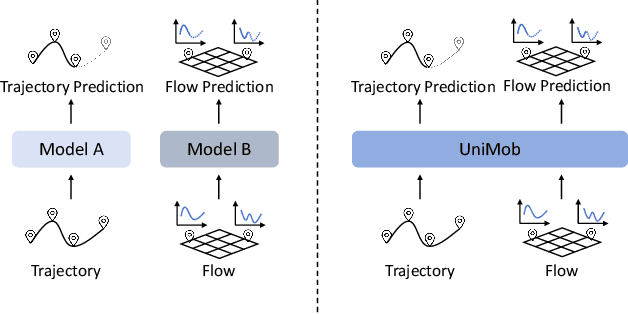
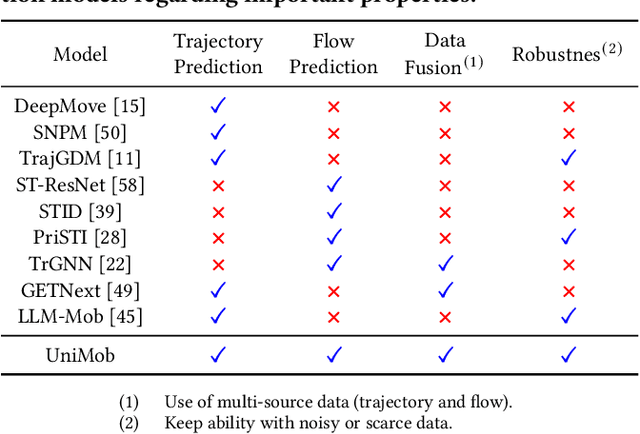
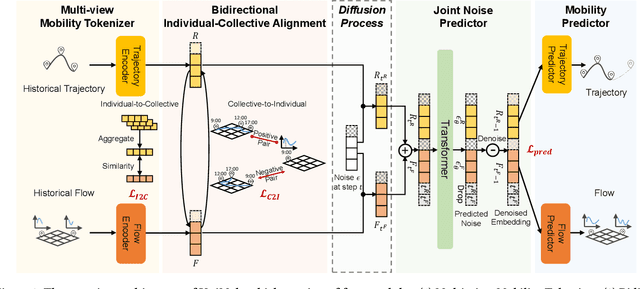
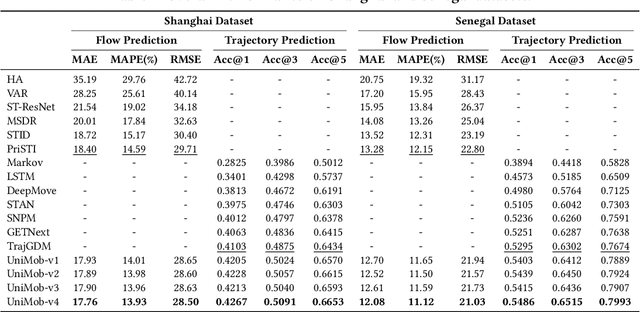
Predicting human mobility is crucial for urban planning, traffic control, and emergency response. Mobility behaviors can be categorized into individual and collective, and these behaviors are recorded by diverse mobility data, such as individual trajectory and crowd flow. As different modalities of mobility data, individual trajectory and crowd flow have a close coupling relationship. Crowd flows originate from the bottom-up aggregation of individual trajectories, while the constraints imposed by crowd flows shape these individual trajectories. Existing mobility prediction methods are limited to single tasks due to modal gaps between individual trajectory and crowd flow. In this work, we aim to unify mobility prediction to break through the limitations of task-specific models. We propose a universal human mobility prediction model (named UniMob), which can be applied to both individual trajectory and crowd flow. UniMob leverages a multi-view mobility tokenizer that transforms both trajectory and flow data into spatiotemporal tokens, facilitating unified sequential modeling through a diffusion transformer architecture. To bridge the gap between the different characteristics of these two data modalities, we implement a novel bidirectional individual and collective alignment mechanism. This mechanism enables learning common spatiotemporal patterns from different mobility data, facilitating mutual enhancement of both trajectory and flow predictions. Extensive experiments on real-world datasets validate the superiority of our model over state-of-the-art baselines in trajectory and flow prediction. Especially in noisy and scarce data scenarios, our model achieves the highest performance improvement of more than 14% and 25% in MAPE and Accuracy@5.
A Foundation Model for Unified Urban Spatio-Temporal Flow Prediction
Nov 20, 2024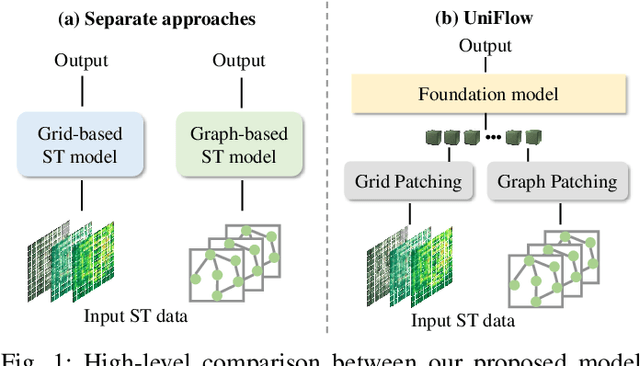
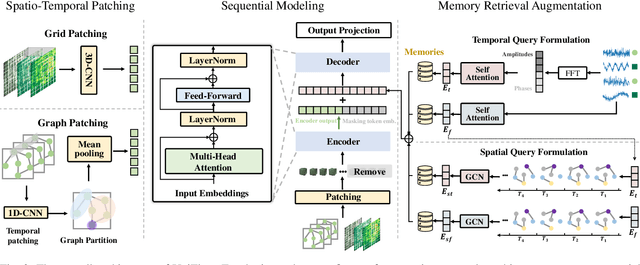
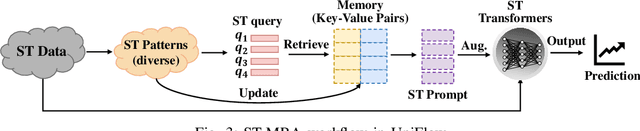
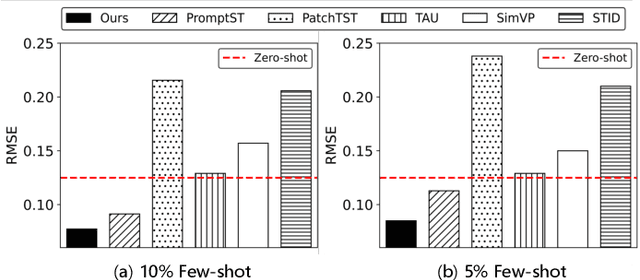
Urban spatio-temporal flow prediction, encompassing traffic flows and crowd flows, is crucial for optimizing city infrastructure and managing traffic and emergency responses. Traditional approaches have relied on separate models tailored to either grid-based data, representing cities as uniform cells, or graph-based data, modeling cities as networks of nodes and edges. In this paper, we build UniFlow, a foundational model for general urban flow prediction that unifies both grid-based and graphbased data. We first design a multi-view spatio-temporal patching mechanism to standardize different data into a consistent sequential format and then introduce a spatio-temporal transformer architecture to capture complex correlations and dynamics. To leverage shared spatio-temporal patterns across different data types and facilitate effective cross-learning, we propose SpatioTemporal Memory Retrieval Augmentation (ST-MRA). By creating structured memory modules to store shared spatio-temporal patterns, ST-MRA enhances predictions through adaptive memory retrieval. Extensive experiments demonstrate that UniFlow outperforms existing models in both grid-based and graph-based flow prediction, excelling particularly in scenarios with limited data availability, showcasing its superior performance and broad applicability. The datasets and code implementation have been released on https://github.com/YuanYuan98/UniFlow.
Comparing Fairness of Generative Mobility Models
Nov 07, 2024This work examines the fairness of generative mobility models, addressing the often overlooked dimension of equity in model performance across geographic regions. Predictive models built on crowd flow data are instrumental in understanding urban structures and movement patterns; however, they risk embedding biases, particularly in spatiotemporal contexts where model performance may reflect and reinforce existing inequities tied to geographic distribution. We propose a novel framework for assessing fairness by measuring the utility and equity of generated traces. Utility is assessed via the Common Part of Commuters (CPC), a similarity metric comparing generated and real mobility flows, while fairness is evaluated using demographic parity. By reformulating demographic parity to reflect the difference in CPC distribution between two groups, our analysis reveals disparities in how various models encode biases present in the underlying data. We utilized four models (Gravity, Radiation, Deep Gravity, and Non-linear Gravity) and our results indicate that traditional gravity and radiation models produce fairer outcomes, although Deep Gravity achieves higher CPC. This disparity underscores a trade-off between model accuracy and equity, with the feature-rich Deep Gravity model amplifying pre-existing biases in community representations. Our findings emphasize the importance of integrating fairness metrics in mobility modeling to avoid perpetuating inequities.